 Skip to content

Have you noticed more neighbors looking for professional tree care lately? It’s not just you. The reason why 2026 is driving a surge in arborist searches is a perfect storm of environmental, regulatory, and financial pressures hitting South Bay homeowners. Escalating climate volatility is damaging trees, while new local rules and insurance demands are making expert assessments a necessity.
This guide explains the key factors behind this trend and what it means for protecting your property. You'll learn why credentialed expertise is now more critical than ever.
The Perfect Storm: Climate, Rules, and Risk Converge
We're witnessing a fundamental market shift. Homeowners are rightly moving away from hiring general laborers for tree work and are now actively seeking out credentialed, certified arborists. This change is fueled by a growing understanding that your mature trees directly impact your property value, insurance, and legal compliance.
This diagram shows how several key forces are intersecting to create this unprecedented demand.
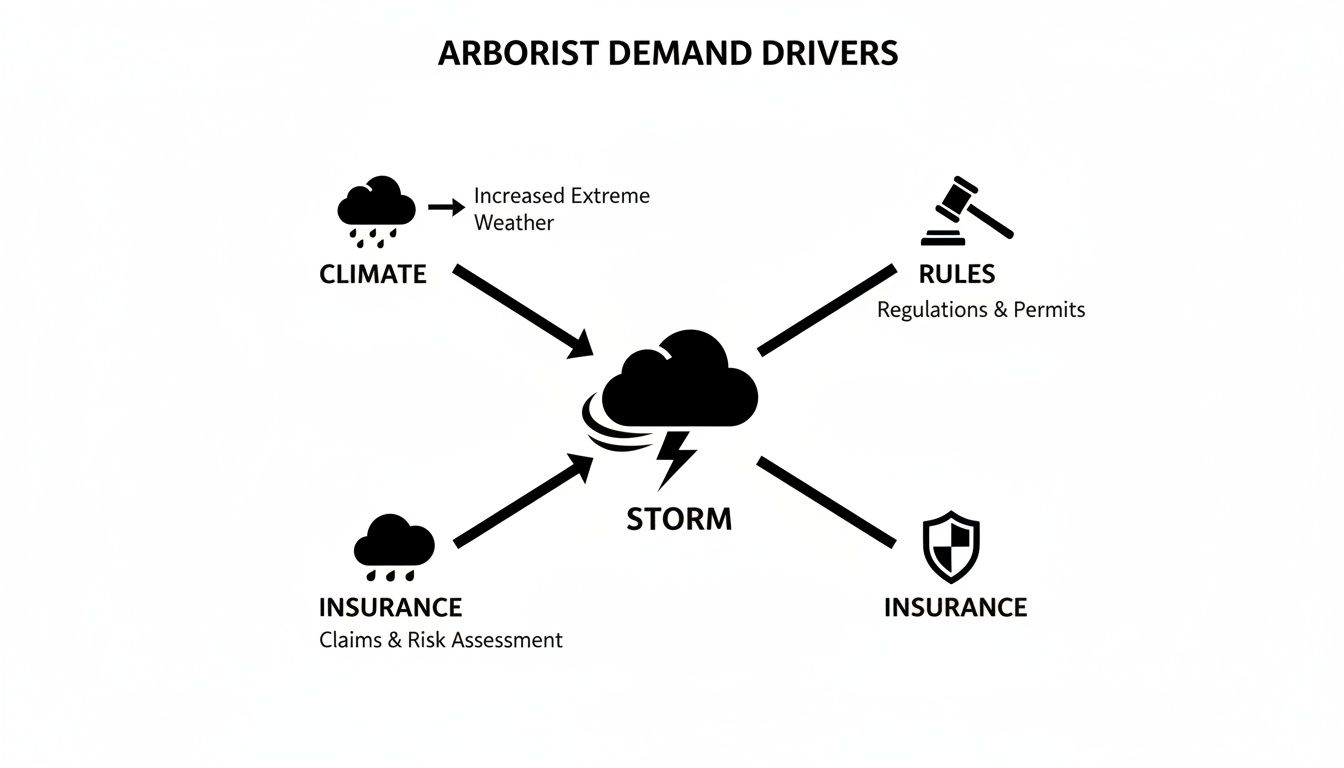
These factors are intertwined, compelling property owners to seek a higher level of expertise for their tree care needs.
A New Era of Homeowner Caution
Today’s property owners are more cautious and informed. Customers are asking about permits, liability, and long-term outcomes before approving work. This smarter approach stems from powerful local trends:
- Climate-Induced Stress: Years of intense drought followed by punishing atmospheric rivers have left root systems across the South Bay weak and compromised, creating hidden risks.
- Regulatory Roadblocks: In regulated cities like San Jose, arborist guidance increasingly determines whether a project moves forward. Strict ordinances often require an arborist's report to start the permit process.
- Insurance and Real Estate Demands: Insurers are increasingly requiring professional tree risk assessments to issue or maintain coverage. Real estate deals often hinge on an arborist's evaluation to clear a property of potential hazards.
You can read more about how modern tree care trends are protecting South Bay homes in our detailed guide.
Table: Key Drivers of the 2026 Arborist Search Surge
| Driving Factor | Impact on Homeowners | Why Certified Expertise Is Essential |
|---|---|---|
| Climate Volatility | Weakened tree roots and branches create unseen falling hazards after storms. | An arborist can identify structural weaknesses, nutrient deficiencies, and soil compaction before a tree fails. |
| New Regulations | Strict local ordinances require permits and arborist reports for removing or pruning protected trees. | A certified arborist understands San Jose's specific tree ordinances, ensuring legal compliance and avoiding hefty fines. |
| Insurance Requirements | Insurers demand professional risk assessments to mitigate liability and maintain homeowner policies. | Arborists provide the official documentation needed to satisfy insurance carriers and prevent coverage gaps. |
| Pest & Disease Outbreaks | Invasive species and new diseases are spreading, threatening valuable mature trees. | Early and accurate diagnosis from an expert is critical for effective treatment and preventing spread to other trees. |
| Real Estate Transactions | Buyers and lenders now require tree inspections to identify potential hazards before closing a sale. | An arborist's report provides a clean bill of health for a property's trees, smoothing the way for a successful sale. |
Pro Insight: Contractors who don’t clearly differentiate arborist expertise blend into a crowded, mistrusted market. The demand is now for diagnosis and strategy, not just a chainsaw and a truck.
At San Jose Tree Service & Landscaping, we lead with education-first recommendations and certified arborist assessments. This approach ensures you receive advice rooted in tree science and local experience, leading to better outcomes and fewer disputes.
How Climate Volatility Impacts Your South Bay Trees
If there's one single reason why 2026 is driving a surge in arborist searches, it's our increasingly unpredictable weather. Intense swings between long droughts and sudden, heavy atmospheric rivers are creating a silent crisis for trees across the South Bay.
These extreme patterns put our urban forest under deep, cumulative stress, hitting beloved local species like our native oaks and redwoods particularly hard.
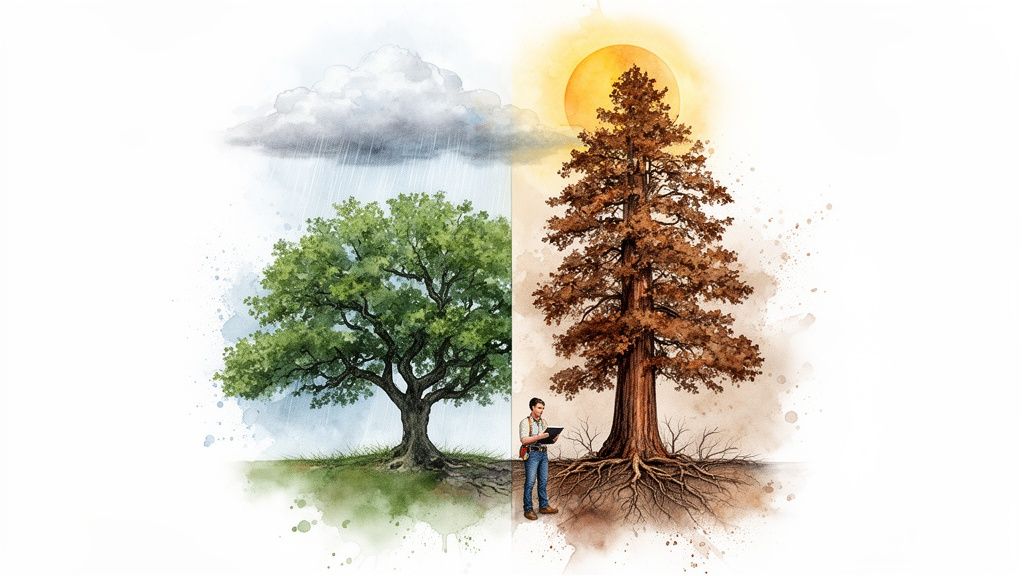
Years of drought force a tree to drain its reserves, causing critical roots to die back. Then, a powerful atmospheric river hits. The parched, dense clay soil common in San Jose can’t absorb the deluge, and the weakened root system can't hold the tree steady against high winds.
The Hidden Damage You Can't See
The scariest part about this climate-driven stress is that you often can't see it. A tree can look perfectly healthy while its internal structure and root system are on the verge of collapse. A homeowner might not see a single red flag until a massive limb snaps off or the entire tree comes crashing down.
An arborist’s assessment is like a diagnostic health screening for your trees. It moves you from a reactive position—dealing with a disaster after it happens—to a proactive one.
This is why getting a professional evaluation is so crucial. A certified arborist is trained to spot the subtle, almost invisible signs of distress that point to much bigger problems.
What an Arborist Looks for After Extreme Weather
A professional assessment is more than a quick glance. Here are just a few things a certified arborist analyzes:
- Soil Compaction and Root Health: They check how drought has hardened the soil, looking for clues that the root zone is compromised.
- Canopy Dieback and Stress Indicators: Tiny changes in leaf color, size, or density can tell an expert a tree is struggling.
- Structural Flaws and Cracks: An arborist can spot hairline cracks and weak branch unions that are prime candidates for failure.
- Pest and Disease Vulnerability: A stressed tree is an open invitation for opportunistic insects and diseases.
To learn more, read our guide on how San Jose's storm seasons are reshaping contractor demand. Proactive risk management is now part of responsible homeownership in the South Bay.
Navigating San Jose's Complex Tree Permit Regulations
It's not just the weather. One of the biggest reasons for the 2026 surge in arborist searches is the tangled web of local city laws. San Jose and other South Bay municipalities have tightened their tree protection ordinances, changing the game for property owners.
Many homeowners get a rude awakening when they learn their project is dead in the water without a city permit. To get that permit, you often need an official report from a certified arborist first.
This layer of red tape is a direct response to the critical need to protect our urban forest. As a result, people now call on arborists not just for tree care, but to guide them through municipal bureaucracy.
Why an Arborist Report Is Now Non-Negotiable
For many trees, especially larger or older "heritage" trees, getting an arborist's official assessment isn't just a good idea—it's a mandatory first step. Trying to remove or even heavily prune one without the city’s blessing can land you in serious hot water.
An arborist provides the objective, science-backed paperwork needed for a permit application. This comprehensive document details:
- Tree Health and Condition: Is it sick, infested, or structurally sound?
- Risk Assessment: What is the probability of the tree failing and causing damage?
- Proposed Mitigation: A professional plan, whether it's pruning, cabling, or removal as a last resort.
- Species Identification and Justification: A clear reason for the work based on industry standards.
Our team can help determine if your project requires one of these critical arborist preservation reports. We’ve navigated this process hundreds of times.
The High Cost of Non-Compliance
Trying to sidestep these regulations is a gamble you don't want to take. The penalties for unpermitted tree work can be staggering.
Warning: Homeowners who skip the permit process can be hit with hefty fines, work-stop orders, and even be forced to plant several replacement trees at their own cost.
Working with a licensed and insured professional like San Jose Tree Service & Landscaping (CSLB #985639) is your best protection. We know the specific ordinances in San Jose and the surrounding South Bay cities, ensuring every step is above board.
Protecting Your Property with an Arborist's Assessment
The search for arborists is increasingly driven by a powerful financial reality: protecting the value of your home. Hiring a certified arborist has become a core strategy for managing financial risk, satisfying insurers, and ensuring real estate deals don't fall apart.
This pivot from a yard chore to a necessary investment is a huge reason why 2026 is driving a surge in arborist searches. The cost of an assessment is pocket change compared to a denied insurance claim or a property sale going sideways.
The New Rules of Insurance and Real Estate
Insurance carriers are tightening their belts. After brutal storm seasons, it's becoming common for them to demand a professional tree risk assessment before renewing a policy, especially for properties with large, mature trees.
An arborist's report is your proof—concrete evidence that you took responsible steps to mitigate risk. Without it, you could be on the hook for thousands in repairs after a claim is denied.
The same logic applies to real estate. An arborist’s report is becoming a standard part of the disclosure packet to:
- Reassure buyers and their lenders that beautiful trees aren't a hidden danger.
- Negotiate costs for any needed tree work before closing.
- Give everyone peace of mind that the property's biggest natural features are assets, not liabilities.
An Investment in Your Property's Future
Data shows that "98% of homeowners believe landscaping increases property value" (San Jose Tree Service & Landscaping Content Intelligence Report, 2024). A healthy, safe tree canopy is a major part of that value.
This isn't a small trend. The growing tree service industry on gorilladesk.com reflects this rising demand for professional care. Homeowners are specifically looking for licensed, professional companies like San Jose Tree Service & Landscaping (CSLB #985639) to ensure work is done right.
Our guide on what tree maintenance helps prevent storm damage dives deeper into what that proactive care looks like.
A certified arborist doesn’t just see branches to be cut; they see a complex living asset that needs to be managed for long-term safety and value. Their assessment is your roadmap for protecting your home.
Ultimately, getting your trees professionally evaluated is now a fundamental part of responsible homeownership, just like checking your roof or watching for signs of water damage in ceilings.
Understanding the Difference: Why an Arborist Isn't Just a "Tree Guy"
As homeowners grapple with fiercer storms and new city rules, one question keeps coming up: what’s the real difference between a certified arborist and a regular tree trimmer? It's a critical distinction, and it’s a key reason why 2026 is driving a surge in arborist searches.
An arborist is like a physician for your trees. They diagnose diseases, understand the intricate biology, and create a long-term wellness plan. A basic trimmer is more like a surgeon who only knows how to amputate; they might miss the underlying disease. For a detailed breakdown, check our guide on explaining the difference between an arborist and a tree guy.
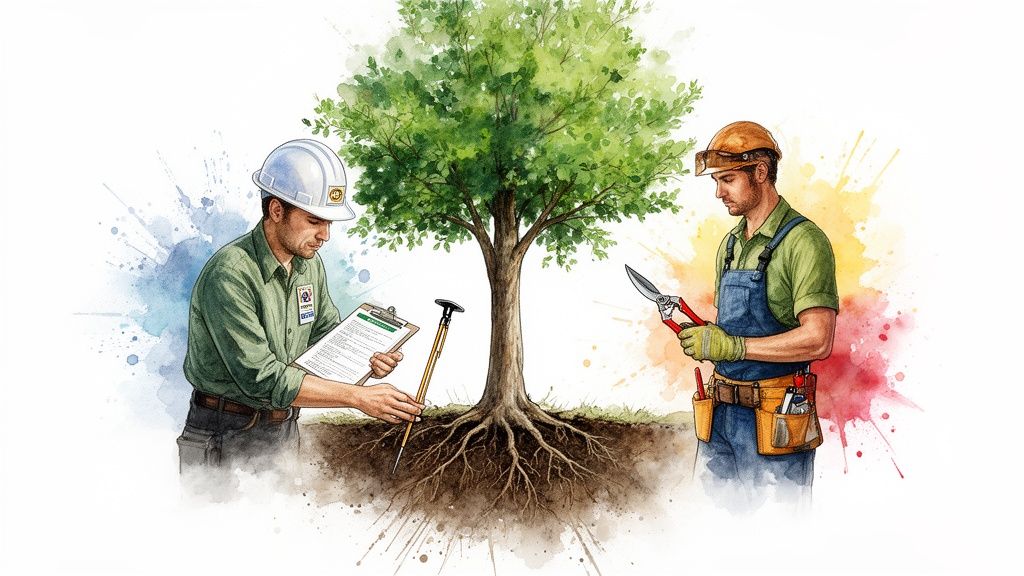
This difference in expertise often means we can save a beautiful old oak that another service might have immediately marked for removal.
What It Takes to Become a Certified Arborist
Earning the title of an ISA (International Society of Arboriculture) Certified Arborist is a professional credential that demands years of hands-on experience and passing a tough exam.
An arborist's training is comprehensive and includes:
- Tree Biology: They understand how trees function, grow, react to pruning, and fight infections.
- Soil Science: Arborists know how our local clay soil affects root health, water absorption, and tree stability.
- Pest & Disease Management: They can correctly identify and treat local threats, from oakworm to fungal rot.
- Safe Work Practices: Certified arborists are trained in industry-standard safety protocols to protect your home and their team.
This scientific foundation allows an arborist to see the big picture. They’re not just looking at a branch; they’re assessing the entire tree as a living system, focusing on its long-term health.
Conclusion: Partner with a Local Expert for Peace of Mind
The convergence of volatile climate, complex local regulations, and new insurance demands explains why 2026 is driving a surge in arborist searches. Proactive, expert tree care is no longer a luxury—it's a fundamental part of protecting your home, your investment, and your family's safety in the South Bay.
At San Jose Tree Service & Landscaping, we provide the licensed tree removal contractors and San Jose tree service expertise you need. As a BBB Accredited business since 2013 with CSLB #985639, we are committed to safety, compliance, and the long-term health of our community's urban forest.
Your Trusted, Licensed, and Local Expert
Don't wait for a winter storm to expose a weak branch or a permit denial to derail your project. Take the first step toward peace of mind with a professional assessment from a team that understands our local challenges.
Contact San Jose Tree Service & Landscaping today to schedule a complete consultation. Our experienced team will provide the clear, straightforward advice you need to ensure your property is safe, compliant, and beautiful for years to come.
Frequently Asked Questions (FAQs)
1. What's the main difference between an arborist and a tree trimmer?
An arborist is a "tree doctor" trained in tree biology, health, and risk assessment. A trimmer primarily focuses on cutting branches, but may lack the diagnostic skills to address underlying health or structural issues.
2. When do I absolutely need to call an arborist?
You should call an arborist for any concerns about a tree's health, safety, or structural integrity, especially for large, mature trees. They are also essential for navigating city permit requirements for protected trees in San Jose.
3. Can an arborist help me save a sick tree?
Yes, in many cases. A certified arborist can accurately diagnose diseases or pest infestations and recommend a treatment plan, such as soil treatments or targeted pruning, to restore a tree's health.
4. How can I prepare my trees for a big storm?
An arborist can perform a pre-storm inspection to identify and prune weak or hazardous limbs. This proactive maintenance is the best way to prevent catastrophic failures during high winds and heavy rain.
5. Is hiring a certified arborist more expensive?
While the initial cost may sometimes be higher than an uncredentialed trimmer, an arborist's expertise prevents costly mistakes. They can save trees that might otherwise be removed, help you avoid fines, and prevent property damage, offering better long-term value.
Contact San Jose Tree Service & Landscaping to schedule a consultation with our licensed and accredited team. Find out more at https://sanjosetreemaintenance.com/.
