
Many San Jose homeowners ask this exact question because they’ve seen the consequences of poor tree work firsthand. A rushed, unqualified crew can leave mature oaks and redwoods weaker, unsafe, and even dying. This isn’t just an aesthetic issue; improper pruning can dramatically shorten a tree’s lifespan and turn it into a significant hazard during the next atmospheric river.
The most common misstep is hiring based on the lowest price alone, assuming all “tree services” are created equal. In reality, unqualified crews often over-prune or top trees, causing long-term damage and increasing safety risks instead of preventing them. Professional tree care is a science rooted in arboriculture, safety protocols, and a deep understanding of local San Jose ecosystems.
This guide simplifies the process by breaking down the 8 most important factors to evaluate before you hire anyone. We’ll show you exactly what to look for—from licensing and insurance to certified arborist credentials and safety records. Following this checklist ensures you partner with a professional who uses preventive care to protect your property value and help you avoid costly, irreversible mistakes.
1. Proper Licensing and Insurance Coverage
When deciding what to look for before hiring a tree service in San Jose, nothing is more fundamental than verifying licenses and insurance. This isn’t just a formality; it’s your primary defense against financial and legal liability. A legitimate tree care company operates with the proper credentials, which protects you, their workers, and your property from the significant risks inherent in tree work.

In California, any contractor performing tree services valued at $500 or more (including labor and materials) must hold a C-61/D-49 Tree Service Specialty license from the Contractors State License Board (CSLB). This is non-negotiable. Without it, a company is operating illegally, leaving you with zero recourse if something goes wrong.
Why It’s Your First Checkpoint
An unlicensed and uninsured operator places all the risk squarely on your shoulders. If a worker is injured on your property, you could be held liable for their medical bills. A reputable company will carry two essential types of insurance:
- General Liability Insurance: This covers damage to your property or your neighbor’s property.
- Workers’ Compensation Insurance: This protects the company’s employees if they are injured on the job, shielding you from any liability.
Actionable Steps for Verification
Don’t just take a contractor’s word for it. Proactive verification is simple and necessary.
- Verify the CSLB License: Ask for the contractor’s license number (like our CSLB #985639) and check its status directly on the CSLB’s official website (www.cslb.ca.gov).
- Request a Certificate of Insurance (COI): Ask the company to have their insurance provider send you a COI directly. This certificate should name you as an “additional insured” for extra protection.
- Check Expiration Dates: Confirm that both the general liability and workers’ compensation policies will be active through the entire duration of your project.
For more detailed information on what to look for, you can learn more about our licenses and credentials at San Jose Tree Maintenance. This step is the most important one you can take to ensure a safe and professional experience.
2. Certified Arborist Credentials
Beyond a state license, a key indicator of expertise is whether the company employs ISA Certified Arborists. A license means a company can legally operate, but arborist certification means an individual possesses a deep, verified knowledge of tree science. This credential ensures your trees are cared for by a professional committed to their long-term health, not just a crew with a chainsaw.
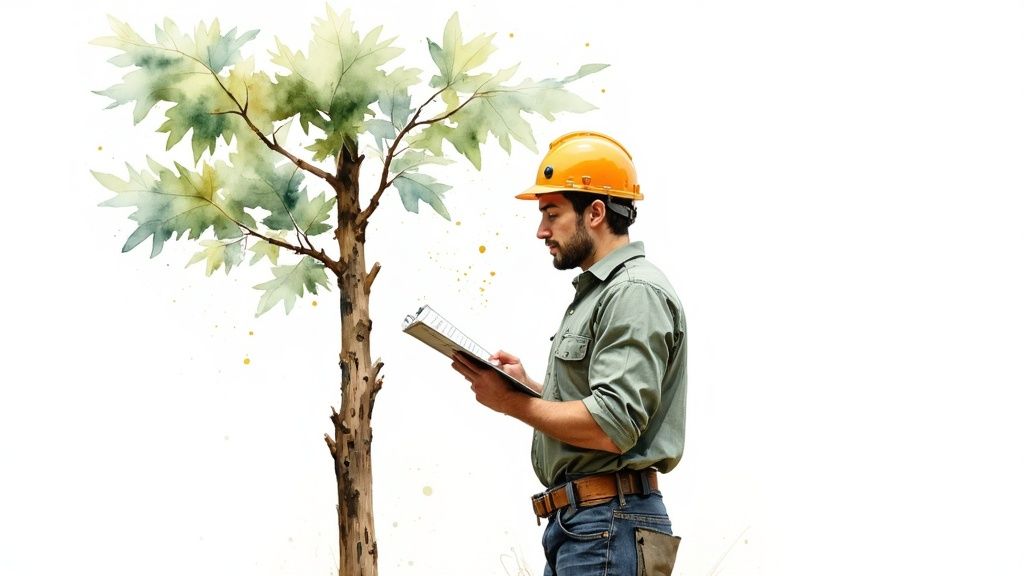
An ISA Certified Arborist has passed a comprehensive examination covering everything from tree biology and disease diagnosis to safe pruning techniques. This distinction is the gold standard in the tree care industry. Hiring a service with this expertise is the difference between getting a simple haircut and consulting a doctor for a health assessment.
Why It’s Your Second Checkpoint
Many homeowners mistakenly believe all tree trimming is the same, often hiring based on the lowest price. This can lead to disastrous results like over-pruning or “topping,” which severely damages a tree’s structure and invites disease. A certified arborist follows industry best practices (ANSI A300 standards) and focuses on preventive care to enhance a tree’s health, safety, and beauty.
A company with certified arborists on staff can provide:
- Expert Diagnosis: Accurately identifying diseases, pest infestations, and structural weaknesses.
- Proper Pruning Techniques: Making precise cuts that promote healthy growth, rather than cuts that harm the tree.
- Long-Term Health Plans: Developing holistic care plans for your valuable trees, considering species, age, and location.
Actionable Steps for Verification
Don’t be shy about confirming credentials. A professional service will be proud to share their qualifications.
- Ask for an Arborist: Specifically request that an ISA Certified Arborist visit your property to perform the initial assessment.
- Verify Credentials Online: Ask for the arborist’s name or certification number and verify their status on the ISA’s “Find an Arborist” tool (www.treesaregood.org).
- Request a Written Assessment: A qualified arborist should provide a detailed, written report of their findings and recommendations, explaining the “why” behind their proposed work.
For a deeper understanding of how these professionals can protect your property’s valuable green assets, you can learn more about our arborist services at San Jose Tree Maintenance. Prioritizing this credential ensures your trees receive expert care.
3. Safety Record and OSHA Compliance
A company’s commitment to safety is a critical indicator of its professionalism. Tree work is consistently ranked as one of the most dangerous jobs, and a company that prioritizes safety protects not only its crew but also you and your property. A strong safety record and adherence to OSHA (Occupational Safety and Health Administration) standards are signs of a well-run, responsible business.
Neglecting safety protocols leads to accidents, property damage, and potential liability issues. A professional service invests in training, equipment, and documented procedures to ensure every job is completed without incident.
Why It’s a Non-Negotiable Factor
A company’s safety culture directly impacts the outcome of your project. Unsafe practices, such as failing to use proper fall protection or operating poorly maintained equipment, dramatically increase the risk of an accident on your property.
Furthermore, a focus on safety indicates a higher level of expertise. Crews trained to mitigate hazards are better equipped to handle complex tree removals and pruning, especially near homes or power lines. This professional discipline translates into cleaner work and a more predictable, stress-free experience.
Actionable Steps for Verification
Verifying a company’s commitment to safety requires asking direct questions and observing their operations.
- Ask About Their Safety Program: Inquire if they have a formal, documented safety program and if they hold regular safety meetings.
- Observe Their Equipment: Look at their trucks, chippers, and chainsaws. Is the equipment clean and well-maintained, or does it look old and neglected?
- Check for Personal Protective Equipment (PPE): The crew should always be using appropriate PPE, including hard hats, safety glasses, and proper footwear.
- Inquire About Training: Ask what kind of safety and skills training their employees receive, particularly for climbers and equipment operators.
You can learn more about how a safety-first approach is integrated into every project by reviewing our professional process at San Jose Tree Maintenance. Prioritizing a company with a proven safety record is one of the smartest decisions you can make.
4. Experience and Local Reputation
A company’s experience and local reputation are powerful indicators of reliability. A long-standing, community-rooted business has proven its ability to deliver quality work year after year. They understand the specific challenges of caring for trees in the Bay Area, from our clay-rich soil to our drought-and-storm cycles.
An established San Jose tree service with deep local knowledge is familiar with native species like Coast Live Oaks and Redwoods. Their long-term success depends entirely on satisfying local homeowners, making their reputation a valuable asset.
Why It’s a Crucial Checkpoint
Hiring a company with a proven track record minimizes your risk. An experienced crew has developed efficient and safe work methods that only come with time. Choosing a well-regarded local company ensures you’re working with professionals who have a vested interest in maintaining their good name.
A reputable company will have a verifiable history of:
- Customer Satisfaction: A long list of happy clients who can vouch for their professionalism.
- Local Expertise: In-depth knowledge of San Jose’s specific environmental conditions and tree species.
- Proven Safety Protocols: A history of completing projects without incidents or property damage.
Actionable Steps for Verification
A little research will confirm their standing in the San Jose area.
- Ask About Local Experience: Inquire specifically, “How many years have you been serving the San Jose community?”
- Check Verified Reviews: Consulting local business review sites like Yelp and Google Maps can provide valuable insights into a tree service’s standing.
- Request Local References: Ask for 3-5 recent references from projects similar to yours in the San Jose area.
- Verify with the BBB: Check the company’s rating and complaint history with the Better Business Bureau (BBB). A long-standing accreditation, like our own since 2013, is a strong positive signal.
To see examples of work completed right here in the South Bay, you can view some of our past projects at San Jose Tree Maintenance. This portfolio demonstrates our commitment to quality and our extensive experience.
5. Transparent Pricing and Detailed Written Estimates
A key part of what you should look for before hiring a tree service in San Jose is a commitment to clear, comprehensive pricing. Professional companies provide detailed, itemized written estimates that outline every aspect of the job. This ensures there are no misunderstandings or surprise charges once the work is complete.
This document is your roadmap for the project. It protects you by clarifying the scope of work, including labor costs, equipment fees, debris removal, and any additional services like stump grinding. Vague pricing is a major red flag.
Why It’s a Key Checkpoint
An unusually low bid might seem tempting, but it’s often a sign of cut corners. These bids may omit crucial services like debris hauling or indicate a lack of proper insurance. A detailed estimate allows you to compare apples to apples when evaluating different companies.
A professional written estimate should clearly break down:
- Labor Costs: The price for the crew’s time on your property.
- Specific Services: A line-by-line description of the work to be done.
- Debris Removal and Cleanup: Confirmation that all wood, branches, and leaves will be hauled away.
- Additional Services: Any extra costs, like stump grinding or wood chipping.
Actionable Steps for Verification
Don’t commit to a service until you have a clear, written contract in hand.
- Get at Least 3 Written Estimates: Contact multiple reputable companies to get a baseline understanding of fair market pricing.
- Beware of Outliers: Be cautious of any estimate that is significantly lower than the others and ask why.
- Clarify Every Detail: Ask directly, “Does this price include complete cleanup and debris hauling?”
- Confirm in Writing: Before work begins, ensure the final agreed-upon price and scope of work are documented in a signed contract.
This principle of clear, upfront pricing is essential for a smooth and successful tree care experience.
6. Equipment and Technology Assessment
The quality and type of equipment a company uses speaks volumes. Professional, well-maintained machinery directly impacts job safety, efficiency, and the final health of your trees. A company that invests in modern, appropriate tools is demonstrating its commitment to professionalism.
The right tool for the right job is a critical safety principle in arboriculture. A crew using outdated or poorly maintained equipment can create dangerous situations and perform subpar work. In contrast, a company with advanced tools can work faster, cleaner, and with greater precision.
Why It’s a Key Indicator of Professionalism
The equipment a tree service brings to your property is a direct reflection of their capabilities. A professional crew will arrive with a fleet of clean, sharp, and well-cared-for tools designed for specific tasks.
A well-equipped company will have a range of tools to tackle various scenarios:
- Bucket Trucks (or Aerial Lifts): Essential for safely working on tall trees.
- Professional-Grade Wood Chippers: To process large limbs and debris efficiently.
- Stump Grinders: Specialized machinery that grinds stumps down below the soil level.
- Cranes: For large, hazardous, or difficult-to-access tree removals.
Actionable Steps for Verification
You don’t need to be an equipment expert to assess a company’s readiness.
- Ask About the Plan: During the consultation, ask, “What specific equipment do you plan to use for my project?”
- Observe Their Fleet: When they arrive for the estimate, take a look at their truck and any visible equipment. Does it appear modern and well-maintained?
- Inquire About Difficult Access: If your tree is in a tight spot, ask how they plan to access it.
- Confirm Availability: For large tree removals, specifically ask if they own or have ready access to a crane or bucket truck.
Assessing a company’s equipment is a practical step in determining their ability to complete your job safely and efficiently.
7. Customer Service and Communication
Beyond technical skills, evaluating customer service is a critical step. A company’s communication style is a direct reflection of its professionalism and respect for its clients. Responsive, clear, and proactive communication prevents misunderstandings and makes the entire process smoother.
Excellent customer service means the company values your business and the trust you place in them. Poor communication, conversely, is often a leading indicator of future problems, including scheduling delays, surprise costs, and unsatisfactory results.
Why It’s Your First Impression Checkpoint
The initial interactions you have with a tree service set the tone for the entire project. A professional crew understands that you need to be kept informed about who will be on your property, what work will be performed, and when it will happen.
A company committed to great service will:
- Be Responsive: Promptly return calls and emails.
- Provide Clear Explanations: Take the time to explain the proposed work and what to expect.
- Listen to Your Needs: Address your questions and concerns thoughtfully.
Actionable Steps for Verification
You can gauge a company’s commitment to service before you ever sign a contract.
- Monitor Initial Contact: Pay close attention to how quickly and professionally they respond to your first inquiry.
- Ask About the Process: Inquire about their project timeline and who your on-site point of contact will be.
- Request a Written Schedule: A professional service should be able to provide a clear timeline for the work.
- Check Reviews for Communication Mentions: When reading online reviews, look specifically for comments about the company’s communication and professionalism.
Excellent communication is a hallmark of a well-run, client-focused business that ensures you feel respected and valued.
8. Warranty, Guarantees, and Follow-Up Services
A company’s willingness to stand behind its work is a powerful indicator of quality. A warranty or guarantee is a formal commitment to the quality of their service and the long-term health of your trees. This assurance protects your investment and demonstrates the company’s confidence in its practices.
A reputable contractor understands that their responsibility doesn’t end when the wood chipper leaves. They offer post-service support, separating true professionals from “cut-and-run” operators.
Why It’s a Mark of Professionalism
Commitment to long-term results shows that a company is focused on tree health, not just tree removal. This level of accountability is a cornerstone of a trustworthy business relationship.
A company that provides clear post-service guidance is also investing in your success. They understand that proper care after a service like structural pruning is critical for the tree’s recovery and vitality.
Actionable Steps for Verification
Before signing any contract, make sure you understand the full scope of their commitment.
- Ask for Specifics: Inquire directly about their warranties, for example, against regrowth after stump grinding.
- Get Everything in Writing: Any warranty, guarantee, or follow-up service plan must be explicitly detailed in your written contract.
- Clarify Exclusions: Understand what is not covered, such as damage from an extreme weather event.
- Discuss Follow-Up Care: Ask if they provide a tree health maintenance schedule or offer ongoing plant health care plans.
By confirming these details, you are not just hiring a crew for a one-time task; you are partnering with a team dedicated to the lasting health and safety of your landscape.
Making the Right Choice for Your San Jose Property
Choosing the right partner for your tree care needs is one of the most significant decisions you can make for the long-term health, safety, and value of your San Jose property. The process of figuring out what to look for before hiring a tree service in San Jose boils down to a clear, actionable checklist. By moving beyond price and thoroughly vetting a company’s qualifications, you protect your home, ensure your trees receive expert care, and avoid costly mistakes.
A hurried decision based on a low bid often leads to bigger problems. Unlicensed operators may lack insurance to cover property damage, while unqualified crews can perform harmful trimming techniques like “topping” that weaken a tree’s structure. This is why verifying credentials is not just a formality; it is your primary defense against risk.
Your Path to a Confident Decision
The eight pillars we’ve covered form a comprehensive framework for your hiring process. Each one serves a distinct purpose in ensuring you receive professional, safe, and effective tree care.
- Licensing and Insurance: This is your non-negotiable foundation. Always verify the contractor’s license (like our CSLB #985639) and ask for a certificate of insurance.
- Arborist Credentials & Safety: Look for ISA Certified Arborists. Their presence signifies a commitment to scientific, health-focused tree care and adherence to strict safety protocols.
- Local Experience & Detailed Estimates: A company with deep roots in the South Bay understands our unique climate. Paired with a transparent, itemized estimate, this ensures you know exactly what you are paying for.
- Communication & Follow-Up: A professional service prioritizes clear communication. Guarantees or warranties on their work provide an extra layer of confidence and show they stand behind their services.
Ultimately, your goal is to find a tree care partner, not just a crew with a chainsaw. The right company acts as a steward for your landscape, offering guidance that enhances your property’s beauty and ecological health for years to come.
Your Questions Answered: FAQs About Hiring a Tree Service
1. What’s the difference between tree topping and proper pruning?
Topping is the indiscriminate cutting of tree branches to stubs, which is extremely harmful and makes trees unsafe. Proper pruning, performed by an arborist, involves selective cuts that enhance a tree’s health, structure, and safety.
2. Why is a local San Jose tree service better?
A local company understands the South Bay’s specific challenges, like clay soil, drought conditions, and common pests. They have experience with native species like oaks and redwoods and know local permit requirements.
3. Does the lowest price mean the best deal for tree service?
Almost never. An unusually low bid often indicates a lack of proper insurance, untrained workers, or hidden costs for things like debris removal. Hiring licensed tree removal contractors protects your property and ensures quality work.
4. How can I verify a company is licensed and insured?
Ask for their CSLB license number and verify it on the CSLB website. Request a Certificate of Insurance (COI) be sent directly from their insurance provider to you.
5. How often should I have my trees inspected?
It’s a good practice to have mature trees inspected by a certified arborist every 1-2 years, especially before or after a major storm season. This helps identify potential hazards before they become serious problems.
Ready to partner with a San Jose tree service that meets every one of these critical criteria? The experts at San Jose Tree Service & Landscaping are licensed, insured, and led by arboricultural professionals dedicated to the health and safety of your property. Contact us today for a comprehensive consultation and a detailed estimate to see how professional tree care can make all the difference.
