 Skip to content

By 2026, California landscaping will be completely transformed. New state and local rules are set to overhaul how we design and water our yards in San Jose, marking one of the biggest transformations in landscape requirements in decades. This isn’t a gentle nudge toward conservation—it’s a hard pivot from thirsty lawns to smart, water-wise landscapes.
This guide explains what the new 2026 rules mean for your property. You’ll learn why purely ornamental turf is being phased out, how water budgets will impact your utility bills, and what steps you can take now to create a beautiful, compliant, and future-proof yard.
The Great Landscape Reset of 2026
For homeowners and landscape contractors, 2026 is the year everything changes. What was once a “nice-to-have” option—like xeriscaping or precision irrigation—is becoming the mandatory baseline. This shift is about meeting strict new “water budgets” assigned to every property.
This completely flips the script. The conversation is no longer, “Do I want a drought-tolerant yard?” Homeowners are now asking, “What will still be legal, affordable, and sustainable in five years?” That question is reshaping the entire South Bay landscaping industry.
At a Glance: The 2026 Landscape Transformation
This table gives a quick rundown of how our approach to South Bay yards is changing from the ground up.
| Traditional Landscaping (Pre-2026) | Future-Ready Landscaping (2026 & Beyond) |
|---|---|
| Lush, thirsty lawns as the default centerpiece. | Dramatically reduced turf (or none at all). |
| Pop-up sprinklers spraying wide areas. | High-efficiency irrigation like drip lines and smart controllers. |
| Ornamental, non-native plants chosen for looks. | California native and climate-adapted plants that thrive on little water. |
| Simple permit process for smaller jobs. | More complex permitting requiring detailed water use plans. |
| Water use based on what homeowners wanted to pay. | Mandatory “water budgets” enforced by local water districts. |
| Aesthetics over function. | Beauty, resilience, and sustainability are equally important. |
The takeaway is simple: the era of installing landscapes without a long-term water strategy is officially over.
A Statewide Mandate for Water Efficiency
California’s new regulations are a direct response to our ongoing water challenges. Current market data shows a significant shift: new regulations will phase out purely ornamental turf, pushing the adoption of native plants and xeriscaping. For landscape installers, this means getting very good, very quickly, at replacing high-water lawns with native gardens and micro-irrigation.
This isn’t just a suggestion—it’s a regulatory reality. Staying ahead of these rules is crucial for protecting property value and avoiding expensive, mandated retrofits. This is especially true in San Jose, Los Gatos, Almaden, and Campbell, which is why it’s so important to understand how San Jose homes can prepare for drought and storms.
Embracing the New Standard
This shift isn’t about turning every yard into a rock garden. It’s about creating beautiful, resilient outdoor spaces that belong in the South Bay’s climate, blending aesthetics with ecological smarts. A great place to start is by reviewing practical outdoor water conservation tips.
Contractors who continue proposing traditional lawns or high-water plants risk costly redesigns and customer dissatisfaction. Homeowners are actively looking for providers who can deliver compliant, low-water landscapes—meaning outdated installation strategies lead to lost leads.
This is a crossroads moment for local contractors. The companies that thrive will have mastered native plant design, efficient irrigation systems, and new compliance rules, delivering the peace of mind homeowners want.
What California’s New Water Efficiency Rules Mean For You
To understand why 2026 will be a game-changer, you need to look at the specific rules coming to San Jose. The old way of turning on sprinklers until the lawn looked green is being replaced by a much smarter, data-driven system built for our climate.
The core of this shift is a new metric called the Landscape Efficiency Factor. Think of it as a “miles per gallon” rating for your yard. Your property will soon have a strict water budget it must meet, making it a measurable, enforceable standard.
The New Era of Water Accountability
For decades, outdoor water use has been lumped together on one utility bill. That’s changing with the introduction of dedicated irrigation meters. These devices will measure every single gallon used on your landscape, separate from indoor water use.
This simple change makes outdoor water consumption crystal clear. No more guesstimating—every drop will be tracked, making it possible to enforce property-wide water budgets.
This diagram shows the fundamental shift from the old, resource-heavy approach to the new, performance-based standards.
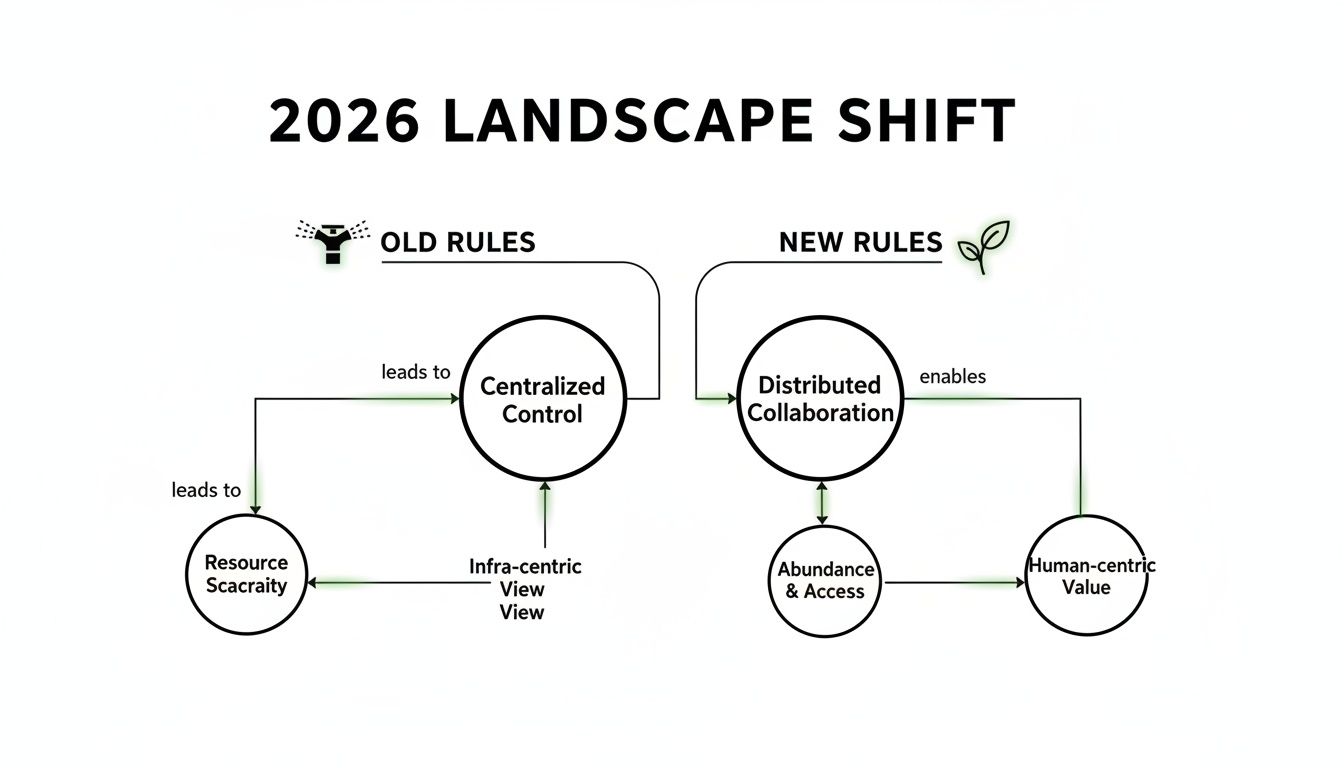
As you can see, the industry is moving from an outdated model toward a future defined by efficiency, native plants, and strict compliance.
Mandated Meters and Performance Rules
Requiring dedicated meters is the cornerstone of these regulations, especially for larger properties. This will completely change how commercial and institutional landscapes are designed, forcing them to install measurable water-saving retrofits.
California’s new rules mandate that at least 20% of large landscapes convert to dedicated meters by 2026. That number jumps to 60% by 2028 and hits 100% by 2030. This one-two punch of mandatory metering and landscape efficiency factors will force contractors to get serious about performance.
The bottom line: These new regulations aren’t just suggesting we save water—they are enforcing it with data. The combination of water budgets and dedicated meters makes efficient landscape design a non-negotiable part of every project.
This changes everything for property owners. Your utility bills will now directly reflect your landscape’s efficiency, making a water-wise yard a financial necessity. Now is a great time to review irrigation management best practices that align with these upcoming requirements.
How the Landscaping Industry Is Being Reshaped
The 2026 regulations are actively reshaping the entire landscaping industry. This isn’t just a trend; it’s a fundamental shift in how we approach design, what materials we use, and what skills are essential, all driven by our water supply.
We’re seeing a real pivot away from the old model of turf and thirsty plants. The new focus is squarely on water-wise technology, intelligent design, and long-term sustainability. This is creating a clear split in the market.
Demand is plummeting for water-guzzling products like sod and traditional spray sprinklers. In their place, we’re seeing a huge surge in requests for high-efficiency drip systems, native California plants, and smart irrigation controllers.
A New “Skills Gap” Is Emerging
This rapid change is creating a significant skills gap. The days of simply knowing how to lay sod and install sprinklers are over. Today’s projects demand a more specialized skillset.
To stay relevant, landscape professionals now need proven expertise in:
- Irrigation Auditing: The ability to scientifically measure a property’s water use and recommend data-backed upgrades.
- Xeriscaping and Native Plant Design: Deep knowledge of plants adapted to our local microclimates that thrive with minimal water.
- Smart Controller Programming: The skill to install and manage complex weather-based irrigation systems.
- Soil and Water Management: Understanding how to amend our heavy clay soils to make every drop of water count.
As industry analyses point out, these rules are steering both money and labor toward water-saving technologies. Many cities already offer rebates that require certified plans, putting credentialed installers in a prime position. For a deeper dive, explore the H2O Collective’s resource library.
The Choice: Adapt or Become Obsolete
Landscape contractors who get ahead of these changes will establish themselves as the go-to experts. They’ll be the ones winning more bids and landing higher-value projects.
The conversation has completely changed. Clients used to ask, “Do I want a drought-tolerant yard?” Now, they’re asking, “What will still be legal, affordable, and sustainable in five years?” If a contractor can’t answer that with confidence, they’re already behind.
Those who cling to outdated methods are risking their business. Proposing a traditional lawn will lead to rejected plans, costly redesigns, and unhappy clients. This is just as critical as understanding how San Jose’s storm seasons are reshaping contractor demand.
A Practical Checklist To Future-Proof Your Landscape
The 2026 regulations are coming, and getting ahead of them is the smartest move you can make. It will save you headaches and protect your property’s value. The goal is to shift to a beautiful, resilient yard that thrives in our local climate.
This checklist will walk you through exactly how to do it.
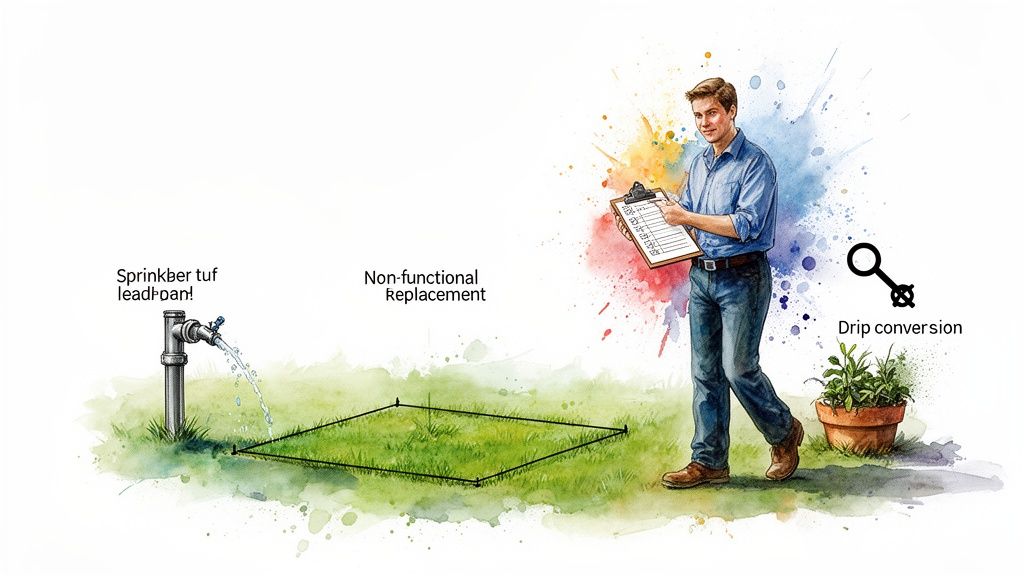
Your Compliance Action Plan
Where do you start? Target the biggest water-wasters first. This simple action plan shows you where to focus your efforts for the greatest impact.
| Area Of Focus | Problem (High Water Use) | Compliant Solution | Primary Benefit |
|---|---|---|---|
| Non-Functional Turf | Unused ornamental lawns, especially front yards and parking strips. | Replace with native plants, groundcovers, or permeable hardscaping. | Drastically reduces your landscape’s overall water budget. |
| Irrigation Systems | Old-school pop-up sprinklers that mist, runoff, and waste water. | Convert spray zones to drip irrigation or high-efficiency rotary nozzles. | Delivers water directly to plant roots, cutting waste by 30-50%. |
| Watering Schedule | “Set-it-and-forget-it” timer that over-waters based on a fixed schedule. | Install a weather-based smart controller that adjusts automatically. | Waters only when needed, adapting to rain, heat, and humidity. |
| Plant Selection | Thirsty, non-native plants unsuited for our dry summers. | Choose California natives and other drought-tolerant species. | Creates a beautiful, low-maintenance garden that thrives naturally. |
Tackling these four areas is the foundation for creating a landscape that’s not just compliant, but genuinely sustainable.
Step 1: Start With a Professional Water Audit
You can’t fix what you don’t know is broken. A professional water audit is the only way to get a clear picture of where every drop of water is going. An expert will check for hidden leaks, busted sprinkler heads, and pressure issues, giving you a clear roadmap for upgrades.
Step 2: Identify Your “Non-Functional” Turf
The new rules are laser-focused on getting rid of “non-functional turf”—any grass that’s just for show. Take a walk around your property and be honest about which patches of lawn are just decorative.
Common culprits include:
- Parking Strips
- Front Lawns (if nobody plays on them)
- Odd Patches in side yards
Converting these spots to low-water gardens is one of the most effective ways to slash your water use.
Step 3: Upgrade To Smart Irrigation Technology
An old, inefficient irrigation system can waste thousands of gallons every year. It’s time to move into the 21st century.
“Outdoor water use can be reduced by up to 50% with drought-tolerant landscaping.” This powerful statistic highlights the massive savings possible with smart upgrades. (Source: The Water Research Foundation)
The biggest wins come from converting garden beds from spray to drip irrigation and swapping old sprinkler heads for high-efficiency rotary nozzles. A weather-based smart controller is the other non-negotiable upgrade.
Step 4: Choose Plants That Belong in The South Bay
A water-wise landscape is built on one principle: right plant, right place. You must choose plants that are native to California or adapted to our Mediterranean climate.
Think about incorporating beautiful and hardy options like:
- Ceanothus (California Lilac)
- Salvia (Sage)
- Eriogonum (Buckwheat)
New tools can even help you visualize the possibilities. Exploring methods like AI-assisted xeriscape planning can make it easier to design a stunning, low-water garden.
Step 5: Create a Realistic Budget and Timeline
Transforming your landscape is an investment. A solid plan is essential to prioritize upgrades and phase the project in a way that makes sense for you. To help, our team has created an advanced guide to planning a realistic landscape installation budget that walks you through the process.
Why a Holistic Landscape Strategy Is Your Best Investment
The new water rules rolling out in 2026 aren’t about small tweaks. To build a landscape that is beautiful, compliant, and thrives long-term, you must think of your yard as a single, interconnected system. Trees, soil, plants, and irrigation all work together.
A piecemeal approach—fixing one part without considering the others—is a recipe for failure. A healthy, mature tree canopy creates natural shade, cutting down on water evaporation. Amending our heavy South Bay clay soil helps it hold moisture longer.
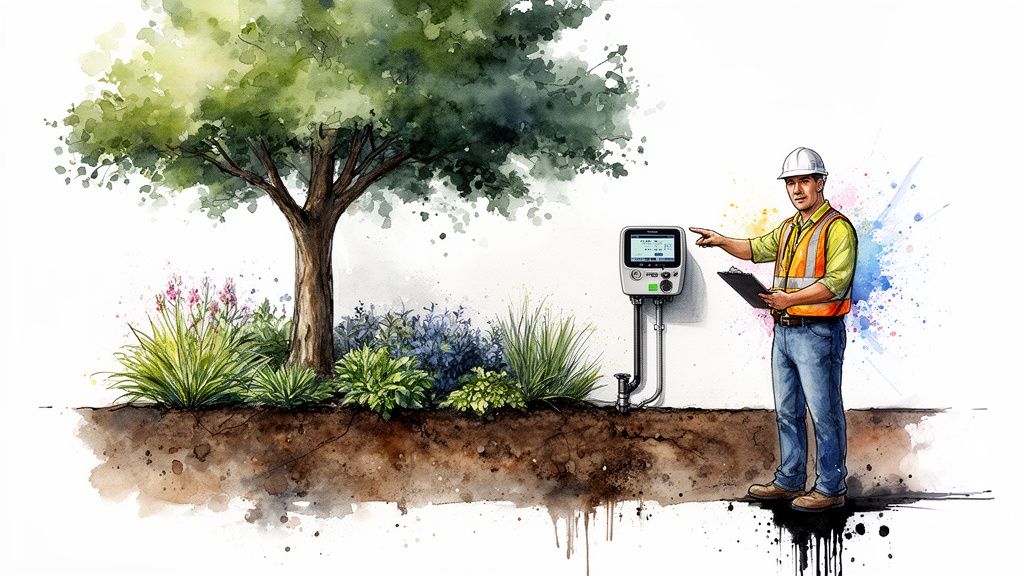
Unifying Tree Health and Landscape Design
At San Jose Tree Service & Landscaping, we’re built for this new reality. As a dually-licensed contractor (CSLB #985639 – C-27 Landscaping + D-49 Tree Service), we enable a holistic installation strategy that blends tree health, native planting, and reduced irrigation demand. This perspective allows us to design and build smarter, more water-wise outdoor spaces.
Our unified approach means we look at how every piece fits into the larger puzzle:
- Tree Canopy Management: We prune strategically to create microclimates that conserve water.
- Soil and Root Zone Health: We prep soil to support thriving low-water plants and strong tree root systems.
- Integrated Planting Plans: We choose native plants that complement your existing trees.
- Precision Irrigation: Our irrigation systems are designed for the complete picture, giving trees and plants exactly the water they need.
The question for homeowners has changed from, “Do I want a drought-tolerant yard?” to, “What will be legal, affordable, and sustainable in five years?” A contractor without a holistic strategy can’t answer that confidently.
Your Best Investment in a Changing Climate
Investing in a holistic landscape strategy is the smartest way to protect your property’s value and breeze through the 2026 regulations. A contractor who only does plants or only irrigation will miss the big picture.
As a BBB Accredited business since 2013 with deep roots in the San Jose community, our mission is to build solutions that last. By combining our deep understanding of arboriculture with expert sustainable landscape design, we create beautiful spaces ready for California’s climate.
Conclusion: Partner with San Jose’s Future-Ready Landscape Experts
The 2026 water rules are a huge shift. Thinking ahead isn’t just a smart move—it’s essential for protecting your property’s value and ensuring your outdoor space remains beautiful and functional. This is why 2026 will redefine landscape installation as new water rules take effect, and those who plan now will come out on top.
Here at San Jose Tree Service & Landscaping, we’re already ahead of the curve, designing landscapes that meet tomorrow’s tough standards today. We encourage contractors and homeowners in San Jose, Los Gatos, Almaden, Campbell, and Willow Glen to prepare for rising customer demand by partnering with a team already designing for tomorrow’s water restrictions.
Our deep knowledge of the area’s specific microclimates and soil types is what makes our projects successful. Our landscape installation services include:
- Xeriscaping & Native Plants: We design gorgeous, vibrant gardens using plants built to thrive here on very little water.
- Smart Irrigation: Our team specializes in irrigation optimization and drip conversions designed to meet emerging water-use compliance.
- Integrated Tree & Landscape Care: With our dual C-27 and D-49 licenses, we combine expert tree care with sustainable landscape design for a healthier outdoor environment.
Don’t wait until you’re forced to make a change. The best time to start planning is right now. By working with a team that knows the ropes, you can turn your yard into a stunning, low-maintenance retreat that adds real value to your home.
Contact us today for a consultation and start planning your sustainable outdoor transformation.
Frequently Asked Questions (FAQs)
What is the biggest change with the 2026 water rules?
The biggest change is the phase-out of “non-functional” or purely ornamental turfgrass, which will be replaced with climate-appropriate plants to meet strict new property-wide water budgets. This shift prioritizes drought-tolerant landscaping in California as the new standard.
Does “drought-tolerant landscaping” mean my yard will be just rocks and cacti?
Not at all! A modern, water-wise garden in the South Bay can be lush and full of colorful native flowers, ornamental grasses, and plants that attract pollinators. The goal is a beautiful, thriving space that works with our climate, not against it.
How will these new water rules be enforced?
Enforcement will primarily happen through mandatory new water budgets for each property and the installation of dedicated irrigation meters that track every gallon used outdoors. Exceeding your budget will likely result in higher utility bills and potential penalties.
Can I still have a vegetable garden or fruit trees?
Yes, absolutely. These new regulations are aimed at wasteful ornamental lawns, not productive gardens. Smart watering with drip irrigation is the perfect way to support your fruit trees and vegetable beds while remaining compliant.
What is the best first step to make my landscape compliant?
The smartest first step is to schedule a professional water audit with a licensed landscape contractor. An expert can analyze your current system, identify the biggest water-wasters, and create a strategic plan for upgrading to a beautiful and compliant landscape.
