
It's the fear that keeps homeowners up at night. It's not just about the money you've invested; it's the nightmare scenario of a torn-up yard, a half-finished project, and a landscape contractor who has suddenly vanished. This frustration comes from a deep need for reliability and communication, not just a low price.
The good news is, you can absolutely know a landscape contractor won’t disappear. The secret is to thoroughly vet their license, insurance, local reputation, and contract terms before you sign anything. This guide will show you how to spot a stable, professional partner and avoid the risky operators.
Why Vetting Matters More Than You Think
For homeowners in San Jose, Los Gatos, and Campbell, the fear of project abandonment is a real source of stress. The common misstep is hiring based solely on the lowest bid without verifying licensing, scheduling systems, or communication practices.
This guide is your roadmap to avoiding that situation. It’s about learning to spot the green flags of a trustworthy local business and the red flags of a contractor who might leave you scrambling.
The Sobering Reality of Contractor Failure
You might wonder why this is such a common problem. The unfortunate truth is that many landscaping businesses are not built to last. A staggering 80% of small businesses in the lawn care and landscaping sectors fail within their first 18 months (U.S. Bureau of Labor Statistics).
When a company goes under, it’s often their clients who are left dealing with the fallout.
Trust is Built on Transparency
So, how do you find the ones who are built to last? It all comes down to trust and transparency. Understanding the importance of online reputation is a great starting point, as it shows you what past clients are saying.
A contractor who is truly invested in the community—like we are at San Jose Tree Service & Landscaping—isn't just looking for the next job. We prioritize clear scheduling and consistent follow-through. This has become even more critical as our region's weather patterns change, a topic we cover in our article on how San Jose's storm seasons are reshaping contractor demand.
How to Vet a Contractor’s Credentials Like a Pro
Your first move is to confirm you’re dealing with a legitimate, licensed professional. This is the single most important step in protecting yourself. A reputable company will display its California State License Board (CSLB) number proudly on their trucks, website, and business cards.
Think of that CSLB number as their professional ID card. It proves they’ve met the state’s rigorous experience and testing requirements. Without it, they are operating outside the law and likely lack the insurance, bonding, or financial stability to see a job through.
Start with the CSLB Instant License Check
The CSLB has a fantastic online tool that lets you check a contractor's status in about 30 seconds. Don’t just glance at it—scrutinize the details.

When you pull up their record, you’re looking for a few key things:
- Does the business name on the license match the name on their estimate?
- Is the license "Active" and in good standing?
- Do they hold the right classifications for your job?
For a company that handles both landscaping and tree work in the South Bay, you need to see two specific licenses:
- C-27 Landscaping: This covers everything from planting and irrigation to patios and retaining walls.
- C-61/D-49 Tree Service: This specialty license is non-negotiable for anyone pruning or removing trees.
A Quick Tip from Experience: Never just take someone's word for it. We encourage all our potential clients to do their homework on us. Go ahead and look up our CSLB #985639. You'll find our active C-27 and C-61/D-49 licenses right there, a simple check that builds immediate trust.
Next Up: Confirm Their Insurance Coverage
Once you’ve verified their license, the very next question should be, "Can I see your insurance certificates?" A pro will have two critical policies: General Liability and Workers’ Compensation.
General Liability is what protects your property. Understanding what liability insurance for contractors actually covers is essential for your peace of mind. Workers' Compensation is just as crucial, as it protects you if one of their crew members gets hurt on your property.
Always ask for a Certificate of Insurance (COI). It should come directly from their insurance agent, not just be a photocopy they hand you. A contractor who fumbles this request is waving a massive red flag.
Why a Local Presence Signals Long-Term Stability
When you're trying to figure out if a landscape contractor is going to stick around, one of the best clues is how deeply they're rooted in the local community. A contractor who is genuinely part of the San Jose community has a reputation to protect.
This goes way beyond just having a local phone number. A truly local business is invested. They know the ins and outs of working in neighborhoods from Campbell to Morgan Hill because they've probably done work for your neighbors.
From P.O. Boxes to Physical Roots
One of the first things to check is for a physical business address—not just a P.O. Box. A real address, even a service yard, signals infrastructure and investment. It proves they have a home base in the South Bay.
Beyond the address, look for other signs of a stable, local operation:
- Branded Company Vehicles: Professional, branded trucks and equipment show a level of seriousness and long-term investment.
- A Local Project Portfolio: Ask to see photos of their work, specifically in the San Jose area. A contractor who can point to a finished patio in Willow Glen is proving their local experience.
- Community Engagement: Do they have a track record with the Better Business Bureau? Our BBB Accreditation since 2013 is a public record of our long-standing commitment.
A contractor who understands San Jose's heavy clay soil and the need for drought-tolerant landscaping in California isn't just passing through. They're a neighbor invested in providing sustainable, beautiful results.
Verifying Their Local Track Record
Digging into a company's local history is easier than you might think. Online reviews on platforms like Yelp and Google are a great start. Hunt for reviews that mention specific neighborhoods or projects similar to yours.
A contractor with deep roots will also have an established history serving the entire region. You can learn more about our commitment by exploring the San Jose Tree Service & Landscaping service area and seeing the communities we proudly work in every day.
Understanding the Contract and Payment Schedule
A flimsy, one-page estimate is not a contract. A professional contract is your single best defense against a contractor who might disappear. It is a legally binding agreement that lays out every expectation, timeline, and financial term.
A legitimate, stable company will always insist on a comprehensive contract. It protects them just as much as it protects you and is one of the clearest signs you're dealing with a pro.

What Every Legitimate Contract Must Include
Before you sign, carefully review the document for these non-negotiable items. If they are missing, insist they be added—or walk away.
- A Detailed Scope of Work: The contract should break down every single task. Vague descriptions like “new front yard landscaping” are a major red flag.
- A Specific Materials List: It should specify the exact materials being used, like ‘Belgard Catalina Grana pavers in Danville Beige.’ This prevents a contractor from swapping in cheaper materials.
- A Realistic Project Timeline: The document needs a clear start date and an estimated completion date.
- A Clear Payment Schedule: The total cost should be broken down into smaller payments tied directly to completed project milestones.
The Red Flag of a Large Upfront Deposit
One of the biggest warning signs is the demand for a huge upfront payment. Here in California, the law is crystal clear on this.
A down payment for any home improvement project cannot exceed $1,000 or 10% of the total contract price, whichever amount is less. Any contractor asking for more is not only violating the law but also waving a giant red flag.
A contractor who needs a massive deposit often doesn't have the operating cash to buy materials, a classic sign of a poorly managed business. A solid understanding of project financials is key, and you can learn more by reading our guide on planning a realistic landscape installation budget.
Key Takeaway: A professional payment structure always ties payments directly to completed work. This keeps you in control. Never pay for work that hasn't been done yet (aside from the initial modest deposit).
Sample Phased Payment Schedule for a Landscape Project
| Project Phase | Percentage of Total Cost Due | Example Work Completed |
|---|---|---|
| Contract Signing | 10% (or $1,000, whichever is less) | Legal deposit to schedule the job. |
| Phase 1 Complete | 30% | Demolition, site clearing, and grading are finished. |
| Phase 2 Complete | 30% | All hardscaping and irrigation main lines are installed. |
| Phase 3 Complete | 20% | Soil amendment, planting, and mulching are done. |
| Final Walkthrough | 10% | Project is 100% complete, cleanup is done, and you've signed off. |
This structure incentivizes the contractor to keep the project moving forward to get their next payment.
Protecting Yourself With Lien Waivers
Finally, your contract should address lien waivers. A lien waiver is a document stating that the contractor has paid their subcontractors and suppliers.
If your primary contractor fails to pay a supplier, that company can place a mechanic's lien on your property. This means you could be on the hook to pay that bill a second time. Always insist on receiving a signed lien waiver before you hand over the final payment.
Reading Between the Lines of Contractor Communication
Pay close attention to how a contractor communicates with you before you sign anything. This initial back-and-forth is a preview of what the project will be like.
A disorganized or vague communicator during the bidding process isn't going to magically become reliable later. A contractor who’s serious about their business will reply to emails and phone calls promptly and give you straight, clear answers.
Green Flags of Great Communication
As you talk with potential landscapers in the San Jose area, look for these positive signs:
- Prompt and Clear Responses: They get back to you within a business day and actually answer the questions you asked.
- A Single Point of Contact: You know exactly who to call or email to keep details from falling through the cracks.
- Willingness to Educate: They take the time to explain why they’re recommending a certain plant or design approach.
- Follows Through on Promises: If they say the estimate will be in your inbox by Friday, it’s there on Friday.
A Pro’s Perspective: For homeowners in Los Gatos and Campbell, we’ve found that consistency often matters more than pure speed. A contractor who communicates methodically is usually the one who delivers a more reliable, high-quality result.
Red Flags You Cannot Ignore
On the flip side, some communication habits are giant red flags. Be very cautious if a contractor:
- Uses High-Pressure Sales Tactics: Watch out for lines like, "This price is only good for today."
- Gives Vague, Evasive Answers: If they can't give you a straight answer about timelines, materials, or the crew, it’s a sure sign of poor planning.
- Is Impossible to Reach: If it takes multiple calls just to get a quote, imagine how hard it’ll be to reach them when there's an actual problem.
You’re looking for a partner for your project, not just hiring a pair of hands.
Your Final Vetting Checklist Before Signing
You’ve done your homework and are feeling good about your top choice. But before you pick up that pen, let's do one last, thorough walkthrough. This final pre-flight check is your last line of defense.
This simple flow chart boils down the communication part of the process.
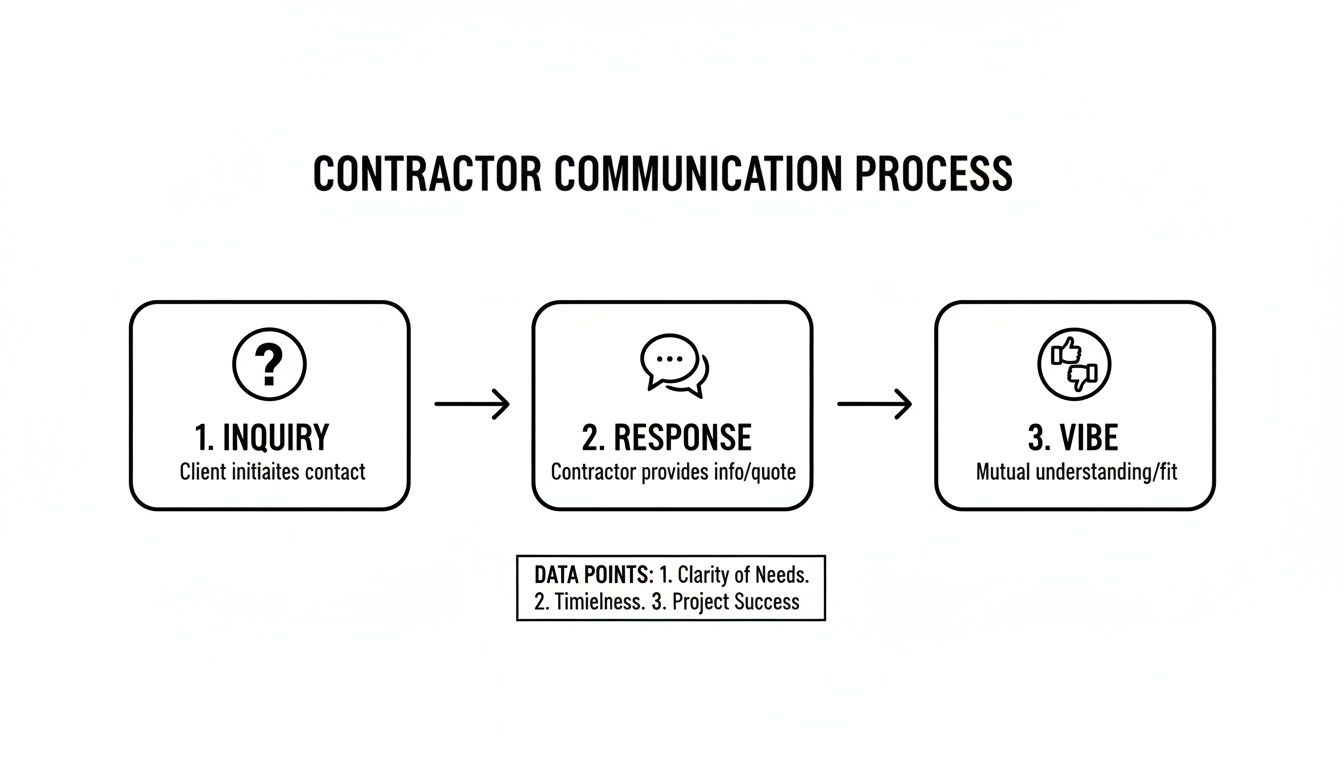
It’s a great visual reminder that success depends on asking clear questions, getting prompt answers, and having a good gut feeling about their professionalism.
Your Pre-Signature Checklist
Go through these final items one more time before you commit. It's a small effort that can save you a world of frustration.
CSLB License Check: Pull up the CSLB website one last time and punch in their license number (ours is CSLB #985639). Is it still active with the right classifications (C-27 and D-49)?
Proof of Insurance: Do you have a current Certificate of Insurance from their agent covering both General Liability and Workers' Compensation?
Confirmed Local Address: Did you verify they have a real, physical business address or a service yard in the San Jose area?
Called Their References: Have you actually spoken to at least two recent, local clients about their experience?
Final Contract Review: Does the contract spell out the scope of work, list specific materials, provide a clear timeline, and have a legally compliant payment schedule (10% or $1,000 deposit, whichever is less)?
If you want an even deeper look, our guide on what to look for before hiring a tree service in San Jose has some great extra tips. Once you can confidently tick every one of these boxes, you’re in a great position to sign.
Conclusion
Choosing the right landscape contractor is about more than just a quote—it's about finding a stable, reliable partner who will see your project through to completion. By thoroughly checking for a valid CSLB license, verifying insurance, confirming a local presence, and insisting on a detailed, legally compliant contract, you can protect your investment and avoid the stress of a disappearing contractor. These vetting steps ensure you hire a professional who is committed to quality work and clear communication from start to finish.
Ready to work with a landscaping partner who is licensed, accredited, and committed to seeing your project through from start to finish? The team at San Jose Tree Service & Landscaping is here to provide the stability and expertise you deserve. Contact us today for a professional consultation and estimate.
Frequently Asked Questions (FAQs)
1. What’s the single most important thing to check before hiring a landscaper?
Without a doubt, their CSLB license. Check that it's active and has the correct classification (C-27 for landscaping) on the California State Licensing Board's website.
2. Is it a red flag if a contractor asks for a large down payment?
Yes, it's a huge red flag and illegal in California. The legal limit for a down payment is $1,000 or 10% of the contract total, whichever is less.
3. Why is a physical address better than a P.O. Box?
A physical business address or service yard in the South Bay indicates that the company has a stable, local infrastructure. It’s a sign they are invested in the community and aren't a temporary operation.
4. How can I be sure the contractor will use quality materials?
Your contract should include a detailed materials list, specifying the exact brand, color, and type of products being used. This prevents them from substituting cheaper, lower-quality alternatives.
5. What if I just get a bad feeling about a contractor?
Trust your gut. If a contractor is pushy, evasive, or unprofessional during the bidding process, it's best to walk away and find a company you feel comfortable and confident with.
