
Direct Answer: Italian cypress browning usually traces to spider mites, canker disease, or uneven watering. Where the browning starts matters most: top-down dieback suggests canker, dull bronzing suggests mites, single brown trees suggest irrigation.
Almost every call I get about Italian cypress starts the same way. A homeowner planted a row of them years ago for privacy, the screen filled in beautifully, and now sections of it are going brown while the rest looks fine.
One homeowner reached out recently with twelve Italian cypress turning brown, and in the same message asked for help with the sprinkler system. That pairing shows up constantly, and the two things are connected far more often than people expect.
Browning cypress has three common causes in San Jose: spider mites, canker disease, and water. Below I will walk through how I tell them apart, what recovery really looks like in a tight screen, and why years of spraying sometimes changes nothing.
Where the Browning Starts Separates the Three Causes
Before anyone talks treatment, I want to know the pattern. Not just that the tree is brown, but where the brown began and how fast it spread.
Here is how the three usually present:
- Canker disease: dieback that starts at the top of the tree, or whole individual branches browning and dying through the canopy. Sometimes the color shift happens over just a few days. Canker gets in through cracks in the bark caused by pruning cuts, boring insects, or weather damage.
- Spider mites: dull, stippled foliage that bronzes before it yellows, often with fine webbing in the crown. The worst symptoms land on the trees getting the most sun and the least water.
- Water problems: browning that follows the irrigation line rather than the tree. One or two trees in a row look terrible, their neighbors look untouched.
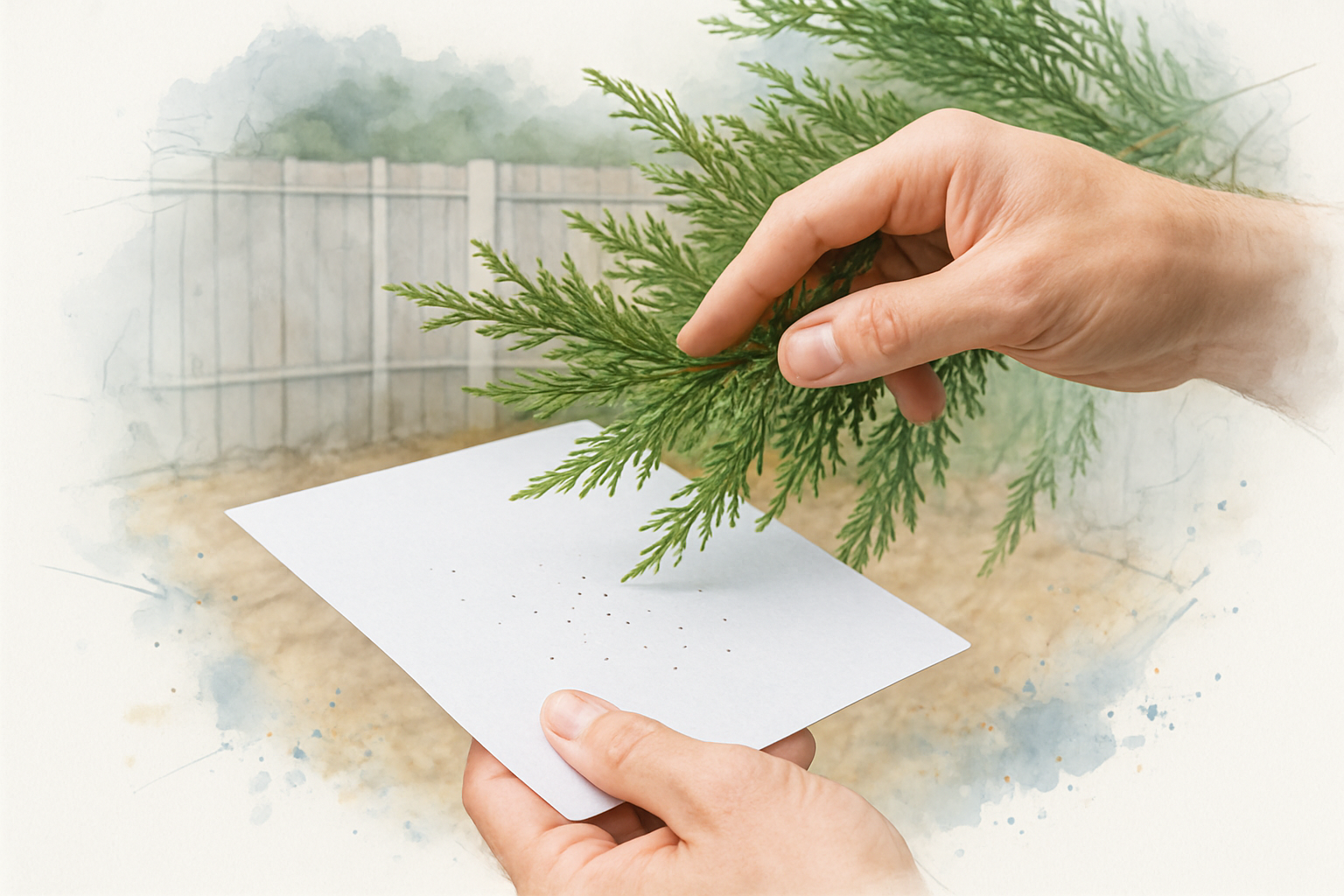
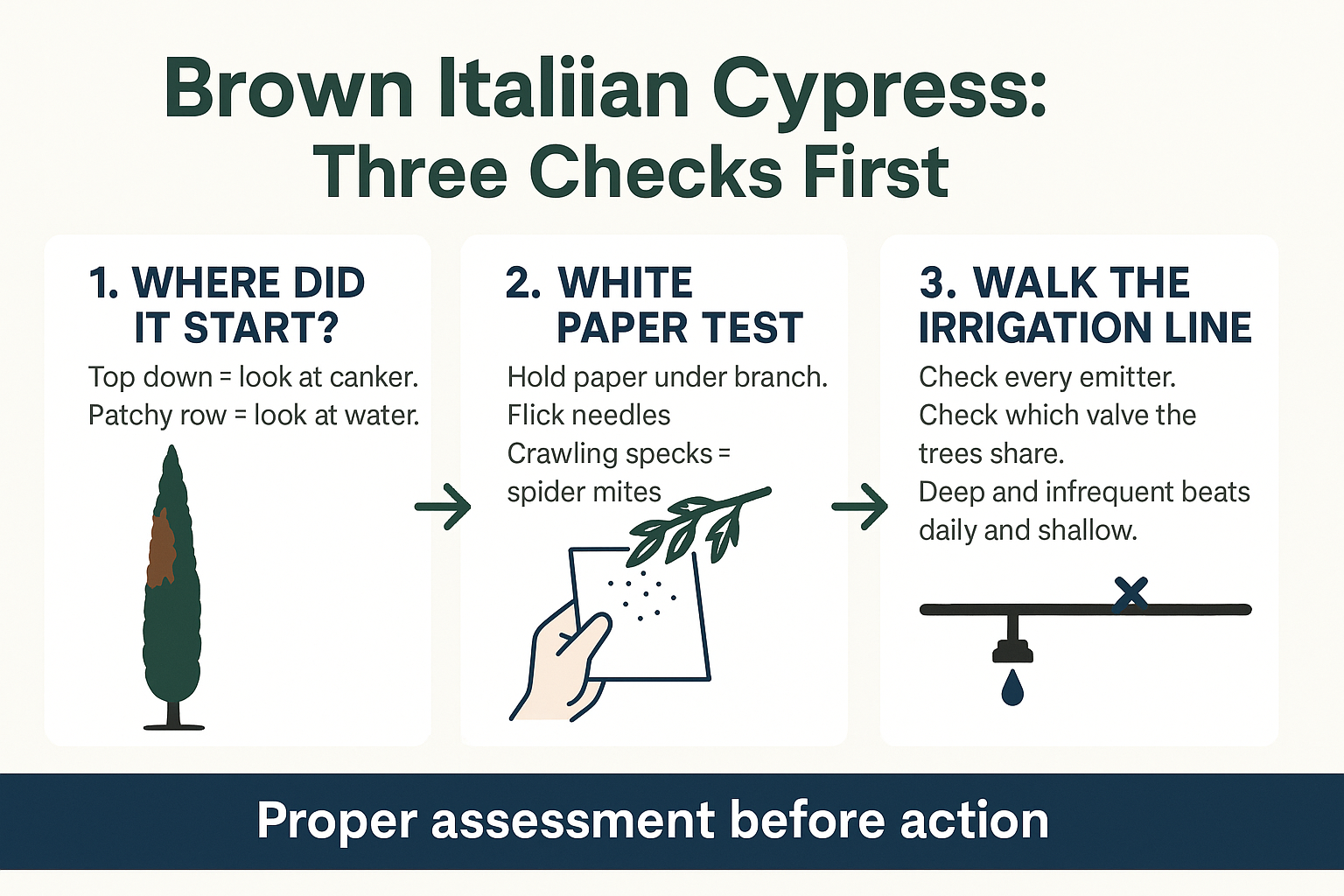
For mites, there is a field test any homeowner can do. Hold a sheet of white paper under a branch, flick the needles sharply, and look at what lands. Tiny specks that crawl and smear when you drag your finger across them are mites.
No specks on the paper does not rule out a problem. It just moves the conversation toward bark, root zone, and water instead of pests.
Irrigation Is the Cause I Find Most Often, and the Easiest to Fix
If I had to bet on one cause before seeing a property, I would bet on water. It is also the most commonly misdiagnosed, because brown foliage looks like disease to almost everyone.
South Bay clay soils hold water unevenly. Cypress want a deep, infrequent soak that pushes moisture well below the surface, and clay plus short daily cycles gives them the opposite.
The setup problems I see over and over:
- Shared valves. A cypress row running on the same zone as lawn or small potted plants. One local homeowner described five drip zones that grouped establishing trees together with small pots, and that arrangement starves the biggest plants on the line every single cycle.
- Overhead spray. Water hitting the foliage instead of the root zone. It keeps the needles damp, which favors fungal problems, and almost none of it reaches where the roots actually are.
- One failed emitter. In a twelve-tree row, a single clogged or broken emitter explains perfectly well why trees four and five are brown and the other ten are green.
That last one is why I always ask to see the controller and walk the line. A row planted on the same day, in the same soil, with the same exposure should not fail in isolated spots unless the delivery is uneven.
Broken emitters and leaks also quietly run up the bill. We covered that in detail in how much water a broken sprinkler quietly wastes in San Jose.
Reading the Symptoms Side by Side
This is the mental checklist I run through on site. It is not a diagnosis, but it tells you which direction to look.
| What you see | Likely direction | What I check next |
|---|---|---|
| Top of tree browning first, or whole branches dying | Canker disease | Bark for cracks, cuts, sunken lesions, and boring insect entry |
| Dull, bronzed, stippled foliage with fine webbing | Spider mites | White paper test, plus sun exposure and water history |
| One or two trees brown, the rest of the row green | Irrigation failure | Emitters, valve grouping, run times, soil moisture at depth |
| Needles wet often, browning from inside the canopy | Overhead spray on foliage | Head placement, spray pattern, conversion to drip |
| Whole row thinning slowly over a couple of seasons | Chronic shallow watering or root issues | Soil probe at the root zone, root collar condition |
The Three-Minute Check Before You Call Anyone
Run these three checks yourself and you will walk into the conversation with real information instead of a guess.
The Part Nobody Explains First: Brown Cypress Does Not Green Back Up
This is the hardest conversation I have, and I would rather have it before any cuts than after. A cypress branch that has gone fully brown does not recover. There is no dormant bud waiting to push new growth from dead wood.
So in a tight privacy screen, cutting out the dead sections leaves a permanent gap, not a fresh flush of growth. The trees on either side will not fill that space the way a shrub hedge would, because cypress grow up, not sideways.
That changes the real question. It is not only “can this tree be saved.” It is “what does this screen look like in three years”, and that is a planning conversation rather than a spraying conversation.
I bring this up early with homeowners in Willow Glen, Almaden Valley, and Santa Clara who planted a row specifically for privacy from a second story next door. If the goal is screening, the plan has to account for the gap, the replacement, and the growing time. Treating the plants and hoping the screen repairs itself is not a plan.
Why Years of Spraying Sometimes Changes Nothing
I regularly hear from homeowners who have treated a hedge or screen for two or three seasons with no improvement. One wrote in after three years of spraying a row of large shrubs and said plainly that it did not seem to be helping.
The reason is almost always the same: the treatment was chosen before the cause was identified.
Two specific things go wrong:
- Broad insecticides take out the predators. Mite populations are normally held down by beneficial insects. Spray for the wrong culprit, kill the predators, and the row can look worse a few weeks later than before treatment.
- Canker and water stress do not respond to insecticide at all. No product fixes a cracked branch union or a clogged emitter.
University of California IPM lists the realistic range of causes behind browning cypress foliage, including spider mites, bark beetles, canker diseases, root and crown rot, and simple water deficit or excess. You can see their breakdown on the UC IPM cypress page.
That range is exactly why I look at root zone, bark, and canopy first, and product second, if a product is even needed. Proper assessment before action is the whole point. If you want more on how we separate pest problems from everything else, see tree pest and disease questions San Jose homeowners keep asking.
If Two or Three Trees Are Already Gone, Think Hard About the Replant
Once a couple of trees in the row are dead, most homeowners want to drop matching Italian cypress into the same holes. I understand why. It looks like the simplest fix.
But if the spot is hot, dry, dusty, and poorly irrigated, planting the same species in the same conditions repeats the original problem on a delay. Right tree, right place, right time matters most on a narrow screen, where there is no room to correct a bad choice later.
There are species better suited to a tight privacy line in San Jose’s long dry summers. The right pick depends on the setting:
- Foothill properties in Saratoga, Los Gatos, or Monte Sereno: defensible space comes first. What belongs near the house changes when fire exposure is part of the picture.
- Flat Campbell or Santa Clara backyards: the problems to solve are usually mature width and honest irrigation design, not fire clearance.
- Any replant: planting depth, root flare, and a dedicated valve or emitter group for the trees, separate from lawn and pots.
A screen replant is a landscape decision as much as a tree decision. Getting the irrigation right at planting is the single thing that most changes how it looks a decade out.
What a Real Diagnosis Looks Like
Every diagnosis and treatment plan at San Jose Tree Service & Landscaping runs through a Board-Certified Master Arborist, and any product application is supervised under a California State Qualified Applicators License. That is a different standard than a crew arriving with a sprayer and a guess.
What long-term clients tend to point at is the restraint. As one reviewer put it: “They’re super knowledgeable and never push work that doesn’t need to be done.” That is Kathryn P., and it is the part I care about most.
Plenty of homeowners start by emailing photos when they are not sure what they are looking at. It is a reasonable first step for a browning row, though an uneven irrigation line usually needs someone walking it. On-site arborist consultations in our area generally run in the low-to-mid hundreds depending on scope, and a quick call will tell you what applies to your property.
Frequently Asked Questions About Brown Italian Cypress
Will the brown parts of my Italian cypress turn green again?
No. Fully brown cypress foliage does not recover. Healthy green sections can be kept healthy, and new growth comes from living wood, but dead branches stay dead. That is why the planning question matters as much as the treatment question.
Only two trees in my row of twelve are brown. Is it contagious?
Usually not. A pattern like that points much more strongly to irrigation than disease, because a shared pest or pathogen rarely stops neatly at two trees in a uniform row. The first thing I check is the emitters serving those specific trees.
Can I just cut the brown sections out to clean it up?
You can, and sometimes you should, but understand what you get. In a tight screen the cut leaves a permanent gap, and pruning cuts are also one of the ways canker gets into cypress bark. Timing and cut placement matter more here than on a shade tree.
Should I water my cypress more often?
More often is usually the wrong adjustment. Cypress prefer deep and infrequent watering, and in clay soil frequent short cycles keep moisture in the top few inches where it does the roots little good. Longer run times on fewer days, measured with a soil probe, is the direction to go.
Is this worth an arborist visit, or should I send photos first?
Photos are a fine starting point for identifying the pattern, especially if you include a wide shot of the whole row plus close-ups of the affected foliage and the trunk base. If the suspicion lands on irrigation, someone needs to be on the property to test the line and check moisture at depth.
Want a Second Opinion on a Browning Cypress Row?
If a privacy screen in San Jose, Willow Glen, Almaden Valley, Campbell, or the surrounding South Bay cities is going brown in patches, the useful first step is figuring out which of the three causes you are actually dealing with. We handle diagnostics and irrigation assessments across this service area, and photo review by email is how a lot of homeowners start. You can reach us at (408) 422-1313 or at sanjosetreemaintenance.com when you are ready to talk it through.
