 Skip to content

Direct Answer: California’s wildfire package, signed September 29, 2026, creates a low-interest loan program to lower the up-front cost of home hardening and defensible space work for homes and businesses statewide.
Most homeowners I talk to already know what their property needs. The brush on the slope has to come down, the lower limbs on the oaks are too close to the roof, and the junipers hugging the house should have been pulled years ago.
What stops them is the up-front cost. I hear some version of “we want to get it done before the rain season starts, but not all at once” almost every fall.
On September 29, 2026, Governor Newsom signed a wildfire package that could change that math. One piece of it creates a low-interest loan program meant to reduce the up-front cost of home hardening and defensible space work. Here is what the law actually says, what it does not say yet, and how I would plan around it on a San Jose or Los Gatos property.
What the new California defensible space loan program for homeowners actually does
The package was signed in San Francisco and applies statewide, so Santa Clara County properties are covered the same as foothill properties anywhere else in California.
According to the Office of the Governor’s announcement, the new laws:
- Establish a low-interest loan program to incentivize home hardening and defensible space activities for homes and businesses, reducing up-front costs
- Create the California Wildfire Preparedness Program to support county-level coordination of wildfire mitigation, prevention, preparedness, and recovery
- Have that program develop guidance and standards for local wildfire-risk modeling and analysis, so communities can prioritize where mitigation money goes
- Codify streamlined permitting for wildfire mitigation projects
- Extend State-Certified Prescribed Fire Burn Boss certification from one year to three years
- Establish a Fire Innovation Unit inside CAL FIRE for wildfire technology research and deployment
Note the wording carefully: the loan program covers homes and businesses. That matters for the HOAs and small commercial property owners who call us about common-area slopes in Almaden Valley and Campbell.
Here is the honest limit. Most California bills signed in 2026 take effect January 1, 2027, and the state still has to build the program before anyone applies. Loan amounts, interest rates, income rules, and the list of eligible work have not been published. I would not build a plan around a specific application date yet.
The work a loan like this is designed to pay for
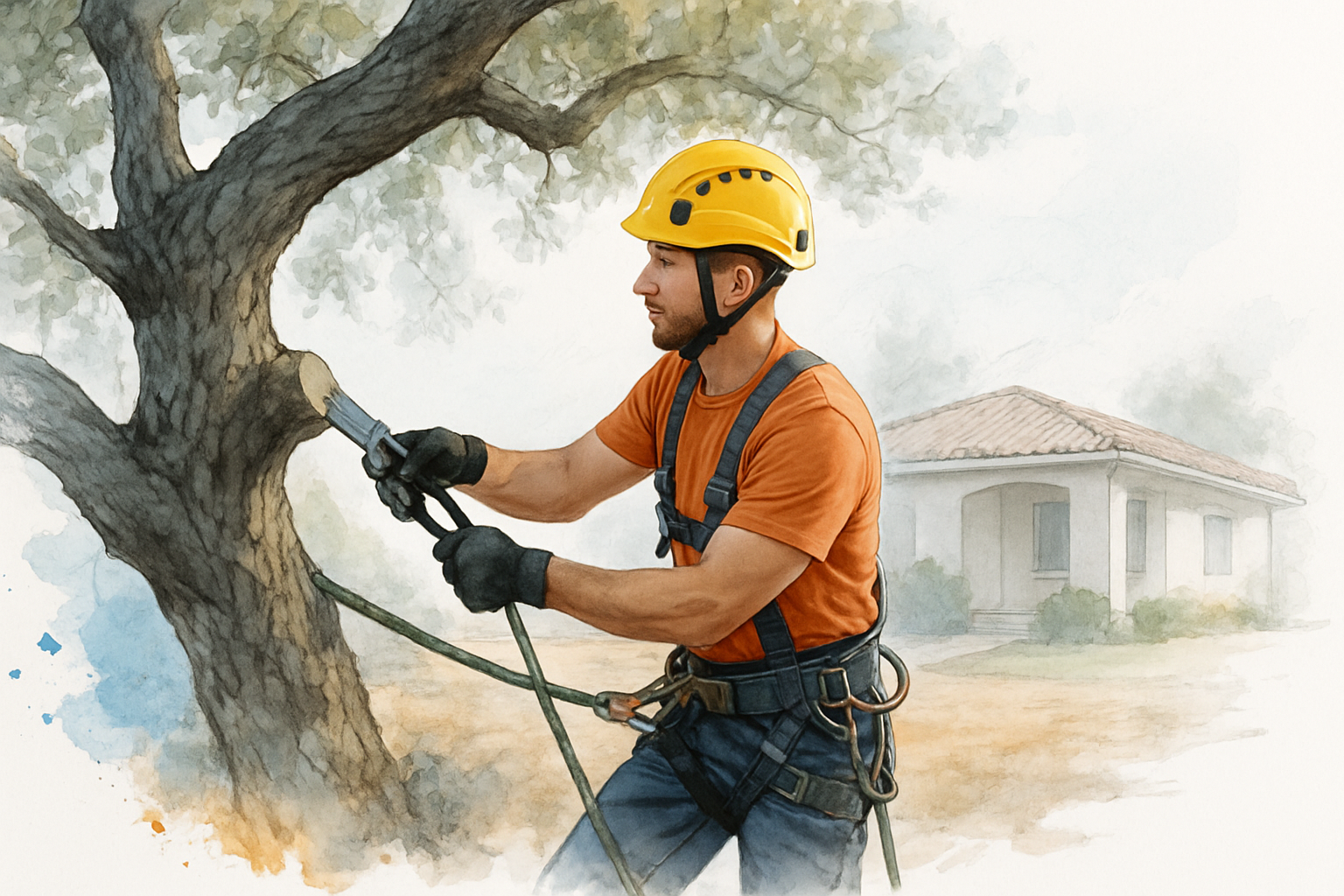
“Home hardening” covers the building itself: vents, eaves, windows, roofing. That side falls outside what we do. Defensible space is the part that lands squarely in tree and landscape work, and it is usually the bigger line item on an older South Bay lot.
On the properties we walk in Willow Glen, Almaden Valley, Saratoga, and the Los Gatos hills, that work usually looks like:
- Pruning and limbing up so low branches sit well clear of the ground and the roofline, without topping the tree
- Deadwood removal and crown thinning on mature oaks, pines, and eucalyptus
- Brush and weed clearing on slopes, including the dry foxtail and star thistle that take over by June
- Pulling flammable foundation plantings, which around here is usually juniper, bamboo, or an untended hedge pressed against a stucco wall
- Replacing those plantings with lower-fuel, drought-tolerant and native species that stay hydrated through a dry September
- Irrigation repair or redesign, because a stressed plant is a drier plant
- Stump grinding so nothing is left to carry fire or resprout
Removal is sometimes part of it, but it is not the starting point. A tree that is too close to the house is often a pruning and spacing problem, not a removal problem. Proper assessment before action saves real money here, and one longtime customer put it the way I would want every homeowner to feel about it: they “never push work that doesn’t need to be done.”
Defensible Space Zones and the Work That Usually Falls in Each
CAL FIRE organizes defensible space by distance from the structure. This is how I break down a scope sheet when I walk a property.
| Zone | Distance from house | Typical tree and landscape work |
|---|---|---|
| Ember-resistant zone (Zone 0) | First 5 feet | Remove shrubs against walls, clear leaf and needle litter, swap mulch for gravel or hardscape, cut back overhanging limbs |
| Lean, clean and green (Zone 1) | 5 to 30 feet | Deadwood removal, limbing up, spacing between canopies and shrub groups, irrigation checks, lower-fuel plant replacements |
| Reduced fuel (Zone 2) | 30 to 100 feet | Brush and annual weed clearing, grass height control, thinning crowded trees, removing ladder fuels under canopies |
A Sensible Order of Operations While the Program Gets Built
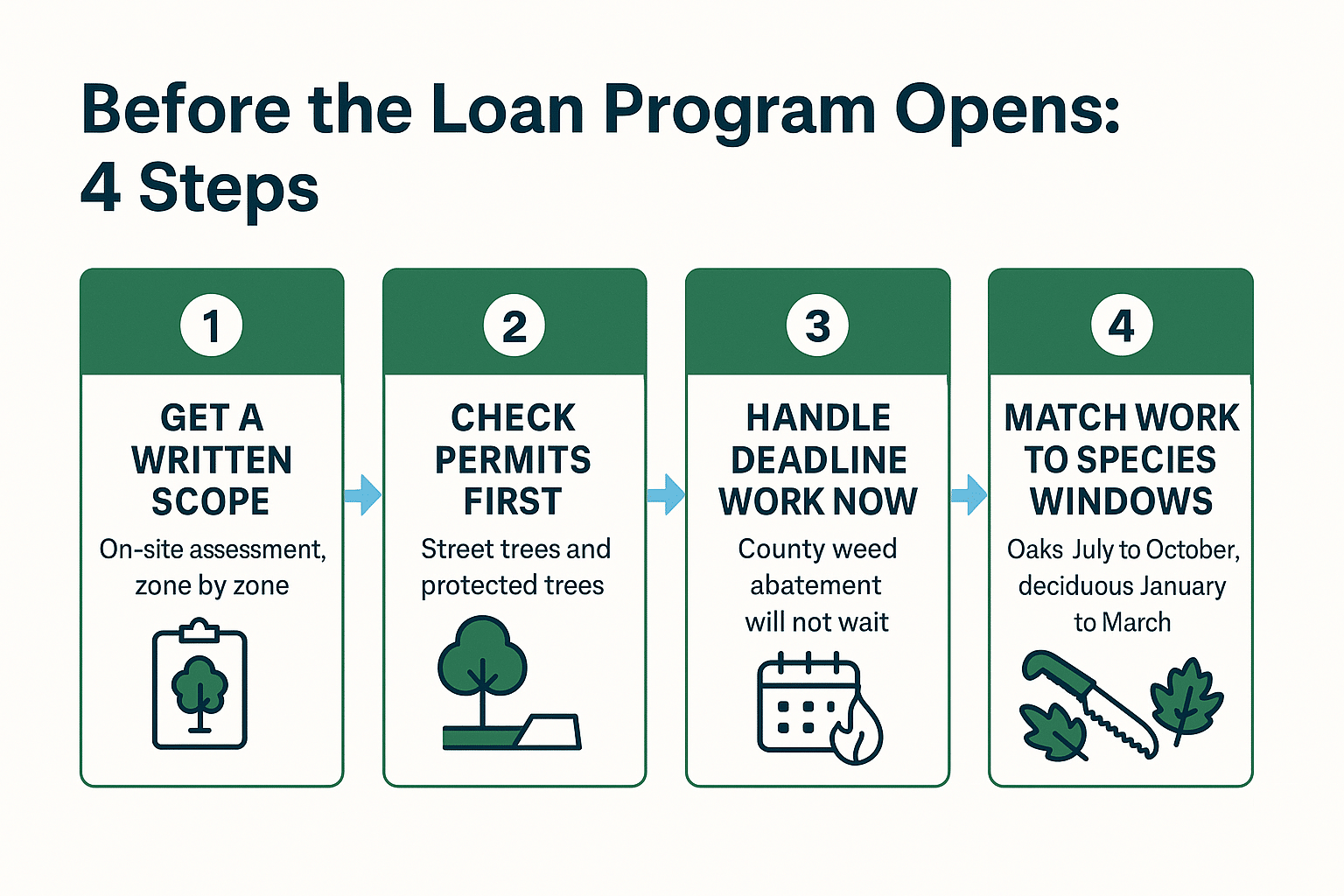
If you are waiting on the loan program, these four steps keep you from losing a year of good working weather.
What drives the cost of this work on a South Bay property
A loan lowers the up-front hit. It does not change the price of the job, so it helps to understand what the number is built from.
Costs vary a lot from one lot to the next, but these are the factors that move an estimate the most:
- Tree size and species. A 36-inch valley oak and a 12-inch strawberry tree are different jobs entirely.
- Access. A backyard reachable only through a side gate means hand carrying everything out. A driveway a chipper can back into cuts hours.
- Slope. The foothill lots in Saratoga and Los Gatos take longer per square foot than a flat Willow Glen yard.
- Debris volume. Hauling costs money. Chipping on site and leaving mulch sometimes costs less.
- Proximity to the house, fences, and power lines. That is rigging work, not felling work.
- Whether a written arborist report or permit is needed, which adds documentation time before any crew shows up.
An unusually low bid is usually a sign something got left out, most often the debris haul, the insurance, or the permit. Ask any contractor to show you what is and is not in the number.
On assessments: a quick photo review by email is often enough for a ballpark, and that is how a lot of homeowners here prefer to start. A full on-site consultation with a certified arborist generally carries a set fee that varies by company, so ask what it includes before you book it.
Permits and timing still apply, loan or no loan
The new law codifies streamlined permitting for wildfire mitigation projects, which is genuinely useful. It does not erase local tree rules.
In San Jose, trees in the park strip between the sidewalk and the street fall under city jurisdiction, and that covers pruning, not just removal. Unpermitted work on a street tree can carry penalties into the thousands of dollars per tree, so the order matters: assess first, permit second, cut third. Saratoga has its own updated tree rules worth reading if your property sits in the hills there.
Two more timing notes I would not ignore while you wait:
- Santa Clara County weed abatement has its own deadlines, and missing one can mean the county hires a contractor and bills you through your property tax statement. That is not work to postpone for a future loan.
- Species windows are fixed. California oaks should be pruned roughly July through October while they are dormant. Most deciduous trees do best January through March. Waiting six months for financing can push a job into the wrong window.
Also worth separating in your head: the proposed statewide Zone 0 five-foot rule is a different item from this loan package, and it is still not law. If you are rethinking plantings near the house anyway, there are separate Valley Water rebates for lawn conversion that are already active and can stack with good fire-wise plant choices.
The goal is safety, health, and longevity. Financing changes when you can afford the work, not what the work should be.
Frequently Asked Questions About the New Defensible Space Loan Program
When can I actually apply for the loan?
No application date has been published. The legislation was signed September 29, 2026, and most California laws signed in 2026 take effect January 1, 2027, but the state still has to stand the program up before homeowners can apply. Treat the start date as unknown for now.
Does it cover tree removal and brush clearing, or only work on the house?
The law’s own language says the program is meant to incentivize home hardening and defensible space activities for homes and businesses. Defensible space work is explicitly named, so brush clearing, pruning, and fuel reduction are the kind of work it targets. The final list of eligible expenses has not been released, so I would not assume any one line item is covered until the state publishes the rules.
Should I hold off on my tree work until the program opens?
It depends on what the work is. If it is a tree with a split in the trunk, a limb hanging over a bedroom, or a county abatement notice with a deadline, waiting creates a bigger problem than it solves. If it is a planned slope clearing or a landscape replanting with no safety issue attached, waiting a season is reasonable.
Does this apply to HOAs and commercial properties?
The program language covers homes and businesses. That reads as broader than single-family homeowners, which is encouraging for HOA common areas and small commercial lots in the same hillside neighborhoods. The eligibility details will come with the program rules.
Will doing this work help with my fire insurance?
Many carriers ask about defensible space and home hardening, and documented work can help in those conversations. I cannot promise an outcome with any specific insurer. What I can say is that a written, dated scope of work with before and after photos gives you something concrete to hand over.
Planning defensible space work on a Santa Clara County property?
If you want a clear, zone-by-zone picture of what your property needs before any financing program opens, that starts with a walk of the lot and a written scope. We handle assessments like this across San Jose, Los Gatos, Saratoga, and Campbell, and photos by email are a fine place to start if you just want a ballpark. Reach us at (408) 422-1313 or sanjosetreemaintenance.com when the timing works for you.
