 Skip to content

Direct Answer: Missing the deadline means the county hires its own contractor and bills your property tax statement. Published 2026 fees stack on top of the full contractor invoice, and monitoring continues for three years.
Most homeowners I talk to assume a weed abatement notice is a nudge. A reminder. Something you get around to when the weekend frees up.
Then the county contractor shows up, does the work, and the charge lands on the property tax statement months later. By then there is no negotiating it down.
I want to walk you through what the Santa Clara County Weed Abatement Program actually does when a deadline passes, what the published 2026 fees look like, and why one missed spring can follow a property for three years.
How the Santa Clara County Weed Abatement Program Actually Works
The program runs on a city-by-city inspection calendar, and that is where most of the confusion starts. People hear “fire season” and think summer. The compliance deadlines are much earlier than that.
Once your city’s inspection window opens, county inspectors evaluate properties from the public right of way. They do not knock. They do not need to enter your yard to write you up.
If a parcel does not meet Minimum Fire Safety Standards, here is the sequence:
- The property owner gets a 15-day courtesy notice to bring the parcel into compliance
- If the work is not done in that window, a county contractor performs the abatement
- The contractor’s full invoice, plus county fees, becomes a special assessment on the property tax bill
That last part is the piece that catches people. This is not a fine you can dispute like a parking ticket. It attaches to the property itself.
And 15 days is short. In April, reputable crews across San Jose, Los Gatos, and Saratoga are already booked out. A homeowner who waits for the notice before making calls is usually too late to beat the clock.
Weed Abatement Deadlines by City
Deadlines vary depending on where your property sits. These are the compliance dates the county publishes, and they come earlier than most homeowners expect.
| Compliance Deadline | Cities and Parcels | What This Means for You |
|---|---|---|
| March 1 | Campbell, plus undeveloped parcels in San Jose | Work needs to be scheduled in January or February, before spring growth even peaks |
| April 15 | Los Gatos, Monte Sereno, Santa Clara | Native grasses are still green here, which fools people into thinking there is no hazard yet |
| April 30 | Cupertino, Los Altos, Saratoga, Palo Alto | Foothill grasses cure to fuel fast in late April, so a yard that passed in March can fail weeks later |

What the 2026 Fee Schedule Adds Up To
This is the part I wish more homeowners saw before the deadline instead of after. The county publishes its fee schedule openly, and the numbers are not small.
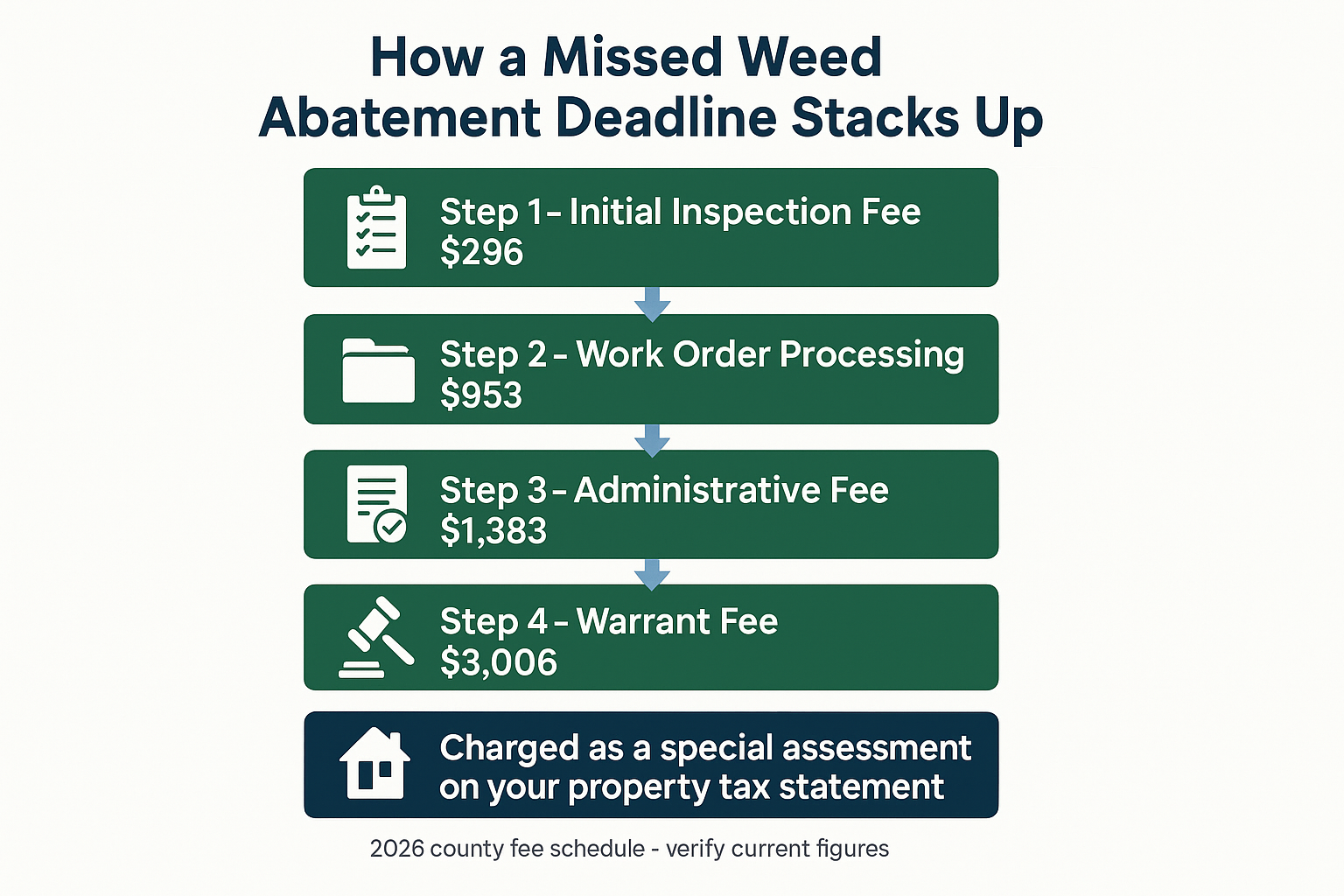
According to the county’s weed abatement program FAQ, the 2026 schedule lists:
- Initial inspection fee: $296
- Work order processing fee: $953 for a non-compliant parcel
- Administrative fee: $1,383 for contractor invoice processing
- Warrant fee: $3,006
- 100 percent of the contractor’s invoice, billed directly to the property owner on top of all county fees
Fees are set by the county and can change year to year, so always confirm current figures directly with the program before you plan around them.
Do the math on a mid-size parcel with a slope and you are looking at a number that dwarfs what scheduled abatement would have cost. A homeowner who assumes a missed deadline means a warning is in for a real surprise when the tax bill arrives.
The frustrating part is that none of those fees buy you better work. You pay the administrative overhead of the county managing a job you could have handled on your own schedule, with your own crew, protecting the plants and trees you actually care about.
How the Costs Stack
Here is how a missed deadline turns into a layered bill rather than a single charge.
One Missed Spring, Three Years of Scrutiny
Here is the detail almost nobody knows going in. Once a property enters the program, it does not leave after you clean it up.
Santa Clara County requires three consecutive years of compliance before a parcel comes off active monitoring. That means one missed deadline creates three straight years of inspections and inspection fees.
So the real cost of a single bad spring is not one bill. It is:
- The contractor invoice and county fees from the year you missed
- Annual inspection fees in each of the following years while you are monitored
- A restarted clock if you slip again in any of those three years
I have seen this catch people who bought a property with existing history on it. The previous owner missed a deadline, the parcel is still in the program, and the new owner inherits the monitoring without ever being told.
If you just closed on a home in Almaden Valley or on a larger lot toward Saratoga, it is worth asking whether the parcel has an abatement history. That one question can save you a genuinely unpleasant discovery in April.
A Tidy Yard and a Compliant Yard Are Not the Same Thing
This trips up careful homeowners every single year, and it is the most common misunderstanding I run into.
The program inspects against specific vegetation height standards and combustible debris, not general tidiness. Santa Clara County requires flammable vegetation kept below 6 inches. A property can look perfectly maintained from the street and still fail.
Things that trigger a notice on otherwise well-kept properties:
- Tall native grasses along a back fence line or slope, out of view from the front
- Dried brush and dead limbs stacked near a structure
- Accumulated yard waste piles that were “going to get hauled next week”
- Poison oak thickets on rear slopes, common on the Los Gatos and Saratoga edges
- Deadwood still in the canopy or dropped under mature oaks
Foothill properties are the hardest cases. Native grasses in those neighborhoods grow fast through March, look green and harmless, then cure to fuel by late April right as the deadline lands.
CAL FIRE’s defensible space guidance treats the first 5 feet around the house as the ember-resistant zone, and that zone is where I see the biggest gap between how a yard looks and how it performs. Wind-driven embers travel a long way. What they land in decides everything.
When vegetation has gotten past the point that trimming and clearing will handle it, that becomes a different scope of work. Land clearing is a separate conversation from weed pulling, and knowing which one your property needs matters before you start booking dates.
One long-standing customer put it well in a review: the crews “never push work that doesn’t need to be done.” That applies here. Proper assessment before action, then clear only what the standard actually requires.
Frequently Asked Questions About the Santa Clara County Weed Abatement Program
Can I dispute the charge after the county contractor does the work?
Once the work is performed and the assessment is placed on your property tax statement, your options narrow considerably. The county has a process for questions about the assessment, but the window to act is really the 15-day courtesy notice period, not after. If you get a notice, treat it as the deadline, not the warning.
I got a notice but my yard looks fine. What are they seeing?
Almost always something out of sight from your front door. Check the back fence line, any slope, the area within 5 feet of the house, and anywhere yard debris has piled up. Inspectors work off vegetation height and combustible material, not curb appeal.
Does abatement work mean cutting down trees on my property?
No, and it should not. Weed abatement is about ground fuels, brush, and dead material. Trees usually need selective pruning, deadwood removal, and clearance from structures rather than removal. Removal is a last resort, not a shortcut to compliance.
When should I schedule the work to stay ahead of my deadline?
Back up at least four to six weeks from your city’s date. If you are in Campbell or hold an undeveloped San Jose parcel with a March 1 deadline, that means January. For an April 30 city like Cupertino or Saratoga, aim for early to mid March. Spring is the busiest stretch of the year for crews across the South Bay.
My insurance company is also asking me to clear branches off the roof. Is that the same job?
Related, but not identical. Insurers care about overhanging limbs and roof clearance, while the county cares about ground fuels and vegetation height. The two often get handled in the same visit, though pruning has its own correct timing windows by species that matter for tree health.
Know Your Deadline Before the Notice Arrives
The homeowners who never deal with county fees are the ones who look up their city’s compliance date in winter and plan backward from it. That is the whole trick. If you want a straight answer about what your property needs to meet the standard, or whether the parcel carries abatement history you inherited, our team works across San Jose, Los Gatos, Saratoga, Campbell, and the surrounding South Bay communities and can be reached at (408) 422-1313 or sanjosetreemaintenance.com.
