 Skip to content

Direct Answer: Perfectly round holes the size of a pen tip, plus dark wet staining or fine boring dust, can signal invasive shothole borer. Have a licensed arborist assess the tree before any cutting.
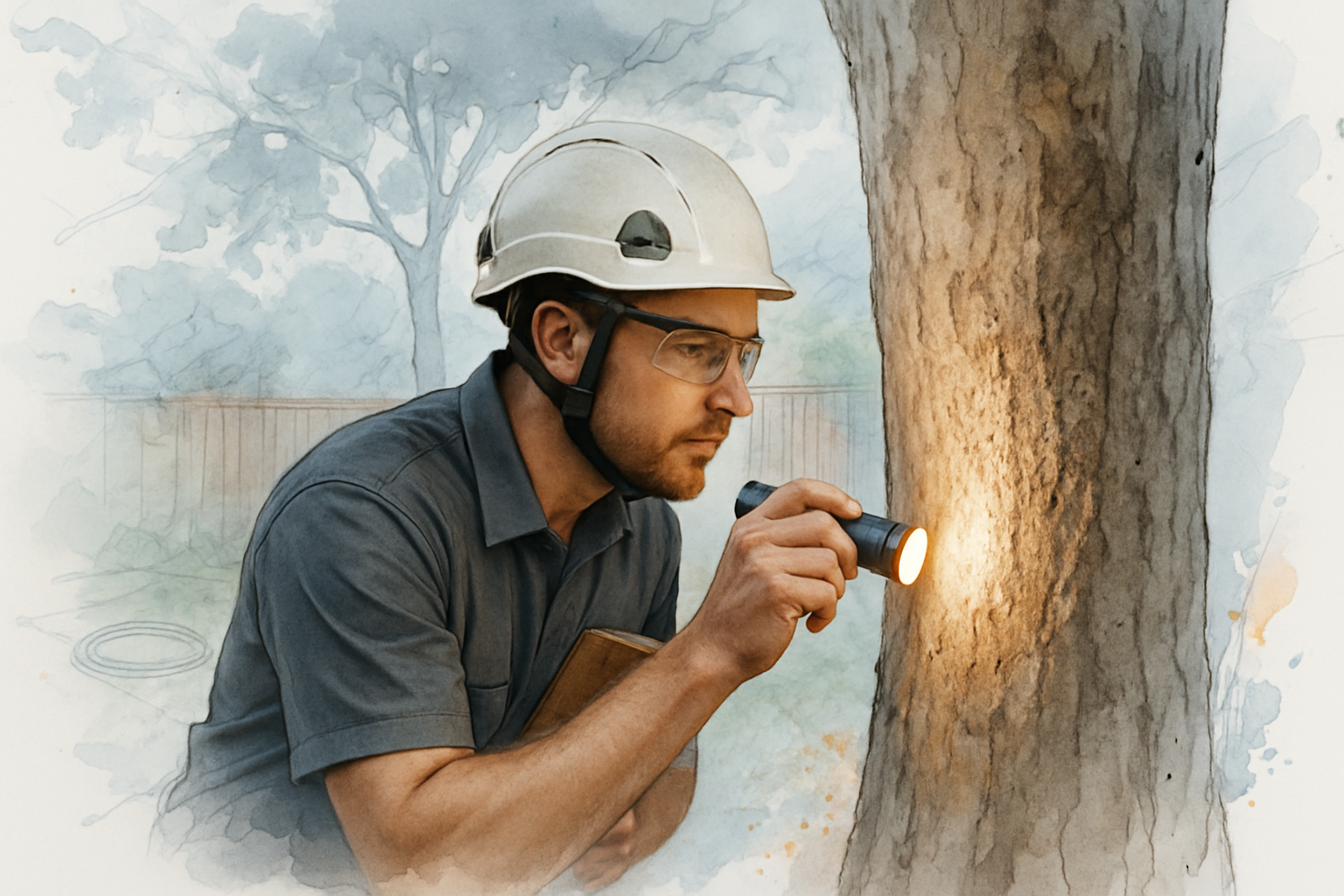
You were moving the hose or pulling weeds, and you happened to look closely at the trunk. There were little round holes in the bark, and a dark wet stain running down from them.
That is how almost every one of these conversations starts. Not with a bug, with a stain and a hole. The beetle behind it is about the size of a sesame seed, and you will almost certainly never see one.
Santa Clara County confirmed the invasive shothole borer in San Jose in 2024, and it matters most in exactly the kind of yards we work in every week: the liquidambar street trees in older neighborhoods, the sycamores and birches around Willow Glen, the valley oaks in Almaden Valley and up into the Saratoga and Los Gatos foothills. Here is how to read what you are seeing, what the city handles, and what you handle.
What Pen-Tip Holes and Dark Staining Actually Mean
The giveaway is the shape and size of the hole. A perfectly round entry hole, about the size of the tip of a medium ballpoint pen, is the signature. Not a slot, not a ragged tunnel, not a woodpecker divot.
On its own, one hole proves nothing. What raises my concern is a hole plus one or more of these signs:
- Wet staining or dark discoloration on the bark, often streaking downward from the holes
- Fine boring dust that looks like very pale sawdust, caught in bark crevices or collected at the base
- Gumming, a clear or amber ooze around the hole
- A crusty sugary buildup ringing the entry point
- Holes clustered in one area of the trunk or on a few scaffold limbs, not scattered randomly
The beetle itself tunnels in and carries a fungus with it. That fungus causes Fusarium dieback, which interferes with the tree’s ability to move water and nutrients up the trunk.
So the canopy symptoms show up later, not first. Branch dieback, thinning canopy, and limbs that leaf out weakly are the second act. The holes and staining are the first, which is why looking at the trunk in spring is worth five minutes of your time.
The Trees in San Jose Yards That Can Host It
This is always the second question, and it deserves a straight answer. Some species have been confirmed as reproductive hosts, meaning the beetle can complete its life cycle and kill the tree.
Confirmed killers include:
- Box elder
- California sycamore
- Valley oak
- Japanese maple
- American sweetgum, the liquidambar lining so many older San Jose streets
Beyond that, dozens of other species can host the beetle without necessarily dying from it, including coast live oak, California buckeye, willow, acacia, and avocado. Read that list next to a typical mature Silicon Valley yard and you will see the overlap right away.
Now the important part. Owning a host species is not a reason to take down a healthy tree. I have had homeowners ask about pre-emptive removal, and I talk them out of it every time.
One homeowner wrote to us about a large Japanese maple she had lived with for nine years: “Would love to keep this tree as healthy as possible! It’s my favorite.” That is the right instinct, and that is what a real assessment protects. Proper assessment before action, every time.
Where Things Stand in San Jose Right Now
Santa Clara County’s Division of Agriculture confirmed the invasive shothole borer in San Jose in August 2024. Based on how far along the infested trees already were, experts believe the beetles had likely been in the area five or more years before anyone identified them.
Once a population is established, eradication is considered virtually impossible. That sounds grim, but it actually simplifies the job.
The realistic goal is:
- Monitoring, so you catch it on your own property early
- Early diagnosis, before dieback sets in
- Containment, mostly by handling infested wood correctly
- Keeping trees vigorous, because stressed trees are the ones that lose these fights
That last point is where most homeowners can actually move the needle. Deep, infrequent summer watering on a mature valley oak, correct mulch depth, no soil compaction over the root zone, and no unnecessary pruning during the wrong window all matter more than anything in a spray tank.
And this is exactly why I do not diagnose from a driveway. A drought-stressed tree and an infested tree can look identical from the street. Our long dry summers punish trees that are already struggling, and the visible symptoms overlap almost completely.
Street Tree or Private Tree? Two Different Phone Calls
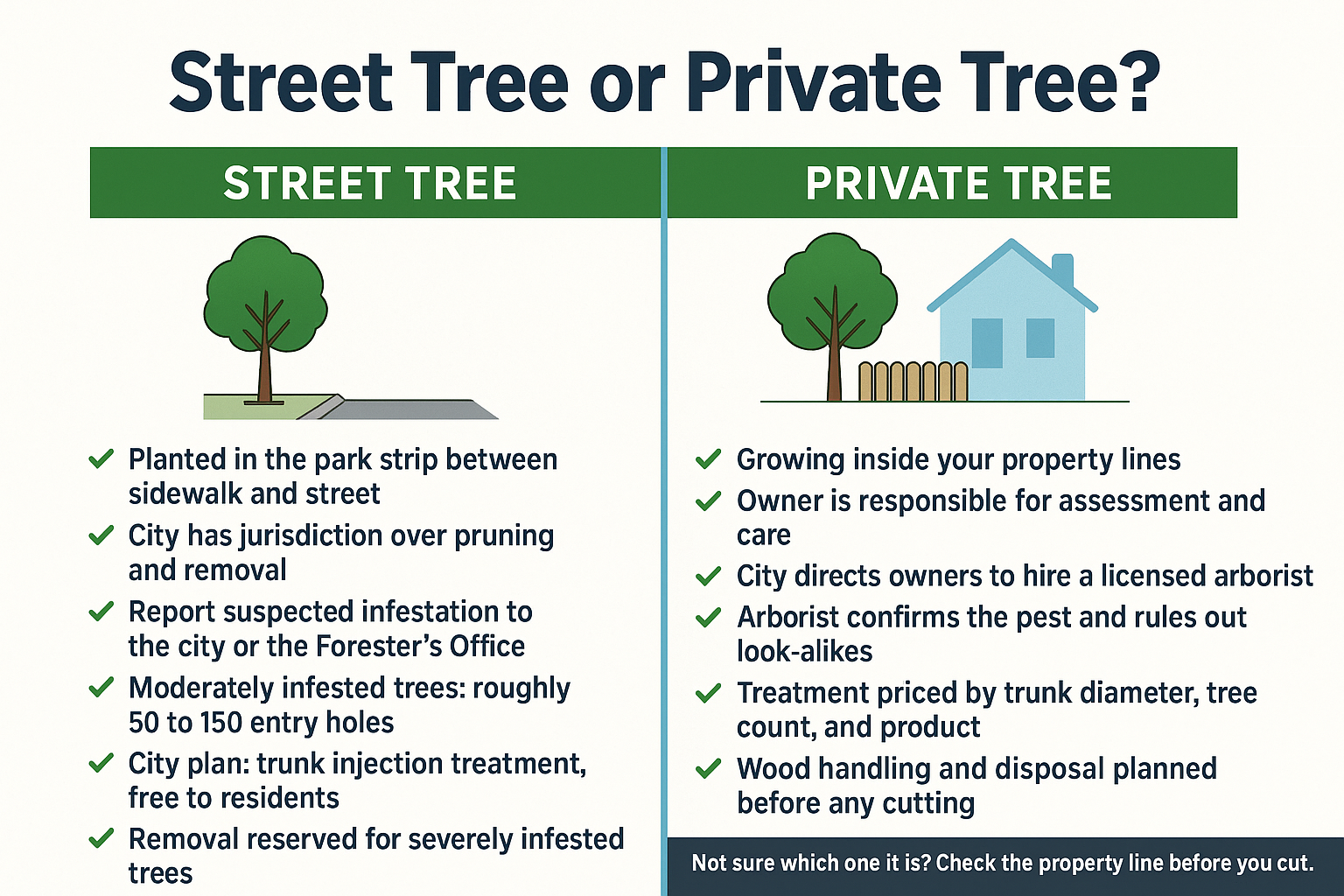
Homeowners mix these two up constantly, and it changes who you call and who pays. This breaks down the split.
Who to Call First Depends on Where the Tree Stands
Before anything else, figure out which side of the property line the trunk is on. If the tree is in the park strip between the sidewalk and the street, the city has a say, and that applies to pruning as much as removal.
For suspected street trees, the first call goes to the city or the Forester’s Office. According to the City of San José’s invasive shothole borer page, the Department of Transportation has a plan to treat moderately infested street trees, defined as roughly 50 to 150 entry holes, using trunk injection. The city has said that treatment of moderately infested street trees is free for residents, with removal reserved for severely infested trees where appropriate.
For a tree inside your property lines, the city’s own direction is to have a licensed arborist assess it. That is on you as the owner.
If you genuinely cannot tell which category your tree falls into, that question comes up so often we wrote a whole piece on who actually owns the tree in front of your house. Get that answer before anyone touches the tree, because cutting first and asking later is how homeowners end up with a permit problem stacked on top of a pest problem.
Look-Alikes: What Else Causes These Symptoms
Honest diagnosis means ruling things out. Several unrelated problems produce overlapping symptoms, and I have seen all of these misread as beetle damage.
| What you see | Could be shothole borer if… | But it could also be… |
|---|---|---|
| Small round holes in bark | Holes are uniformly round, pen-tip sized, and clustered | Other borers, woodpecker feeding, or old sapsucker damage |
| Dark wet staining on trunk | Staining streaks down directly from round holes | Bacterial wetwood, a canker fungus, or a bark wound |
| Fine pale sawdust | Dust collects around visible entry holes | Carpenter ants, longhorn beetles, or general bark weathering |
| Thinning canopy, branch dieback | Paired with trunk holes and staining on a host species | Drought stress, root damage, poor irrigation, or past over-pruning |
| Oozing or gumming | Ooze rings a round hole | Normal stress response in stone fruit and some ornamentals |
The Part Almost Nobody Tells Homeowners: What Happens to the Wood
This is the piece I wish more people heard before they picked up a saw. Moving infested wood is how this beetle reaches a new block.
Infested branches and logs should not be:
- Hauled to green waste without proper handling
- Stacked in the side yard as firewood
- Handed off to a neighbor who wants it for a fire pit
- Chipped and spread as mulch without a plan
County guidance is to consult an arborist before moving or disposing of infested material. On our jobs, chipping and disposal are written into the work plan up front, not sorted out at the end of the day when the truck is already loaded.
On cost, I will not quote you a number here, because the honest answer is that it depends. Treatment on private trees is priced by trunk diameter, the number of trees, and the product used, and the disposal side depends on how much wood comes down. An on-site look comes before any number, and if you want a sense of how estimates get built in general, we broke that down in what goes into the price of tree trimming in San Jose.
One last thought, for anyone who does lose a tree. County officials have pointed to species diversity as the real protection, because a street planted with one species can lose its entire canopy to one pest. Replanting with something different from what came out is right tree, right place, right time in practice.
Frequently Asked Questions About Invasive Shothole Borer in San Jose
Should I remove my sycamore or liquidambar just to be safe?
No. Owning a host species is not a reason to remove a healthy tree. Mature canopy in neighborhoods like Willow Glen and Almaden Valley carries real property value, shade, and cooling benefit. Removal is a last resort here, and only after an assessment shows the tree is genuinely beyond stabilizing.
Can you tell from a photo whether it is the shothole borer?
Sometimes photos help a lot, especially clear close-ups of the holes with something for scale. But the staining, boring dust, and hole shape all need to be read together, and canopy condition and root-zone stress matter just as much. We do look at photos, and there are limits worth knowing about, which we covered in detail in our piece on photo assessments versus an on-site visit.
Is treatment for a private tree free like the city street tree program?
No. The free trunk-injection treatment applies to moderately infested city street trees, roughly 50 to 150 entry holes, under the city’s plan. Trees on private property are the owner’s responsibility, and the city directs owners to hire a licensed arborist.
How many holes is too many?
The city uses 50 to 150 entry holes as its working definition of moderate infestation for street trees. On a private tree I look at more than a count: where the holes are, whether they sit on structural limbs or the root collar, how much staining there is, and how the canopy is responding. Ten holes at a weak union can matter more than sixty scattered on a healthy trunk.
Can I just spray it myself?
I would not. Over-the-counter sprays do not reach a beetle living inside the wood, and the fungus it carries is the actual damage. An Integrated Pest Management approach starts with confirming what you have, then keeping the tree vigorous, and only uses product where it will do something useful.
Does my tree need a permit before any work is done?
Possibly, yes. Street trees fall under city jurisdiction for pruning as well as removal, and private trees can hit ordinance-size thresholds that trigger a permit. Sort that out before scheduling work, not after. Our guide on what triggers a permit on your property walks through it.
Not Sure What Those Holes Are? Get Eyes on It Before You Cut
Diagnosis and any treatment planning sit under one roof here. Robert Apolinar is a Board-Certified Master Arborist and also holds a California Qualified Applicators License, and we run an Integrated Pest Management approach rather than defaulting to spraying or to removal, which is what one long-time customer was getting at when she wrote, “They’re super knowledgeable and never push work that doesn’t need to be done.” Assessments and treatment planning are available in San Jose, Willow Glen, Almaden Valley, Los Gatos, Saratoga, and Campbell at (408) 422-1313. If the tree is in the park strip, start with the city or the Forester’s Office and their invasive shothole borer page first.
