
Direct Answer: In San Jose, the homeowner adjacent to a street tree is responsible for maintenance costs, but the city controls what work gets done. You need a permit before any pruning or removal happens, even on your own dime.
One of the most common calls we get goes something like this: a homeowner in Willow Glen wants the big tree out front trimmed back. They hire a crew, the crew shows up, and a few weeks later there’s a notice from the city. The homeowner is stunned. They thought it was their tree.
The short answer is: it’s complicated. In San Jose, the tree between your curb and your sidewalk sits in the public right-of-way, but the responsibility for maintaining it lands squarely on you as the adjacent property owner. At the same time, you cannot touch that tree without the city’s permission. Who pays and who controls those two things are not the same person.
This article walks through the three categories of protected trees you’re most likely to encounter in San Jose, what the permit rules actually mean in practice, and what to do if your situation straddles both private and public property. I’ll also cover a financial assistance option most homeowners have never heard of.
What San Jose Municipal Code Actually Says About Street Trees
Under San Jose Municipal Code Section 13.28, the property owner adjacent to a street tree bears the cost of care. That means watering, pruning, and any required maintenance is your financial responsibility, even though the tree grows in city-controlled space.
But that same code requires you to get a permit before doing any of that work. The city’s Department of Transportation, Trees and Sidewalks division manages the permit process, and it applies whether you’re pruning or removing. Callers frequently tell me they assumed that a simple trim didn’t count. It does.
The permit itself is free. But free doesn’t mean fast or informal. Here’s what the process involves:
- You submit a permit request to the city
- A city inspector visits the site to assess the tree
- A 14-day public notice period follows before any removal work can proceed
- Pruning work must meet established professional standards
The fine for unpermitted work on a street tree can reach $15,000 per tree. That’s not a typo, and it applies to work done by a hired crew on your behalf just as much as work you do yourself. The property owner is the responsible party.
For permit information and to start a request, contact the Trees and Sidewalks office directly at 408-794-1901 or [email protected]. The city’s own permit page at sanjoseca.gov confirms that permits are free and that financial assistance is available for required work at owner-occupied single-family residences, more on that below.
Three Categories of Protected Trees, and Why It Matters Which One You Have
Not every tree follows the same rules. Knowing which category applies to your tree tells you which agency to call, what permits are required, and how serious the consequences are for unpermitted work.
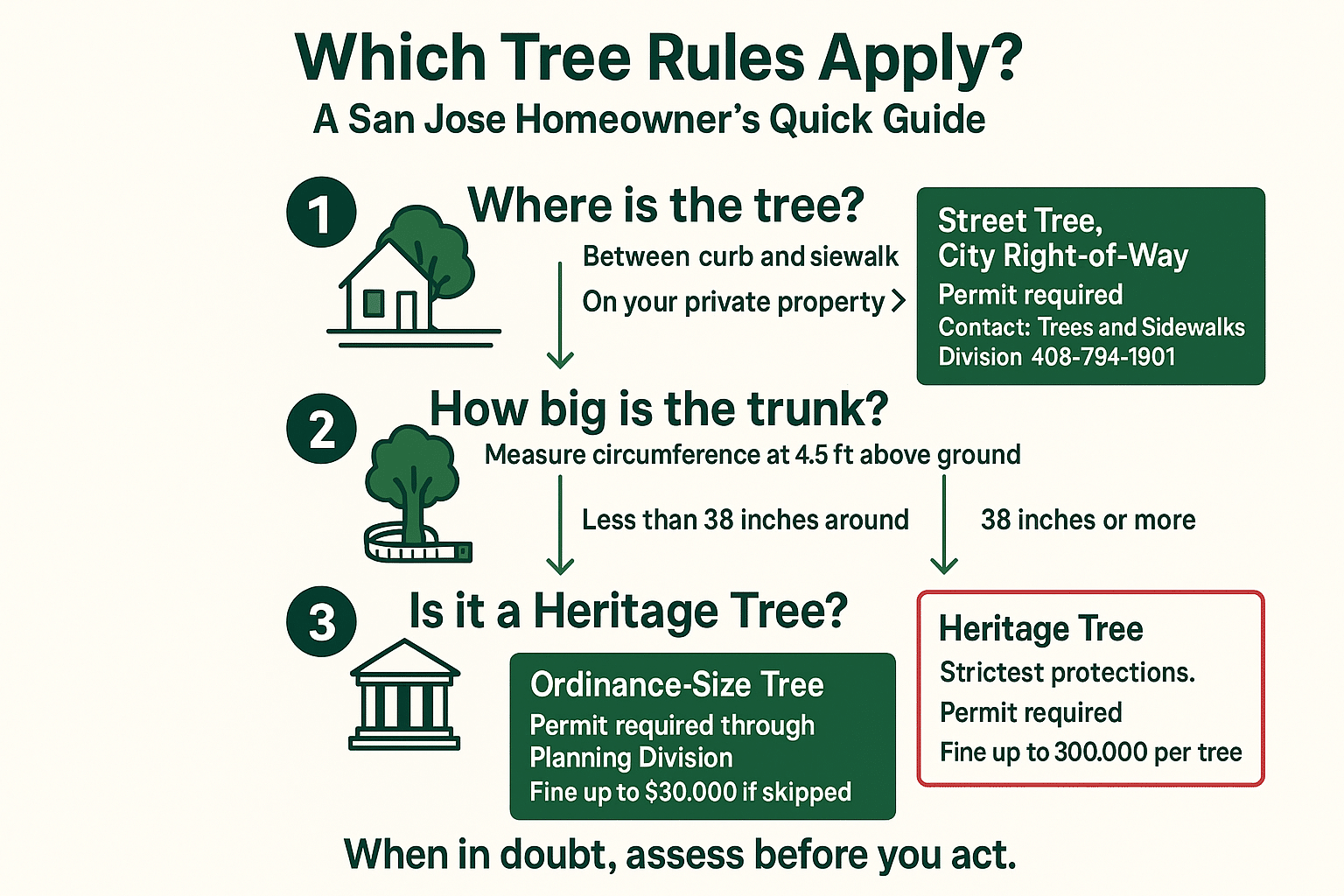
Here’s a simple way to think about it: where is the tree, and how big is it?
1. Street Trees in the Public Right-of-Way
These sit between the curb and sidewalk. Maintenance cost falls on you; control stays with the city. Permits are required for pruning and removal. Fines for unpermitted work can reach $15,000 per tree.
2. Ordinance-Size Trees on Private Property
San Jose protects trees on private property once the trunk reaches a circumference of 38 inches or more, measured at 4.5 feet above ground. These trees require a separate permit process through the city’s Planning Division before any significant pruning or removal. If you’re not sure whether your tree qualifies, a certified arborist consultation can give you a clear answer before you commit to anything.
3. Heritage Trees
Heritage trees are specifically designated by the San Jose City Council and carry the strictest protections. Work on a heritage tree without a permit can result in fines up to $30,000 per tree. These trees are documented by the city, but not every homeowner knows if one sits on or near their property.
The practical takeaway: before any tree work happens on your property in San Jose, a quick assessment of where the tree sits and how large it is can save you from an expensive mistake. We always recommend understanding what San Jose requires before a tree comes down, the permit process is different depending on which category applies.
San Jose Tree Permit Categories at a Glance
This table gives you a quick reference for the three categories you’re most likely to encounter as a San Jose homeowner.
| Tree Category | Location | Who Issues Permit | Max Fine for Unpermitted Work |
|---|---|---|---|
| Street Tree | Public right-of-way (curb to sidewalk) | Dept. of Transportation, Trees and Sidewalks | $15,000 per tree |
| Ordinance-Size Tree | Private property, trunk 38″+ circumference at 4.5 ft. | City Planning Division | Varies, significant civil penalties apply |
| Heritage Tree | Private or public, Council-designated | City Planning Division | $30,000 per tree |
How to Figure Out Which Tree Rules Apply to You
Use this decision framework before making any call to a tree crew or the city.
When a Tree Straddles Both Sides, What Happens Then
One situation I see regularly in Almaden Valley and Willow Glen is a tree that doesn’t fit neatly into one category. A large oak or eucalyptus with the trunk on private property but branches extending well over the street and the roofline creates a split situation that requires handling two separate processes at once.
We had a conversation recently with a homeowner who described exactly this: branches overhanging both the roof and the street, and a neighbor’s concern about a limb that crossed the property line. That single tree touched three different rule sets.
Here’s what that kind of situation typically involves:
- Street-side branches require a street tree permit, even if the trunk is on private property, because work in the right-of-way triggers city oversight
- Private-side pruning near the roofline may fall under ordinance-size tree rules if the trunk qualifies
- Property line questions are a separate civil matter between neighbors, not a city permit issue, but a certified arborist’s written assessment is often the clearest way to document the tree’s condition before any conversation with a neighbor
The best approach in these cases is to get a proper assessment before calling any crew. Knowing exactly what you’re working with saves time, avoids permit violations, and gives you the information you need to talk to the city and your neighbors from an informed position. When a tree problem requires an arborist rather than just a trimmer is worth reading before you make that call.
Financial Assistance for Required Street Tree Work
Most homeowners I speak with have no idea this exists: if the city requires you to perform street tree work on your property, and you own and occupy a single-family residence, financial assistance may be available through the city to help cover those costs.
This is not widely advertised. You won’t find it on a banner in front of City Hall. But it’s a real resource, and pointing people toward it is part of why we take the time to talk through the permit process before any work begins.
To find out if you qualify, contact the Trees and Sidewalks office directly:
- Phone: 408-794-1901
- Email: [email protected]
This is the same office that handles the street tree permit process, so one call can address both questions at once. There’s no cost to ask.
Frequently Asked Questions About Street Tree Permits in San Jose
If I’m paying for the tree work, why do I still need a city permit?
Because street trees are city property, even though you’re responsible for their upkeep costs. The city controls what happens to them. Paying for the work doesn’t transfer that control to you. The permit requirement exists regardless of who writes the check.
Can a tree crew just trim the street tree without a permit if they’re only doing a small trim?
No. The permit requirement applies to pruning, not just removal. There is no minimum size threshold that makes a trim exempt. Any work on a street tree in the public right-of-way requires a permit. The fine for skipping it can reach $15,000 per tree, and that applies to work a hired crew does on your behalf.
How long does the street tree permit process take?
It depends on the scope of work. For removal, there is a mandatory 14-day public notice period after an inspector visits the site. Pruning permits can move faster, but the inspector visit is still part of the process. Plan for at least a few weeks from request to approval, and don’t schedule a crew before the permit is in hand.
How do I know if my backyard tree is large enough to need a permit?
Measure the trunk’s circumference at 4.5 feet above the ground. If it reaches 38 inches or more, it falls under San Jose’s ordinance-size tree protections. If you’re unsure how to measure or whether the measurement applies, a certified arborist can walk you through it during a site assessment.
What’s the difference between an ordinance-size tree and a heritage tree?
An ordinance-size tree qualifies for protection based purely on its size, a trunk circumference of 38 inches or more at 4.5 feet above ground. A heritage tree is a specific designation made by the San Jose City Council and is usually a historically significant or ecologically notable tree. Heritage trees are listed by the city. Ordinance-size trees are not listed, you have to measure to know.
Who do I contact first, a tree service or the city?
For street trees, contact the city’s Trees and Sidewalks division first to start the permit process. Then, once you understand what work is allowed and what the permit covers, bring in a licensed tree service to do the actual work. For trees on private property, a certified arborist assessment can help you understand what category your tree falls into before you contact the city at all.
Not Sure Which Rules Apply to Your Tree?
If you have a tree in San Jose, whether it’s between the curb and sidewalk, growing large in the backyard, or hanging over both your roof and the street, a proper assessment is the clearest starting point. San Jose Tree Service & Landscaping holds an active CSLB license with both Tree Service and Landscaping classifications, and we work through the permit process regularly for homeowners across Willow Glen, Almaden Valley, Los Gatos, and Campbell. Reach us at (408) 422-1313 or visit sanjosetreemaintenance.com to request an assessment.
