
Direct Answer: A certified arborist assessment covers tree structure, root health, disease signs, risk factors, and a care recommendation — not just a quick look and a removal quote.
You’ve got a tree that doesn’t look right. Maybe a few branches died over the summer. Maybe the trunk has a crack you didn’t notice before, or the whole tree leaned a little after the last winter storm. You’re not sure if it’s serious — but you’re not sure it isn’t, either.
That uncertainty is one of the most common things homeowners across San Jose deal with. Established neighborhoods like Willow Glen and Almaden Valley are full of mature trees — oaks, redwoods, sycamores — that have been growing for decades. They add real value to a property. But they also carry real risk when something goes wrong.
A professional tree assessment from a certified arborist is how you get a clear, honest answer. Not a sales pitch. Not a guess. An actual evaluation of what’s happening with the tree — and what, if anything, needs to be done about it.
What Is a Certified Arborist, and Why Does the Credential Matter?
A certified arborist is someone who has passed a rigorous exam administered by the International Society of Arboriculture (ISA) and maintains continuing education to keep that certification active. It’s not a license you can buy or a title anyone can print on a business card.
In California, tree work doesn’t always require a certified arborist — but for a tree that’s large, old, diseased, or near a structure, you really want one. The ISA credential means the person assessing your tree has been trained specifically in tree biology, diagnosis, and risk evaluation.
There’s an important distinction worth knowing: an ISA Certified Arborist can assess and recommend. A TRAQ-qualified arborist (Tree Risk Assessment Qualification) is additionally trained to formally evaluate and document tree failure risk — relevant when a tree is near a house, a fence line, or a public walkway. For homeowners in San Jose’s foothills near Los Gatos or Saratoga, where fire risk adds another layer of concern, that formal risk documentation can matter.
You can learn more about the broader role of this credential in our guide on what a certified arborist actually does for your trees.
What Triggers the Need for a Tree Assessment?
Most homeowners don’t call an arborist on a schedule. They call because something changed. The most common triggers include:
- A storm knocked down a limb — or the tree is leaning more than before
- Bark is cracking, peeling, or showing discoloration
- Leaves are yellowing, dropping early, or sparse in sections that used to be full
- Mushrooms or fungal growth appear at the base of the trunk
- Roots are visibly lifting pavement or growing toward the foundation
- A neighbor’s tree is overhanging your property and looks unhealthy
- You’re planning construction or landscaping work near a tree’s root zone
- You need a permit to prune or remove a protected tree in San Jose
Some of these are urgent. Others can wait a few weeks. But the only way to know which category you’re in is a proper assessment — not a guess based on what a tree looks like from the street.
If you’re dealing with a situation after a recent storm, our resource on San Jose emergency tree services after storm damage covers what to do right away.
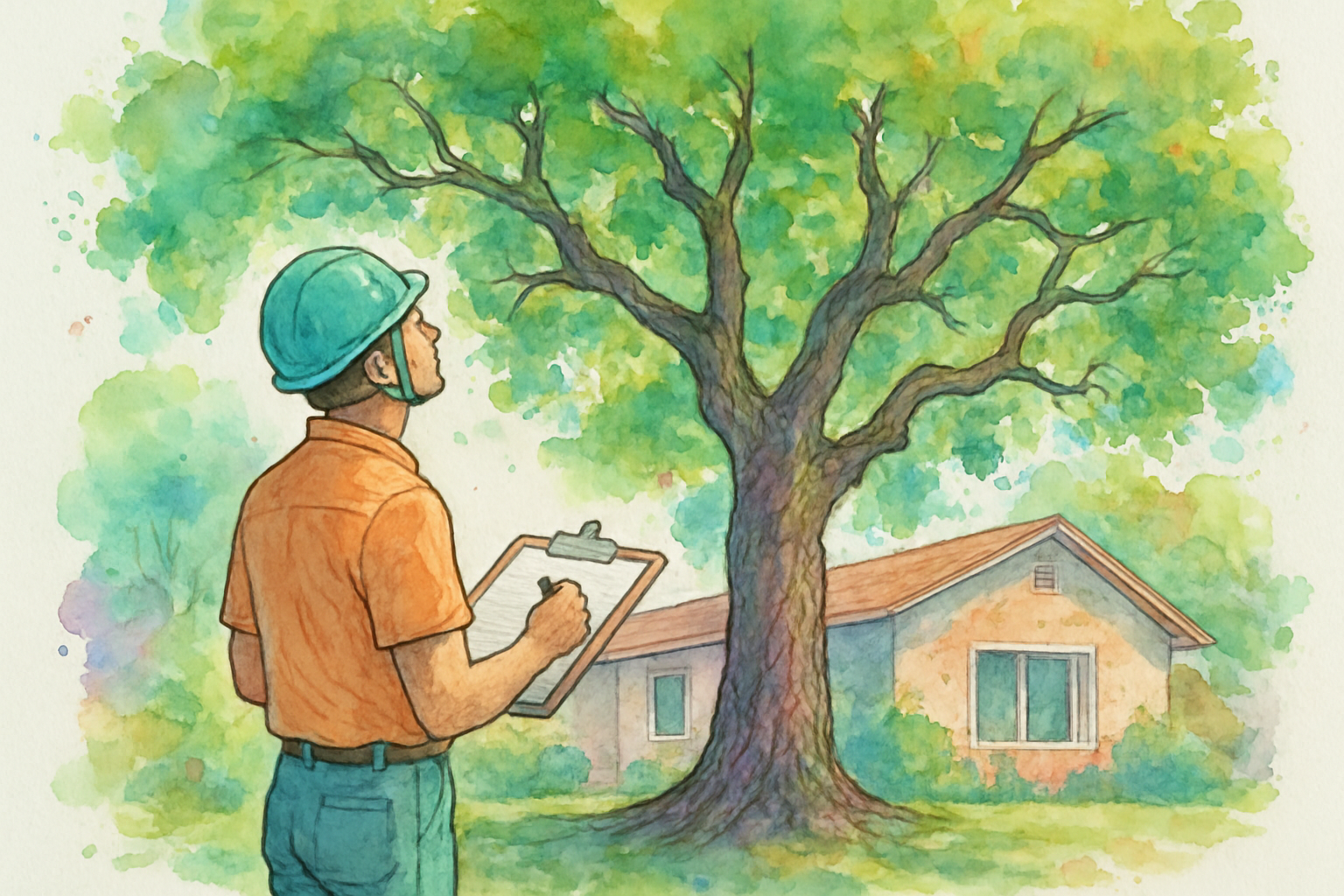
What a Professional Tree Assessment Actually Covers
A thorough assessment by a certified arborist isn’t a five-minute walkthrough. Here’s what a proper evaluation should include:
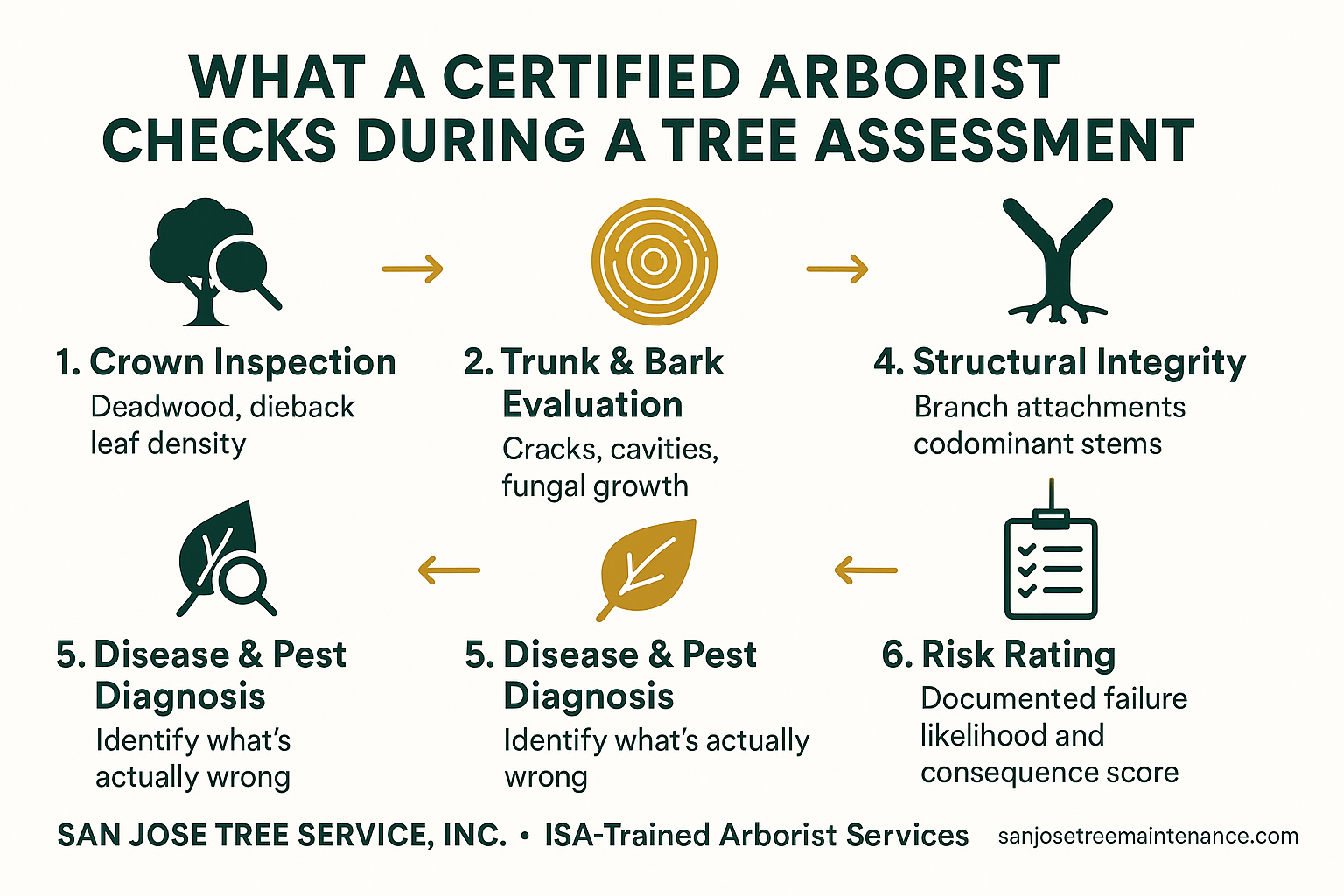
1. Visual Crown Inspection
The arborist looks at the entire canopy — branch density, deadwood presence, signs of dieback, unusual leaf color or drop patterns. They’re looking for clues the tree gives from the outside about what might be happening inside.
2. Trunk and Bark Evaluation
Cracks, cavities, fungal growth, old pruning wounds, bark inclusions — the trunk tells a lot. A vertical crack on a mature valley oak in Campbell or Cupertino is a very different situation than a surface wound healing over cleanly.
3. Root Zone Assessment
Root problems are often invisible until they’re serious. The arborist looks at soil compaction, signs of root decay, girdling roots, and proximity to pavement or structures. Homes in Almaden Valley with older landscaping often have roots that have been quietly working their way under hardscape for years.
4. Structural Integrity Check
This includes looking at branch attachments, the angle of the main leader, codominant stems, and any prior damage that weakened the tree’s structure. Weak branch unions are one of the leading causes of failure during winter storms.
5. Disease and Pest Diagnosis
Some symptoms that look like drought stress are actually disease or pest damage. A trained eye can tell the difference. If you’ve noticed orange fungal growth on a tree, that’s exactly the kind of symptom that needs a proper diagnosis — not a guess.
6. Risk Rating
If the arborist is TRAQ-qualified, they assign a formal risk rating based on the likelihood of failure and the potential consequences. This is documented and can be used if you need to pull a permit or file an insurance claim.
The 6 Parts of a Professional Tree Assessment
This breakdown shows exactly what a certified arborist evaluates during a full tree assessment — from the canopy down to the roots.
How Much Does a Tree Assessment Cost in San Jose?
Pricing varies depending on the scope and who’s doing the work. Here’s what you’ll typically see in the San Jose and South Bay market:
- Basic arborist consultation: $100–$200 for a single tree visit, often applied as a credit toward any work that follows
- Formal written risk assessment (TRAQ-documented): $250–$500, depending on tree size and report detail
- Multi-tree evaluation for permits: $400–$800+ when multiple trees need documented assessments for a city permit application
Some companies offer free estimates — but a free estimate is not the same as a certified arborist assessment. A free estimate is designed to result in a sale. A paid arborist consultation is designed to give you honest, unbiased information about the tree.
In San Jose, protected trees — generally those with a trunk diameter of 12 inches or greater measured at 54 inches above grade — require a permit before any significant pruning or removal can happen. The City of San Jose’s Urban Forestry program administers this process. An arborist assessment is often required as part of that permit application. Los Gatos and Saratoga have their own protected tree ordinances, and they can be stricter — worth confirming before you schedule any work.
Tree Assessment Types: What You Get and What It Costs
Here’s a quick side-by-side of the most common assessment types San Jose homeowners encounter, what each one involves, and the typical price range.
| Assessment Type | What It Includes | Typical Cost (San Jose Market) |
|---|---|---|
| Basic Arborist Consultation | Visual inspection, verbal recommendation, basic care advice | $100–$200 |
| Written Arborist Report | Documented findings, species ID, condition rating, written recommendations | $200–$400 |
| TRAQ Risk Assessment | Formal risk rating, failure likelihood score, documented for permits or insurance | $250–$500 |
| Multi-Tree / Permit Assessment | Multiple trees evaluated, written report formatted for city permit submission | $400–$800+ |
| Emergency Post-Storm Evaluation | Immediate structural review after storm damage, safety determination | $150–$350 |
What Happens After the Assessment?
A good arborist doesn’t just hand you a report and walk away. They explain what they found in plain terms and give you a clear set of options — not a single path that happens to be the most expensive one.
Possible recommendations after an assessment include:
- No action needed — the tree is healthy and stable, monitor annually
- Pruning — deadwood removal, crown thinning, or structural pruning to reduce weight and improve form
- Cabling or bracing — hardware installed to support a weak union or leaning structure
- Disease treatment — fungicide application, soil amendment, or root zone aeration
- Tree removal — only recommended when the tree poses a documented safety risk that cannot be mitigated
- Permit application — when the recommended work requires city approval
Removal is never the default answer with a thorough assessment. The goal is always safety, health, and longevity — and most trees, even ones that look rough, have a path forward that doesn’t involve taking them out.
If the assessment reveals that the tree is structurally compromised but still viable, a certified arborist may recommend cabling and support work as part of a longer-term care plan.
How to Choose the Right Arborist for the Job
Not everyone who calls themselves a tree service is qualified to give you a real assessment. Here’s what to look for:
- ISA certification — verify at the ISA website using the arborist’s name or credential number
- CSLB license — California requires a contractor’s license for tree work over $500; look for a C-61/D-49 classification for tree service work
- TRAQ qualification — matters most when you need a formal risk report for a permit or insurance situation
- Insurance — general liability and workers’ comp, current and verifiable
- BBB accreditation or third-party reviews — not a substitute for credentials, but a useful trust signal
- No pressure toward removal — a qualified arborist gives you options; a contractor looking for a job steers you toward the biggest ticket
For deeper context on what separates a qualified local arborist from a general tree cutter, the article on what a local arborist should actually know is worth reading before you make a call.
And if you’re planning any landscape work alongside tree care — irrigation, planting, hardscape — it’s worth knowing that a contractor holding both a C-27 landscaping license and a C-61/D-49 tree service license can coordinate the full scope without you managing two separate companies.
Frequently Asked Questions About Tree Assessments in San Jose
Do I need a certified arborist, or can any tree company give me an assessment?
Any company can look at a tree and give you an opinion — but only an ISA Certified Arborist has the training to give you a documented, credible evaluation. For permit applications, insurance claims, or any tree near a structure, you want certified credentials in writing.
How long does a tree assessment typically take?
A single-tree assessment usually takes 30 to 60 minutes on-site. A multi-tree evaluation or one that includes a formal written report can take longer — sometimes 2 to 3 hours for larger properties. The written report may take a few additional days to prepare.
Will the arborist automatically recommend removing the tree?
A qualified arborist recommends removal only when the tree poses a genuine, unmitigable risk. Most assessments result in a care recommendation — pruning, treatment, or monitoring — not removal. Be cautious of any company that recommends removal without a thorough on-site evaluation.
Does San Jose require a permit for tree removal, and does an arborist help with that?
Yes. San Jose requires a Heritage Tree Permit for removal or significant pruning of trees with a trunk 12 inches or larger in diameter (measured at 54 inches above ground). A certified arborist can prepare the required assessment documentation and help you submit the application correctly.
What’s the difference between a free estimate and a paid arborist consultation?
A free estimate is a sales visit — the goal is to sell you a service. A paid arborist consultation is an independent professional evaluation with no attached sales pressure. If you need an honest answer about a tree’s health or risk, pay for the consultation.
Ready to Get a Straight Answer About Your Tree?
If you have a tree in San Jose — or anywhere across the South Bay from Willow Glen to Los Gatos — that’s giving you concern, the right move is a proper assessment before anything else. San Jose Tree Service, Inc. holds an active ISA-trained arborist practice, a CSLB license with both C-61/D-49 and C-27 classifications, and a track record built on honest, education-first service. Call (408) 422-1313 or visit sanjosetreemaintenance.com to schedule a consultation.
