
If you're looking at a tree in your yard and thinking, "It probably just needs trimming," that's a normal place to start. Most homeowners in San Jose call when something looks off: a canopy getting thin, a limb hanging over a roof, roots pushing up near hardscape, or a mature tree that just doesn't look as vigorous as it used to.
That question often turns into a better one. What does a certified arborist do for your trees? The short answer is that a real arborist doesn't begin with a saw. The work starts with diagnosis, then moves to the least aggressive fix that protects safety and supports long-term tree health.
More Than a Trimmer The Arborist as a Tree Doctor
A lot of tree work gets framed as cutting. Trim it, raise it, reduce it, remove it. But a certified arborist is there to figure out what the tree needs before any of that happens.
The International Society of Arboriculture defines an arborist as someone trained in the art and science of planting, caring for, and maintaining individual trees, and in practice that means a certified arborist performs a full inspection from canopy to roots before recommending action, as outlined by ISA's explanation of why hiring a certified arborist matters. That difference matters because a branch problem is often only the visible part of a larger issue.
A tree cutter may see overgrowth and reach for a chainsaw. An arborist asks better questions. Is the branch overextended because the tree was previously topped? Is the canopy thin because of root stress? Is the lean new, or has the tree grown that way for years? Is the defect cosmetic, or does it change the risk to people and structures?
Practical rule: A good arborist treats pruning and removal as responses to a diagnosis, not as the diagnosis itself.
Certified Arborist vs Tree Trimmer At a Glance
| Focus Area | Tree Trimmer / Cutter | ISA Certified Arborist |
|---|---|---|
| Main objective | Cut or clear branches | Evaluate tree health, structure, and site conditions first |
| Inspection depth | Usually visible canopy issues | Canopy, scaffold limbs, trunk, root flare, and soil conditions |
| Typical recommendation | Trim or remove | Prune, monitor, support, improve root conditions, treat, or remove if needed |
| View of tree problems | Branch-focused | Whole-tree and site-focused |
| Decision standard | Immediate clearance or appearance | Health, structure, safety, longevity, and property context |
That is why homeowners often feel the difference during the first conversation. One contractor tells you what they can cut. A qualified arborist tells you what they see, what it means, and what options make sense.
For homeowners trying to sort out that difference online, this local article on what a local arborist should actually know is useful. If you're curious how tree companies present that expertise in a crowded market, the tree surgeon digital marketing guide is also an interesting outside look at how arborist services are explained and compared.
What that means in a San Jose yard
In the South Bay, the visible problem isn't always the actual issue. Mature trees often react to drought, compacted soil, irrigation problems, or nearby construction long before a homeowner notices obvious limb failure.
So when a certified arborist walks your property, the job isn't "make the tree smaller." The job is to decide whether the tree needs correction, support, preservation, or in some cases careful removal.
What Happens During an Arborist Consultation
Most homeowners expect the visit to focus on the branch they can see from the driveway. A proper consultation is broader than that. The arborist is reading the whole site, not just the obvious symptom.
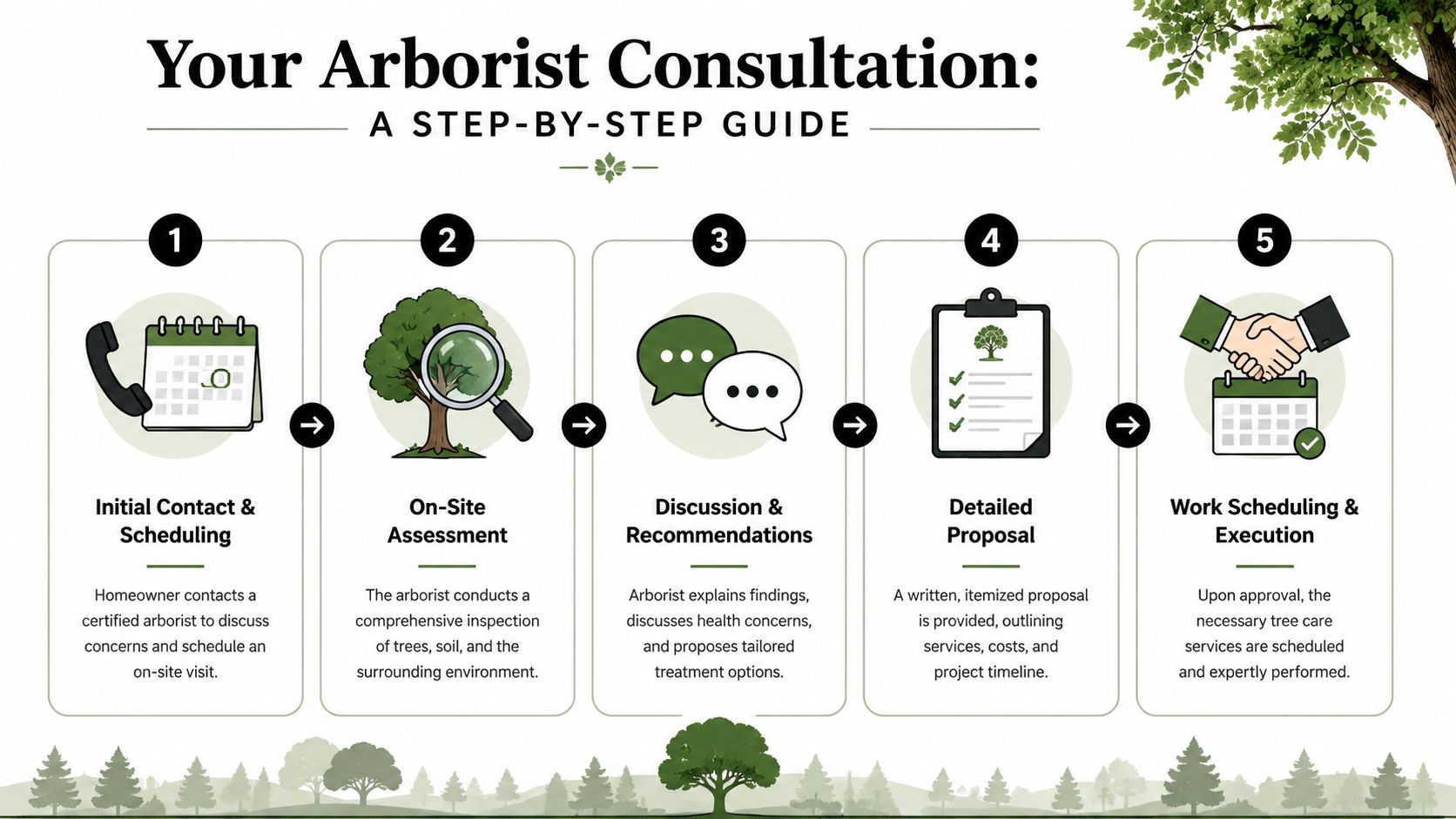 arborist consultation process from initial contact to tree service completion.” />
Arborists assess tree health, structural soundness, soil and root conditions, and preventive care measures, not just canopy appearance. In places like San Jose, mature trees often struggle more from compacted soil, drought stress, poor irrigation, or construction impacts than from obvious branch problems, and the best visit may end with less cutting and more preservation-focused work, as described by Pacific Northwest ISA's overview of arborist benefits.
The inspection usually starts at the top
The canopy tells you a lot. An arborist looks at leaf size, color, density, dead tips, uneven growth, and whether one side of the tree is declining faster than the other. That pattern helps separate normal seasonal response from a stress issue.
Then the attention shifts to branch structure. Weak unions, cracked attachments, overextended laterals, old topping cuts, rubbing limbs, and deadwood all matter. What looks like "too much growth" from the ground may be poor structure that needs selective pruning rather than a broad haircut.
The trunk and root flare often tell the real story
A trunk inspection looks for cavities, cracks, decay pockets, bark changes, and fungal signs. But the base of the tree often answers the question the canopy cannot. If the root flare is buried, the soil is heavily compacted, or irrigation is hitting the trunk, the tree may be dealing with chronic stress.
That's especially common in established South Bay neighborhoods where grade changes, foot traffic, parked vehicles, trenching, or lawn conversions have changed the rooting environment over time.
A solid consultation often includes attention to things like:
- Soil condition: Is the root zone compacted, dry, overwatered, or stripped of mulch?
- Irrigation pattern: Is the tree being watered like turf, shrubs, or not at all?
- Recent disturbance: Was there trenching, paving, regrading, or nearby construction?
- Target exposure: If a limb fails, what does it hit? A patio, driveway, roofline, fence, or nothing important?
Many tree problems in San Jose start below grade. Homeowners notice leaves and limbs first because that's what they can see.
What you should expect from the conversation
A real consultation should leave you with a clearer decision, not more confusion. The arborist should explain what appears urgent, what can be monitored, and what can be corrected with pruning, support, irrigation adjustment, or root-zone care.
If you want a local example of that diagnostic approach, this page on consultation and diagnostics in San Jose reflects what a homeowner should expect from an arborist-level site visit. The value is in the reasoning. Before a single cut is made, you should understand what the tree is responding to and why the recommended work fits that condition.
Common Arborist Services for Tree Health and Safety
Once the inspection is done, the work plan usually gets narrower, not broader. Good arborists don't throw every service at a tree. They match the treatment to the problem.
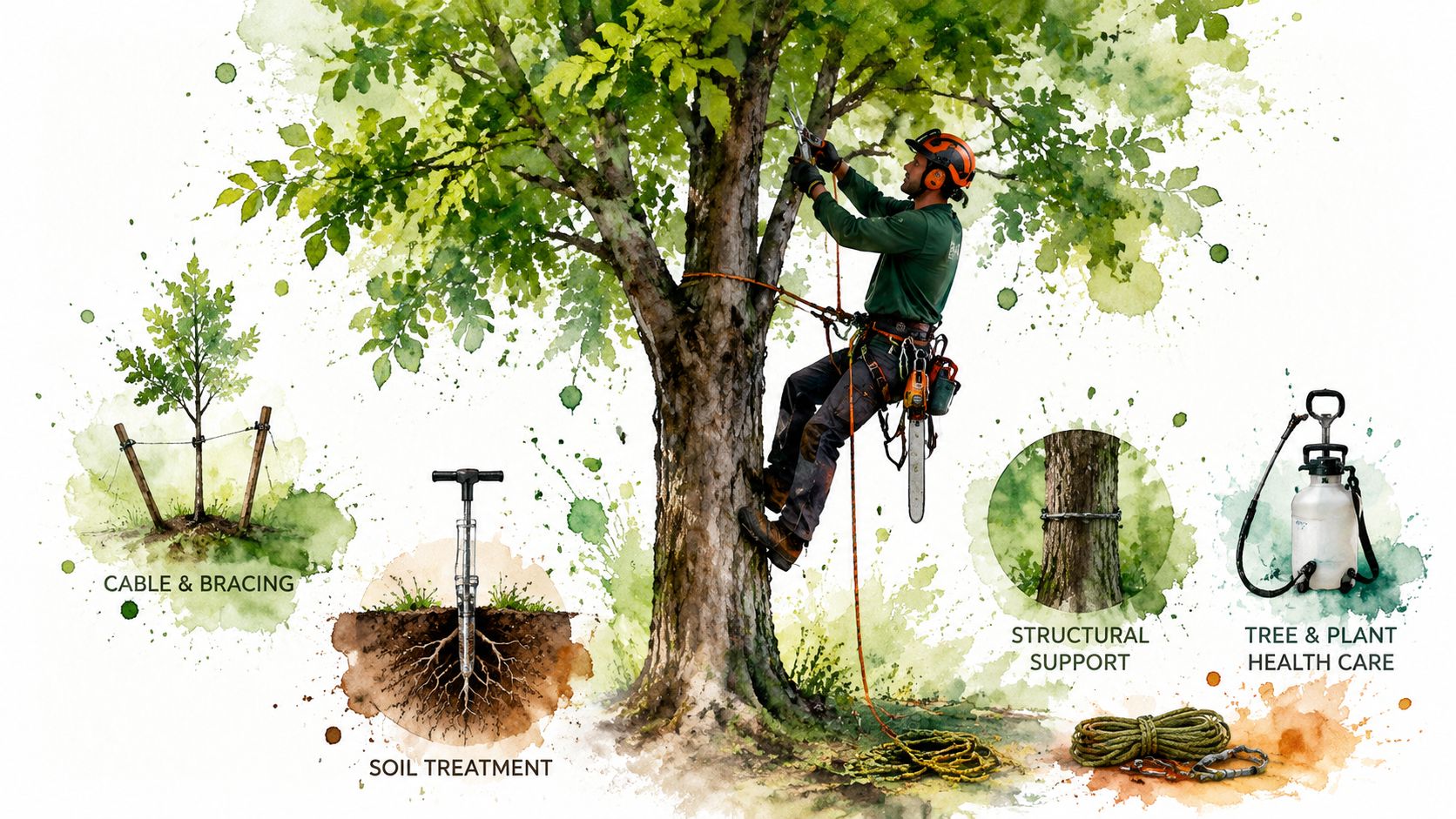
Proper pruning types such as crown thinning, crown reduction, and structural pruning each serve different technical purposes, and arborists also work on the root-zone system through soil aeration, mulch, and irrigation because root stress suppresses canopy vigor and raises breakage risk, particularly for drought-stressed South Bay trees, as noted in this overview of arborist work and pruning goals.
Pruning isn't one thing
Homeowners often use "trim" as a catch-all term, but the type of pruning matters.
- Crown thinning removes selected interior branches to improve light movement and reduce clutter in the canopy.
- Crown reduction shortens parts of the canopy when limb length and physical strain are the problem.
- Structural pruning is more corrective. It guides branch architecture so defects don't become bigger problems later.
- Deadwood removal addresses non-living branches that can fall or interfere with healthy growth.
- End-weight reduction takes stress off long, heavy limbs without stripping the branch bare.
What doesn't work is aggressive overcutting. Trees rarely benefit from broad, appearance-only cutting that ignores structure and biology. It can create weak regrowth, sun exposure issues, and repeat problems.
Many fixes involve less cutting than people expect
A mature tree with sparse foliage may not need more pruning. It may need a root-zone correction. In South Bay yards, arborists often recommend some combination of mulch changes, soil aeration, irrigation adjustment, or monitoring after construction impacts.
Cabling and bracing also come up when a tree has a structural issue that doesn't automatically justify removal. If a valued tree has a weak union or a long limb with included bark, support hardware may help manage load and preserve the tree while reducing risk.
The best outcome is often preservation with correction. Removal solves every tree problem, but it also eliminates shade, screening, and landscape value.
Diagnosis leads to the right service
A few common examples help:
A coast live oak over a driveway may need selective end-weight reduction and deadwood removal, not a hard canopy reduction.
A multi-stem ornamental near a patio might benefit from cabling and structural pruning if the union is weak but the rest of the tree is serviceable.
A mature shade tree with canopy thinning after nearby outdoor work may need root-zone attention and irrigation changes before anyone removes live wood.
For homeowners who want to see how real projects play out, it's reasonable to look at documented customer experiences. To see real customer stories and learn more about San Jose Tree Service, visit their success stories page. The company's broader tree health and preservation approach is also reflected in its local information on plant health care in San Jose. If you like seeing how service businesses present proof and feedback in other industries, the Decentralu case studies are an interesting example of how customer outcomes can be organized clearly.
Assessing Risk and Managing Tree Removal
Most homeowners don't want to remove a mature tree unless they have to. That's usually the right instinct. Removal should follow a clear risk discussion, not a vague feeling that a tree "looks dangerous."
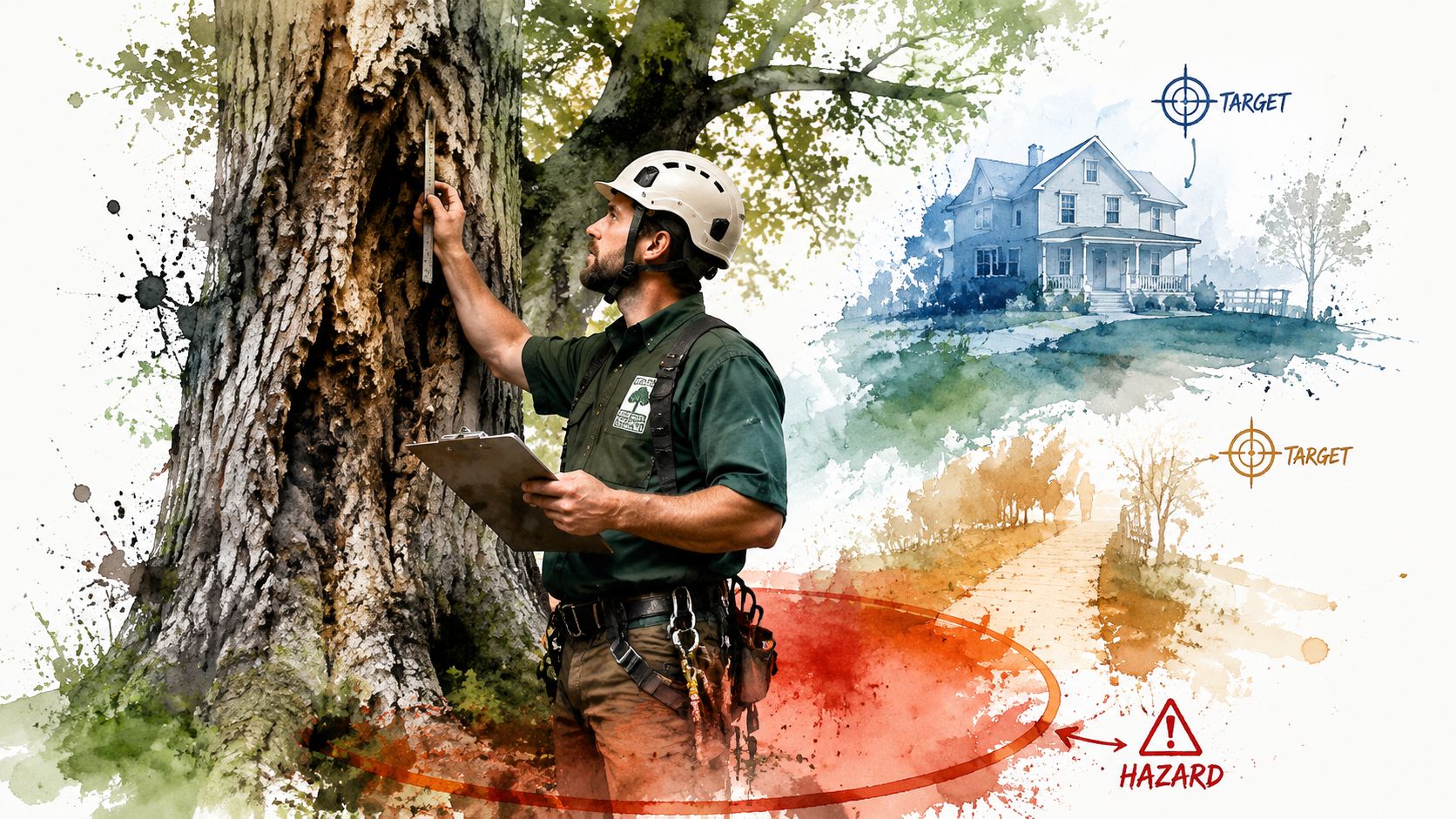
One of the most valuable arborist services is separating routine maintenance from high-risk conditions. For urban trees where liability, storm failure, and local rules matter, arborists provide evaluations and written reports to support decisions about mitigation or removal, as explained in Casey Trees' discussion of what a certified arborist does.
How arborists think about risk
The tree itself is only part of the equation. Arborists look at the defect, then consider the target.
A hollow limb over an unused corner of a yard is a different situation than that same limb over a bedroom, sidewalk, parked car, or play area. The questions are practical:
- What could fail
- What would it hit
- Can the risk be reduced without removing the tree
- Would pruning, cabling, bracing, or restricted access solve the problem
That framework helps take emotion out of the decision.
Removal is sometimes the right answer
Some trees have advanced structural failure, significant decline, root instability, or defects that can't be managed reasonably. In those cases, removal isn't a failure of arboriculture. It's the final step after preservation options no longer make sense.
In San Jose and surrounding cities, there is also the local regulation side. Certain trees may involve permit review or documentation before removal. That's another place where arborist-level work matters. Written assessments and permit guidance help a homeowner move forward correctly instead of creating a second problem with the city.
For readers sorting through that side of the process, this local page on working with a tree removal contractor is useful because it connects field conditions, safety planning, and decision support in one place.
Questions to Ask Before You Hire an Arborist
A lot of bad tree work starts with one assumption: if someone owns climbing gear and a saw, they must know trees. That's not a safe assumption.
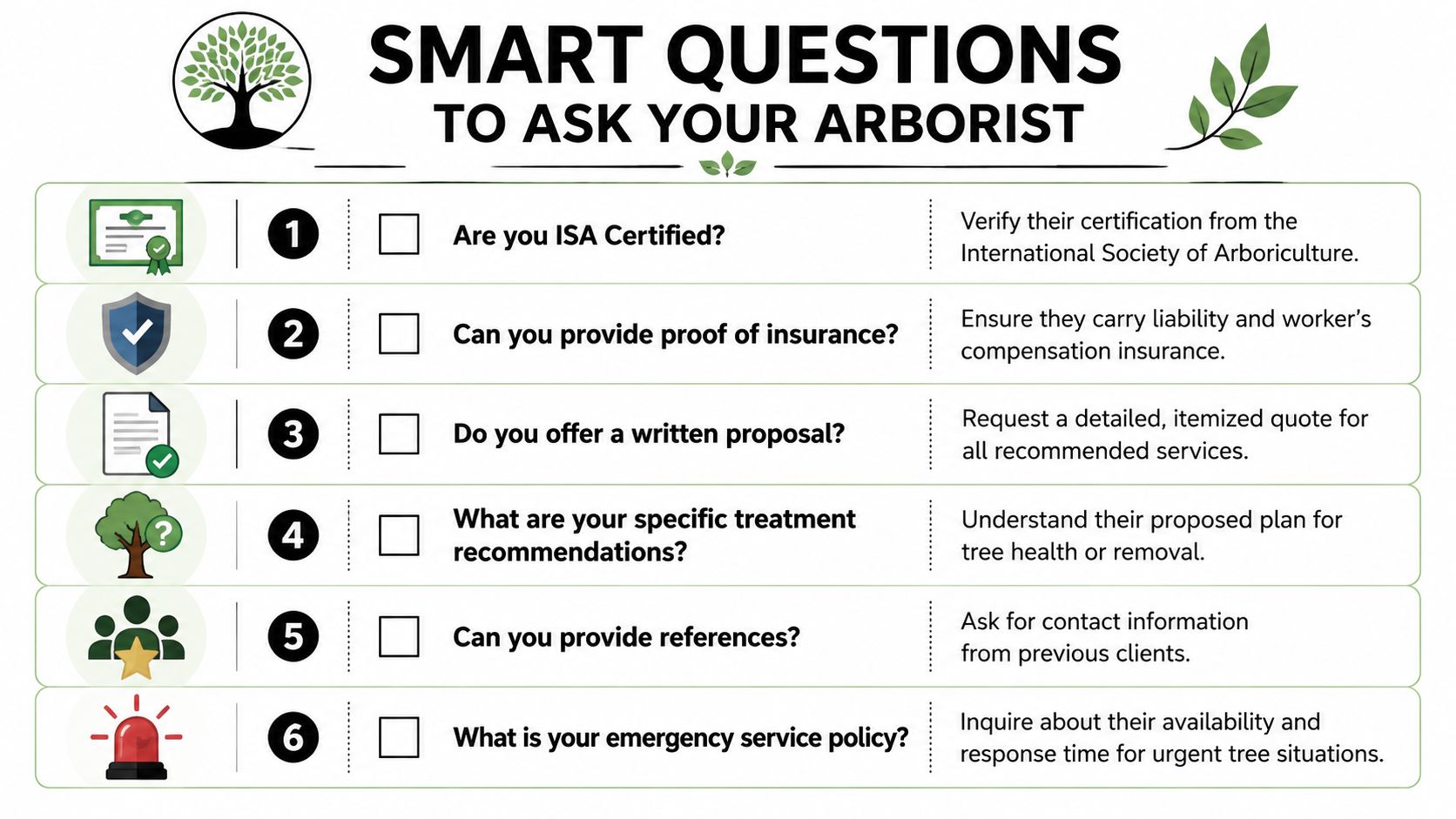
ISA Certified Arborists must pass a rigorous exam and maintain certification through continuing education, which separates trained professionals from general groundskeepers and helps keep them current on best practices for pruning, planting, appraisals, and emergency tree care, according to this explanation of ISA Certified Arborist standards.
Questions that tell you a lot fast
Ask direct questions and pay attention to whether the answers are specific.
- Are you ISA Certified? Ask for the certification number if arborist-level evaluation is part of the service.
- Can you provide proof of insurance? Tree work involves risk to workers, structures, vehicles, and neighboring property.
- Will I get a written proposal? Verbal descriptions lead to misunderstandings. A written scope forces clarity.
- What pruning type are you recommending, and why? "We'll clean it up" is not a technical answer.
- Will you provide a written assessment or permit guidance if needed? That matters when removal or regulated trees are involved.
- How do you handle urgent work after limb failure or storm damage? Emergency response should still follow a decision process, not panic cutting.
A few answers should make you cautious
If the contractor says every tree needs the same kind of trimming, that's a warning sign.
If they can't explain whether the issue is structural, biological, or site-related, they may be selling cutting rather than diagnosis.
If they recommend removal before discussing mitigation, that deserves a second opinion.
Ask the arborist to explain the goal of the work in plain language. If the explanation isn't clear, the work plan probably isn't either.
This local checklist on what to look for before hiring a tree service in San Jose is a practical follow-up if you're comparing bids or trying to sort out who is evaluating and who is only cutting.
Your Partner in Protecting Your Property's Green Assets
A mature tree is not yard clutter. It's a living part of the property with shade value, screening value, habitat value, and real safety implications if it declines or fails. That's why the most useful arborist work often happens before anything dramatic is needed.
A certified arborist's value is not just in pruning, removal, or emergency response. It's in judgment. Knowing when to reduce a limb, when to leave it alone, when to support a weak union, when to address soil and irrigation, and when removal is the responsible decision. That kind of work protects both the tree and the property around it.
For South Bay homeowners, that diagnostic-first approach makes even more sense because drought stress, mature canopies, tight urban sites, and city rules all affect the right answer. Quick cutting can make a tree look handled. Proper arboriculture solves the actual problem.
If you like reading how specialty local service businesses explain visibility and reputation online, the Reviews To The Top landscaping SEO advice offers an interesting outside perspective on how homeowners tend to evaluate outdoor service and tree companies before they hire them.
If you want a local team that handles tree diagnostics, pruning, risk assessment, removal, and tree preservation work for outdoor properties in San Jose and the surrounding South Bay, San Jose Tree Service & Landscaping is one established option to review. Their site covers the practical side of arborist consultations, plant health care, permit-related decisions, and other services homeowners often need when a tree problem is more complex than simple trimming.
