
Direct Answer: If a tree looks dangerous after a storm, keep everyone away from it and call a licensed tree service for an assessment before touching anything. Don’t wait.
You wake up after a winter storm and look out the window. A big limb is cracked and hanging. Or the tree in your front yard is leaning at an angle it wasn’t at yesterday. Your stomach drops — and you’re not sure what to do next.
This happens across San Jose every winter, especially in established neighborhoods like Willow Glen and Almaden Valley where mature trees are common. A single overnight storm can turn a healthy-looking tree into a genuine hazard in hours.
This guide walks you through exactly what to do — and what not to do — when a tree looks dangerous after a storm. We’ll cover what warning signs actually matter, what the assessment process looks like, and what you can reasonably expect to pay for emergency tree services in San Jose.
Your First 30 Minutes After a Storm: What to Do Right Now
Before you do anything else, stay away from the tree. A cracked limb under tension can drop without warning. The wood fibers are still loaded with stress, and movement — even wind — can release that energy instantly.
Here’s what to do in the immediate aftermath:
- Keep kids and pets inside until you’ve assessed the situation from a safe distance
- Don’t try to move hanging branches yourself — this is how homeowners get hurt
- Check for downed power lines anywhere near the tree; if you see lines down, call PG&E at 1-800-743-5000 before calling anyone else
- Take photos from a safe distance — document the damage for your insurance company
- Note whether the tree is touching your house, fence, or a neighbor’s property — this affects how the situation is handled
If the tree has made contact with your home or a power line, that’s an immediate emergency. Call 911 first, then a tree service. For everything else — a leaning tree, a split limb, visible root lift — you have a short window to get a professional assessment before conditions worsen.
San Jose typically sees its most serious storm damage between November and March, when soils are saturated and wind events are most common. A tree standing in wet soil has far less root anchorage than usual, which is part of why storms cause so much damage so fast.
Warning Signs That Mean a Tree Is Actually Dangerous
Not every tree that looks rough after a storm is a true emergency. But some signs should be treated seriously and assessed by a professional the same day.
High-priority warning signs:
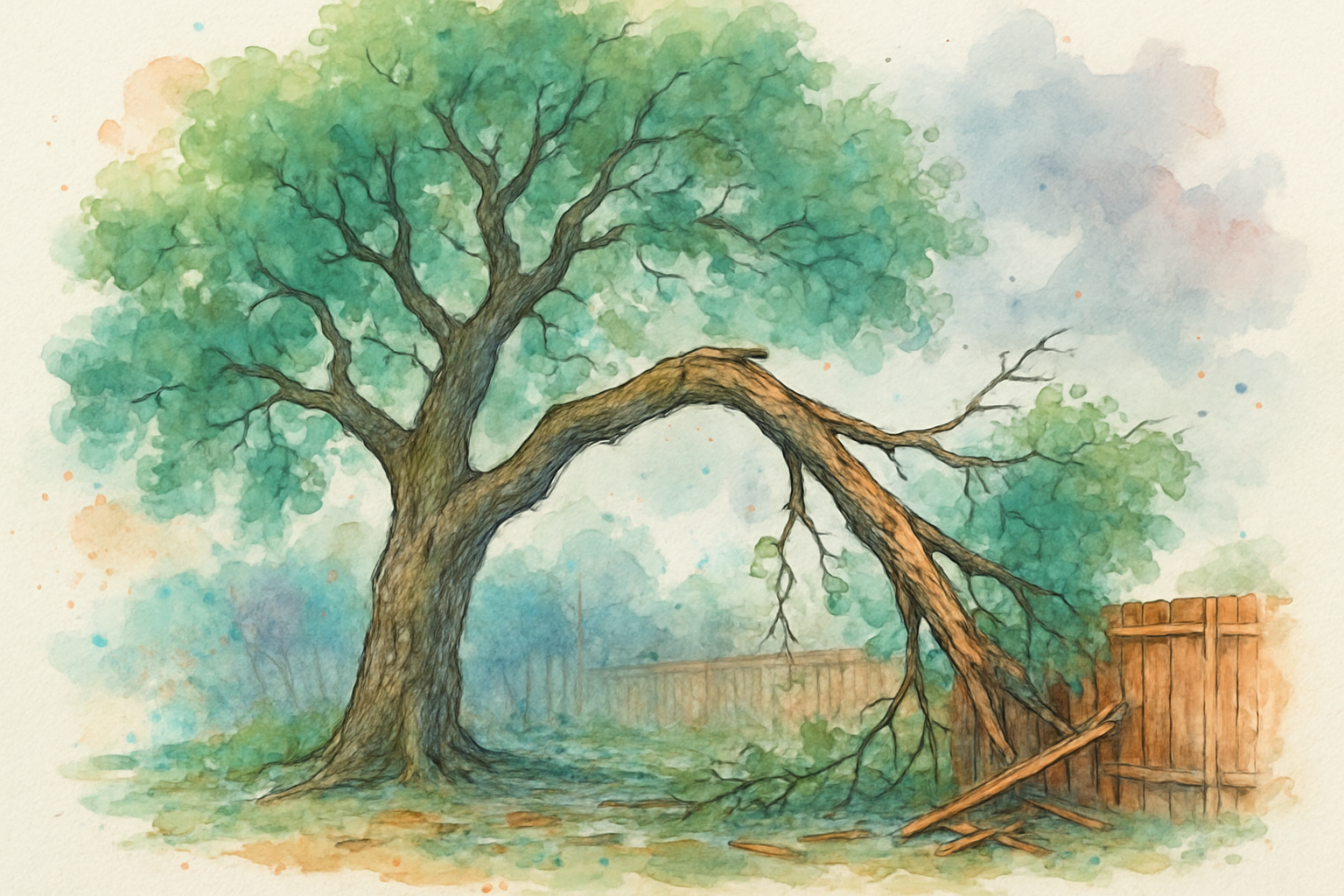
- Hanging limbs — any large branch that is split but still attached is called a “widow maker” in the arborist trade; it can fall at any time
- Visible root lift — if the soil around the base is cracked or raised, the root system may have partially failed
- A new lean — a tree that has shifted its angle overnight is a red flag, especially in saturated soil
- Split at a major fork — when a tree splits between two large co-dominant stems, the structural integrity of the entire tree is compromised
- Bark stripped from the trunk — exposed wood is vulnerable to infection and may signal deeper structural damage
Lower-priority but still worth monitoring:
- Small branch drop in the canopy
- Leaf loss after a windstorm
- Superficial bark scrapes from debris
A certified arborist can tell the difference between a tree that needs urgent attention and one that just looks bad. Don’t make that call yourself — the visual signs can be misleading in both directions.
 Emergency Tree Services: What to Do When a Tree Looks Dangerous After a Storm” class=”aligncenter size-full” />
What a Professional Emergency Tree Assessment Actually Covers
When an arborist arrives for a storm damage assessment, they’re not just looking at the obvious break. They’re evaluating the whole picture.
A thorough post-storm assessment includes:
- Crown inspection — how much of the canopy is damaged, and whether the tree can survive the loss
- Trunk and bark evaluation — checking for cracks, splits, or cavities that weren’t visible before
- Root zone inspection — signs of soil disturbance, root exposure, or soil heaving at the base
- Lean measurement — determining whether the tree’s center of gravity has shifted
- Target assessment — identifying what’s in the fall zone (your house, a fence, a neighbor’s yard, a public sidewalk)
In San Jose, if a tree is in the public right-of-way or falls under a heritage tree designation, the City may require a permit before any work is done — even emergency work. A licensed arborist familiar with local regulations can help you navigate that quickly so work isn’t delayed unnecessarily.
The goal of a proper assessment is always the same: understand what’s actually wrong before deciding what to do about it. Removal is sometimes the right answer, but it’s not always the first answer. Many storm-damaged trees can be saved with structural pruning, cabling and bracing, or targeted crown reduction.
Post-Storm Tree Danger: A Step-by-Step Response Guide
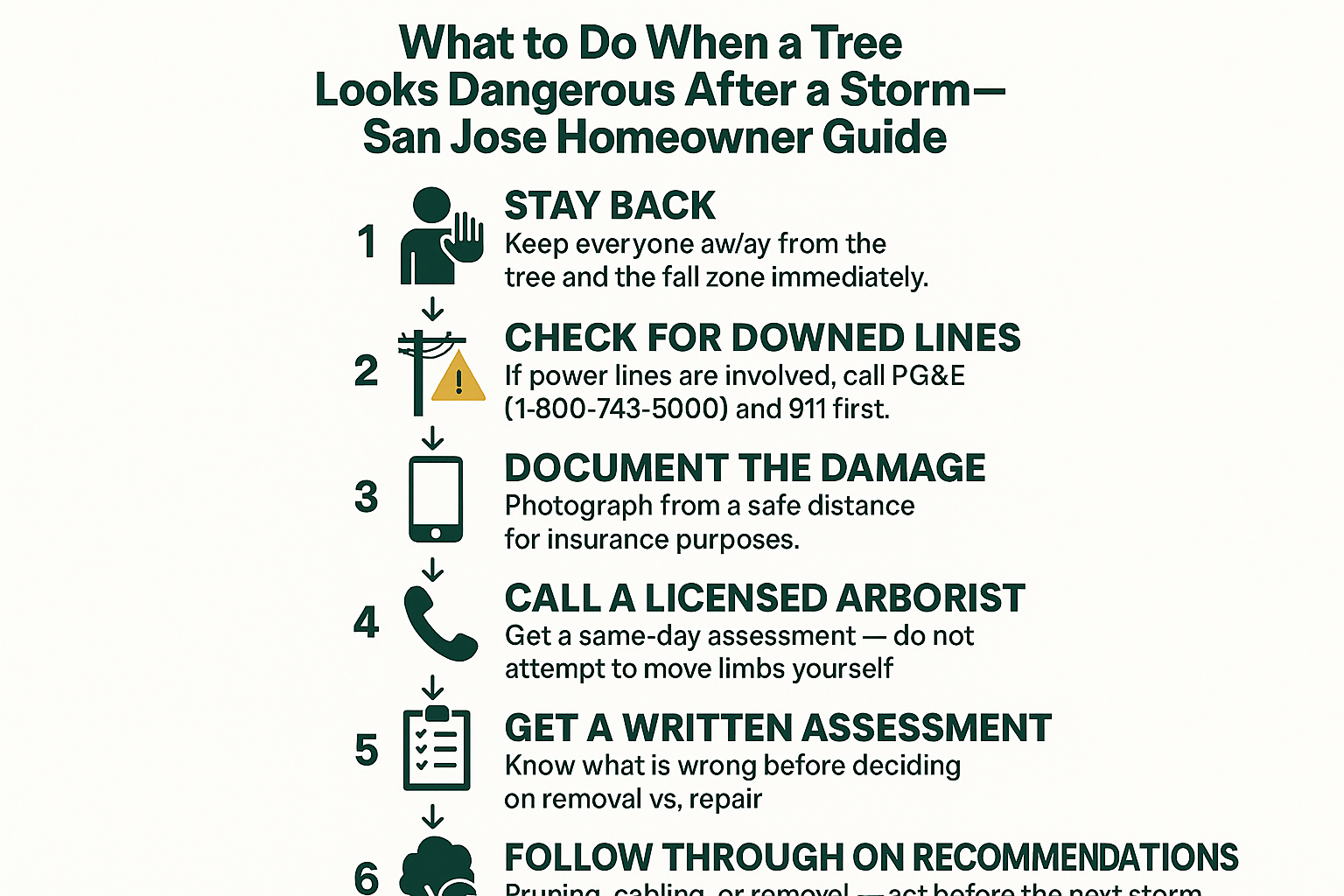
This infographic walks through the correct sequence of steps when you discover a potentially dangerous tree after a storm — from the first moments to final resolution.
 Emergency Tree Services: What to Do When a Tree Looks Dangerous After a Storm” class=”aligncenter size-full” />
When Is It a True Emergency vs. When Can It Wait?
This is the question most homeowners struggle with. Here’s a practical way to think about it.
Call for same-day emergency service if:
- The tree or a limb is touching your roof, siding, or a power line
- You can see active root lift or a fresh lean that wasn’t there before the storm
- A large hanging limb is positioned over a walkway, driveway, or occupied structure
- The tree has split at a major union and both halves are still standing
Can typically wait 24–48 hours (but don’t put it off):
- Smaller branch drop in the canopy with no target below
- Bark damage on lower trunk with no structural concern
- Tree looks rough but has no obvious structural failure
In Los Gatos and Saratoga, where homes often sit closer to hillside trees and fire-adapted species like blue oak and gray pine, a leaning tree after winter rain deserves faster attention than it might in a flat residential lot. Slope adds significant fall risk.
When in doubt, a quick phone call to a licensed arborist takes two minutes and can answer the question. Most reputable tree services can tell you over the phone whether your situation sounds urgent based on what you describe.
San Jose Emergency Tree Service: What to Expect in Terms of Cost
Costs for emergency tree work in San Jose vary based on size, urgency, and complexity. This table gives you a realistic starting-point range — not a quote, but a fair benchmark.
| Service Type | Typical Cost Range | Key Variables |
|---|---|---|
| Emergency hazard assessment | $150 – $350 | Some companies apply this toward work performed |
| Hanging limb removal (single limb) | $300 – $800 | Limb size, height, access, and proximity to structure |
| Full tree removal (emergency) | $900 – $3,500+ | Tree size, location, debris volume, permit requirements |
| Crown reduction after storm damage | $400 – $1,200 | Tree species, canopy size, amount of work required |
| Cabling and bracing (split union) | $500 – $1,500 | Number of cables, tree height, hardware type |
| Stump grinding (post-removal) | $150 – $500 | Stump diameter, root spread, access to the site |
Does Homeowner’s Insurance Cover Storm Tree Damage?
Sometimes — and it’s worth understanding the distinction before you file a claim.
Most standard homeowner’s insurance policies in California cover tree removal if the tree has fallen on a covered structure (your house, an attached garage, a fence). If the tree fell in the yard and missed everything, removal is often not covered.
Here’s what typically affects your claim:
- Where the tree landed — contact with a structure is usually required for coverage
- The cause of the fall — storm damage is generally covered; disease or neglect may not be
- Whether the tree was previously reported as a hazard — if you ignored warnings and it fell, that can complicate coverage
- Your deductible — for smaller removals, the out-of-pocket cost may fall below your deductible anyway
That documentation we mentioned earlier — photos taken right after the storm — matters here. Insurance adjusters look for evidence that the damage was storm-related, not pre-existing.
If you’re unsure about the condition of your trees heading into storm season, a tree risk assessment before a storm hits is always smarter than dealing with the aftermath. Proactive care is almost always cheaper than emergency response.
What Happens After the Danger Is Gone: Restoring Your Tree and Your Yard
Once the immediate hazard is resolved, there’s usually cleanup and recovery work to think about.
For the tree itself, a damaged tree that survived a storm may still need structural pruning to remove torn wood, deadwood, or weakened secondary limbs. Exposed wood is a direct entry point for fungal infection — a real concern in San Jose’s wet winter months. Learning to recognize early signs of tree fungus can help you catch problems before they compound.
For the yard, storm cleanup often leaves behind more than just the obvious debris. Root disturbance can affect nearby plants and irrigation lines. If a tree was removed, you’ll eventually need to deal with the stump — and a stump removal guide for San Jose homeowners can help you understand your options.
In some cases, a removed tree opens up an opportunity to rethink part of your landscape entirely — whether that means adding a drought-tolerant planting, updating an irrigation zone, or working toward a yard that handles storm runoff better. If you’re in that situation, the Almaden Valley front yard renovation project is a good example of how tree loss can become a starting point for something better.
How to Choose the Right Tree Service for an Emergency Call
Not every company advertising “emergency tree service” in San Jose is equipped to do the job safely. Here’s what to verify before you hire anyone.
Always confirm:
- Active CSLB license — California requires a C-61/D-49 license classification for tree work; you can verify any contractor at cslb.ca.gov
- Proof of liability insurance and workers’ compensation — non-negotiable for any tree work near a structure
- ISA-certified arborist on staff — especially important for assessments and anything involving tree health decisions
- Written scope of work — get it in writing before any cuts are made
Red flags to watch for:
- A crew shows up uninvited right after a storm offering discounted removal (storm chasers)
- No CSLB number or an expired license
- Pressure to commit immediately without a written assessment
- Quote given without anyone physically looking at the tree
For a broader understanding of what separates a genuinely knowledgeable arborist from someone just calling themselves one, this article on what a local arborist should actually know breaks it down well.
Frequently Asked Questions About Emergency Tree Services in San Jose
How fast can an emergency tree service respond in San Jose?
Most reputable companies in the San Jose area can respond within 2–4 hours for true emergencies involving structural contact or active hazards. For non-contact situations, same-day or next-morning response is typical. Always call directly rather than submitting a web form during an emergency.
Can I remove a storm-damaged tree myself?
Small branches under 2 inches in diameter that are fully on the ground are generally manageable for a homeowner. Anything hanging, partially attached, near a structure, or involving the main trunk should be handled by a licensed professional. The risk of injury from tension in damaged wood is not worth it.
My tree is leaning toward the house — is it definitely going to fall?
Not necessarily. A lean doesn’t always mean imminent failure, but it does mean a qualified arborist needs to look at it quickly. Root lift, soil saturation, and the degree of lean all factor into the actual risk. Get an assessment before drawing any conclusions.
Does San Jose require a permit for emergency tree removal?
It depends. Trees in the public right-of-way, heritage-designated trees, or trees covered by a specific development or grading permit may require city approval even for emergency removal. A licensed arborist familiar with San Jose’s urban forestry regulations can determine this quickly and help expedite the permit if needed.
What if the storm-damaged tree is on my neighbor’s property but hanging over mine?
California law generally allows you to trim branches that cross your property line, but only up to the property line — and only if the trimming doesn’t damage the tree. If the situation is hazardous, both property owners should be notified and a professional assessment is the right first step. Do not attempt to remove the tree yourself — liability questions are real and depend on who owns the tree and the specifics of the situation.
Ready to Get a Clear Answer About Your Tree?
If a tree on your San Jose property looks dangerous after a storm, the most useful thing you can do right now is talk to someone who can actually assess it. San Jose Tree Service & Landscaping holds an active CSLB license with C-61/D-49 tree service certification, is BBB-accredited, and carries a 4.96-star average across 70 Google reviews — built on consistent, honest work, not marketing. Call (408) 422-1313 or visit sanjosetreemaintenance.com to schedule an assessment.
