 Skip to content

Direct Answer: True San Jose landscaping experts hold proper licenses, understand local soil and climate, and plan for your property’s long-term health — not just what looks good at install.
If you’ve ever gotten three landscaping bids in San Jose and walked away more confused than when you started, you’re not alone. Prices swing wildly, every contractor sounds confident, and it’s nearly impossible to tell who actually knows what they’re doing until the project is finished — and sometimes not even then.
The South Bay has no shortage of landscaping crews. But there’s a real difference between someone who can install sod and someone who understands how a Willow Glen lot drains after a winter storm, or why a drought-tolerant design in Almaden Valley requires different plant selection than one in Los Gatos. That local knowledge is what separates a landscaping expert from a landscaping vendor.
This article breaks down what actually distinguishes a qualified landscaping professional from the rest — the licenses, the planning process, the questions worth asking — so you can make a confident decision about your property.
Why Licensing Matters More Than You Think
In California, anyone doing landscaping work valued over $500 in labor and materials is legally required to hold a contractor’s license issued by the CSLB (Contractors State License Board). The relevant classification is a C-27 Landscaping license. But many homeowners never ask to see it — and many contractors are working without one.
Unlicensed work creates real problems. If something goes wrong — a retaining wall fails, an irrigation line floods a neighbor’s yard, a tree damages a structure — you may have no legal recourse and could be held liable for the damage yourself.
A licensed C-27 contractor has passed trade exams, carries required insurance, and is accountable to the state. That accountability matters on jobs that touch your property’s structure, drainage, and long-term value. Here’s what a legitimate contractor should be able to show you before work starts:
- CSLB license number (verify it at cslb.ca.gov — it takes 30 seconds)
- General liability insurance covering property damage
- Workers’ compensation if they have employees on site
- BBB accreditation or equivalent as a secondary trust signal
Some contractors in the South Bay hold both a C-27 Landscaping and a C-61/D-49 Tree Service classification. That dual credential is relatively rare and means the same company can legally handle your trees and your landscape design under one licensed contractor — which matters when a project involves working around mature trees or tree roots. You can learn more about what a certified arborist actually does for your trees and why that credential carries real weight on landscape projects.
The Planning Process Is Where You’ll See the Difference
A landscaping expert doesn’t just install what you ask for. They start by understanding your property — how it drains, what the soil is like, which areas get full afternoon sun, and what’s already growing there. In San Jose and surrounding communities like Saratoga and Campbell, that site-specific knowledge directly affects how long a design holds up.
Silicon Valley’s climate is deceptively demanding. Hot, dry summers stress shallow-rooted plantings. The occasional heavy winter rain — like the storms that hit the South Bay hard in early 2023 — can saturate clay soils quickly, especially on lots in Almaden Valley and Los Gatos where hillside drainage adds another variable. A contractor who skips a proper site assessment is guessing.
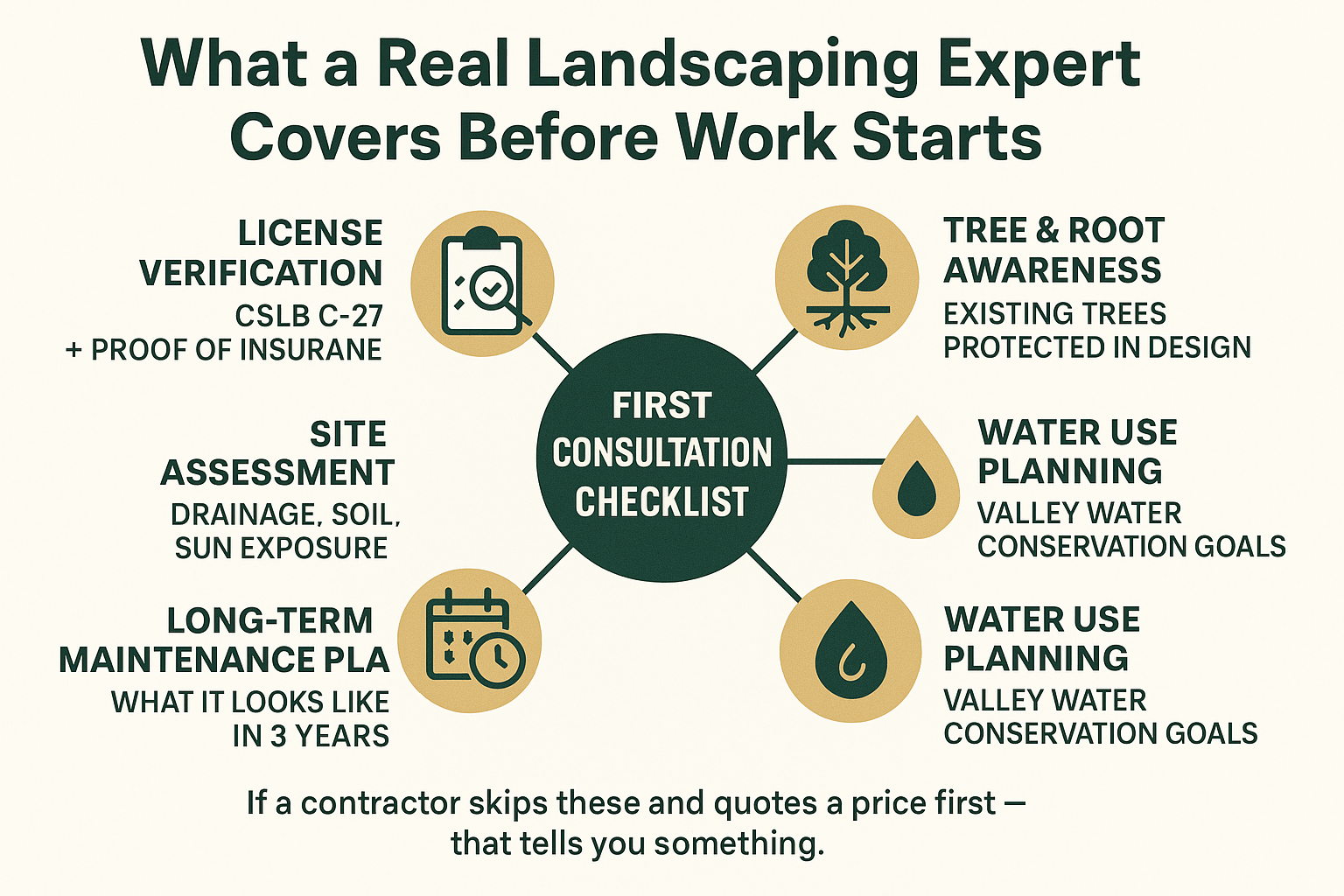
What a serious planning conversation should cover:
- Existing tree locations and root zones — new planting beds too close to mature trees will compete and lose
- Drainage patterns — where does water pool or run off during heavy rain?
- Soil composition — clay-heavy San Jose soils hold water differently than the sandier areas further south
- Sun and shade mapping — a plant list without this is just wishful thinking
- Water use goals — especially relevant now that EBMUD and Valley Water have ongoing conservation requirements
- Long-term maintenance expectations — what will this look like in three years without ongoing care?
If a contractor skips most of that conversation and goes straight to a price, that’s information. A good landscape plan takes time to develop, and the planning itself has real value. This Almaden Valley project shows what that kind of upfront planning looks like in practice — and why it matters for the long term.
For homeowners thinking about how landscape investments affect property value, this San Jose guide on landscaping and home value is worth reading before you finalize scope.
What a Qualified Landscaping Contractor Should Bring to Your First Conversation
This breakdown shows the key areas a serious landscaping professional addresses before any work begins — and what their absence signals.
Landscaping Contractor Red Flags vs. What to Look For
Use this as a quick reference when comparing contractors in San Jose, Los Gatos, Campbell, or anywhere in the South Bay.
| What You See | Red Flag | Green Flag |
|---|---|---|
| Licensing | Can’t provide a CSLB number or deflects the question | Shares license number and invites you to verify it |
| Site visit | Quotes a price without walking the property | Spends time assessing soil, drainage, and existing trees |
| Tree awareness | Ignores mature trees when planning beds or irrigation | Discusses root zones and tree health as part of the design |
| Plant selection | Proposes generic plants without asking about water use goals | Recommends drought-tolerant or native species suited to your conditions |
| Contract | Verbal agreement or single-line invoice | Written contract with scope, materials, timeline, and payment terms |
| Insurance | Vague or delays providing proof | Provides certificate of insurance before work starts |
Trees and Landscape Design Are Not Separate Problems
One of the most common mistakes homeowners make is treating tree work and landscape work as two completely separate projects. They’re not — at least not on a property with mature trees.
In established neighborhoods like Willow Glen or the older streets of Campbell, a significant percentage of lots have trees with root systems that extend well beyond the canopy drip line. Installing new irrigation, hardscape, or planting beds without accounting for those roots can cause serious long-term damage to the tree — and to whatever you just installed.
A landscaping contractor who also holds a tree service credential can evaluate both at once. They’ll know which areas are safe to dig, where to route irrigation to avoid root conflict, and whether a tree overhead will eventually shade out a sun-dependent planting bed. That integrated view saves you from expensive corrections later.
For homeowners who already have trees showing signs of stress — yellowing leaves, unusual growth patterns, or fungal issues — those conditions should be assessed before a landscape redesign begins, not after. This guide on diagnosing yellow leaves on San Jose trees is a useful starting point if something in your yard doesn’t look right.
And if you’re in a foothill community like Saratoga or Los Gatos where fire risk adds another layer to landscape planning, that consideration should be built into plant selection and placement from the start — not treated as an afterthought.
What a Fair Project Quote Actually Looks Like
Landscaping prices in the South Bay vary significantly based on scope, materials, and whether you’re doing design-only, installation-only, or both. A few benchmarks worth knowing:
- Basic drought-tolerant front yard refresh (plant removal, soil prep, native plants, mulch): $3,500–$8,000 for a typical San Jose lot
- Full backyard landscape installation (design, grading, planting, irrigation): $15,000–$40,000+ depending on hardscape and complexity
- Irrigation system installation or retrofit: $2,500–$6,000 for a mid-size residential lot
- Landscape design fee (standalone): $500–$2,500 depending on property size and design detail
Those ranges are wide because scope varies enormously. A quote that lands well below the low end of comparable work either means something is being skipped, or the contractor is underqualified and underinsured.
Get at least two written bids that itemize materials separately from labor. If one bid is dramatically lower, ask specifically what’s different — sometimes it’s legitimate (fewer plants, simpler irrigation), sometimes it’s a sign of a problem. A professional contractor won’t be offended by that question. This project in Los Gatos gives a real-world look at what a fully scoped outdoor living installation involves from planning to completion.
Frequently Asked Questions About Hiring a San Jose Landscaping Expert
Do I really need a licensed contractor for landscaping work, or is it okay to hire someone without a license for a smaller job?
In California, any job over $500 in combined labor and materials legally requires a licensed contractor. That threshold is lower than most people expect. For small planting work, some homeowners take the risk — but the moment a job involves grading, drainage, irrigation, or anything structural, an unlicensed contractor creates real liability exposure for you as the property owner.
How do I verify a contractor’s CSLB license before I hire them?
Go to cslb.ca.gov and search by license number or company name. It shows whether the license is active, what classifications it covers, whether insurance is on file, and any disciplinary history. Takes about 30 seconds and tells you a lot.
My backyard has two large oak trees. Can I still redesign the landscape around them?
Yes — but the tree root zones need to be part of the design conversation from the start. Oak roots in particular can extend well beyond the canopy, and disturbing them during grading or irrigation installation can cause serious long-term stress to the tree. A contractor who holds both a landscaping and tree service credential is better positioned to design around mature trees without damaging them. You can also read about what a professional tree assessment actually covers if you want a dedicated arborist evaluation before the landscape work begins.
What’s the difference between a landscape designer and a licensed landscape contractor?
A landscape designer creates the plan — plant selection, layout, design concept. A licensed C-27 landscape contractor is legally authorized to perform the physical installation work. Some contractors do both; others specialize in one. If you’re hiring for a full project that includes installation, the person doing the work needs the contractor license, not just design credentials.
How long should a good landscape installation last before needing major work?
A well-designed and properly installed landscape should hold up for 7–15 years before needing significant replanting or hardscape repair — assuming ongoing maintenance. Irrigation systems typically need component replacement around 5–8 years. Designs that skip proper soil prep or use plants poorly matched to the local climate will often show stress within 2–3 years, especially through San Jose’s dry summer season.
Should I get the landscape design and the installation done by the same company?
Usually yes. When the designer is also the installer, there’s no gap between what was planned and what actually gets built. When two separate firms are involved, details get lost in translation — plant substitutions, irrigation placement, grading changes. Unless you have a specific reason to separate them, keeping design and installation under one licensed contractor simplifies accountability significantly.
Ready to Talk Through Your Landscape Project?
San Jose Tree Service & Landscaping holds an active CSLB license with both C-27 Landscaping and C-61/D-49 Tree Service classifications — one of the few contractors in the South Bay licensed to handle trees and landscape design together under one roof. If you have questions about a project, a tree that needs to be factored into a design, or you just want to talk through what a realistic scope looks like for your property, reach out at (408) 422-1313 or visit sanjosetreemaintenance.com.
