
Direct Answer: A certified arborist is trained to diagnose tree health, assess structural risk, and make decisions about long-term tree care. A tree crew executes the physical work — cutting, hauling, and clearing.
You call a tree company and two guys show up with chainsaws. They look at your tree for three minutes, quote you a price, and start cutting. If that’s ever made you nervous — it should have. The person swinging a saw and the person who should be deciding what gets cut are not always the same person.
A certified arborist holds credentials from the International Society of Arboriculture (ISA), which requires passing a written exam, demonstrating years of field experience, and completing ongoing education to stay current. That’s different from someone who is skilled at operating equipment. Both have their place. But mixing them up is where homeowners — especially those with mature trees in established neighborhoods like Willow Glen or Almaden Valley — end up with irreversible mistakes.
This article breaks down exactly what a certified arborist brings to the table that a general tree crew doesn’t, what decisions genuinely require that credential, and how to tell the difference before any work begins on your property.
The Core Difference: Diagnosis vs. Execution
Think of it this way. A tree crew does the physical labor. They climb, cut, chip, haul, and clean up. They’re skilled tradespeople, and good ones are genuinely valuable. But their job is to execute a scope of work — not to determine what that scope should be.
A certified arborist is trained to figure out what the tree actually needs. That starts with reading the tree: its structure, its root zone, its bark, its canopy density, how it’s been pruned before, and whether what you’re seeing on the outside reflects something going wrong on the inside.
This matters most when the situation isn’t obvious. If a branch broke in a storm, any crew can remove it. But if a tree is declining slowly, leaning slightly more than it used to, or showing discoloration on the bark, those are diagnostic questions — and the answer determines whether you’re looking at a $400 pruning visit or a $2,500–$6,000 removal. Getting that call wrong in either direction costs real money.
For a deeper look at what a formal arborist evaluation actually covers, the article on what a professional tree assessment actually covers walks through the full process step by step.
What a Certified Arborist Actually Does in the Field
When a certified arborist shows up to your property, the first thing they do is not pick up a saw. They walk the tree — sometimes all the way around it, looking at the root flare, checking for fungal growth, examining old pruning cuts, and assessing the canopy structure from the ground.
Here’s what that evaluation typically includes:
- Structural risk assessment — identifying weak branch unions, codominant stems, or lean patterns that could become a hazard
- Root zone inspection — checking for heaving soil, girdling roots, or signs of root decay near the base
- Bark and cambium evaluation — looking for cracks, cankers, wounds, or pest activity
- Crown analysis — evaluating density, dead wood distribution, and whether past pruning created long-term structural problems
- Disease and pest diagnosis — recognizing symptoms like yellowing leaves or orange fungal growth that point to specific pathogens or infestations
- Permit guidance — in San Jose and surrounding cities, protected trees often require city approval before any work begins, and an arborist knows how to navigate that process
After the walkthrough, a certified arborist gives you a written or verbal recommendation with reasoning. Not just “trim it” or “take it down” — but why, what specifically, and what the likely outcome is either way.
That level of reasoning is what you’re paying for. And for mature trees on properties in Los Gatos or Saratoga — where a single heritage oak can represent decades of growth and significant property value — that reasoning matters enormously.
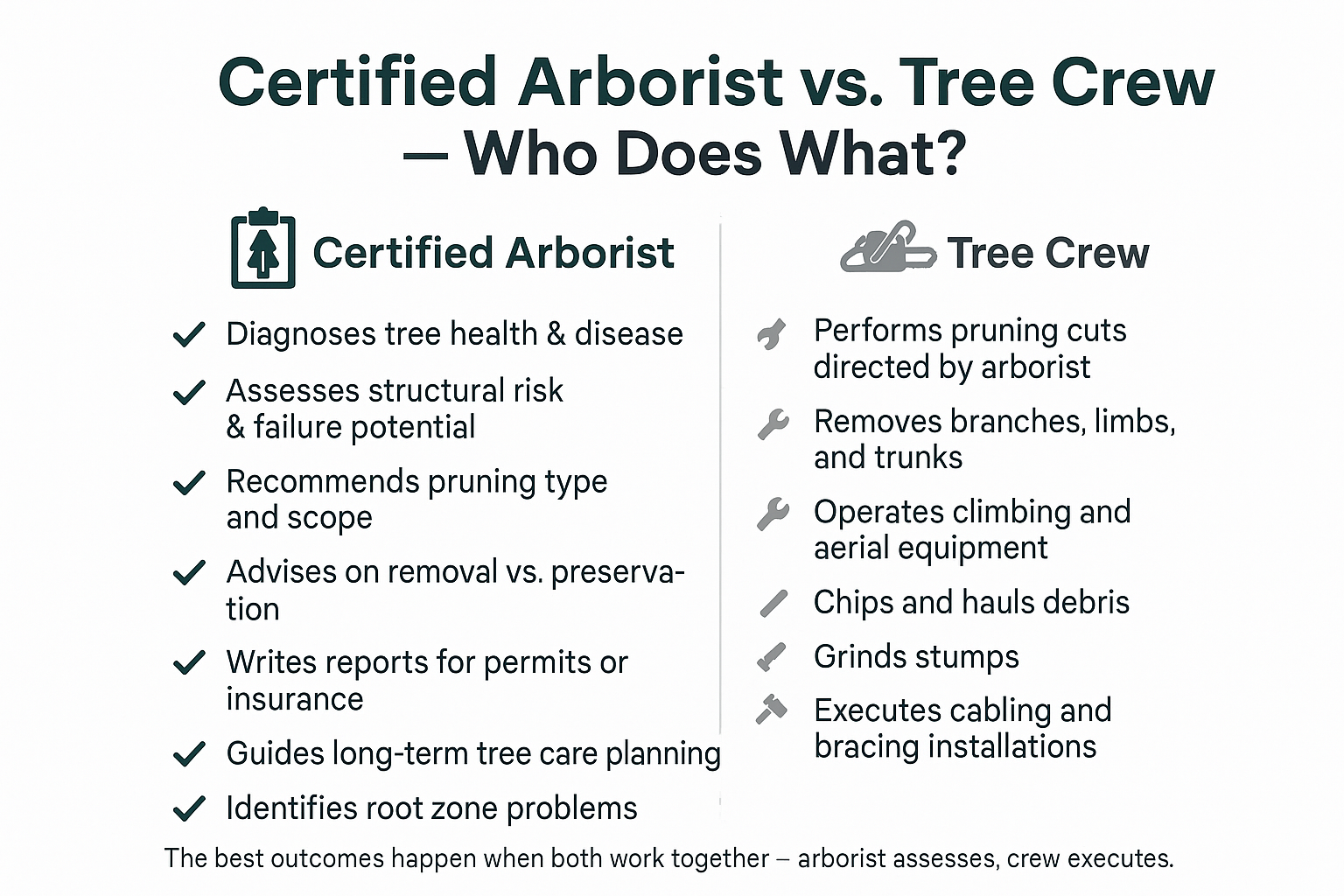
Certified Arborist vs. Tree Crew: A Side-by-Side Breakdown
This comparison shows the specific roles, responsibilities, and decisions that belong to each — so you know who you actually need before you make a call.
When You Actually Need a Certified Arborist vs. When You Don’t
Not every tree situation requires a credentialed arborist on-site. Knowing when you do — and when a skilled crew is enough — saves you money and gets the right person to your property.
You likely need a certified arborist when:
- A tree is showing signs of decline, disease, or unusual growth patterns and you don’t know why
- You’re considering removing a large or mature tree and want a second opinion before committing
- A tree is near your house, power lines, or a structure and you’re concerned about risk
- You need a written tree risk assessment for insurance documentation or a real estate transaction
- A city permit is required for work on a protected or heritage tree
- A tree was damaged in a storm and you’re not sure if it’s worth saving — see what to do after storm damage for more on that process
A qualified tree crew is usually sufficient when:
- The scope of work is already defined — a dead branch removal, a scheduled trim, or a previously approved removal
- You’re doing routine maintenance on a healthy, well-established tree
- A certified arborist has already assessed the tree and written a care plan that the crew is following
The most common mistake homeowners make is skipping the arborist step entirely and going straight to whoever can come out fastest. In established neighborhoods across San Jose’s west side — where 40- and 50-year-old trees are the norm — that shortcut often leads to over-pruning, misdiagnosed decline, or unnecessary removal of trees that could have been saved.
What Different Tree Services Typically Cost in San Jose (2025)
These are general ranges for the San Jose and South Bay market. Actual pricing depends on tree size, site access, and complexity of work.
| Service | Who Performs It | Typical Cost Range |
|---|---|---|
| Certified arborist consultation | ISA-certified arborist | $150 – $350 |
| Written tree risk assessment report | ISA-certified arborist | $250 – $600 |
| Structural pruning (mid-size tree) | Arborist-directed crew | $400 – $900 |
| Crown reduction (large tree) | Arborist-directed crew | $800 – $2,000 |
| Tree removal (30–50 ft tree) | Tree crew | $1,500 – $4,500 |
| Emergency storm response | Crew with arborist oversight | $500 – $3,000+ |
| Cabling and bracing installation | Arborist + crew | $600 – $1,500 |
| Disease diagnosis + care plan | ISA-certified arborist | $200 – $500 |
The ISA Credential: What It Means and How to Verify It
ISA stands for the International Society of Arboriculture. Their certified arborist credential — often written as ISA CA-XXXX on a business card or estimate — is the most recognized professional standard in tree care in North America.
To earn it, a candidate must have at least three years of full-time experience in arboriculture and pass a written exam covering tree biology, diagnosis, pruning standards, risk assessment, and safe work practices. After that, they must earn continuing education credits to keep the credential active.
Verifying it takes about 30 seconds. Go to treesaregood.org and use their credential lookup tool. Type in the arborist’s name or certification number and it will show you whether their credential is current.
For context on what to look for more broadly when evaluating any tree or landscape contractor, the article on what sets true San Jose landscaping experts apart covers the key questions worth asking before any work begins.
And if you want to go deeper on arborist expertise specific to the South Bay, what a local arborist should actually know is worth reading — it covers the local tree species, soil conditions, and fire-risk considerations that matter in communities like Los Gatos and Saratoga.
Frequently Asked Questions About Certified Arborists
Can a tree crew do the same work without an arborist on-site?
Yes, for defined, routine work — like removing a branch that already broke off, or completing a previously scoped trim. But when the scope of work isn’t already determined, sending a crew without arborist guidance means the person making decisions about your tree may have no formal training in tree health or structural risk. That’s a meaningful difference, especially for large or mature trees.
How much does a certified arborist consultation typically cost in San Jose?
Most consultations run $150 to $350 depending on how many trees are being evaluated and whether you need a written report. If a formal risk assessment document is required — for insurance, a permit, or a real estate transaction — expect $250 to $600 for the written version.
Does every tree company have a certified arborist on staff?
No, and this is worth asking directly before hiring anyone. Some companies have one certified arborist who signs off on jobs but isn’t present during the actual work. Others have multiple certified arborists who are hands-on throughout. Ask specifically: will a certified arborist be on-site during the assessment, or just for the initial consult?
My neighbor says my tree looks dangerous. Do I need an arborist, or can I just get a removal quote?
Get the arborist assessment first. Removal quotes are easy to get, and many companies will tell you a tree needs to come down because that’s the higher-ticket job. A certified arborist gives you an objective read on whether removal is actually necessary, or whether pruning, cabling, or other care can address the concern. A $200 assessment that saves you from an unnecessary $3,000 removal is money well spent.
Are there trees in San Jose that require a permit before pruning or removal?
Yes. The City of San Jose has a protected tree ordinance that covers trees above a certain diameter and species classification, including many oaks. Work on these trees without the proper permit can result in fines. A certified arborist will know which trees trigger the permit requirement and can help you through that process before any work starts.
What if I just want a tree trimmed — do I really need an arborist for that?
For a straightforward trim on a healthy, accessible tree with a clear scope of work, a skilled crew is usually fine. But if the tree is large, near your home, or hasn’t been pruned properly in years, having an arborist assess the pruning approach first protects both the tree and your property. Bad pruning cuts on a mature tree can create long-term structural problems that are expensive to correct later.
Have Questions About a Tree on Your Property?
San Jose Tree Service & Landscaping has certified arborists on staff who work alongside our crews — so the person making decisions about your trees is actually qualified to make them. If you have a tree you’re uncertain about, we’re happy to take a look and give you a straight answer. Reach us at (408) 422-1313 or visit sanjosetreemaintenance.com to learn more about our tree assessment and arborist services across San Jose, Los Gatos, Saratoga, and surrounding South Bay communities.
