
Direct Answer: Call a certified arborist when you see structural failure, disease, root damage, or a tree near a structure. A trimmer handles routine cutting — an arborist diagnoses what’s actually wrong.
Most homeowners call whoever trimmed their tree last time. And for a routine cleanup before summer, that’s often fine. But when something looks wrong — a branch that cracked overnight, leaves turning yellow in July, roots pushing up near the foundation — a trimmer with a chainsaw isn’t who you want making the call.
Around Willow Glen, Almaden Valley, and across the neighborhoods of San Jose, mature trees are part of what makes a property feel established. They also carry real weight: a 60-foot oak dropping a limb on a roof, or a declining redwood slowly girdling its own root system, is not a trimming problem. It’s a diagnostic one.
This article focuses on two things homeowners consistently get wrong: understanding when a situation crosses the line from routine to arborist-level, and knowing what an arborist actually does differently. Get that right, and you make better calls — before something gets worse or gets removed when it didn’t need to be.
What a Tree Trimmer Does — and Where That Ends
A tree trimmer is trained to cut. They can remove dead branches, bring a canopy back within bounds, clean up after a storm, and make a tree look better. For a young tree or a routine annual trim, that’s exactly what you need.
But trimming is mechanical work. It doesn’t require understanding why a branch died, whether a wound is healing correctly, or whether the tree’s decline is coming from the roots up. A trimmer reads the canopy. An arborist reads the whole tree — and the site around it.
The distinction matters most in these situations:
- A branch died back with no obvious cause — that’s a symptom, not the problem
- The canopy looks thin or off-color — could be water stress, root damage, fungal disease, or a dozen other things
- There’s a crack, cavity, or included bark in a main stem or union
- The tree leans more than it used to, especially after wet winter soil
- Mushrooms, conks, or orange weeping sap appear at the base or on the trunk — see how to identify orange tree fungus for context
- Roots are being cut, paved over, or compacted by a construction or landscaping project
In any of these cases, cutting first and asking questions later can accelerate decline — or create liability if the tree fails afterward.
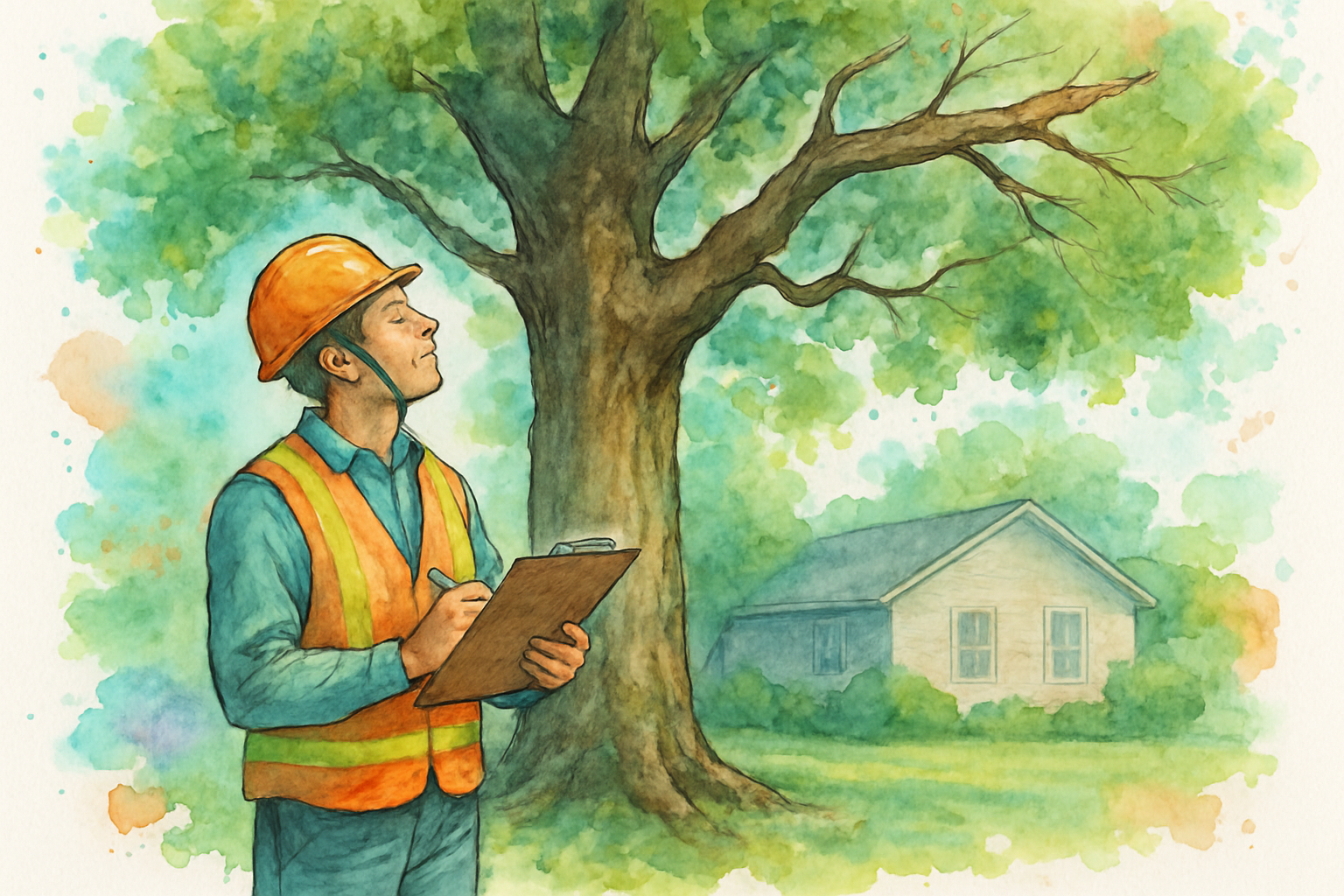
The Signs That Actually Require a Diagnostic Eye
There’s a specific set of conditions where getting a trimmer instead of an arborist isn’t just a missed opportunity — it’s a mistake that costs more to fix later.
Structural problems are the clearest example. A crack in a main stem, co-dominant trunks with included bark, or a tree that’s visibly tilting toward a house — these require a tree risk assessment, not a trim. In San Jose and surrounding areas, a professional risk assessment typically runs $150 to $350 depending on tree size and complexity. That’s a small investment compared to what a failed limb over a roof costs.
Disease and decline are the other category homeowners frequently underestimate. A tree that’s losing leaves out of season, showing dieback in the upper canopy, or weeping sap at the base may have a treatable condition — or it may be a species in terminal decline. Without a proper diagnosis, you can’t know. And a trimmer removing “the dead parts” without understanding why they died can actually remove the tree’s last defense mechanisms.
As described in our certified arborist assessment guide, a proper evaluation covers root zone condition, vascular health, canopy structure, and site factors — not just what you can see from the ground.
For homeowners in Los Gatos and Saratoga, where fire-risk overlaps with mature native oaks and bay laurels, the stakes go up further. Deadwood in those species near a structure isn’t just an aesthetic issue — it’s a defensible space concern that requires thoughtful removal, not aggressive cutting.
Trimmer vs. Arborist: Which Situation Calls for Which
Use this as a quick reference. The left column is the situation; the right two columns tell you who to call and roughly what it costs in the San Jose area.
| Situation | Who to Call | Typical Cost Range (San Jose Area) |
|---|---|---|
| Annual shape trim or canopy cleanup | Tree trimmer / crew | $200 – $600 |
| Dead branch removal (known cause, healthy tree) | Tree trimmer / crew | $150 – $400 |
| Unexplained dieback or off-color canopy | Certified arborist | $150 – $350 assessment |
| Crack, cavity, or split in main trunk or union | Certified arborist first | $150 – $350 + possible cabling |
| Mushrooms, conks, or fungal growth at base | Certified arborist | $150 – $350 assessment |
| Tree leaning more than usual after rain | Certified arborist | $150 – $350 risk assessment |
| Root damage from nearby construction | Certified arborist | $200 – $400 + preservation plan |
| Post-storm limb failure or split canopy | Arborist for assessment, crew for removal | $250 – $600+ depending on damage |
| Permit required for removal (San Jose city trees) | Certified arborist | Permit guidance included in assessment |
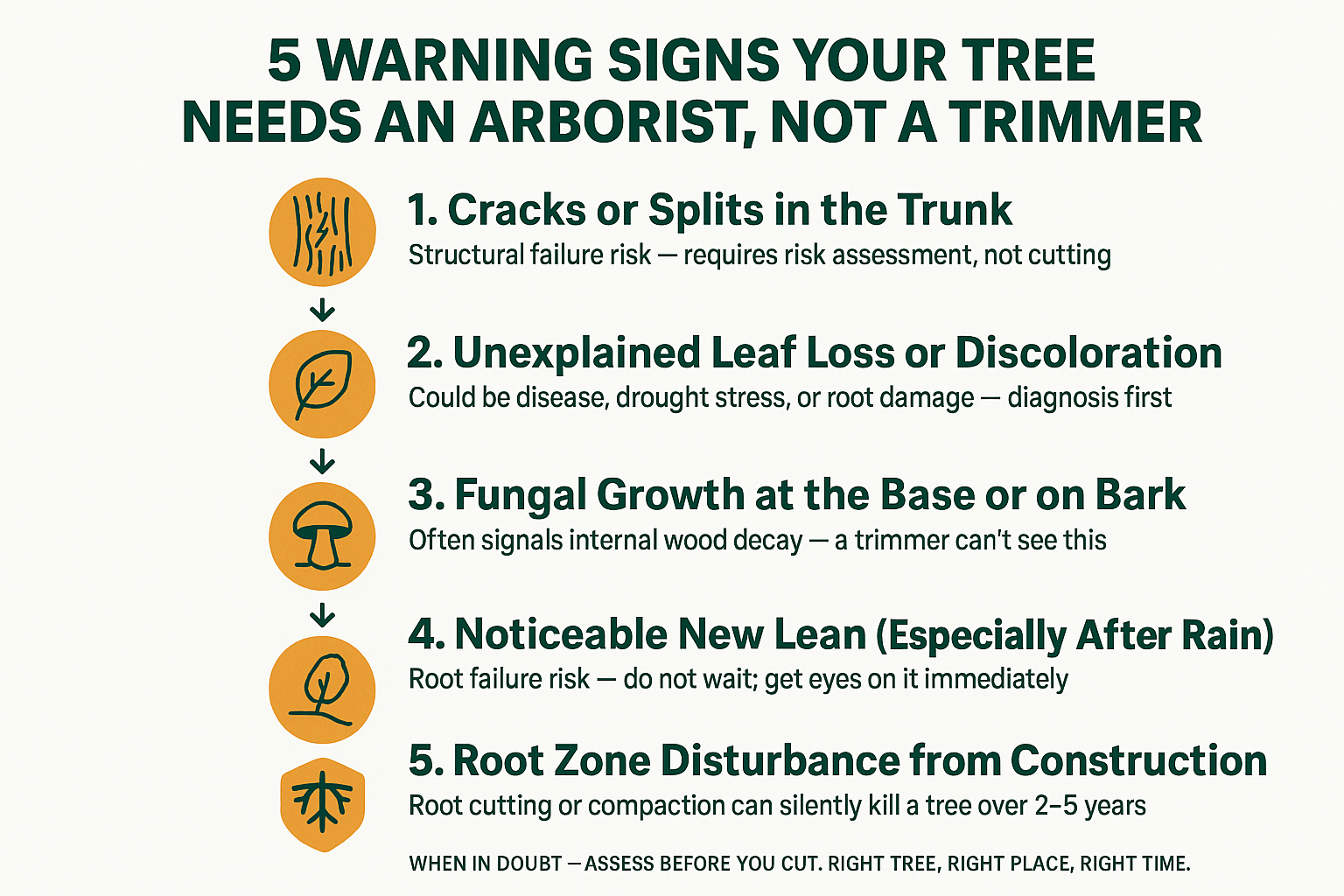
5 Warning Signs Your Tree Needs More Than a Trim
These five conditions are the ones homeowners most often try to trim their way out of — and can’t. Each one points to something deeper that cutting alone won’t fix.
The Root Zone Problem Most Homeowners Never See Coming
Of all the situations that call for an arborist instead of a trimmer, root zone damage may be the most invisible — and the most consequential.
In neighborhoods like Almaden Valley and Campbell, where landscaping projects and irrigation upgrades are common, roots get cut, graded over, or compacted without anyone thinking twice about it. A tree can look completely healthy for two to five years after significant root damage — and then decline fast.
A certified arborist can evaluate the root zone, assess whether a tree has enough structural root mass to stay standing safely, and design a preservation plan if work is still ongoing. For a property undergoing any kind of ground disturbance within 10 to 15 feet of a tree’s drip line, that evaluation is worth having before the project starts — not after the tree starts showing stress.
For context on what that kind of assessment actually covers in practice, this overview of certified arborist services walks through the full picture. And if a landscaping project is already planned, the root preservation planning should be part of that conversation from the start — not an afterthought.
Proper root pruning methods matter here too. Done incorrectly, root pruning near a mature tree can trigger the same kind of slow decline as accidental damage.
Frequently Asked Questions About Arborist vs. Trimmer
Can’t I just get a quote from a tree company and let them tell me what the tree needs?
You can, but be careful about who’s giving you the assessment. A crew that primarily does removals may default to recommending removal. A certified arborist’s job is to give you an honest evaluation of the tree’s condition — not to sell you a service. Look for someone with an ISA Certified Arborist credential and ask specifically whether they do paid assessments separate from any work quote.
How much does a certified arborist consultation cost in San Jose?
Most professional tree risk assessments in the San Jose area run $150 to $350 for a residential tree. More complex situations — large trees, multiple trees, or trees with potential permit implications — can run higher. Some companies roll the assessment cost into the project if you proceed with recommended work, but a reputable arborist will also give you an honest assessment even if the answer is ‘this tree is fine.’
My tree has mushrooms growing at the base. Is that always bad?
Not automatically, but it’s a signal that deserves attention. Some fungal growth is cosmetic. But certain types — particularly conks (shelf-like growths) on or near the root flare — indicate internal wood decay that can’t be seen from the surface. That’s exactly the kind of condition a trimmer isn’t equipped to evaluate. Get an arborist to look at it before assuming either way.
What’s the difference between a tree risk assessment and a standard arborist consultation?
A tree risk assessment is a structured evaluation of the likelihood a tree or part of a tree will fail, and the potential consequences if it does. It follows a formal methodology and results in a written risk rating. A general consultation is more open-ended — it might cover disease diagnosis, pruning recommendations, or permit questions. For a tree near a structure or over a frequently used area, a formal risk assessment is the more appropriate tool. This breakdown of what a professional assessment covers goes into more detail.
Does San Jose require a permit to remove a tree?
Yes — San Jose’s tree ordinance protects certain trees based on species, trunk diameter, and location. Removing a protected tree without a permit can result in fines and replacement requirements. A certified arborist familiar with San Jose municipal code can tell you whether your tree qualifies as protected and guide you through the permit process if removal is warranted. Cities like Los Gatos and Saratoga have their own ordinances as well, so the rules vary by jurisdiction.
After a storm, should I call an arborist or just a tree crew?
If a limb has already come down and the cleanup is straightforward, a crew can handle it. But if the storm left a tree with a major split, a hanging limb over a structure, or visible root heave, get an arborist involved before anyone climbs the tree. Working around a structurally compromised tree without a proper evaluation puts workers at risk. Our guide to post-storm tree decisions covers the full sequence of steps.
Not Sure Whether Your Tree Needs a Trimmer or an Arborist?
If you’re looking at a tree and something feels off — a crack you didn’t notice before, a branch that looks wrong, roots pushing up where they weren’t last year — that’s worth a conversation with someone who can actually evaluate it. San Jose Tree Service, Inc. serves homeowners across San Jose, Los Gatos, Saratoga, Campbell, and surrounding communities, and we’d rather help you understand your tree than have you guess at it. You can reach us at (408) 422-1313 or visit sanjosetreemaintenance.com to learn more about what a professional tree assessment covers.
