 Skip to content

Quick Answer
If you're asking how do you straighten a tree, start by finding out why it leaned in the first place. A small, young, or recently planted tree can often be corrected with careful staking, but a large, mature, or sharply leaning tree needs a professional assessment before anyone tries to pull it upright.
You walk outside after wind or rain and suddenly notice the tree that looked fine last week is leaning. That concern is justified. When people ask how do you straighten a tree, the right answer starts with diagnosis, not stakes.
Some leaning trees can be corrected. Others shouldn't be forced upright at all. If you enjoy unusual plant forms, even living sculptures for home and garden show how much structure and growth habit matter, and trees are no different. The cause of the lean decides the method.
First Assess Why Your Tree Is Leaning
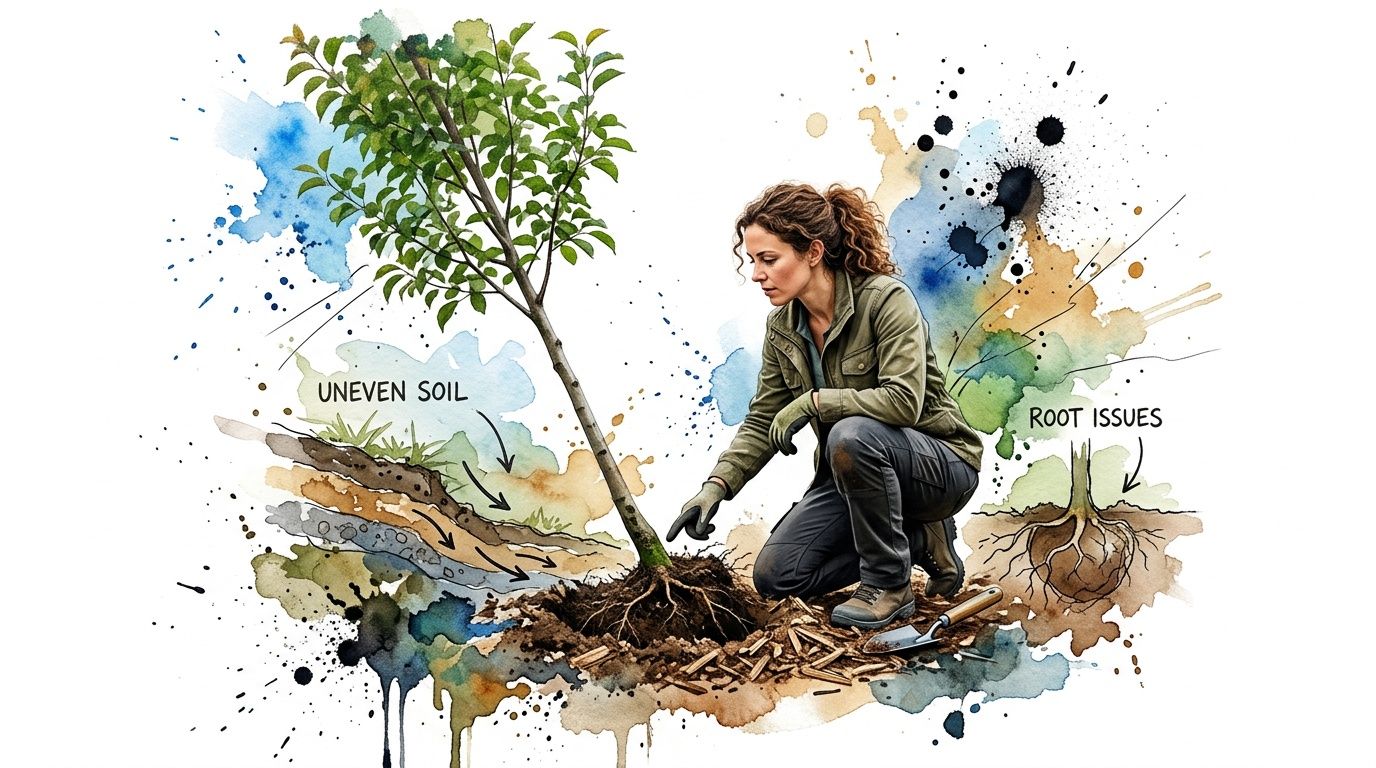
The first thing I’d tell any San Jose homeowner is simple. Don't grab rope and start pulling. A lean caused by loose soil, transplant shock, or a shifting root ball is approached very differently than a lean caused by long-term growth, canopy imbalance, or root loss.
Young and recently planted trees are the most common candidates for correction. The foundational step is to excavate around the root ball, check for looseness or exposed roots, re-level the tree, and compact soil in layers to remove air pockets. That matters because young or recently transplanted trees often lack stable anchorage, and this affects approximately 60–80% of newly installed trees in temperate climates during their first 2–3 years post-installation according to guidance on straightening a leaning tree.
Check the base before you check the trunk
Start low, not high. Look at the soil line around the trunk and the area just outside the root ball.
Watch for these signs:
- Heaving soil on one side: This often means the root plate shifted.
- Exposed roots or a lifted root flare: That suggests the tree moved in the ground, not just in the trunk.
- Wet, soft, or recently saturated soil: In parts of the South Bay with heavier clay, roots can lose hold after soaking rains.
- A trunk that curves but the base stays firm: That usually points to growth habit, light competition, or a long-standing lean.
If the root ball moves when you gently test the tree, you're dealing with a stability problem. If the ground stays solid and only the upper trunk leans, staking alone may not solve much.
Practical rule: If the soil has shifted, treat the root zone first. If the root zone is stable, look at structure and canopy weight.
Consider what changed recently
A tree rarely leans for no reason. Think about timing.
- After planting: Transplant shock and incomplete root establishment are common causes.
- After a storm or strong wind: Sudden lean may point to root movement or partial failure.
- After irrigation changes: Overwatered soil can lose firmness.
- After pruning elsewhere in the yard or new shade: Trees sometimes reach for light over time.
In San Jose neighborhoods such as Almaden Valley or Willow Glen, I also look at wind exposure and site conditions. Open yards, slope transitions, and compacted garden soil all change how a tree anchors.
If the bark near the base looks damaged, the root flare is buried, or you’re seeing fungal issues around the trunk, pause. Problems at the base can make straightening the wrong move. If you’re unsure what trunk or root-zone symptoms mean, this guide to orange tree fungus and trunk concerns is a useful example of why diagnosis comes first.
Choosing the Right Straightening Method
The method follows the cause. A tree that tipped in wet soil calls for a different response than a sapling that leaned after planting or a mature tree that has slowly grown toward light.
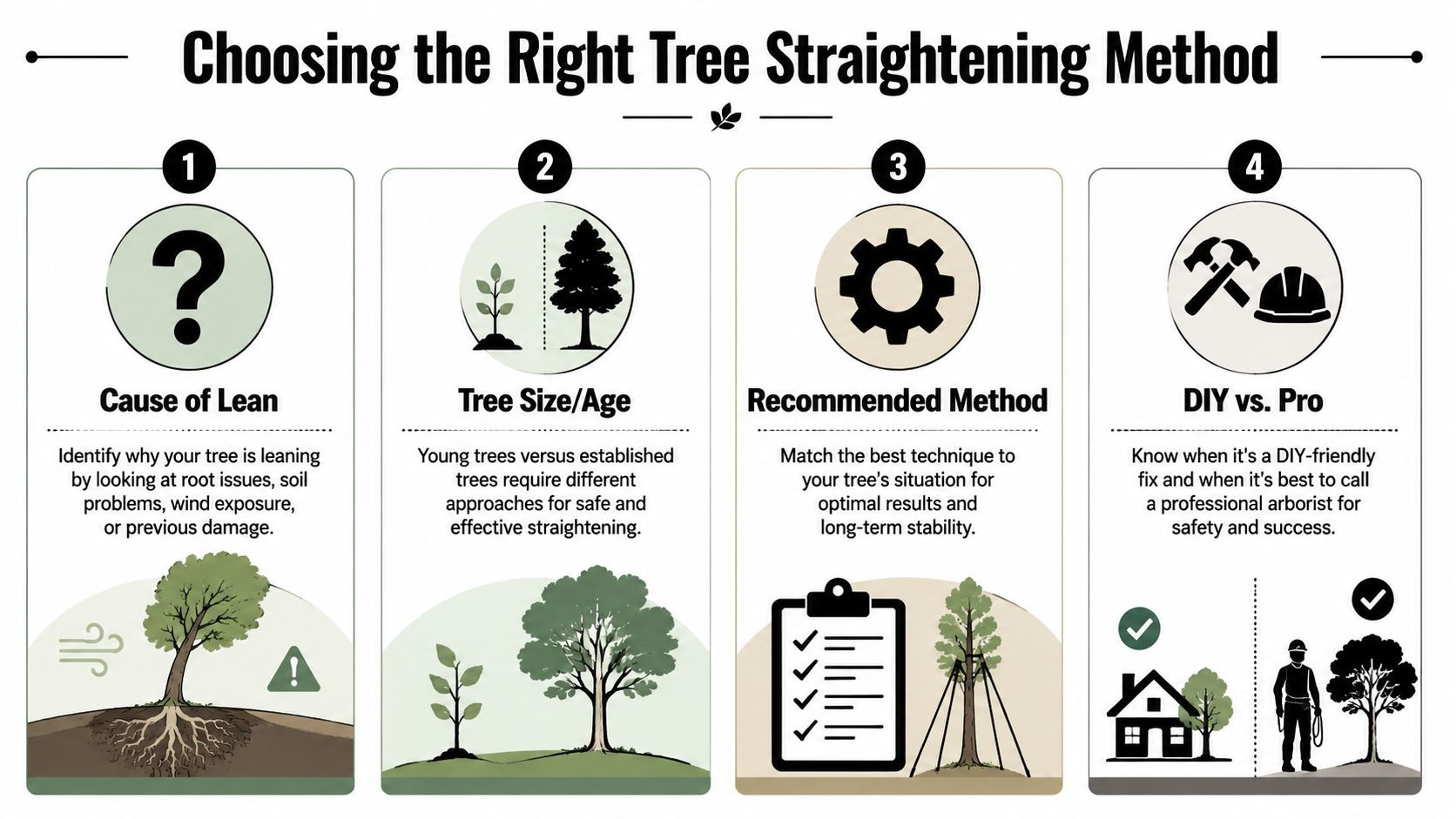
Homeowners often jump straight to stakes because they can see the trunk. The decision usually starts lower, at the root zone. If the roots shifted, staking alone may hold the tree upright for a while without fixing the reason it leaned.
When staking makes sense
Staking fits a narrow set of cases. It works best on young, flexible trees with a recent lean and roots that are still mostly in place.
Good candidates usually have these traits:
- The trunk can be guided gently: It bends without cracking or resisting hard.
- The lean happened recently: The tree has not spent years growing into that position.
- The root system is still recoverable: The root ball is not badly torn, heaved, or exposed.
Staking should limit movement, not eliminate it. If you have to pull hard to force the trunk upright, stop and reassess. That amount of correction can strip roots, split bark, or leave the tree dependent on support.
When root ball correction matters more than staking
Recently planted trees often lean because they were set too shallow, planted into loose backfill, or watered in a way that softened the surrounding soil. In those cases, the trunk is not the main problem.
The fix may involve straightening the root ball, firming and regrading soil, and resetting the tree at the proper level. That is careful root-zone work. Done well, it gives the tree a chance to anchor again. Done poorly, it can break new roots and set back establishment.
When the job belongs to a professional
Large trees change the risk completely. A mature tree with a strong lean may need excavation, controlled repositioning, guying, or a decision that straightening should not be attempted at all.
I tell San Jose homeowners to draw a hard line here. If the tree is large, close to a house, fence, driveway, sidewalk, or overhead utilities, professional assessment comes first. The same applies if the root plate has lifted, the soil is cracking, or the trunk has fresh damage. Those are hazard signs, not weekend project details.
If correction involves digging around major roots, installing anchors, or pulling a heavy trunk under tension, arborist oversight is required.
A quick comparison helps:
| Situation | Usually reasonable for homeowner | Usually needs arborist |
|---|---|---|
| Young tree leaning after planting | Yes, if root ball is only slightly shifted | If roots are exposed or tree is hard to move |
| Flexible sapling after wind | Yes, with proper staking materials | If trunk is damaged |
| Established tree with pronounced lean | No | Yes |
| Tree near driveway, home, fence, or sidewalk | Sometimes | Often yes |
| Large tree needing excavation or support hardware | No | Yes |
How to Straighten a Young Tree with Staking
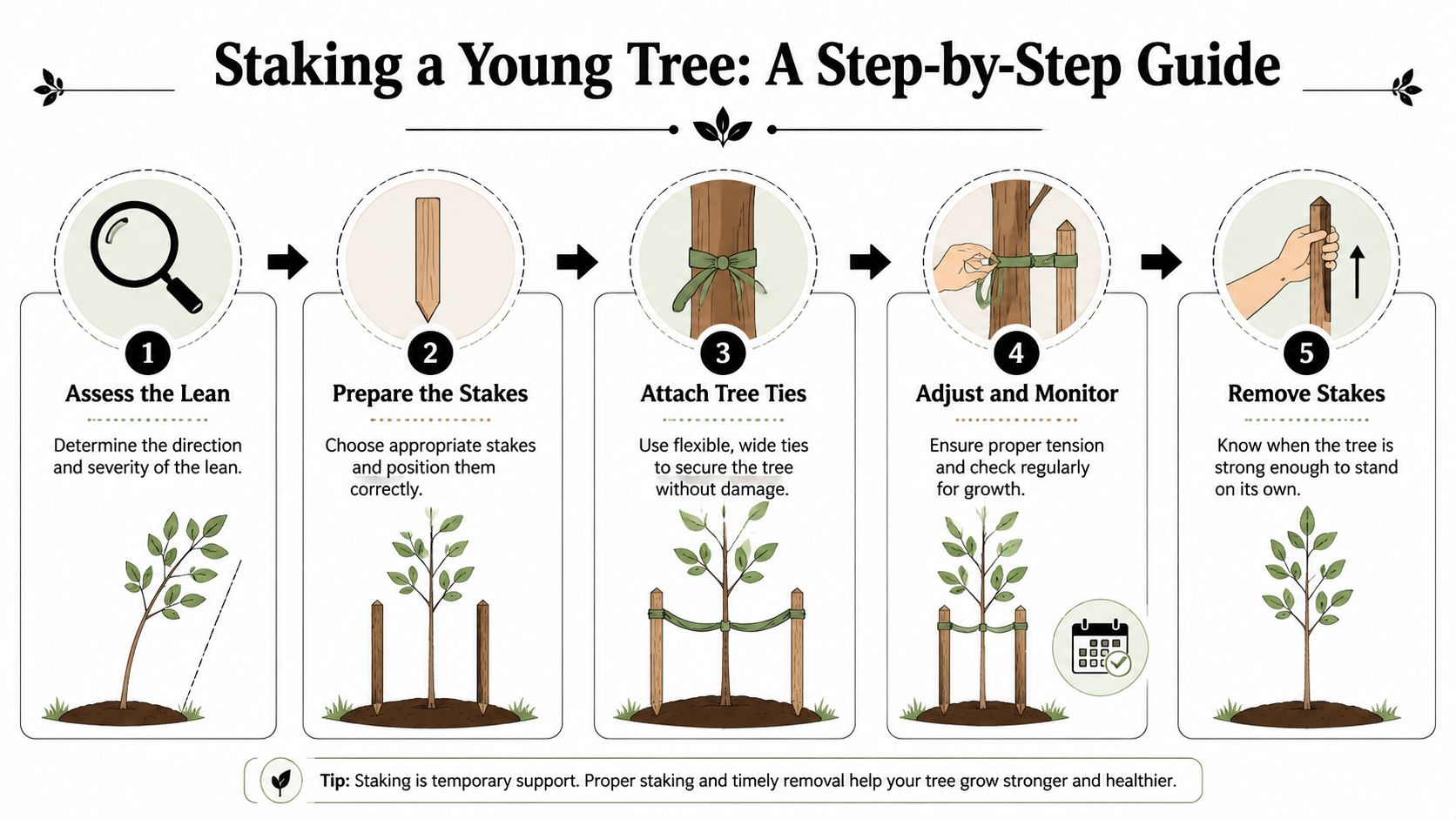
For a young tree, careful staking can work well. It’s also easy to do badly. The biggest mistake homeowners make is trying to hold the trunk perfectly still. Trees need some movement to build strength.
Use the right materials
Choose soft tree staking straps, canvas, or another broad flexible tie. Bare wire, cable, and plain rope can cut into bark and create long-term damage. Protection matters more than pulling power.
For young or smaller trees, one or two stakes can be enough depending on the lean and exposure. Some young trees need a wider support layout if the site is windy or the root ball is still unstable.
Place the stakes where they help, not where they harm
Best practices for staking establish a few dimensions that matter. Stakes should stay in place for at least one full growing season, typically 12 months minimum, and they should be driven at least 18 inches into the ground and set about 2 feet from the trunk to avoid root damage, based on industry guidance for safe tree straightening.
That spacing is important. Homeowners often place stakes too close, then punch through roots or crowd the base of the tree.
A practical setup usually includes:
- Stable stakes: Wood or metal stakes that won't flex with every gust.
- Placement outside the root ball: This reduces the chance of injuring roots.
- Ties at a sensible height: High enough to support the trunk, low enough to allow upper movement.
Pull gently and stop before the tree is perfectly rigid
Straighten the tree only to a natural upright position. Don't try to erase every curve. A slight remaining bend is often better than overcorrecting and tearing roots.
Once the ties are attached, the trunk should still move a little in the wind. That movement helps the tree strengthen itself. If the tie is guitar-string tight, it's too tight.
Leave enough play for the trunk to flex. A supported tree should still behave like a tree, not a fence post.
Monitor it instead of forgetting it
Staking isn't a one-time job. Check ties regularly to make sure they aren't rubbing, tightening, or sinking into bark as the trunk expands.
Considerable damage often happens here:
- Ties left too tight: They girdle bark and interrupt growth.
- Stakes forgotten too long: The trunk becomes dependent and stays weak.
- One-sided tension: The tree rubs against a single support point and develops damage.
If your tree was recently installed, proper planting details matter just as much as the staking itself. This overview of planting and transplanting in San Jose gives useful context on why some trees lean soon after going into the ground.
Know when to remove the support
After that growing season, reassess. If the root system has anchored and the tree stands on its own, remove the stakes. Certified arborists generally recommend removal after one growing season so the trunk can continue developing normal strength.
If the tree still can't stand without support, don't just leave the system up indefinitely. That's the point to reassess the root system, the planting depth, and the overall health of the tree.
Advanced Methods and When to Call an Arborist
A tree that still leans after basic staking, or resists gentle correction, needs a different level of care. This is the point where homeowners often make the problem worse by pulling harder, digging too much, or adding hardware without understanding what the root system can still support.
Guying and anchored support systems
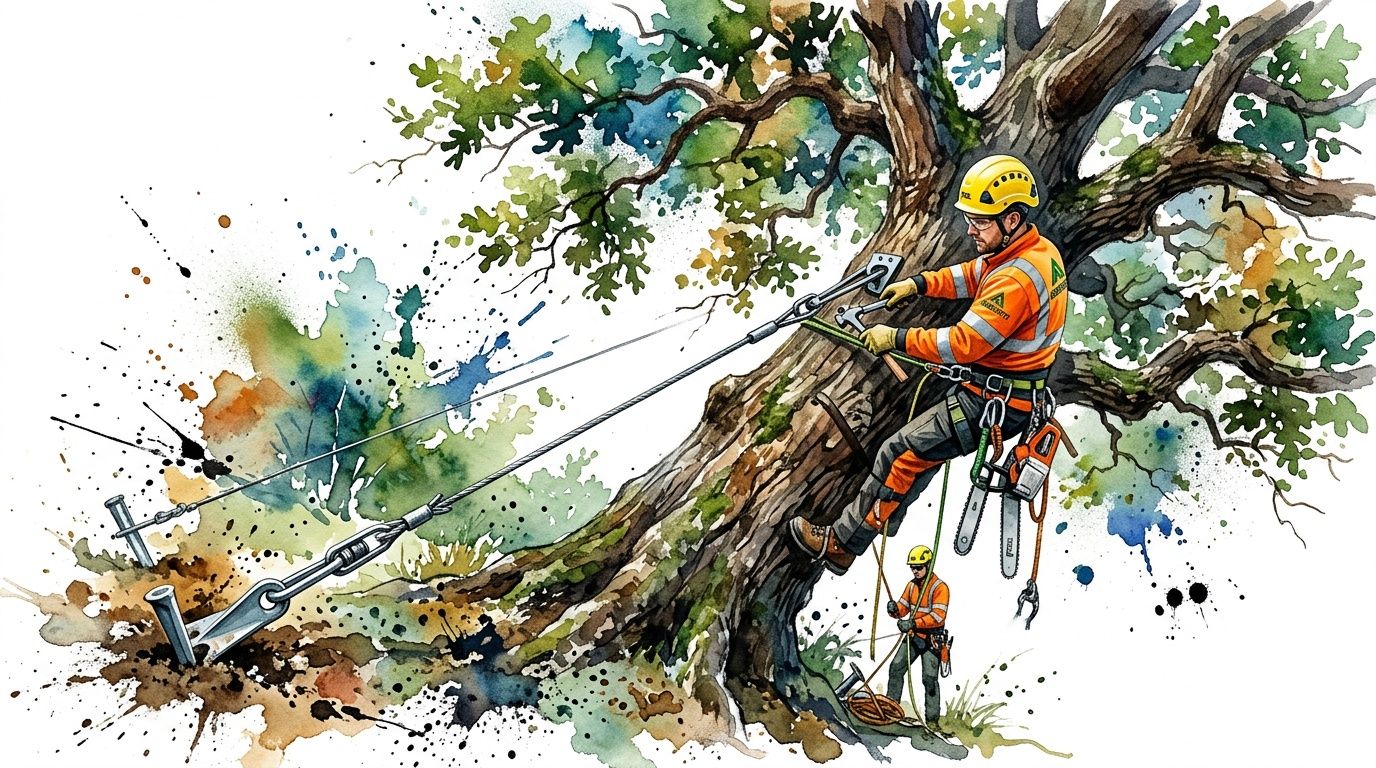
Larger trees sometimes need guying or anchored support systems that spread force across multiple points instead of pulling from one strap on one side. The setup depends on species, trunk diameter, how long the tree has been leaning, soil condition, and what sits nearby, such as a driveway, fence, roofline, or sidewalk.
Cabling and bracing may also come up if the lean is tied to weak branch unions, a split leader, or another structural defect. At that stage, the job is no longer just "straightening." It is stabilizing a compromised tree while reducing failure risk.
Root work and controlled repositioning
Established trees sometimes require root-zone work before any repositioning is even considered. In practice, that can mean selective excavation, air spading, or trenching to see whether roots are circling, torn, buried too deep, or anchored poorly in compacted soil.
This work is invasive. It can help in the right case, but it can also strip away what little stability the tree has left. I do not recommend homeowners experiment here, especially on clay sites or after heavy rain, because the root plate may already be partially detached.
Situations that require a professional
Call an arborist if any of these apply:
- The tree is mature or heavy: Older trees are far less forgiving than young transplants.
- The lean appeared suddenly: Sudden movement often points to root failure or saturated soil.
- The tree is close to a house, fence, parked car, or walkway: The risk is no longer just to the tree.
- You see heaving soil, exposed roots, trunk cracks, or bark splitting: Those are failure indicators, not cosmetic issues.
- The tree may need excavation, anchors, cables, or bracing hardware: That work needs a site-specific plan.
In San Jose, local conditions matter. Expansive clay, shallow irrigation, slope, and tight side yards all change how a leaning tree should be assessed and supported. A local arborist should know how those site factors affect stability, root health, and recovery. This guide on what a local arborist should know about Bay Area tree conditions gives a good sense of that field judgment.
If the tree is large enough to injure someone or damage property, stop trying to straighten it yourself. Secure the area and get it inspected first.
Common Mistakes That Can Harm Your Tree
A leaning tree can survive the original problem and still be damaged by the fix. Most bad outcomes come from rushing, overcorrecting, or using the wrong materials.
Tying directly against the bark
Wire, cable, and thin rope cut bark fast. Even soft ties can cause injury if they’re narrow or cinched tight in one place.
Bark wounds don’t just look bad. They create stress points and open the door to decay and pest problems.
Leaving the tree locked in place
Homeowners sometimes think more support is always better. It isn't. A tree held rigidly for too long doesn't develop normal trunk strength.
Support should be temporary and controlled. The goal is recovery, not dependence.
A straight trunk with a weak root system is not a success.
Using a single bad anchor point
One stake can be enough for some small trees, but one poorly placed support often creates a pivot point. The trunk rubs, twists, or leans against the tie every time the wind shifts.
Balanced support matters. So does tie placement.
Trying to pull the tree upright in one shot
This is the mistake that breaks roots. If resistance is high, stop and reassess. The tree may be too established, too damaged, or leaning for reasons that staking won’t fix.
Watch for these DIY warning signs:
- The root plate lifts as you pull: Stop immediately.
- The trunk creaks or cracks: That’s structural stress, not progress.
- The base doesn't move but the upper trunk bends: You’re forcing the wrong part of the tree.
- The ties keep needing to be tightened: The tree may not be stabilizing.
A lot of tree damage starts with good intentions and poor technique. If you want to avoid broader pruning and support mistakes, this guide on trimming mistakes that kill healthy trees covers the same principle. Small errors add up.
Frequently Asked Questions About Straightening Trees
Can I straighten a tree myself?
If it’s a young, recently planted, flexible tree with a minor lean, you often can. If it’s large, sharply leaning, or near a house, driveway, or sidewalk, get an arborist involved before trying anything.
How long should stakes stay on a tree?
A supported young tree should usually stay staked for at least one full growing season, typically 12 months minimum when staking is needed. After that, the tree should be checked so the support can be removed if it’s anchored well.
Will a leaning tree fix itself?
Sometimes a young tree will correct slightly as it grows, especially if the lean is mild and the root system is stable. A tree with a shifting root ball or a worsening lean usually won’t correct itself in a reliable way.
Is a leaning mature tree dangerous?
It can be, but not every leaning mature tree is automatically hazardous. The concern goes up when the lean changed recently, the soil is lifting, roots are exposed, or the tree could hit a target if it fails.
What kind of ties should I use?
Use wide, flexible materials made for tree support, such as soft staking straps or canvas-style ties. Avoid bare wire, unprotected cable, and thin rope that can cut into bark.
Does straightening a tree cost a lot?
It depends on the tree’s size, site access, the cause of the lean, and whether support systems or excavation are needed. For a real answer, it’s better to have the tree seen on site than to guess from a photo.
When is removal part of the conversation?
Removal comes up when the tree has developed a long-term severe lean, has major root failure, or can't be corrected without leaving an unsafe structure. That decision should follow an actual risk assessment, not panic after noticing the lean.
Get a Professional Opinion on Your Leaning Tree
You walk outside after a windy night, notice the trunk is off-center, and your first instinct is to pull it back upright that same day. That is where homeowners often make the problem worse. Before any correction, the tree needs to be assessed on site to confirm why it leaned in the first place and whether the root system can still hold.
As a licensed arborist in San Jose, I can say this plainly. A slight lean in a young tree is sometimes manageable for a homeowner. A recent lean in a larger tree, a lifting root plate, cracked soil, exposed roots, or any chance of hitting a house, sidewalk, parked car, or play area calls for a professional inspection before anyone starts tugging, staking, or digging.
If you want a clearer sense of what trained tree care includes, this overview of professional arborist services explained is a useful starting point. If you are comparing local companies, this guide on how to find a qualified arborist near me will help you ask better questions about credentials, inspection methods, and risk assessment.
For property owners in San Jose, Willow Glen, Almaden Valley, Los Gatos, Saratoga, Campbell, Cupertino, Santa Clara, and nearby South Bay communities, San Jose Tree Service & Landscaping offers low-pressure site visits for leaning trees. Call (408) 422-1313 or visit sanjosetreemaintenance.com to discuss what changed, what the tree is near, and whether the right next step is monitoring, staking, support hardware, or removal.
