
Direct Answer: Most tree removals in San Jose require a city permit before any work begins. Skipping that step can result in fines up to $30,000 per tree, even if a contractor told you it was fine.
Every week I talk to homeowners in San Jose who are ready to remove a tree, and most of them have no idea a permit might be standing between them and that decision. They’ve already called a crew. Sometimes the crew has already told them they’re good to go. And then I have to explain why that’s a problem.
The City of San Jose has real teeth when it comes to unpermitted tree removal. Fines for removing a street tree without a permit can reach $15,000 per tree. Heritage tree violations can go as high as $30,000 per tree. And here’s the part that surprises people: the homeowner can be held personally liable, even if a contractor made the call.
This article is not about scaring anyone away from removing a tree that genuinely needs to come down. Sometimes removal is the right answer. But the process matters, and understanding it before you hire anyone is the single most important thing you can do.
The Three Categories of Trees, and Why They’re Not the Same
One of the most common mistakes I see is homeowners treating all trees on or near their property as the same. They’re not. The City of San Jose applies different rules to different tree categories, and confusing them is where most permit problems begin.
Here’s how to think about the three main categories:
- Street trees, These are trees located in the public right-of-way, typically between the sidewalk and the curb. Even if the tree is in front of your house, the city considers it public property. Removal almost always requires a free city permit, regardless of the tree’s size. This applies in neighborhoods across San Jose, from Willow Glen to Almaden Valley.
- Private ordinance-size trees, Trees on your own property that meet a certain trunk diameter threshold fall under the city’s protected tree ordinance. In San Jose, that threshold is generally a trunk diameter of 12 inches or more, measured at 54 inches above grade. If your tree meets that size, a permit is likely required before removal.
- Heritage trees, These carry a separate and stricter designation. Heritage trees are protected by name or species and come with their own documentation requirements. The penalties for unpermitted heritage tree removal are the highest of all three categories.
Knowing which category your tree falls into tells you what kind of process you’re looking at, and who is qualified to help you move through it. If you’re not sure, that’s exactly the kind of question a certified arborist in San Jose can answer before anyone picks up a chainsaw.
What Happens When a Development Project Involves Tree Removal
Earlier this year, a homeowner developing a property on Winchester Blvd in San Jose reached out to us through our website. They were planning to demolish the existing structure and rebuild, and several trees were in the way. Their message was honest: they didn’t fully understand what the permit process involved.
That’s more common than people think. When a tree removal is connected to a development, ADU construction, or significant grading, the City of San Jose often requires more than a permit application. They may require a formal certified arborist report as part of that application.
A certified arborist report for city permit purposes typically includes:
- The species, size, and condition of every tree being assessed
- An evaluation of the tree’s structural health and root zone
- An assessment of whether removal is justified, and why
- Documentation of any alternatives to removal that were considered
- A statement of impact if the tree is removed
This is a technical document, not a contractor’s note saying “the tree has to go.” The city requires it to come from someone with the credentials to produce it. A board-certified arborist can generate that report, a general tree crew cannot.
If you’re planning any kind of construction project in San Jose and trees are in the footprint, get the arborist involved early. It’s much easier to build the report into the permit timeline than to discover midway through a project that you’re missing a required document.
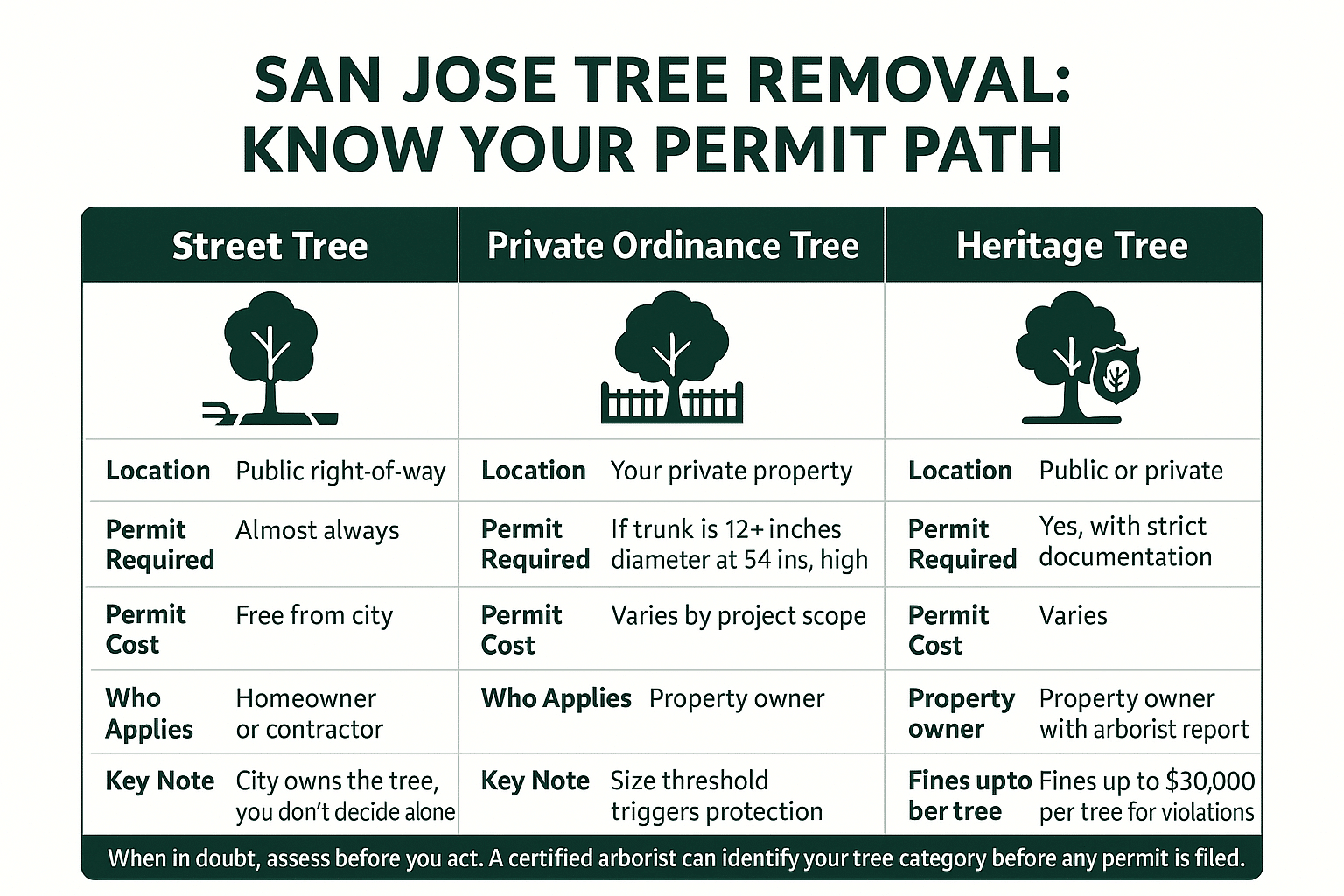
San Jose Tree Removal: Permit Path by Tree Category
This infographic walks through how permit requirements differ depending on which category your tree falls into, and what each path involves.
When You Need to Move Fast, And What ‘Fast’ Actually Requires
I hear this often from homeowners dealing with a visibly failing tree: they assume that because the situation is urgent, they can skip the paperwork. That’s understandable. But it’s not how San Jose’s permit process works.
For ordinance-size trees that pose an imminent hazard, the City of San Jose does offer an expedited, over-the-counter permit process. The key word is ‘expedited’, not ‘skipped.’ To use it, you still need a signed certified arborist report accompanying the application.
This matters for two reasons. First, a general tree crew can’t produce that report, only a certified arborist can. Second, a contractor who tells a homeowner “this is an emergency, we can just take it down” without checking permit status is putting the homeowner at risk, not protecting them.
Speed and proper documentation are not mutually exclusive. We’ve been able to move quickly on urgent situations because the arborist assessment was done correctly from the start. That’s the difference between a fast, clean removal and one that creates legal exposure for the homeowner afterward.
If you have a tree that looks dangerous after a storm or shows signs of sudden structural failure, San Jose emergency tree services can address urgent situations, but the permit step still applies for protected trees, even in those cases. And if you’re unsure whether your tree’s condition is truly an emergency versus a problem that can be assessed more carefully, reading about what to watch for when trees are struggling can help you make that call.
Permit Violations: What San Jose’s Fines Can Look Like
These are the penalty ranges the City of San Jose has stated for unpermitted tree removal. The homeowner is liable even if a contractor performed the work.
| Tree Category | Violation Type | Potential Fine |
|---|---|---|
| Street Tree | Unpermitted removal or damage | Up to $15,000 per tree |
| Heritage Tree | Unpermitted removal or significant damage | Up to $30,000 per tree |
| Ordinance-Size Private Tree | Removal without required permit | Varies, can include replacement costs and civil penalties |
| Any Protected Tree | Work performed by unlicensed contractor | Additional liability may apply to property owner |
Permits Often Come With Replacement Requirements, Plan For That
Getting a removal permit approved doesn’t always mean the story ends there. The City of San Jose frequently attaches replacement planting requirements to approved removal permits, and homeowners are often caught off guard by this.
Depending on the tree’s size, species, and the reason for removal, the city may require you to:
- Plant one or more replacement trees on-site
- Meet specific species requirements for the replacement
- Pay into the city’s tree fund if on-site replanting isn’t feasible
Replacement ratios can affect your project scope and budget in ways that aren’t obvious until the permit comes back. A large ordinance-size tree might require two or three replacement trees of a specified caliper, which adds cost, changes your landscape plan, and requires its own thought about species selection and placement.
This is one reason I always recommend thinking about the full picture before filing anything. A proper assessment that starts with the tree’s condition, moves through the permit process, and ends with a realistic replanting plan gives homeowners a much clearer picture of what they’re actually committing to. If you’re working through a larger landscape project alongside tree removal, how landscape design works when you have mature trees to protect is worth reading before you finalize any plans.
Tammy D., one of our customers, put it well after working through a tree and hedge assessment with us: ‘Robert was quick to assess the issues we are having with our hedges and trees. Once he determined the cause of the problem, he laid out a treatment plan right away and the treatment began.’ That’s what a proper assessment before action looks like, and it applies just as much to permit planning as it does to disease treatment.
Frequently Asked Questions About San Jose Tree Removal Permits
Do I need a permit to remove a tree in my own backyard in San Jose?
It depends on the tree’s size and type. If the trunk measures 12 inches or more in diameter at 54 inches above the ground, it likely meets the ordinance-size threshold and a permit is required. Heritage trees have their own separate protections regardless of size. Street trees, even in front of your house, are almost always subject to permit requirements. If you’re not sure which category your tree falls into, a certified arborist can give you a clear answer before you do anything else.
What if my contractor says I don’t need a permit?
Get a second opinion before trusting that. The homeowner, not the contractor, is the one who faces liability for unpermitted work. A contractor without arborist credentials may genuinely not know the permit rules, or may be giving you the answer that makes it easier to close the job. The city’s fines are assessed against the property owner, not just the crew.
How long does the San Jose tree removal permit process take?
For a standard private ordinance-size tree with no complications, the city’s process can move in a few weeks. For development-related removals that require a formal arborist report as part of the permit application, build in more time, the report itself takes time to prepare correctly, and the city’s review adds to that. For imminent hazard situations, there is an expedited over-the-counter path, but it still requires a signed certified arborist report accompanying the application.
What does a certified arborist report actually include?
A proper arborist report for city permit purposes documents the tree’s species, trunk size, structural condition, and root zone. It evaluates whether removal is the appropriate course of action, notes what alternatives were considered, and assesses the impact of removal. It’s a technical document written by someone with credentials the city recognizes, not a contractor estimate or a one-page opinion letter. You can read more about what a certified arborist actually does versus what a general crew provides.
Can the city really fine me if my contractor removes the tree without a permit?
Yes. The City of San Jose has stated penalties up to $15,000 per street tree and up to $30,000 per heritage tree for unpermitted removal. The property owner can be held personally liable even if the contractor initiated the work or told you a permit wasn’t needed. This is not a technicality, it’s an active enforcement area.
What if I think my tree might just need treatment instead of removal?
That’s actually the right question to start with. A lot of trees that homeowners assume are dying can be treated or managed. Removal should be the conclusion of a proper assessment, not the starting point. If your tree is showing signs of disease, pest damage, or decline, tree pest and disease questions San Jose homeowners keep asking is a good place to start understanding your options before making any decisions.
Not Sure Where Your Tree Stands?
If you have a tree in San Jose, or in Los Gatos, Campbell, Saratoga, or anywhere else in our service area, and you’re not sure whether it needs a permit, a formal arborist report, or just a closer look, we’re happy to help you figure that out before anything else happens. San Jose Tree Service & Landscaping holds active CSLB licenses in both tree service and landscaping, and we’ve guided homeowners through the city’s permit process many times. You can reach us at (408) 422-1313 or visit sanjosetreemaintenance.com to request an assessment.
