
Direct Answer: El Niño wet seasons don’t create tree problems — they accelerate ones already developing. Trees showing sparse canopy, leaf discoloration, or bark changes before winter are the ones most at risk.
Every time an El Niño season gets announced, I hear the same worry from homeowners across San Jose, Willow Glen, and Almaden Valley: “Is my tree going to make it through the winter?” It’s a fair question. But the answer almost never depends on the rainfall itself.
Healthy trees in good soil handle wet winters just fine. What El Niño actually does is take problems that were quietly developing all summer — slow root decline, poor drainage, early disease — and speed them up dramatically. By the time a tree looks obviously sick in February, the options for saving it have usually narrowed.
That’s why the window that matters most is right now, before the first storms arrive. What you’re watching for, and what you do about it, makes the difference between a tree that comes through intact and one that doesn’t.
What El Niño Actually Does to Trees
Let me be straightforward about something: a strong El Niño season is not a death sentence for trees. In most years, the mature oaks, redwoods, and camphor trees in established San Jose neighborhoods handle heavy rainfall without any intervention at all.
The problem is saturated soil. When the ground stays wet for weeks at a time, roots in poorly drained areas are essentially sitting in standing water. Oxygen levels in the root zone drop, fine root tissue starts to die off, and the tree loses its ability to take up nutrients even when they’re present.
For a tree that entered the rainy season healthy and vigorous, this is manageable. For a tree already dealing with compacted soil, a prior drought stress, or a low-level fungal infection, a wet El Niño winter can push it past the point of recovery.
The pathogen connection here is real. UC IPM documents that Phytophthora root and crown rot — one of the most damaging tree diseases in California — thrives specifically in wet, poorly drained soil. A dormant or slow-moving infection that a tree was managing on its own can accelerate sharply once the ground stays saturated through January and February. That’s not a hypothetical. It’s what we see in the field.
The Symptoms That Tell You a Tree Is Already Struggling
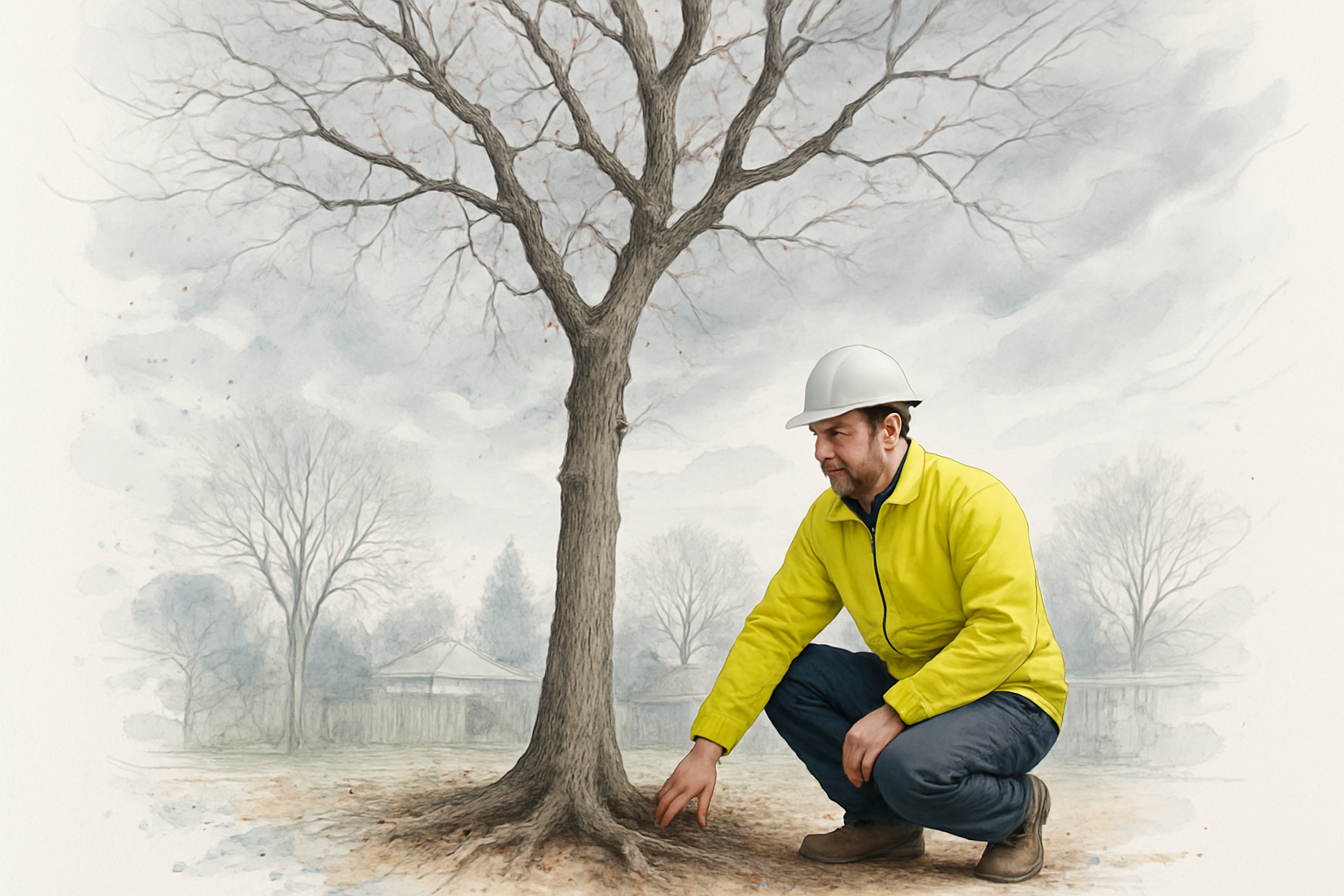
One homeowner sent us photos of an elm in their backyard — wilting leaves, brown patches spreading through the canopy, and some unusual changes to the bark near the base. Their question was exactly the right one: “Can this tree still be saved?”
That instinct to ask early is what makes the difference. A tree showing those symptoms in late summer or early fall almost always still has options. The same tree showing the same symptoms in March, after running through a wet El Niño winter, often doesn’t.
Here’s what I tell people to look for before the rains arrive:
- Sparse or thinning canopy — fewer leaves than prior years, or sections of the crown that didn’t fill out in spring
- Early leaf drop or unusual browning — not normal fall color change, but browning that moves through the canopy unevenly
- Dieback at branch tips — small branches dying back from the ends, working inward
- Bark discoloration or soft spots near the base — especially at or just below the soil line, which is where Phytophthora crown rot tends to start
- Mushrooms or fungal growth at the base of the trunk or on surface roots
- Visible root zone problems — compacted soil, poor drainage after irrigation, or areas where water pools and sits
Any one of these, by itself, might not mean much. Two or more together, going into a wet winter, is when I’d want a certified arborist looking at that tree before the season starts. As we’ve explained in when does a tree problem require an arborist — not just a trimmer, symptom patterns like these need a diagnostic eye — not just a crew with a saw.
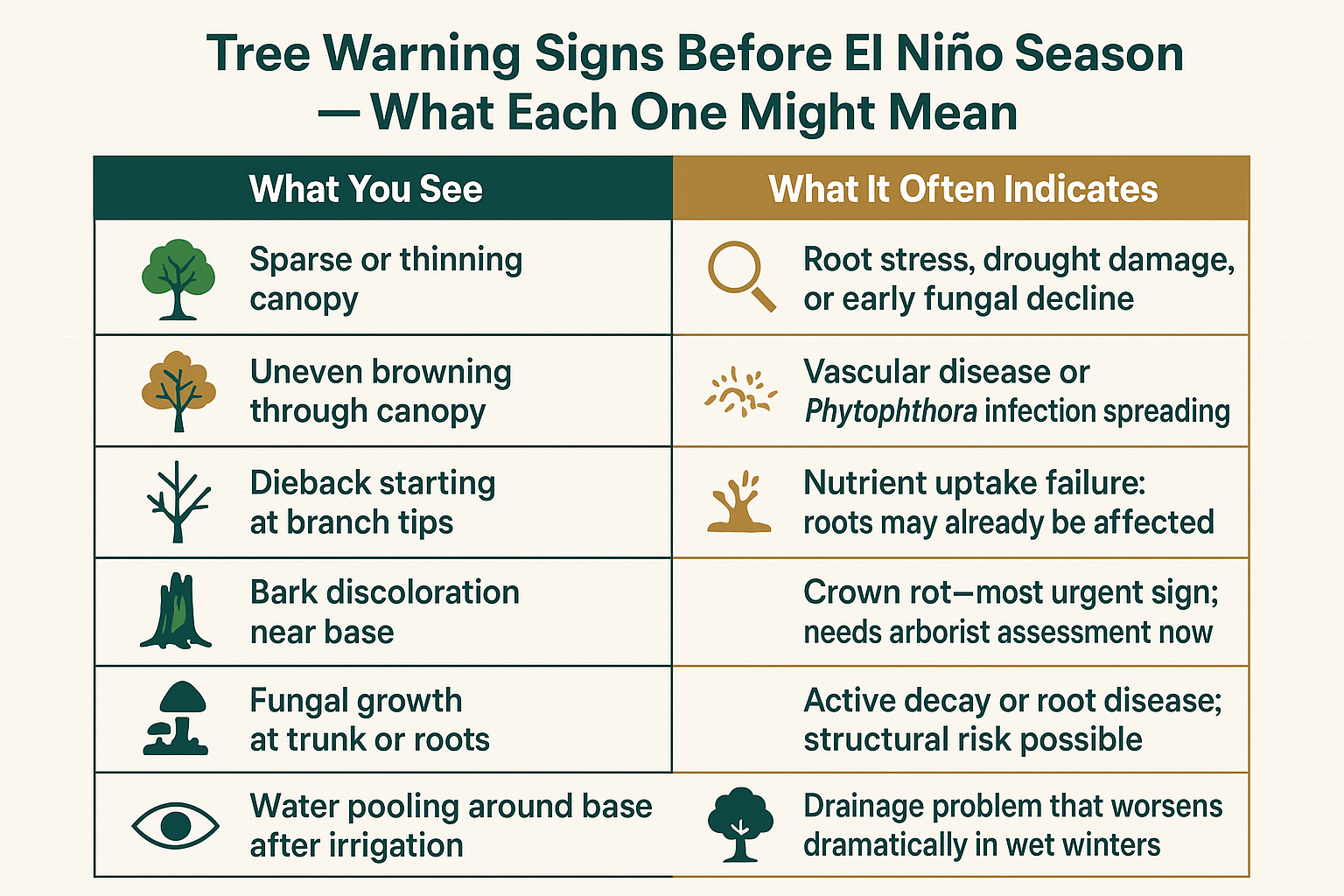
Early Warning Signs vs. What They Might Mean
This reference shows the most common pre-winter symptoms and the underlying conditions they often point to — so you know what warrants a closer look.
Why Oak Trees Deserve Extra Attention
If you have a mature valley oak or coastal live oak on your property — especially in neighborhoods like Almaden Valley, Los Gatos, or Saratoga where these trees are common and genuinely old — El Niño prep matters more than it does for most other species.
Mature oaks are among the highest-value trees on any residential property, both ecologically and in terms of what they actually add to a home’s character and sale price. They’re also slow to show distress and slow to recover from it. By the time an oak looks obviously sick, the underlying problem has usually been building for one or two seasons already.
The specific risk combination for urban oaks is chronic wetness plus soil compaction. In established neighborhoods, tree roots are often dealing with decades of foot traffic, irrigation overspray, and soil settling around hardscape. That compacted root zone drains poorly. Add a wet El Niño winter and you have exactly the conditions that allow Phytophthora and other root pathogens to gain real ground.
A returning customer in Cupertino reached out recently about an oak in his backyard — he wasn’t sure what services it needed, just that it had been looking off for a while. That’s actually the right moment to schedule an assessment. A professional tree assessment can tell you whether you’re dealing with a drainage issue, a soil problem, early disease, or just normal seasonal variation — and what, if anything, needs to happen before winter.
What Treatment Options Actually Look Like Before the Season Starts
When a tree is showing early symptoms and we catch it before a wet season runs through, there’s usually a real management path available. The specific approach depends on what the assessment finds, but here’s what a treatment plan might include:
- Drainage correction — regrading or adding drainage channels around the root zone to prevent saturation
- Root zone aeration — breaking up compacted soil to restore oxygen flow to roots and create conditions where they can recover
- Irrigation adjustment — in many cases, trees showing distress are being overwatered; pulling back irrigation in the root zone before winter is a simple but meaningful intervention
- Fungicide treatment — where Phytophthora or other fungal pathogens are confirmed or strongly suspected, targeted soil drenches or trunk applications can slow or stop the infection’s spread
- Structural pruning — removing deadwood and reducing crown weight can reduce stress on a compromised root system, giving the tree a better chance of holding through a heavy rain season
None of these are guaranteed fixes, and I won’t tell you they are. But a tree with options in October often has no options in March. That’s the honest timing reality.
For deeper background on how we approach the full planning picture, how El Niño winters change tree care planning in San Jose walks through the bigger-picture seasonal strategy. And if you’re thinking about pre-winter pruning specifically, the right time to prune before an El Niño winter is before it starts covers why timing on structural work matters so much.
El Niño Tree Risk: What Changes the Outcome
These are the variables that separate a tree that comes through a wet season intact from one that doesn’t — based on what we actually see in the field.
| Factor | Lower Risk | Higher Risk |
|---|---|---|
| Canopy appearance going into winter | Full, healthy leaf density | Sparse, uneven, or thinning |
| Soil drainage around root zone | Water drains within a few hours | Water pools and sits for days |
| Soil condition | Aerated, loose, well-structured | Compacted from traffic or hardscape |
| Irrigation management | Reduced or paused before rainy season | Running full schedule into winter |
| Prior disease or root stress | No signs of prior decline | History of dieback, fungal growth, or bark changes |
| Tree species | Species tolerant of wet conditions | Oak or other drainage-sensitive species |
Frequently Asked Questions About El Niño and Tree Health
My tree looked fine all summer. Should I still be worried about El Niño?
If it genuinely looked healthy — full canopy, normal leaf color, no dieback — then an El Niño season is probably not your biggest concern. Healthy trees in reasonably well-drained soil handle wet winters without serious problems. The real risk is for trees that were quietly declining through summer and showing early symptoms going into fall.
How do I know if my drainage is bad enough to cause a problem?
The simplest test is to watch what happens after a normal irrigation cycle or a light rain. If water is still sitting around the base of the tree six to eight hours later, that’s poor drainage. In neighborhoods with clay-heavy soil — common across much of San Jose and the Almaden Valley — this is more the rule than the exception.
Is there any point in treating a tree that’s already showing symptoms, or is it too late?
This is exactly what one homeowner asked when they sent us photos of an elm with wilting, browning leaves and bark changes. The honest answer is: it depends on how far the decline has progressed, and you won’t know that without a proper assessment. A tree showing early symptoms still has real options — drainage work, root zone treatment, fungicide application, structural pruning. Those options narrow fast if the problem runs through another wet season untreated. Getting an arborist to look before winter is the move that keeps more doors open.
Do you just come out and recommend removal, or do you actually try to save the tree?
Preservation is always the starting point for us. One reviewer noted she came into her consultation expecting pressure to remove her trees — and was relieved when the arborist evaluated each one individually and only recommended removing the one that genuinely couldn’t be saved. That’s how we approach every assessment. Removal is a last resort, not a default.
Can the same company that diagnoses the tree also fix the drainage and adjust the irrigation?
Yes — and that matters because these problems are connected. A drainage issue that’s stressing the root system, combined with irrigation that’s overwatering the same area, creates conditions that no amount of tree treatment can fully overcome on its own. Because we hold both a tree service license and a landscaping license, we can evaluate the tree, correct drainage, and adjust or repair irrigation as part of one integrated plan. You shouldn’t need three different contractors to solve one problem.
Concerned About a Tree Before the Rains Arrive?
If something about a tree on your San Jose property has been nagging at you — a canopy that seemed thin this summer, a patch of bark that doesn’t look right, water that sits too long after irrigation — the time to get eyes on it is now, not after the first storms hit. San Jose Tree Service & Landscaping offers arborist-led tree health diagnostics and disease assessments for homeowners across San Jose, Willow Glen, Almaden Valley, Los Gatos, Saratoga, and Campbell. You can reach us at (408) 422-1313 or visit sanjosetreemaintenance.com to request an assessment.
