
Direct Answer: The practical window for structural pruning before an El Niño winter is August through mid-November — after that, wet ground and active weather make the same work riskier and more expensive.
Every year, I talk to homeowners who call us in January after a storm has already done what a pruning appointment in October would have prevented. A heavy limb over the garage, a co-dominant trunk that finally split, a camphor that dropped a 300-pound branch onto the fence. These aren’t freak events — they’re predictable ones.
When NOAA signals a strengthening El Niño pattern heading into winter, that’s not abstract weather news for homeowners in Willow Glen, Almaden Valley, or the foothill neighborhoods of Los Gatos and Saratoga. It’s a practical deadline. The mature oaks, ornamentals, and large shade trees on these properties carry real wind-load risk when they haven’t been structurally prepared — and Silicon Valley’s dry summers are followed quickly by the very storms that test them.
The good news is that the window is still open. But it doesn’t stay open long. Here’s what I want homeowners to understand before that window closes.
Why August Through Mid-November Is the Real Pruning Window
The timing case isn’t complicated, but it’s worth being specific. If NOAA’s modeling shows an El Niño event strengthening through fall and into winter, the conditions that make structural pruning practical — firm dry soil, no active rain, manageable winds — start to disappear around mid-November.
After that point, a few things happen at once. Saturated soil loosens root anchorage, which changes how a tree responds to load. Crew access with heavy equipment becomes more difficult and more damaging to surrounding landscapes. And the liability exposure for working around power lines or over structures goes up when weather is unpredictable.
The work itself doesn’t change — but everything around it does. What costs one amount in September can cost meaningfully more in January, and that’s before accounting for the fact that January work is reactive rather than planned. Getting on the calendar before the rains arrive isn’t just good timing. It’s good risk management.
For homeowners in established neighborhoods like Almaden Valley, where mature valley oaks and ornamental trees can carry 40 or 50 feet of canopy, the case is even clearer. End-weight reduction and targeted crown cleaning on those trees before a wet winter carries real structural value — the kind you simply can’t buy after the fact.
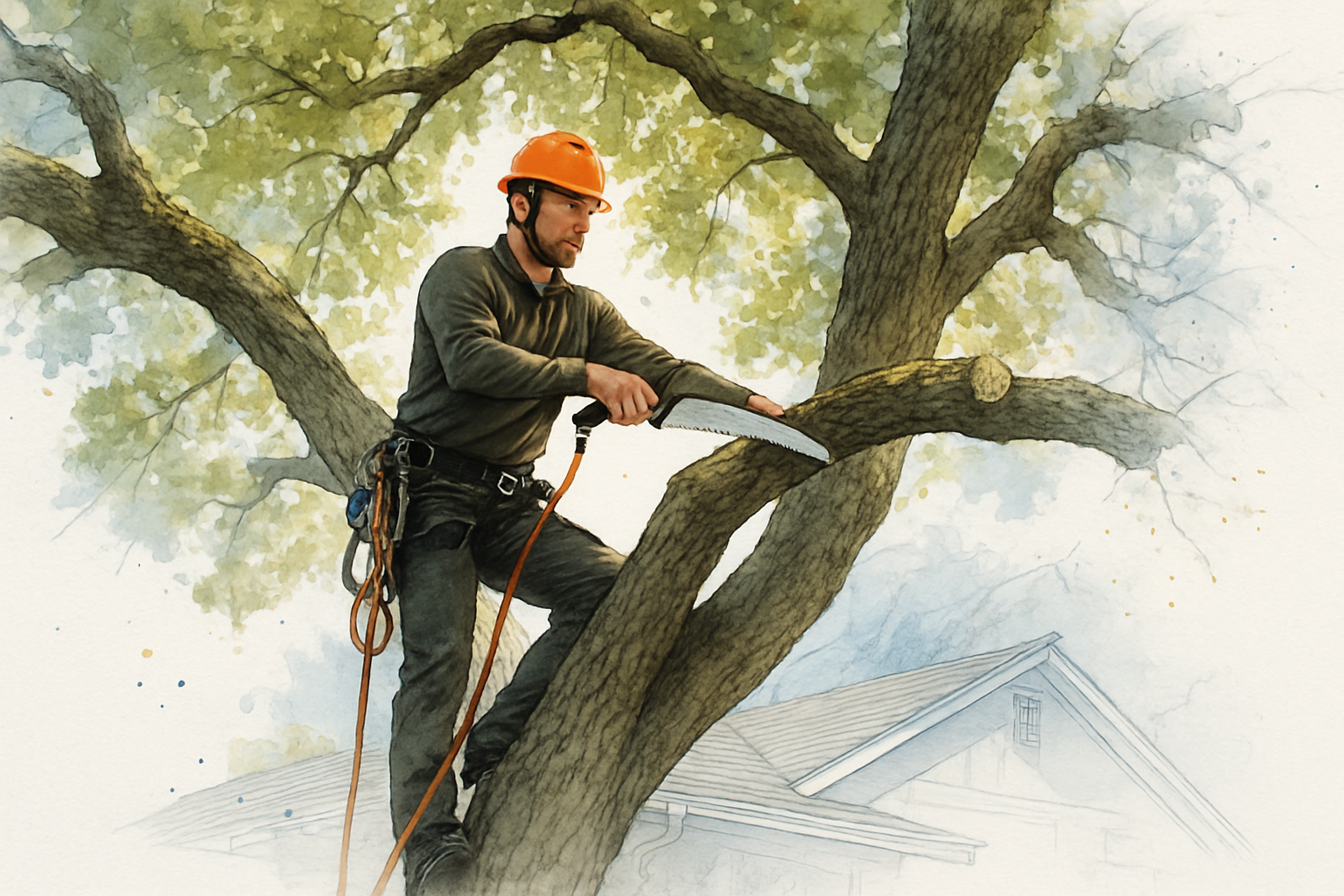
This Isn’t a Call for Blanket Pruning — The Assessment Comes First
I want to be direct about something, because I hear the misconception often: pre-storm pruning doesn’t mean every tree on your property needs work done to it.
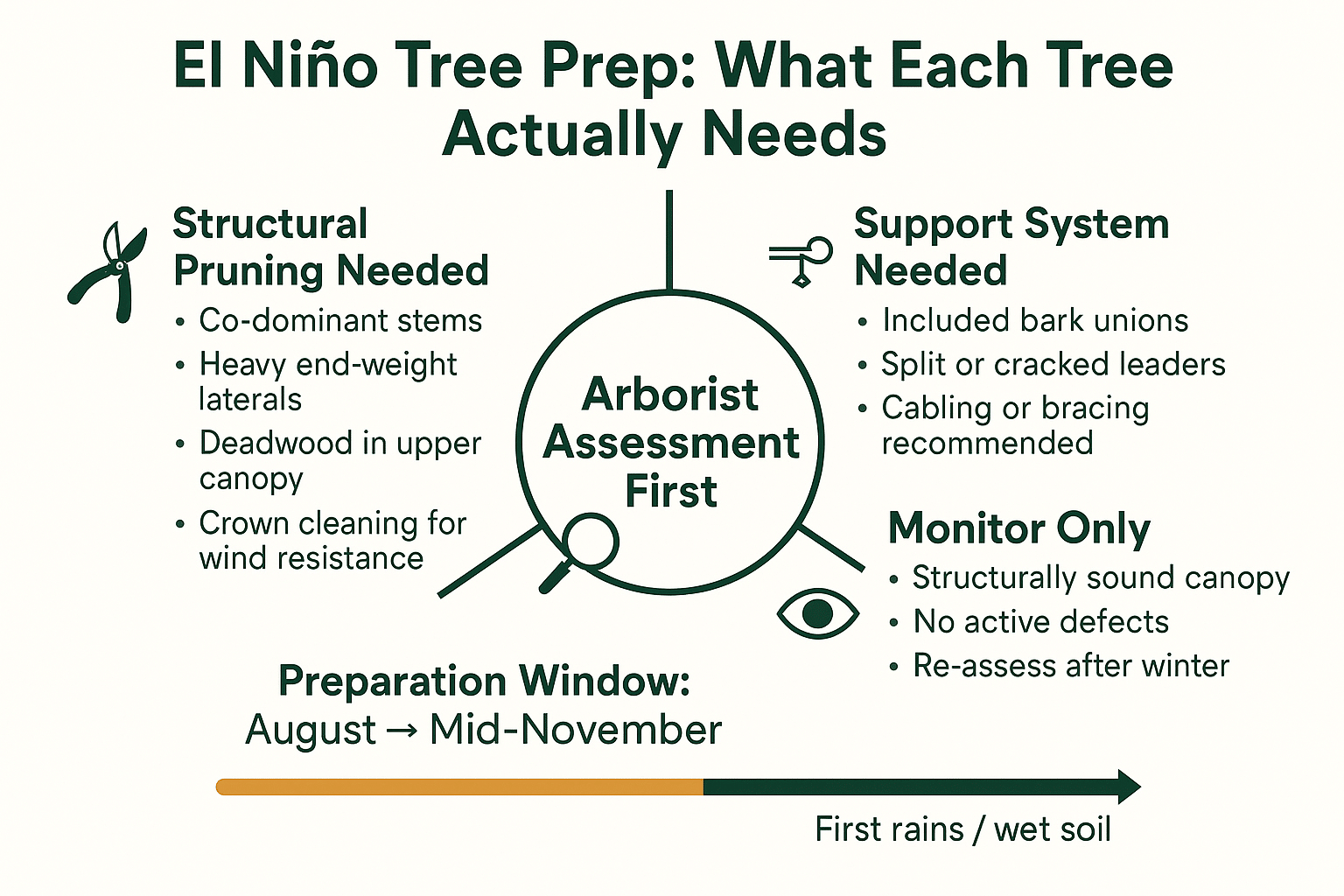
Some trees need structural correction — a co-dominant stem that’s been slowly developing tension, or a long lateral limb with too much weight at the end. Some trees need a support system, like cabling between included unions, rather than any pruning at all. And many trees, honestly, just need to be monitored. An arborist assessment is what separates those three categories.
What I’ve seen go wrong is homeowners who, anxious about an active forecast, hire a crew to “storm-prep” everything — and what they get is over-pruning. Removing more than roughly 25% of a tree’s live canopy in a single season stresses the tree. It triggers weakly attached, fast-growing water sprouts that are actually more vulnerable to wind failure than the canopy they replaced. You haven’t prepared the tree for winter — you’ve set it up for worse problems two or three years from now.
Topping is the extreme version of this, and it’s the wrong answer to El Niño anxiety every single time. What a certified arborist actually does for your trees is fundamentally different from what a crew without arborist training does — and pre-storm season is when that difference matters most.
The goal is always to reduce avoidable failure risk without compromising the long-term health and structure of the tree. Those two things are not in conflict when the work is planned correctly.
El Niño Pruning: The Decision Framework Before Winter
This framework shows how an arborist-led assessment determines which trees need structural work, which need support systems, and which only need monitoring before an El Niño winter.
The Insurance Angle Most Homeowners Don’t See Coming
One of the more practical drivers I’ve seen this season is homeowner insurance. We’ve had customers come to us specifically because their insurer flagged limbs overhanging the roofline — and required trimming as a condition of continued coverage or renewal.
This is real, and it’s becoming more common. One returning customer in Santa Clara came back to us after their insurer flagged their pittosporum, which needed a significantly larger reduction than the previous pruning cycle. The insurer didn’t care about the forecast — they cared about what was growing over the structure. But El Niño conditions make those conversations happen earlier and more urgently.
If you haven’t reviewed your policy’s tree hazard language, or if your insurer has ever mentioned overhanging limbs in correspondence, that’s worth acting on before November rather than after. An arborist can document the condition of the tree and the scope of work performed, which gives you a paper trail with your carrier.
For homeowners in neighborhoods with large established trees — particularly in Willow Glen, where older lots often have mature ornamentals close to the house — this is a more common situation than people realize. You can also read more about what San Jose requires before a tree comes down if your insurer’s request involves any protected species.
Structural Pruning vs. Topping: What Actually Happens to the Tree
Homeowners sometimes hear these two terms used interchangeably. They are not the same thing — and the outcomes for the tree are very different.
| Approach | What Happens to the Tree | Storm Readiness Outcome |
|---|---|---|
| Structural pruning (arborist-directed) | Targeted removal of deadwood, co-dominant stems, and end-weight laterals — cuts made at proper attachment points | Reduced failure risk; preserved canopy structure; long-term health maintained |
| Crown thinning (selective) | Selective removal of interior branches to reduce wind resistance without reducing height or spread significantly | Improved wind-load distribution; minimal stress to the tree |
| Topping / indiscriminate cutting | Large live branches cut back to stubs; no regard for branch collars or tree architecture | Triggers weakly attached water sprouts; increases long-term failure risk; structural decline over time |
| No work / monitoring only | Appropriate for structurally sound trees with no active defects identified in assessment | Acceptable outcome when assessment confirms no intervention is needed |
What the Work Actually Looks Like in Willow Glen and Almaden Valley
In the neighborhoods where we do most of our work, the trees that carry the most pre-storm risk share a few characteristics: they’re large, they’re mature, and they’ve often gone several years without a structural assessment.
In Willow Glen, that usually means mature valley oaks and ornamental shade trees close to older homes — houses built in the 1940s and 50s on lots where the trees have been growing for 60 or 70 years. Those canopies can be 50 feet across. End-weight reduction on a long lateral limb — removing the outer third of a branch that’s been extending itself toward the roofline — is exactly the kind of targeted work that makes a measurable difference in storm performance.
In Almaden Valley, the foothill topography adds a wind-channel effect that flat-lot homeowners don’t deal with. Trees on those properties carry more lateral load during storm events. The same structural principles apply, but the urgency is often higher.
For properties in Los Gatos and Saratoga, fire-risk considerations run alongside storm-risk ones. Deadwood removal and canopy cleaning serve both — a well-cleaned crown is less likely to fail in wind and carries less dry fuel load into fire season.
If you’re not sure where your trees stand, a certified arborist assessment is the right first step — not a crew showing up with a chainsaw and a quote. If a storm has already created a situation on your property, you can learn more about what to do after a tree looks dangerous following a storm.
Frequently Asked Questions About Pre-El Niño Tree Pruning
How do I know if my tree actually needs structural pruning before winter, or if it’s fine?
The honest answer is: you need an arborist to look at it. What you can watch for on your own are co-dominant stems (two trunks of roughly equal size splitting from the same point), long heavy laterals extending over the roof or driveway, and any visible deadwood in the upper canopy. But the structural issues that matter most — included bark, internal decay, root problems — aren’t visible from the ground. An in-person assessment is what tells you which category your tree falls into.
Isn’t it bad to prune trees in the fall?
For most species common in San Jose — valley oaks, camphor, ornamental pears, liquid amber — fall pruning is fine when the work is structurally motivated and done correctly. The one exception worth noting is coast live oak, where open pruning wounds during certain periods can increase disease exposure. Your arborist will factor species and timing into the recommendation.
My insurer is asking me to trim limbs over the house. Does that mean the whole tree needs work?
Usually not. Insurance requests typically target specific limbs or canopy sections that overhang the structure — not the whole tree. A targeted reduction of those limbs, done properly at the right cut points, often satisfies the insurer’s requirement without significant canopy loss. Get documentation of the work performed — it’s useful to have for your carrier.
What’s the difference between crown thinning and topping? I’ve heard both terms used.
Crown thinning is the selective removal of interior branches to reduce wind resistance and improve light penetration — cuts are made at natural attachment points, and the tree’s overall form is preserved. Topping is cutting large branches back to stubs with no regard for structure, often dramatically reducing the tree’s height. Topping stresses the tree severely, triggers weakly attached regrowth, and is widely considered harmful practice by the arborist community. If someone is recommending topping as El Niño preparation, that’s a red flag.
How much does pre-storm structural pruning cost in San Jose?
Cost varies significantly based on tree size, species, canopy access, and the scope of work identified in the assessment. A single large oak in an accessible backyard is a very different job than three ornamentals close to a structure with limited equipment access. Rather than give you a number that may not apply to your situation, I’d recommend scheduling an assessment — you’ll get a clear scope and an honest quote based on what your trees actually need.
What if a tree on my property needs a permit before any work can be done?
San Jose has specific rules around protected trees — particularly oaks and other designated species above certain trunk diameter thresholds. Pruning typically does not require a permit, but removal does in many cases. If your assessment identifies a tree that may need removal rather than pruning, the arborist can guide you through the permit process. You can also read more about what San Jose requires before a tree comes down.
The Window Is Open — But It Won’t Be for Long
If you have mature trees in San Jose, Willow Glen, Almaden Valley, Los Gatos, or any of the surrounding communities, and you haven’t had a structural assessment done this season, August through mid-November is the time to act — not because of urgency for its own sake, but because that’s genuinely when the work is most practical and most effective. We’re a CSLB-licensed, family-owned company with certified arborist expertise, and we’ve built our reputation in this area by telling homeowners what their trees actually need — not what storm season makes them feel like they need. If you’d like to schedule an assessment, reach us at (408) 422-1313 or visit sanjosetreemaintenance.com.
