
Direct Answer: San Jose requires a permit before removing most protected trees, and development projects typically require a certified arborist report as part of the city application. Requirements vary by tree size, species, and location.
One of the most common calls we get goes something like this: a homeowner in Willow Glen or Almaden Valley has already decided a tree needs to go. Maybe it’s leaning, maybe it dropped a branch, maybe they just want the yard opened up. They want to schedule the crew — and then we have to explain that before any of that happens, the City of San Jose may have something to say about it.
San Jose has a protected tree ordinance, and ignoring it isn’t just a fine risk — it can stop a project cold, especially if you’re in the middle of a development or demolition permit. What counts as protected, what triggers a permit, and what the city actually needs from you are questions worth understanding before a single cut is made.
This article covers the parts of San Jose’s tree removal requirements that actually matter to homeowners and property owners in the South Bay — not a legal summary, but a practical explanation of what we see in the field and what trips people up most often.
Which Trees Are Protected Under San Jose’s Ordinance
San Jose’s Urban Forest Preservation Ordinance protects trees that meet certain size thresholds or fall into designated protected species categories. The general rule: if a tree has a trunk diameter of 12 inches or more (measured at 4.5 feet above ground — what arborists call DBH, or diameter at breast height), it’s likely subject to the city’s permit requirement before removal.
Beyond size, some species carry additional protection regardless of diameter. Valley oaks, coast live oaks, and other native oak species are consistently flagged. Blue oaks, California buckeyes, and certain heritage trees designated by the city also fall under stricter rules.
A few things that homeowners often don’t realize:
- Trees on your property still require a permit if they meet the size or species threshold
- Trees in the public right-of-way — the strip of land between your property line and the street — are city property, and you cannot hire anyone to work on them without explicit city authorization
- Grading or construction activity within a protected tree’s root zone can also trigger review, even if you’re not touching the tree itself
If you’re not sure whether your tree qualifies, the size-and-species checklist is the right place to start — but a site visit from a certified arborist is the most reliable way to get a clear answer before you commit to anything.
What Development Projects Actually Require (And Why Homeowners Miss This)
This is the part most homeowners don’t know until they’re already mid-project. When a property owner in San Jose applies for a demolition permit or a new construction permit, the city’s planning department will review whether any protected trees exist on the site — or within the project’s area of impact.
If protected trees are present, the city typically requires a certified arborist report as part of the application package before the permit is approved. We’ve worked with property owners on Winchester Boulevard and in other active development corridors who didn’t realize this until their contractor flagged it. At that point, they needed the report fast — and they needed someone who understood both the city’s requirements and what the report actually has to say.
A proper arborist report for a San Jose development application typically includes:
- Species identification and size documentation for each tree on or near the project footprint
- Health and structural assessment for each tree
- Impact analysis — what the proposed work would do to each tree’s root zone, structure, and long-term viability
- Preservation or mitigation recommendations — this is where removal decisions get justified or alternatives get proposed
The report isn’t a rubber stamp. The city’s urban forestry staff reviews it, and they can ask for revisions or require tree protection measures before work begins. If removal is approved, replacement planting is often required — the city has specific inch-for-inch canopy replacement standards that apply to most removal permits.
For anyone planning a remodel, addition, or ground-up project in San Jose, getting an arborist on-site early — before the permit application goes in — saves real time and real money. What a certified arborist actually does is quite different from what most homeowners expect, and a development report is one of the clearest examples of that.
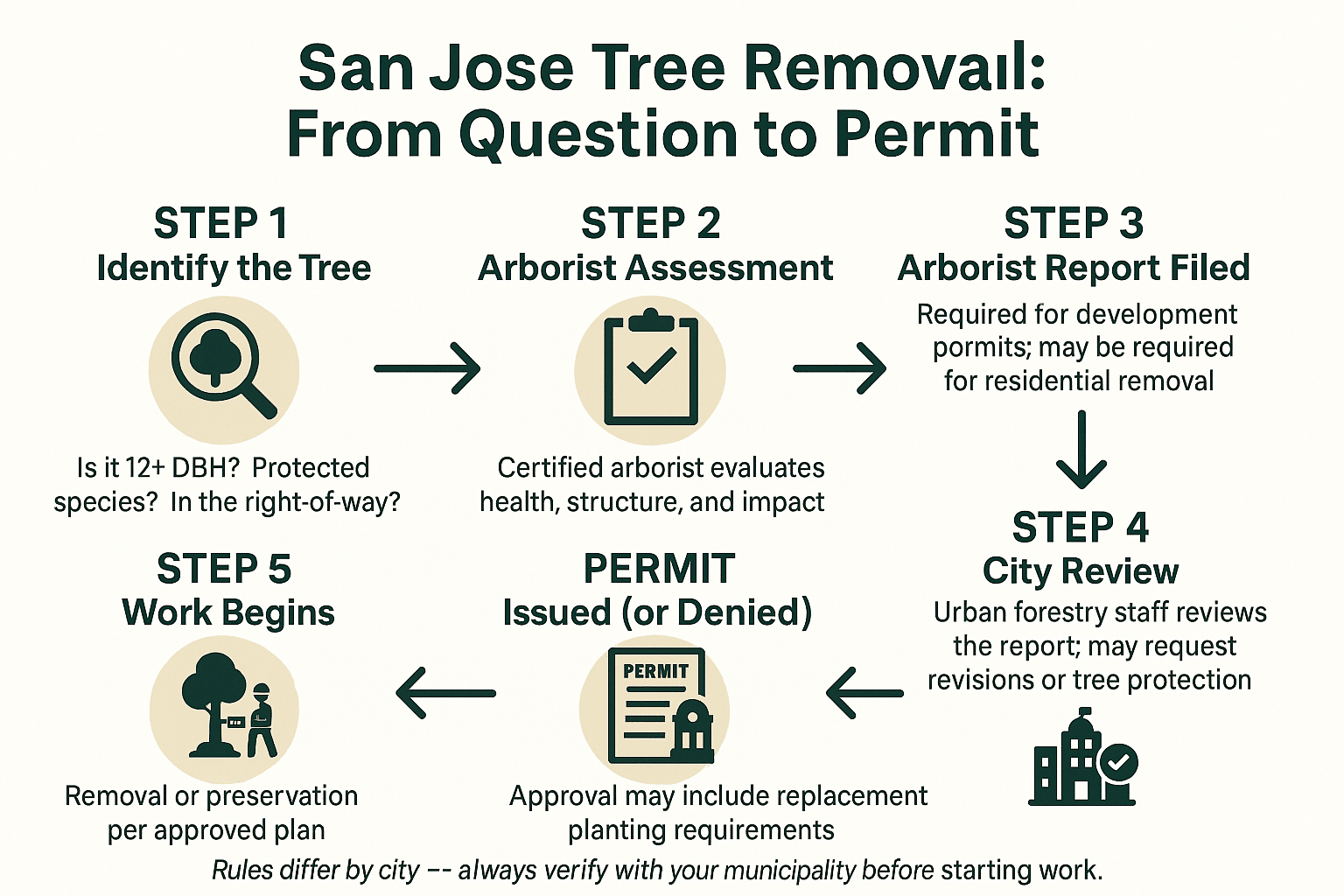
San Jose Tree Removal: From Question to Permit
This is a simplified look at how the permit process typically flows for a San Jose homeowner or property developer — from first question to approved work.
San Jose’s Rules Are Not the Same as Los Gatos, Saratoga, or Campbell
This is where I see homeowners get into real trouble — assuming that because they looked up San Jose’s rules, they know what applies everywhere. They don’t.
Each city across the South Bay manages its own tree ordinance, and the thresholds, species protections, and permit processes can be meaningfully different:
- Los Gatos has its own heritage tree designation and specific pruning rules that can require permits for significant work — not just removal
- Saratoga has protected tree regulations with separate review processes, particularly relevant for foothill properties with mature native oaks
- Campbell has its own ordinance focused on protected species and certain size thresholds that differ from San Jose’s
- Cupertino and Santa Clara each have their own standards as well
“Check your city” isn’t a throwaway line — it’s genuinely different code in each jurisdiction. If you own property in Los Gatos and you’re reading San Jose’s requirements, you may be preparing for the wrong test entirely.
For properties near city boundaries — or if you have multiple properties across different municipalities — the safest path is to have an arborist who knows the South Bay’s patchwork of local rules look at each site individually. That’s the kind of local knowledge that doesn’t come from a Google search.
And if you’re dealing with the aftermath of winter storm damage and wondering whether emergency work bypasses permits, the short answer is: sometimes, partially. Emergency work to address an immediate hazard may proceed without a standard permit, but documentation still matters — particularly if a protected tree is involved. We’ve written about what that process looks like in San Jose emergency tree services.
How Tree Rules Compare Across South Bay Cities
This isn’t a complete legal reference — ordinances change, and your specific tree may fall into a different category. But this gives a general sense of how the cities differ and why checking locally matters.
| City | General Protection Threshold | Key Considerations |
|---|---|---|
| San Jose | Typically 12″ DBH; protected species rules apply | Development permits require arborist report; replacement canopy required |
| Los Gatos | Heritage tree designation; pruning thresholds apply | Permits may be needed for significant pruning, not just removal |
| Saratoga | Protected tree ordinance; separate review process | Native oaks and foothill properties get close scrutiny |
| Campbell | Protected species and size-based rules | Thresholds differ from San Jose; verify before any work |
| Cupertino | Local ordinance applies | Check city separately — not covered under San Jose permit process |
| Santa Clara | Local ordinance applies | Adjacent to San Jose but governed by its own tree code |
The Trees Homeowners Assumed Were Goners — And Weren’t
One of the most consistent things I’ve seen over the years: homeowners come to us already convinced that all three — or all four — of their trees need to go. Sometimes they’ve had a bad experience with a previous contractor who pushed removal as the default. Sometimes they’ve just been living with a tree that looks rough and assumed the worst.
That assumption gets tested the moment a real assessment happens. One customer’s review captured it well: “the consultant looked at each tree and only recommended that one of the 3 trees be removed.” That’s not an unusual outcome. It’s actually the more common one when someone takes the time to look carefully.
A preservation-first assessment asks different questions than a removal crew does. It asks:
- Is the structural defect actually a failure risk, or is it a condition the tree can be managed around?
- Would crown reduction or cabling reduce the risk enough to keep the tree?
- Is the tree declining because of a treatable condition — drought stress, compacted soil, disease — rather than irreversible structural damage?
- What does this tree do for the property’s canopy coverage, and what would replacing it actually require under the city’s replacement standards?
This matters especially in neighborhoods like Willow Glen and Almaden Valley, where mature trees have been in the ground for 40, 50, sometimes 80 years. Those trees can’t be replaced in a homeowner’s lifetime. The question worth asking first isn’t “how do we remove it safely” — it’s when does this problem actually require an arborist and what can that assessment tell us before we make an irreversible decision.
The City-Tree Boundary: What You Can and Can’t Do
A question that comes up regularly — especially after a storm — is about trees that are clearly on or near the street. Homeowners see a city tree with a cracked branch hanging over their driveway and want to know if they can just have it taken care of.
The answer is no. Trees in the public right-of-way belong to the city, and hiring a private contractor to work on them — even for your own safety — is not permitted without city authorization. What you can do:
- Document the hazard with photos and written notes, including the date
- File a formal service request with San Jose’s urban forestry or public works department
- Follow up in writing so there’s a record of your report
This matters because if a city tree causes damage to your property and you’ve never reported the hazard, your legal position is weaker. If you have a documented history of requesting action, that changes things. The city has its own timeline for responding to these requests, and it’s not always fast — but the paper trail is worth creating.
For trees on your own property that overhang city property or the sidewalk, the rules shift again. You may have maintenance obligations for those trees, and if a branch causes damage to a pedestrian or vehicle, liability questions can get complicated quickly. That’s another situation where having a documented professional assessment on file — showing the tree was inspected and managed responsibly — provides meaningful protection.
Frequently Asked Questions About San Jose Tree Permits
Do I need a permit to remove a tree on my own property in San Jose?
It depends on the tree. If it meets San Jose’s size threshold — generally 12 inches in diameter at breast height (DBH) — or if it’s a protected species like a native oak, a permit is likely required before removal. Smaller trees and non-protected species may not need one. When in doubt, check with the city’s planning department or have a certified arborist assess the tree first.
How long does it take to get a tree removal permit in San Jose?
Timelines vary based on the complexity of the application and the city’s current workload. A straightforward residential removal permit can sometimes be processed in a few weeks. A development project requiring a full arborist report may take longer, especially if the city requests additional documentation. Getting the arborist report done early — before the permit application goes in — typically helps avoid delays.
What does a certified arborist report need to include for a San Jose development permit?
The report generally needs to cover species identification, trunk size measurements, a health and structural assessment for each tree on or near the project site, an analysis of how the proposed work affects each tree, and recommendations for preservation or mitigation. If removal is recommended, the report needs to support that conclusion — the city’s urban forestry staff reviews the reasoning, not just the conclusion.
Can I hire someone to trim or remove a tree in the city right-of-way?
No. Trees in the public right-of-way are city property. You cannot authorize private work on them. What you can do is document the hazard and file a formal request with the city’s urban forestry or public works department. Keep a written record of your request and follow up if you don’t hear back.
Does every city in the South Bay use the same tree permit rules?
No — and this trips people up. Los Gatos, Saratoga, Campbell, Cupertino, and Santa Clara each have their own ordinances with different thresholds, species protections, and review processes. What’s required in San Jose isn’t necessarily what’s required in Los Gatos or Saratoga. Always verify the rules for the specific city where the tree is located.
If a tree is a hazard after a storm, can I remove it without a permit?
Emergency situations may allow some latitude for immediate hazard work, but it’s not a blanket exemption. Documentation is still important — especially if a protected tree is involved. Contact the city before work begins if at all possible, even in an urgent situation. If the tree is actively failing and an immediate threat, safety comes first — but getting proper documentation in place afterward matters. We cover this in more detail in our article on San Jose emergency tree services.
Have a Tree That May Need a Permit — or a Project That Requires an Arborist Report?
Permit guidance and certified arborist reports are a standard part of what we do for homeowners and property developers across San Jose, Los Gatos, Saratoga, and the wider South Bay. Our work is led by a Board-Certified Master Arborist whose starting point is always assessment first — with preservation as the goal whenever it’s a safe option. If you have a tree situation that involves city permits, a development project, or just a tree you’re not sure about, we’re glad to take a look. Reach out to San Jose Tree Service & Landscaping at (408) 422-1313 or visit sanjosetreemaintenance.com to request an assessment.
