Skip to content

Direct Answer: Internal decay is found by sounding the trunk with a mallet and, where needed, taking a resistograph reading that measures how much sound wood remains. A green canopy cannot tell you either one.
Most homeowners judge a tree by its leaves. That is a reasonable instinct, and it does rule some things in. A thinning, off-color crown is a real signal worth paying attention to.
But a tree can carry a full green canopy for years while a column of decay spreads quietly behind bark that looks perfectly normal. Decay is common in mature trees. What matters is how much sound wood is left and where that sound wood sits relative to the load the trunk is carrying.
So here is my position, plainly: a tree that looks fine is not the same as a tree that has been checked, and when decay does turn up, removal is almost never the first answer. Below is how we actually look inside a trunk in Willow Glen, Almaden Valley, Los Gatos and Saratoga, and what the findings mean before anyone talks about taking anything down.
Green Leaves Rule Some Things In. They Rule Very Little Out.
The canopy tells you how the tree is doing at feeding itself right now. It says almost nothing about the structure holding that canopy up.
That is because a tree moves water and sugar through a thin layer just under the bark. The wood in the center is already dead tissue doing a structural job. Fungi can hollow out that center for a decade while the living layer keeps the leaves green.
I hear a version of the same sentence almost every week from callers who sense something is off but cannot name it. “It’s seen better days.” That instinct is usually worth trusting even when the tree photographs beautifully.
The other thing green leaves cannot rule out is the opposite problem. A tree that looks half dead in August is sometimes just a stressed tree with a repairable root zone issue, and more than one homeowner near Cherry Avenue has written to us heartbroken, certain a front yard tree was gone, when the answer was dormancy plus drought stress.
The honest summary is that canopy color is one input, not a verdict. Structure is a separate question, and it gets answered at the trunk, not from the driveway.
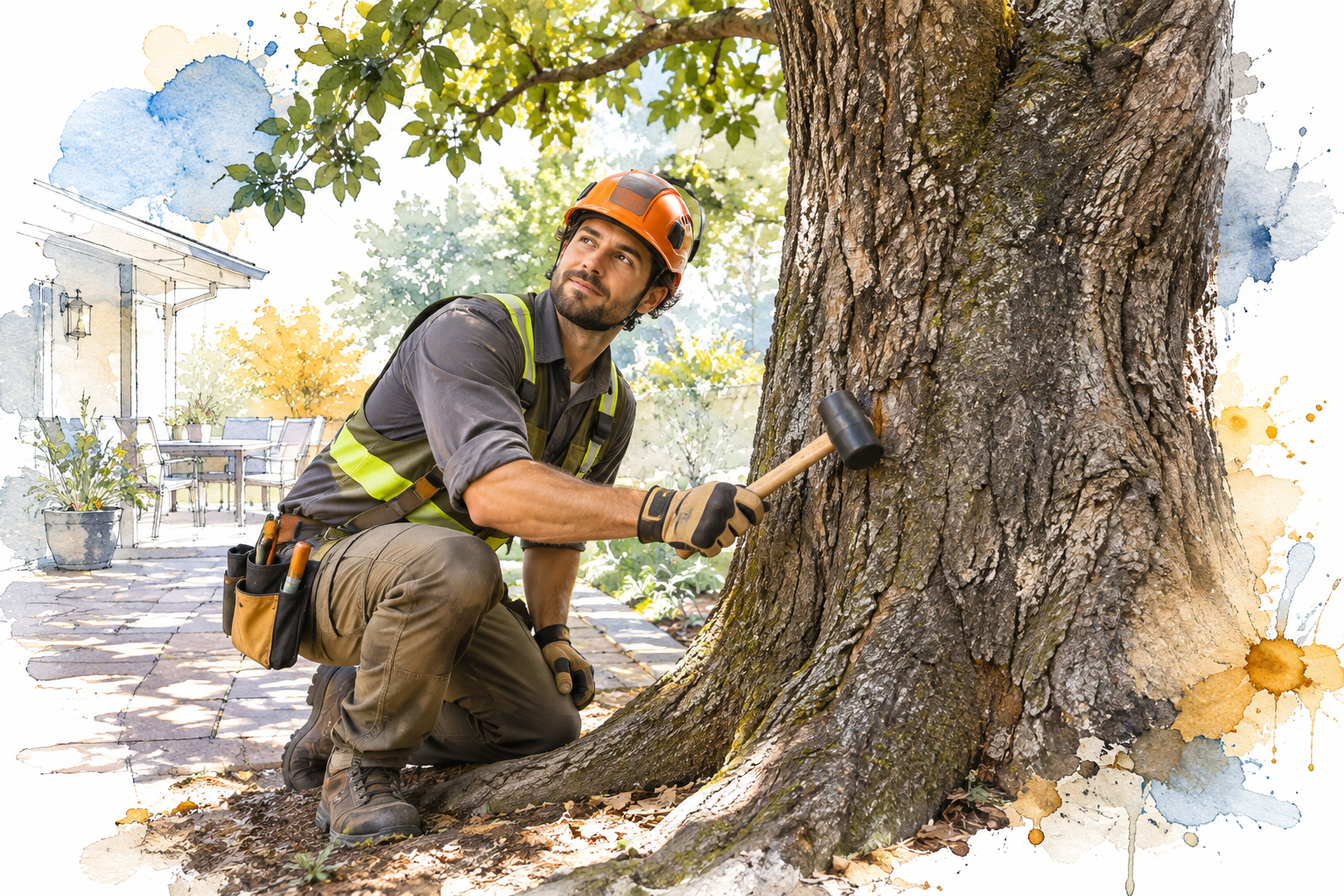
How We Actually Find Decay Inside a Trunk
There is nothing mysterious about this work, and knowing the two main methods takes away the feeling that you are paying someone to squint at your tree and offer an opinion.
Percussion testing, or sounding. We work around the trunk with a mallet and listen. Sound wood returns a tight, solid tone. A hollow or softened section returns a duller, drummier sound. This does not measure anything. What it does is tell us where to look more closely, which is the whole point of a first pass.
Resistograph readings. When sounding raises a question, we drill in with a very fine bit that measures how hard the wood pushes back as it travels inward. The resistance is recorded the whole way, so we can map where sound wood ends and decay begins at that spot.
That second one produces a number, and the number is what changes the conversation. It tells us roughly how thick the remaining shell of solid wood is at the point we tested.
No photo produces that. A walk around the yard does not either. That is the honest reason some questions need a person standing at the trunk with tools, and it is the real difference between a photo review and an on-site visit.
For straightforward trimming or a clear removal, a free photo quote or a free on-site estimate usually handles it. Our $250 Level 1 Arborist Assessment is the diagnostic version, for when the question is what is wrong and whether the tree can be kept.
What Each Check Can and Cannot Tell You
Different questions need different tools. Here is the plain version of what each one is good for.
| Method | What it answers | What it cannot tell you |
|---|---|---|
| Photos emailed in | Species, rough size, obvious deadwood, whether the job is a trimming or a diagnosis | Anything about the wood inside the trunk or the condition of the root collar |
| Visual inspection on site | Lean, old wounds, bark seams, soil movement, canopy pattern, what sits within falling distance | How much sound wood is left behind intact bark |
| Percussion testing (sounding) | Where the trunk sounds different and deserves a closer look | The extent or depth of decay, only its likely presence |
| Resistograph reading | How thick the shell of sound wood is at the tested point, and where decay starts | The condition of every other part of the tree, so placement of the test matters |
Decay Found Is Not the Same as Removal Recommended
The fear I hear most often is that paying for an assessment is a toll you pay to be told the tree has to come down. I understand where it comes from, and it is worth answering directly.
Decay is normal in mature trees. A hollow section in a 90 year old valley oak is not automatically a hazard. Trees are engineered as hollow tubes, and a tube keeps most of its strength as long as the wall stays thick enough relative to the diameter.
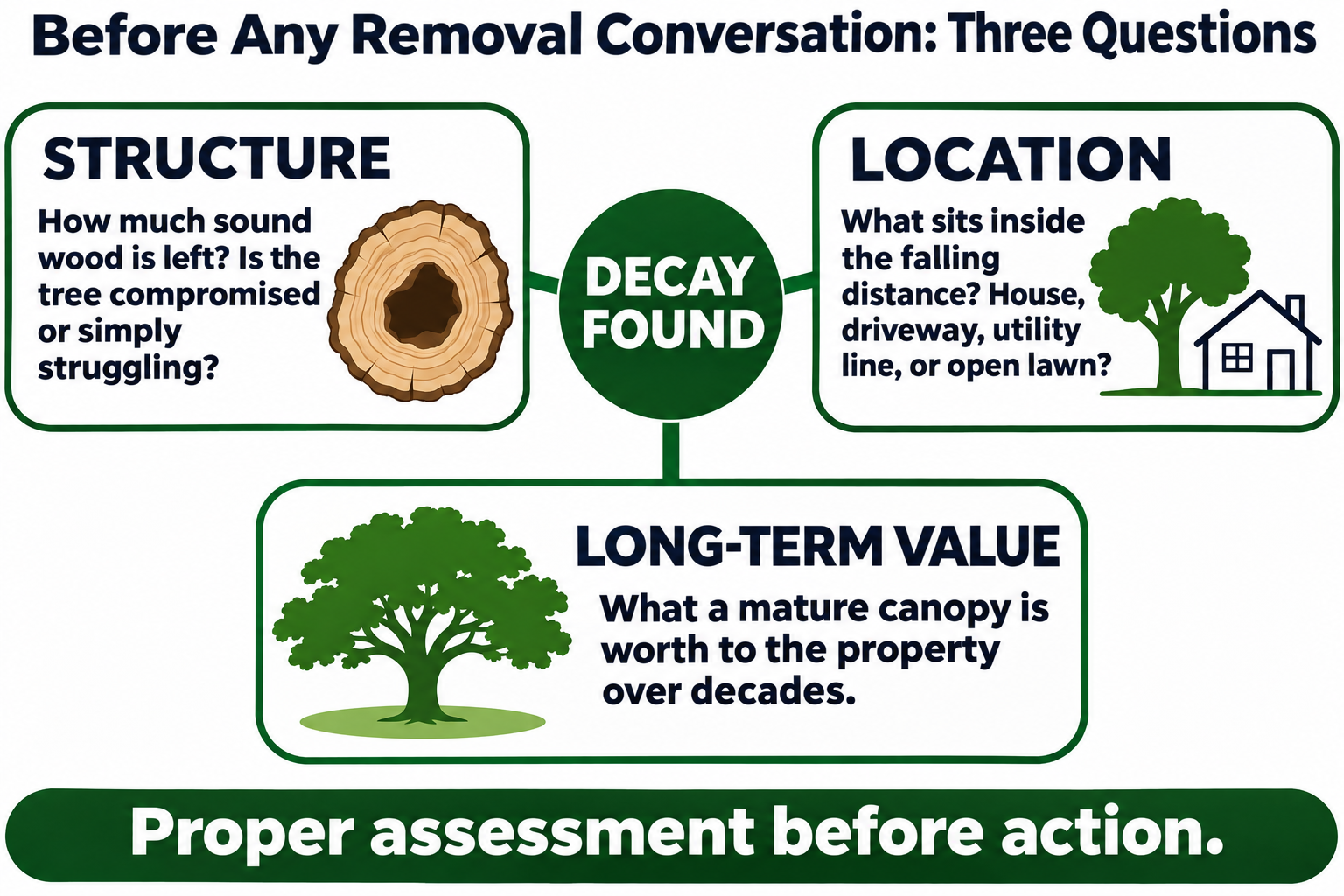
So the question is never “is there decay.” It is three questions:
- How much sound wood remains, and how thick is the wall compared to the trunk’s width
- Where the decay sits, because decay at the root collar or in a main scaffold limb carries far more weight than decay in the upper trunk
- What the trunk is being asked to carry, meaning the size and weight of the crown above the weak point
Between “leave it alone” and “take it down” there is real middle ground. Crown reduction shortens the lever arm so the weak point carries less load. Cabling and bracing can support a questionable union. Sometimes the proportionate answer is a scheduled re-check in a year with a second reading at the same spot.
Removal is the right call when a tree has lost structural integrity, when decay at the root collar or scaffold branches is past stabilizing, or when it conflicts with permitted construction. One longtime client put it the way I would want it said: “They’re super knowledgeable and never push work that doesn’t need to be done.”
The Three Things Weighed Before Any Removal Conversation
Every decay finding gets placed against these three factors before anyone recommends work.
Five Things Worth a Closer Look From the Ground
You do not need tools to notice the things that make me want to sound a trunk. Keep your eyes on the wood and the base rather than the leaves.
- Bark that sounds different or gives under a knuckle. Tap along the lower trunk. A dull, soft spot is worth a question.
- Old pruning wounds that never closed. A cut that has not grown callus tissue around its edges after several seasons is an open door for decay.
- A vertical seam running up the trunk. Long crack lines often sit over an internal column of failing wood.
- Deadwood concentrated in the upper canopy. Scattered dead twigs are normal. Dieback clustered at the top usually points to something below.
- Soil heaved or cracked on one side of the root collar. That is the ground telling you the root plate has moved.
None of these is a verdict on its own. Seeing one is a reason to ask a question, not a reason to assume the worst. If the tree is also leaning in a way that worries you, that moves it up the list.
The Same Trunk, Two Different Conversations
Decay matters differently depending on what is underneath it.
A hollowing trunk at the back of a half acre in Almaden Valley, with nothing but lawn inside its fall radius, is a monitoring conversation. We take a reading, note it, and look again next year.
That same trunk standing fifteen feet from a bedroom in Willow Glen is a different conversation entirely, with the same wood and the same reading. Place your own tree on that scale before anyone quotes you anything.
Season matters too. Our clay-heavy South Bay soils hold water, and a saturated root plate plus wind loads a weak point in ways a dry September never does. NOAA’s winter outlook released in October leans wetter than average for California from December through February.
That is a good argument for checking a structurally questionable tree in November rather than January, which is also when callers tell us the same thing: it has not been trimmed in years and they want it handled before the rains. If storms are the specific worry, it helps to know what a risk inspection actually covers.
Frequently Asked Questions About Internal Tree Decay
Can you tell if my trunk is hollow from photos?
No. Photos are genuinely useful for species, size, deadwood and scoping a trimming job, and we review them at no charge. But internal decay sits behind intact bark, so it takes sounding and, where needed, a resistograph reading at the trunk.
Does a hollow trunk always mean the tree has to come down?
Not at all. Trees hold most of their strength as a hollow tube as long as the wall of sound wood stays thick enough for the crown above it. Decay at the root collar or in a main scaffold limb is the serious version. Decay in the middle of a well-tapered trunk often is not.
What does a diagnostic visit cost compared to an estimate?
An estimate for trimming or removal is free, by photo or on site. The Level 1 Arborist Assessment is $250, and that is the diagnostic version, for when the question is what is wrong with the tree and whether it can be saved. Call to confirm which one your situation needs before you book.
When is the right time of year to do this?
Structural checks can happen any time, and late fall before heavy rain is the most useful window. Pruning timing is species specific. Most deciduous trees prune best in late winter, and California oaks should only be pruned roughly July through October to keep cuts away from wet-weather pathogens.
Mushrooms came up at the base after a storm. Is that decay?
It can be, because many of the fungi that break down wood fruit at the root collar. It depends heavily on which fungus and where. We wrote about that separately, since it is a common and understandably alarming sight.
Wondering What Your Trunk Is Doing Behind the Bark?
Diagnostic visits for trees in San Jose, Los Gatos, Saratoga and Campbell are handled personally by our Board-Certified Master Arborist, the highest credential the ISA awards, because reading a trunk is a different discipline from cutting one. San Jose Tree & Landcare is CSLB licensed in both tree service and landscaping and has been BBB accredited since 2013. If you have noticed something and want an expert read before you decide anything, you are welcome to call (408) 422-1313 or visit sanjosetree.com.