 Skip to content

Direct Answer: Young trees under roughly three to four inches in trunk diameter can often be straightened with staking and guying. Mature trees that have leaned for years usually should be assessed for root integrity instead.
You walk out to the driveway one morning, look up, and the tree looks off. Maybe it always looked that way and you finally noticed. Maybe it genuinely moved after the last storm.
I get this call constantly from homeowners in Willow Glen, Almaden Valley, and up the hill in Los Gatos. The words are usually some version of “it’s seen better days” or “it just doesn’t look right anymore.”
Here is the good news. A lean by itself is not a verdict. What matters is whether the lean is new, whether the roots are holding, and what sits underneath the tree if it ever did fail.
The First Question Is Not How Far It Leans, It Is When It Started
Trees lean for ordinary reasons. They grow toward light, they get crowded by a neighbor’s canopy, they respond to years of wind coming off the same direction. Some species just develop a lean over decades and never lose an ounce of root strength.
So when I walk a property, my first question is almost never “how many degrees?” It is “has this changed recently?”
A tree that has held the same angle since your kids were in elementary school is a different animal from one that shifted after a wet February. Here is what I ask homeowners to think back on:
- Do you have old photos of the yard, holiday pictures, real estate listing shots, that show the same tree?
- Did the lean appear or worsen after a specific storm or an unusually wet winter?
- Did a neighbor do construction, trenching, or grading near the root zone in the last few years?
- Has anything at the base changed, like soil pushing up, a crack in the lawn, or pavers lifting?
A long-standing lean is usually the tree’s anatomy. A new or progressing lean is a structural event, and those two things get handled very differently.
How to Straighten a Leaning Tree, and When You Should Not Try
This is the question people are actually typing into Google, so let me answer it plainly.
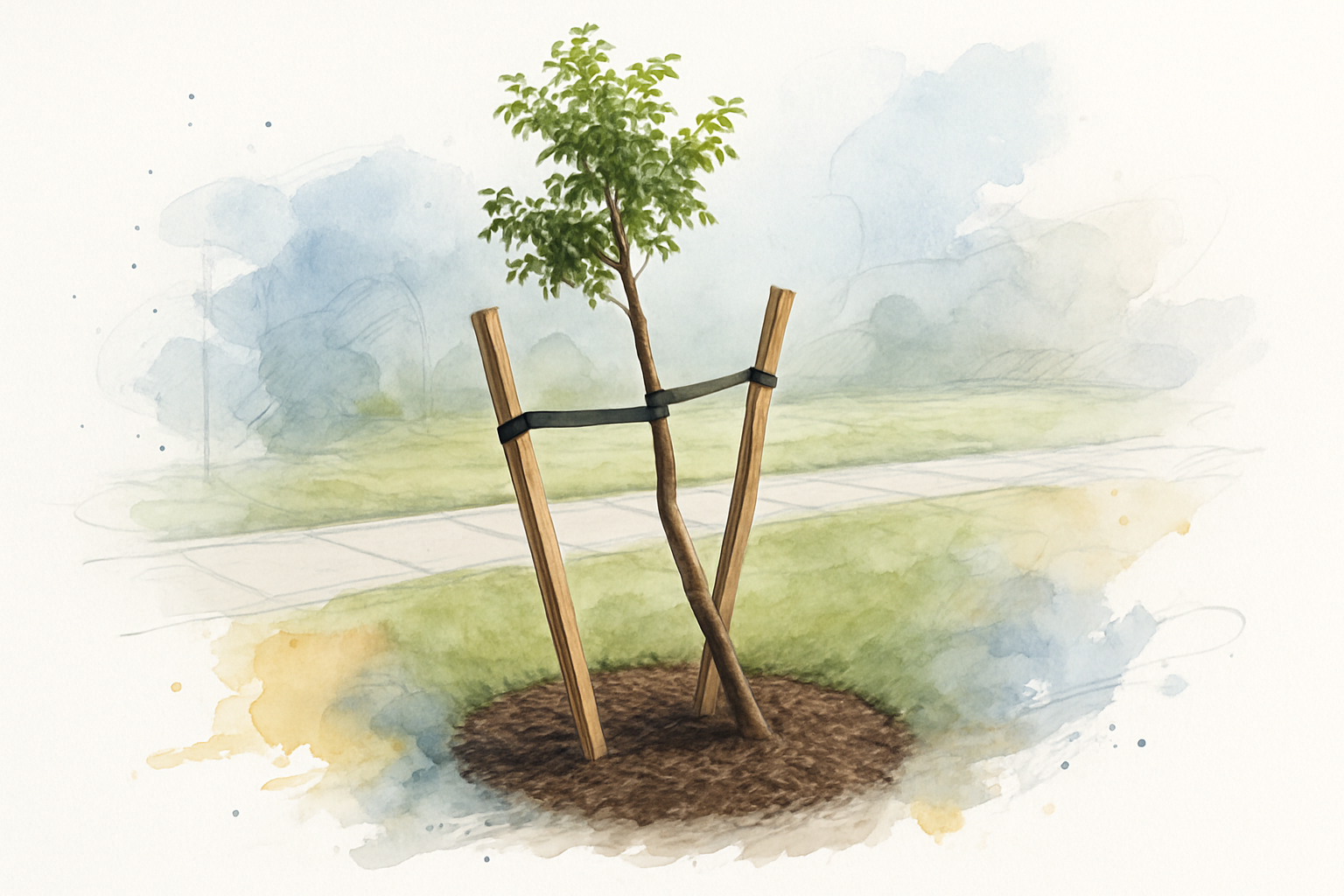
Young trees can often be corrected. If the trunk is under roughly three to four inches in diameter and the root system is still establishing, staking and guying can gradually bring it upright. The keys are catching it early, using wide flexible straps instead of wire or rope that cuts bark, and removing the support once the tree stabilizes.
Staking left on too long causes its own damage. It creates a weak trunk that never learned to flex, and I have seen straps girdle a young tree years after everyone forgot they were there. If you want the step-by-step version, we cover it in more detail in our guide on how do you straighten a tree.
Established trees are a different story. A mature tree that has leaned for years has already built structural wood in the direction of that lean. The trunk has thickened on one side, the roots have anchored to counter it, and the whole system has balanced itself around that angle.
Trying to winch a tree like that upright does not fix anything. It tears anchoring roots, stresses the trunk, and often creates the exact failure risk you were trying to prevent. At that point the honest answer is that the lean is not the problem to solve. Root integrity is.
Can This Tree Be Straightened? A Quick Reference
This is roughly how I sort leaning trees during a site visit. Every property is different, but the pattern holds up.
| Situation | Can it be straightened? | What usually happens instead |
|---|---|---|
| Newly planted tree, under 3-4 inches trunk diameter, lean noticed within the first couple of seasons | Usually yes | Staking and guying with wide straps, support removed once stable |
| Young tree leaning because of a one-time event like a storm or a bumped stake | Often yes if caught early | Reset, temporary support, correct planting depth checked |
| Mature tree with a long-standing lean, no soil movement | No, and it should not be attempted | Monitor, prune for canopy balance, document the baseline angle |
| Mature tree with a lean that appeared or worsened recently | No | Root plate inspection, decay evaluation, risk assessment |
| Any tree with heaving or cracked soil at the base | No | Treated as a possible failure in progress, area kept clear until assessed |
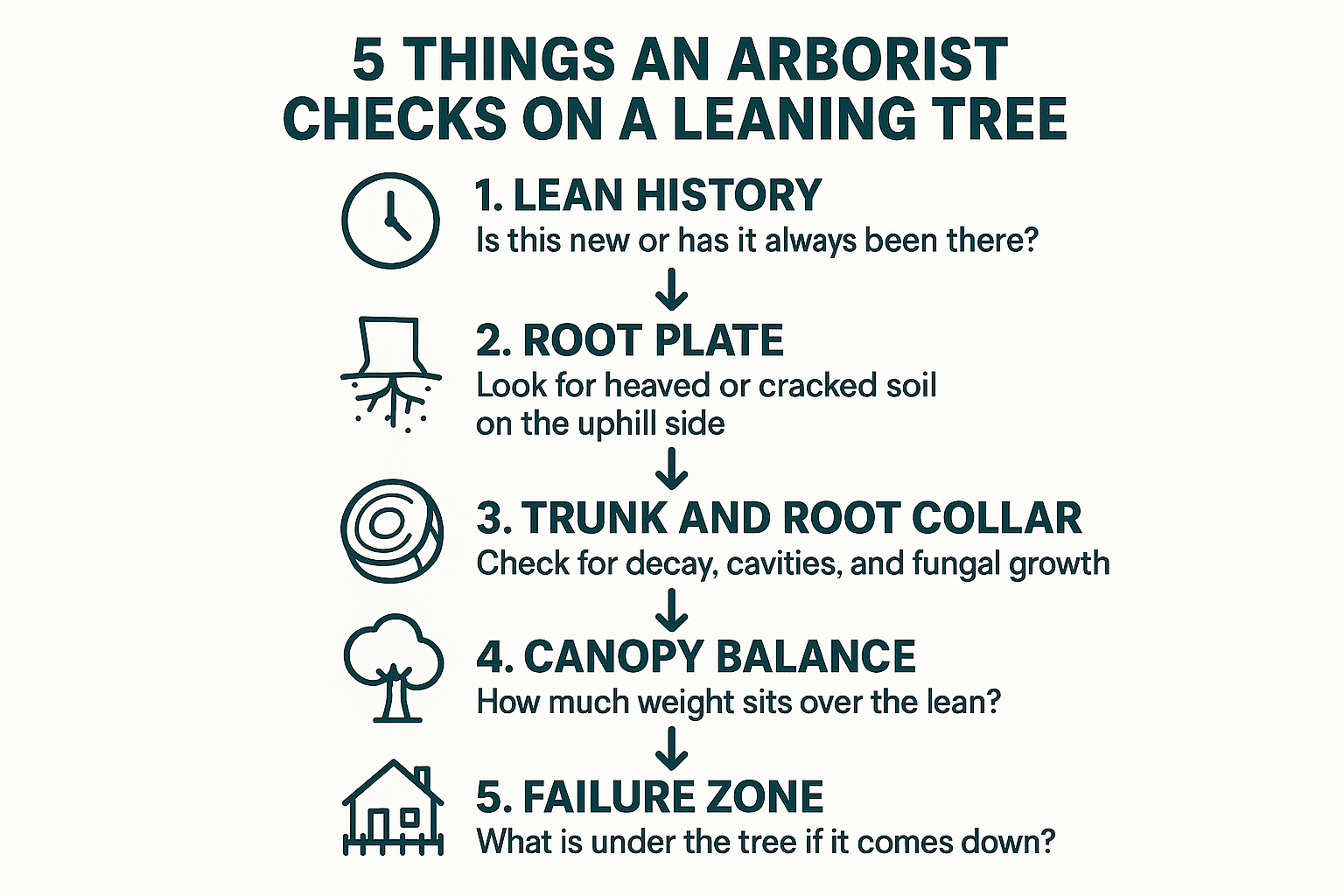
The Five Things I Check on a Leaning Tree
Here is the short version of what an on-site look at a leaning tree actually covers.
Root Plate Movement Is the Signal I Take Most Seriously
If you only remember one thing from this article, make it this one.
Walk to the base of the tree and look at the ground on the uphill side of the lean, meaning the side opposite the direction it is tipping toward. You are looking for:
- Soil that is slightly mounded or heaved up
- A crescent-shaped crack in the lawn or bare dirt around the base
- Turf that has pulled apart or lifted like a rug edge
- Roots that appear to be rising out of the ground on one side
That is root plate movement, and it means the anchoring roots may already be failing. The tree’s center of gravity has shifted past the point the root system can counter. This is not an aesthetic lean. It is a mechanical problem.
San Jose’s heavy clay soils make this worse in the wet months. Clay holds water, saturated soil loses grip, and a tree that stood fine through years of dry summers can start moving during a long wet stretch. We wrote more about that pattern in how El Niño winters change tree care planning.
If you see soil movement, keep people, cars, and patio furniture out from under the canopy and get eyes on it. Storm-related movement in particular is covered in our piece on what to do when a tree looks dangerous after a storm.
What Actually Happens After the Assessment
Homeowners often assume the conversation ends with removal. In my experience, it usually does not.
Most leaning trees in established San Jose yards need neither straightening nor removal. What they need is a clear-eyed read on three things: root integrity, movement history, and what sits in the failure zone.
Depending on what that shows, the realistic outcomes look like this:
- Monitor and document. The angle gets recorded so future changes are measurable instead of a guess.
- Reduce end weight. Selective pruning to take load off the leaning side, without topping, which never makes a tree safer.
- Support hardware. In some cases cabling and bracing addresses a weak union contributing to the lean.
- Decay testing. Percussion testing or resistograph work when the trunk or root collar looks questionable.
- Removal. Reserved for trees that have genuinely lost structural integrity and sit over something that matters.
Costs vary a lot depending on tree size, access, and whether hardware or permits are involved, so I would not trust anyone who quotes a leaning tree over the phone. Ask what the visit includes and what you get in writing. The International Society of Arboriculture’s homeowner resources are a good neutral place to read up before you talk to anyone.
Proper assessment before action. That principle has kept a lot of good trees standing in Almaden Valley and Saratoga that another crew would have taken down.
Frequently Asked Questions About Leaning Trees
My tree has leaned for 20 years. Do I need to do anything?
Probably not beyond normal care. A stable long-term lean with no soil movement, no decay at the base, and a balanced canopy is usually just how that tree grew. The thing worth doing is establishing a baseline so you can tell later if it ever starts moving.
How much of a lean is too much?
There is no magic number, and anyone who gives you one is guessing. A tree leaning 15 degrees with a solid root plate over an empty side yard is a lower concern than a tree leaning 5 degrees with heaved soil over a bedroom. Location and root condition matter more than the angle.
Can I straighten a leaning tree myself with a rope and stakes?
On a small young tree, yes, with wide flexible straps and support removed within a season or two. On anything with a trunk thicker than your forearm, no. Pulling on an established tree tears roots and can cause the failure you were trying to prevent.
Do I need a permit before doing work on a leaning tree in San Jose?
Possibly. San Jose regulates street trees in the park strip between the sidewalk and the curb, and that includes pruning, not just removal. Protected trees on private property can also require review. It is worth confirming before any cutting happens.
Can you tell anything from photos, or does someone have to come out?
Photos help more than people expect for canopy issues and general condition. But root plate movement, soil cracking, and decay at the root collar are things I want to see and touch in person. For a leaning tree specifically, an on-site look is the honest answer.
Want a Straight Answer on a Leaning Tree?
A leaning tree assessment is a one-visit conversation, not a multi-step project, and it gives you a defensible answer either way. We work with homeowners across San Jose, Willow Glen, Almaden Valley, Los Gatos, Saratoga, and Campbell, and we have been BBB accredited since 2013. If you want a second set of eyes on a tree that has you wondering, we are reachable at (408) 422-1313 or sanjosetreemaintenance.com.
