Skip to content

Direct Answer: A young tree that has not grown in two years is usually underwatered at depth, not diseased. In clay soil, water deeply and less often, and move emitters outward as the canopy widens.
The call comes in a few different ways, but it is always the same story. Three trees went in two springs ago, they leafed out beautifully that first year, and now they just sit there. Same height, same skinny trunks, maybe some browning at the tips.
In Willow Glen, Almaden Valley, Los Gatos and Saratoga, the cause is usually not a pest and not a disease. It is water delivery and planting depth, and both are still fixable while the tree is young.
I want to lead with the reassuring part. A stalled two-year-old tree is rarely a death sentence, and the fix is often a change to the irrigation rather than a replacement. Below is how I work through it on a property, in the order I actually look at things.
“It Looked Fine Last Year” Is Not Proof of a Healthy Root System
This is the part homeowners find hardest to accept, and it is the most important thing in this article. A tree planted too deep, or planted with its roots still circling in the shape of the nursery container, can look completely normal for one to two growing seasons.
That first year, the tree is living off the root ball and the soil it came in. The decline happens underground long before anything shows up in the canopy. The gap between the planting mistake and the visible symptom is often two full growing seasons, which is exactly why so many of these calls land at the two-year mark.
Here is what a stalled young tree usually looks like in year two:
- The trunk has not thickened, even if the tree gained a little height
- New shoots at the branch tips are short, a few inches instead of a foot or more
- Leaf edges scorch brown in July and August while the interior stays green
- Fall color arrives early, sometimes in August
- The top of the canopy thins out first
None of that tells you the tree is dying. It tells you the roots are not supporting the canopy yet. With a young tree, there is usually still time to change the outcome, and the goal stays what it always is: safety, health, and longevity.
Start by Finding Out Which Valve Your Trees Are On
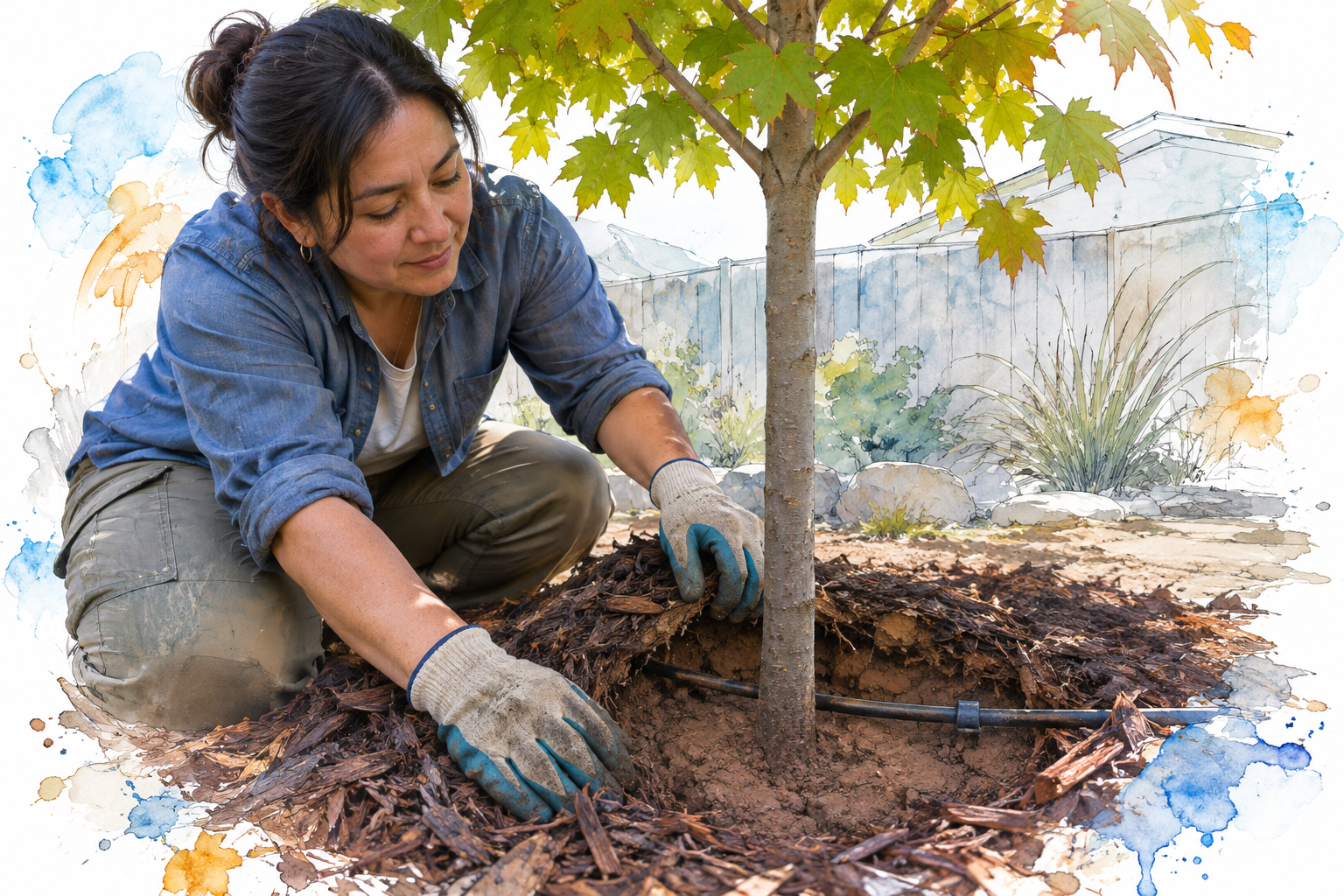
The single most common hidden cause I find is that the young trees share an irrigation zone with pots, annuals, or groundcover. Those plantings want short, frequent cycles, often a few minutes every day or two.
That schedule keeps water in the top two or three inches of soil. A young tree’s roots follow the water, so they never learn to go down. Two years later you have a tree with a shallow root plate and a canopy it cannot supply.
One homeowner who had rebuilt their house and put in a whole new landscape wrote in asking for exactly this: split the existing drip lines into more zones, because growing trees were grouped with small potted plants. That is the right instinct, and it is a change most systems can absorb without starting over.
To check your own setup:
- Open the controller and run one valve at a time manually for two minutes
- Walk the property while it runs and note which emitters come on
- If your trees come on at the same time as pots or flower beds, they are sharing a zone
- Look at where the emitters sit on the ground near each tree
That last one matters more than people expect. The emitters placed at planting time almost never get moved. A tree with a canopy ten feet across is often still being watered in a one-foot circle at the trunk, which is nowhere near where the working roots are now.
How to Tell a Tree Zone From a Shrub or Pot Zone
If you only have one shared zone, this is what it does to each type of planting. It explains why a schedule that keeps your pots alive quietly starves a young tree.
| Zone type | Typical schedule | What it does to a young tree |
|---|---|---|
| Pots and annuals | 5 to 10 minutes, daily or near daily | Keeps moisture in the top few inches, roots stay shallow |
| Shrubs and groundcover | 15 to 20 minutes, two or three times a week | Better, but still rarely reaches root depth in clay |
| Young trees | Long, slow soak, roughly weekly in summer | Pulls roots downward and outward, which is the goal |
| Shared mixed zone | Set for whatever is fussiest | The tree always loses, because pots dictate the timer |
Clay Soil Changes the Answer in Both Directions
Most watering advice online is written for soil that drains. South Bay clay does not drain, and that cuts both ways.
In February, heavy clay in Willow Glen or Almaden can hold water around young roots for days after a storm. In August, that same soil can go hard enough that water runs sideways across the surface and never soaks in. The surface lies to you in both seasons.
So I do not hand people a universal schedule. I give them an observation habit instead:
- Before you water, take a hand trowel and dig four to six inches down at the edge of the canopy, not at the trunk
- If the soil there is cool and damp and holds together when squeezed, skip the watering
- If it is dry and crumbly at that depth, run a long, slow soak
- Check the same spot the day after watering to confirm the water actually got down there
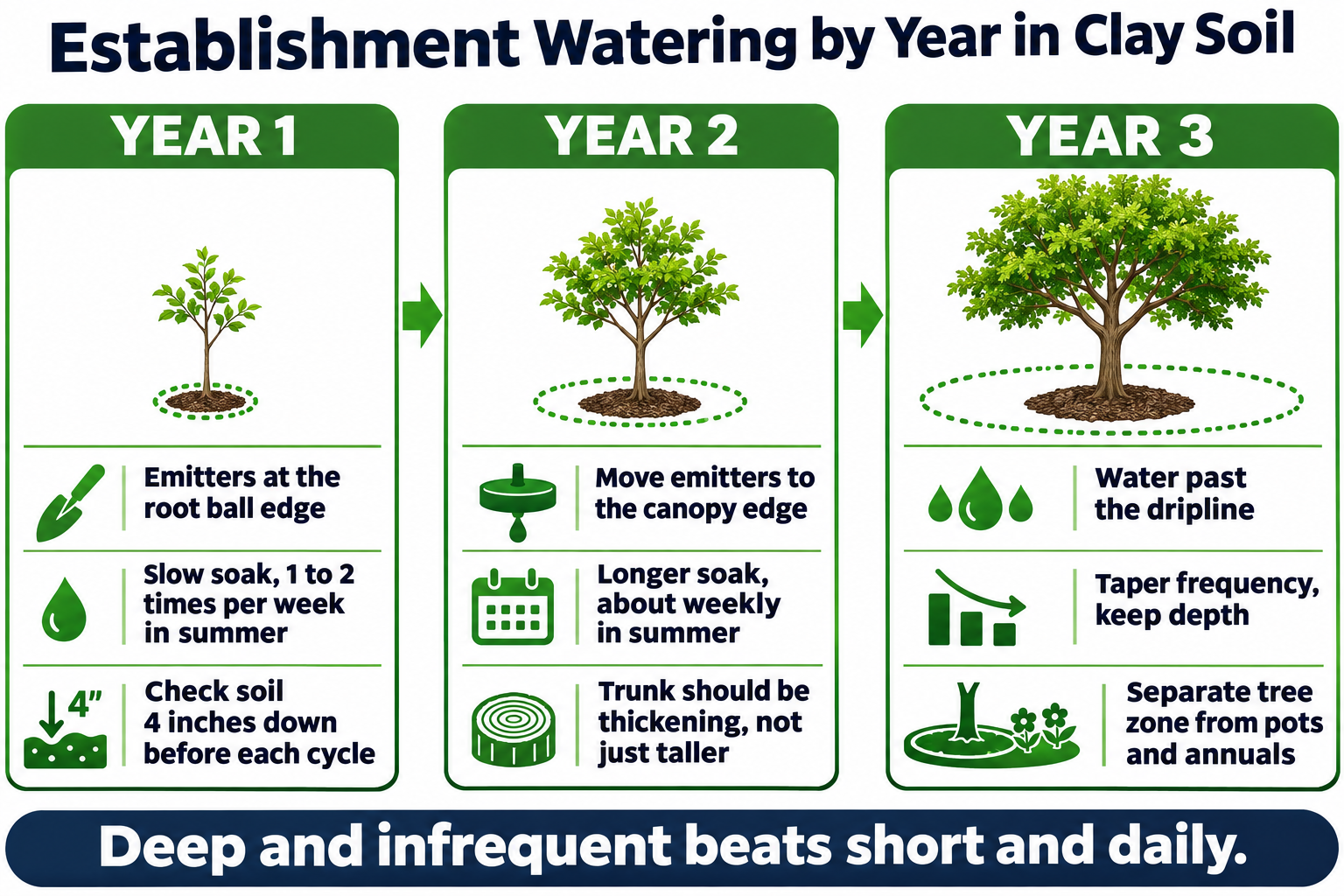
Deep and infrequent beats short and daily in this soil, every time of year. And the watering ring should follow the roots outward. By year two the emitters belong out near the dripline, and by year three they should be past it, because that is where the absorbing roots have moved.
If you have mushrooms showing up at the base after rain, that is a separate signal worth reading. I covered what mushrooms at the trunk actually mean in another piece.
Establishment Watering, Year by Year
Establishment is not one setting you lock in at planting. The ring of water needs to move outward as the roots do.
The Wet Winter Trap, and What I Tell People to Do About It
This is the decision in front of South Bay homeowners right now, and both of the common responses are wrong.
Leaving your summer drip schedule running straight through a wet winter can keep clay soil saturated around young roots for weeks. Roots need air as well as water, and in heavy soil that balance tips fast. Shutting the controller off completely in November and forgetting about it is the other failure, because a three-week dry stretch between February storms will quietly stress a two-year-old tree with a shallow root plate.
The forecast matters here. NOAA’s Climate Prediction Center expects El Nino to persist into spring 2027, with a strong event most likely through the first months of the year. Wetter on average does not mean evenly wet.
So my winter rule is simple: switch the controller to manual instead of off. Then watch the gaps between storms rather than the calendar.
- After a real soaking storm, leave it alone for at least a week
- Do the trowel test at the canopy edge before you run anything
- If two to three weeks pass with no rain, run one deep soak
- Turn the automatic schedule back on when the dry stretch settles in, usually April or May
That is it. No panic, no daily fiddling, just checking the soil before you act.
What a Photo Can Tell Me, and What It Cannot
A lot of people email photos before they commit to anything, and I think that is a smart first move. It costs nothing and it often answers the question.
From good photos I can usually confirm the species, read the pattern of canopy thinning, tell leaf scorch from a fungal issue, and sometimes spot a trunk going into the ground like a post with no root flare showing. That last one alone explains a lot of stalled trees.
What photos cannot show me:
- Soil moisture at root depth
- Where the emitters actually sit and how long they run
- Girdling roots circling just under the mulch
- How deep the root ball was set at planting
- Whether drainage is holding water in the planting hole
Those need someone at the trunk with a hand trowel. I wrote more about where the line falls between a photo read and an on-site visit if you want the longer version.
The worry I hear underneath this is that paying for a visit only buys the news that the tree has to come out. That is not how I approach a young tree. Preservation comes first, and with a two-year-old tree the answer is usually an irrigation change. One homeowner put it this way in a review: “He was helpful in training us how to care for all of the trees on our property and also with suggesting which type of tree we could replant in this location.” That is the conversation I want to be having.
Frequently Asked Questions About Watering Young Trees in Clay Soil
How much water does a two-year-old tree need in San Jose clay?
Less often than you think, and much longer each time. A slow soak that wets the soil six to twelve inches down at the canopy edge, roughly once a week in summer heat, does more for a young tree than daily short cycles. Dig down with a trowel before each watering and let the soil decide.
Should I fertilize a tree that has not grown in two years?
Usually not as the first move. Fertilizer pushes top growth that a struggling root system cannot support, and in clay soil the problem is almost always water or planting depth rather than nutrients. Fix the water delivery first and give the tree a season to respond.
Is it too late if the tree has been in the ground three or four years?
Often not, but the window is narrowing. Girdling roots and a buried root flare get harder to correct as the trunk thickens, so the sooner someone looks, the more options there are. I have seen trees turn around in year four and I have seen trees past saving in year three, which is why an actual look matters more than a rule of thumb.
Can I move the drip emitters myself?
Yes, and for most systems it is a reasonable homeowner job. Pull the emitter and relocate it out toward the canopy edge, or add a second line so the tree gets a ring rather than a single point. If the trees share a valve with pots or annuals, that part usually needs a real zoning change rather than a tweak.
What does an on-site arborist visit cost?
Photo reviews and on-site estimates for tree work are free. A formal arborist diagnostic visit carries a fee because it is a different kind of work, and what it covers varies with the property and the question. Call the office and ask what a current visit includes before you book one.
Looking at a Young Tree That Has Not Moved in Two Years?
One thing worth knowing as you sort this out: we hold both a tree service and a C-27 landscaping classification under the same CSLB license, so the person reading your tree can also look at the drip zoning, emitter placement and drainage that caused the problem. Most homeowners in this spot end up coordinating two contractors who each point at the other. If you would like a look at your trees in San Jose, Willow Glen, Almaden Valley, Los Gatos or Saratoga, you can reach us at (408) 422-1313 or sanjosetree.com, and sending photos first is always a fine place to start.