
Direct Answer: Mushrooms in the lawn are usually harmless soil fungi. Fruiting bodies growing directly from the trunk, root flare, or a buttress root usually mean wood inside has already been decaying for years.
A storm moves through San Jose, the ground finally softens, and four or five days later something new is sitting at the base of your tree. Sometimes it is a cluster of soft mushrooms. Sometimes it is a hard, shelf-like growth pushing straight out of the bark right where the trunk widens into the roots.
People call and describe it in plain words. The tree looks bad. It has seen better days. Almost nobody says “my tree is in decline,” and honestly, that reaction is the right one. Something changed, and you noticed.
So let me give you the part that actually matters, in order: what the location of that growth tells us, why the mushroom is a late signal rather than a new one, and why finding it in November means something different than finding it in July.
The First Thing I Look At Is Where It Is Growing
Not all mushrooms near a tree are about the tree. This one distinction sorts out most of the worry on the first phone call.
- Mushrooms scattered in the lawn or in mulch a few feet out from the trunk. Usually harmless soil fungi doing normal work on organic matter. Common after any wet stretch in Willow Glen and Almaden Valley, where lawns and bark mulch stay damp for days.
- Mushrooms in a ring or an arc across open turf. Still a soil and thatch story, not a structural one.
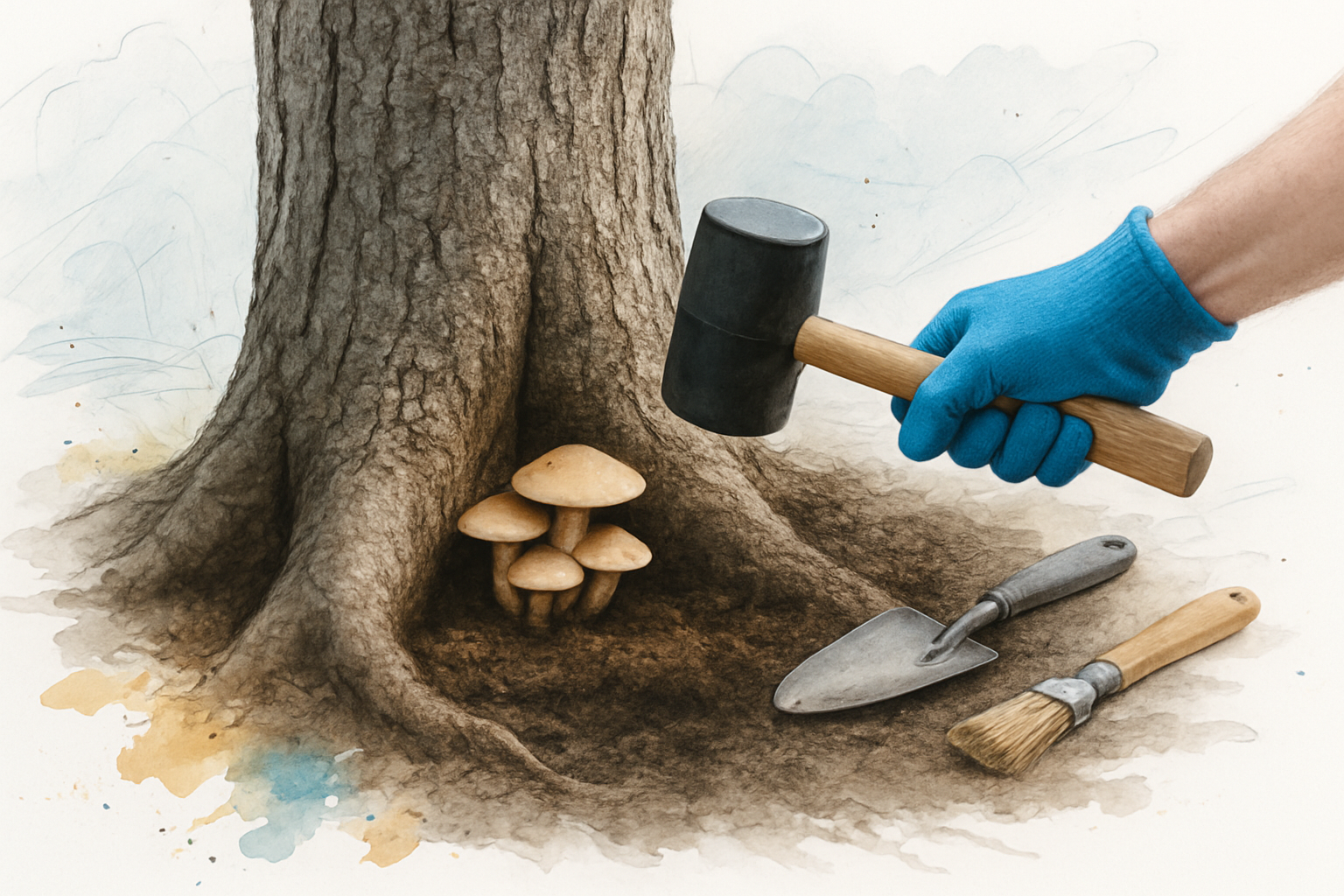
- Fruiting bodies attached directly to the trunk, the root flare, or a buttress root. Different conversation. Wood-decay fungi only fruit where they have wood to eat, and that wood is holding your tree up.
Texture is worth noting too. Soft and fleshy versus hard and woody points toward different groups of fungi, and the hard, layered conks tend to show up on wood that has been breaking down for a long while.
A growth touching the flare is not proof the tree has to come down. It is proof the base deserves a real look instead of a guess from the kitchen window.
The Mushroom Is Late News, Not New News
Here is the idea I most want homeowners to walk away with. Wood-decay fungi live inside the roots and trunk for years before they ever produce a mushroom. Fruiting is the last step in a process that started long before you saw anything.
That explains three things people find confusing:
- Scraping or knocking the conks off does nothing. You removed the fruit, not the organism. University horticulture guidance is clear that mushrooms at the base of a trunk can signal root and butt rot already established inside the tree, and that removing the mushroom does not cure the decay.
- A tree can look great up top and be weak at the bottom. Canopy health and structural strength are two separate measurements. I have seen full, green, beautiful crowns on trunks that had very little sound wood left at the base.
- The rain did not cause this. Wet weather triggered the fruiting. The decay was already there.
So no, this is not a reason to panic. But it is a reason to get an answer this season rather than giving it a wait-and-see year. Waiting does not tell you anything new. An assessment does.
Why a Wet Winter Changes the Timing of the Inspection
NOAA has been tracking a very strong El Niño heading into the 2026-27 winter, with forecasters putting roughly a 63 percent chance that it ranks among the largest events since 1950. For California, that points toward a wetter than normal season.
That matters here for a specific, physical reason. Much of the South Bay sits on clay-heavy soil that holds water and gets heavy and slick when saturated. Saturated ground plus wind is the combination that pulls trees over, and it does not need a hurricane to do it.
A tree whose root plate has already lost strength to rot is exactly the tree that goes over in that scenario. The canopy acts like a sail, the soil gives, and the compromised roots cannot hold the load.
This is why basal fungi found in November gets a faster appointment than the same finding in July. Not because the tree changed, but because the loading on it is about to. If you are already thinking about the season ahead, it is worth reading through the steps homeowners here can take to prepare trees for a wet winter alongside whatever we find at the base.
What Actually Happens During a Basal Decay Assessment
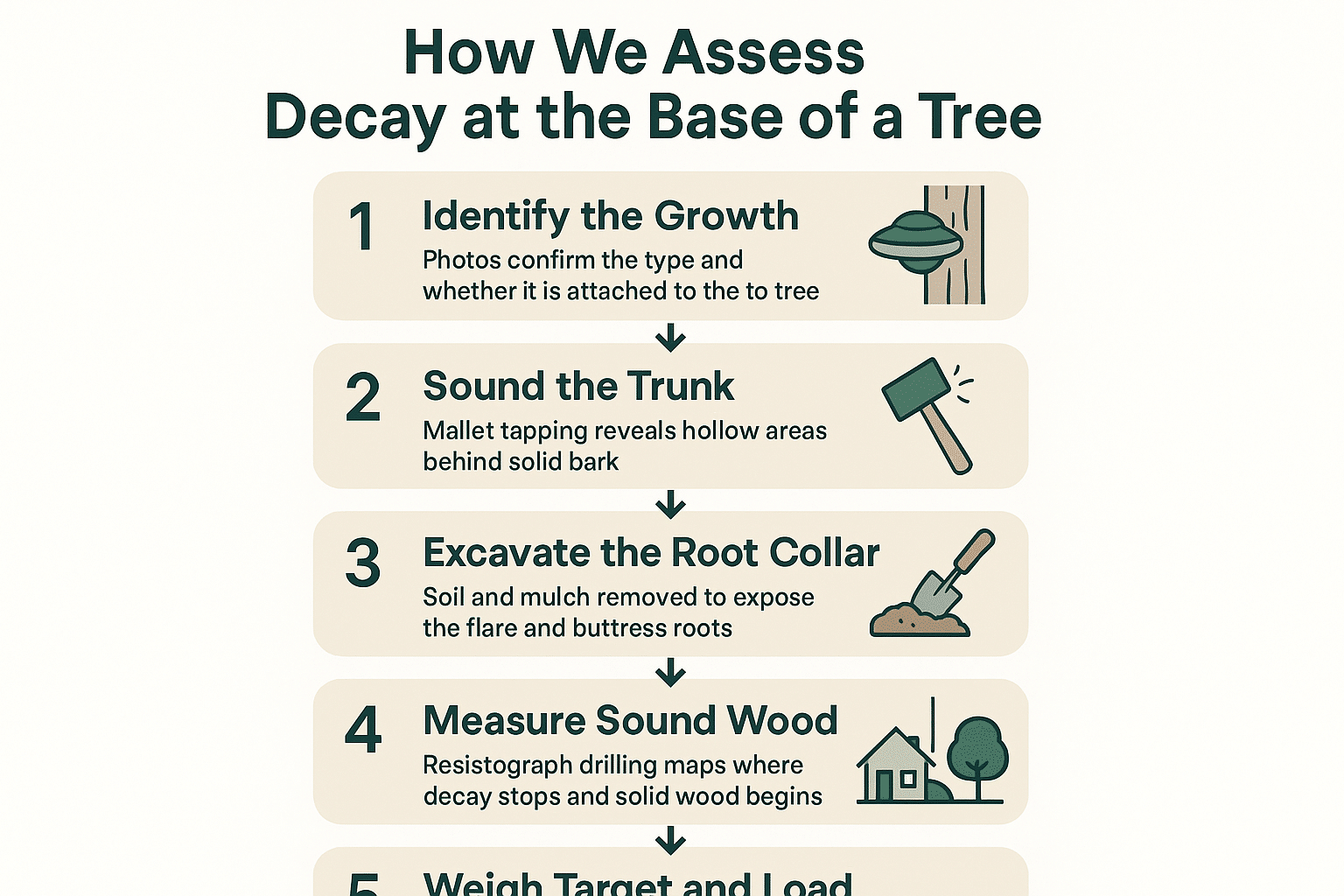
Here is the sequence I follow when a homeowner calls about growths at the base of a tree, from the photo they send to the recommendation at the end.
What an On-Site Visit Adds That a Photo Cannot
A good number of callers ask the same practical question: can I just email photos first? Yes, and photos genuinely help. They tell me what kind of fruiting body we are looking at and, just as important, whether it is attached to the tree at all.
What a photo cannot do is measure how much sound wood is left holding the tree up. That takes hands on the trunk:
- Sounding with a mallet to listen for hollow response behind bark that looks perfectly normal.
- Excavating soil and mulch off the root collar so the flare and buttress roots are actually visible. Buried root collars are one of the most common things I uncover, and they keep the base wet.
- Resistograph drilling where the situation calls for it. A very fine bit measures how hard the wood pushes back, which maps where decay ends and solid wood begins with far more precision than looking at the outside.
One more thing worth knowing up front: a photo review or a work estimate generally comes without a fee, while a full on-site diagnostic consultation typically does carry one, and a formal written report costs more than a verbal one. Fees change, so ask us for current specifics. We also wrote up when a tree visit is free and when it comes with a fee if you want the longer version.
Photo Review vs. On-Site Visit: What Each One Can Answer
Both have a place. This is roughly how I sort which questions each one can honestly answer.
| What you want to know | Photos can usually answer it | Needs someone on site |
|---|---|---|
| Is this growth attached to my tree or just in the soil? | Yes | Only if the attachment point is buried |
| What type of fungus am I looking at? | Often, at least the group | For confirmation in unclear cases |
| Is my root collar buried or staying wet? | Rarely | Yes, requires excavation |
| How much sound wood is left at the base? | No | Yes, sounding and resistograph |
| Has the soil heaved or cracked near the trunk? | Sometimes visible | Yes, needs to be walked |
| Does the tree need to come down? | No | Yes, always |
Fungus at the Base Does Not Mean the Tree Comes Down
I want to push back on this assumption directly, because it drives a lot of unnecessary removals. Some decay fungi are slow movers that mostly feed on wood the tree has already written off. Finding one is information, not a verdict.
The decision comes down to three questions:
- How much intact wood remains around the decay column.
- Where the decay sits relative to the load that part of the tree carries.
- What is inside the fall zone. A bedroom wall and a driveway are one situation. Open lawn at the back of the lot is another.
And there is real middle ground between “do nothing” and “take it out”:
- Reducing end weight on the heaviest limbs so the base carries less leverage.
- Cabling and bracing where a specific union needs support.
- Correcting drainage and irrigation that keeps the root collar sitting wet, which is often the reason the fungus got established.
- Scheduled re-inspection to track whether anything is actually changing year over year.
In mature-canopy neighborhoods like Willow Glen, Almaden Valley, and older parts of Campbell, a large tree with a healthy crown is a real piece of the property’s value. Removing one on the strength of a mushroom alone can cost you more than it protects. Assessment before action, every time.
Species Notes, and What to Write Down Before Anyone Comes Out
One homeowner near Almaden reached out with a request about as short as they come: they wanted a root assessment on their Coast Redwood. Fair question, and species does shape what I look for.
Redwoods, Coast Live Oaks, and old backyard fruit trees each show root and butt decay differently. The foothill oaks in Saratoga and Los Gatos carry an added wrinkle, since several root and crown pathogens look nearly identical from above ground. Identifying the fungus narrows the possibilities. The structural evaluation is what drives the decision. Redwood owners may also want to read why past pruning cuts show up later as limb failure.
Before the visit, jot down:
- Exactly where the growth is attached: trunk, flare, a surface root, or loose soil.
- Whether it is soft and fleshy or hard and woody.
- Whether the canopy thinned out or dropped leaves early this year.
- Whether soil near the base has heaved, cracked, or lifted on one side.
- Any trenching, grading, or root cutting near the tree in the last several years.
That last one matters more than people expect. Fungi almost always get in through a wound, and the two most common local sources are construction work and repeated nicks from mowers and string trimmers at the base.
Safety note: do not climb a tree or lean a ladder against one with fruiting bodies at the base. The trunk may be hollow right where you would be putting the load.
Frequently Asked Questions About Mushrooms and Tree Decay
Should I knock the mushrooms off or spray them?
Removing the mushroom does not treat the decay inside. It is the fruit, not the organism. If you want to clear it for appearance or to keep pets and kids away from it, that is fine, but photograph it first so we can see what it was.
My tree still looks completely healthy on top. Doesn’t that mean it’s fine?
Not necessarily. Canopy health and structural strength are measured separately, and a tree can hold a full green crown while the wood at its base loses strength. That gap is exactly why we sound the trunk and, in some cases, drill to measure sound wood.
Can I just email photos to get started?
Yes, and it is a useful first step. Photos help identify the type of growth and whether it is attached to the tree. They cannot tell us how much solid wood is left, so anything involving a fall zone with a house, a driveway, or a play area will still need someone on site.
How fast do I need to deal with this?
For growths attached to the trunk or root flare, I would not let it sit through the winter unlooked at. Saturated clay soil plus wind is the combination that topples trees with weakened root plates, so before the rainy season sets in is the right window rather than after.
If it does turn out the tree needs to come down, do I need a permit?
Possibly. San Jose regulates trees by size and location, and street trees in the park strip have their own rules with steep penalties for cutting without approval. Any removal recommendation should come with a clear explanation of what the city requires first.
Wondering What That Growth at the Base of Your Tree Actually Means?
Every decay evaluation we do happens before any recommendation gets made, and internal decay work is handled by a Board-Certified Master Arborist rather than a crew making a call from the ground. That approach shows up in what customers tell us, including one longtime client who wrote, “They’re super knowledgeable and never push work that doesn’t need to be done.” If you have mushrooms or conks at the base of a tree in San Jose, Los Gatos, Saratoga, or Campbell, we are available at (408) 422-1313 or sanjosetreemaintenance.com to take a look and tell you what we find. The goal is safety, health, and longevity.
