
Thinking about overhauling your yard often starts with a quick search on a landscaping cost calculator. But for homeowners in the South Bay, that’s usually the first mistake. Those generic tools can’t grasp the real-world complexities we face here, leaving you with a budget that’s more of a guess than a plan.
This guide provides a realistic roadmap for planning your landscape installation. You’ll learn why local factors matter, where your money really goes, and how to create a budget that prevents expensive surprises and delivers long-term value.
Why Generic Landscaping Budgets Don’t Work in the South Bay
That national average for a new patio or garden? It’s pretty much useless for a homeowner in San Jose, Los Gatos, or the Almaden Valley. Most broad-stroke advice fails to address homeowner-level budgeting, phased project planning, and the real cost drivers unique to residential properties in our region.
What we’ve seen time and again is a major gap in the guidance homeowners get. There’s a real lack of practical advice on how to budget from a homeowner’s perspective, how to break a big project into manageable phases, and what the true cost drivers are for a residential property in our unique climate.
The South Bay Difference: Clay Soil, Drought, and Microclimates
Landscaping here isn’t like landscaping anywhere else, and your budget has to reflect that. These aren’t just minor details; they are fundamental pieces of the puzzle that can dramatically swing the final price tag.
Here are a few of the local factors that a generic calculator will never account for:
- Clay Soil Remediation: Most of us are working with heavy, dense clay soil. Getting anything to thrive means amending it properly with organic matter so your plants don’t drown or suffocate. That’s a real, necessary cost.
- Drought-Tolerant Design: Water conservation is a way of life. A modern California budget is built around drought-tolerant landscaping in California, smart irrigation systems, and plants that won’t punish you with a massive water bill. If you want to learn more, our guide on how San Jose homes can prepare for drought and storms is a great resource.
- Microclimate Considerations: A sun-baked yard in Willow Glen requires a completely different plant palette and watering schedule than a shady, sloped property in the Almaden hills. These nuances dictate everything.
Expert Insight: “California is pushing water restrictions and native-plant conversions. A smart budget plans for the upfront investment in good soil prep and efficient irrigation, because that’s what pays you back for years in water savings and reduced maintenance.”
Seeing the Whole Picture: Integrated Landscape & Tree Health
A budget that actually works has to consider how every piece of your landscape interacts—especially your trees. This is where our dual expertise as C-27 Landscape and D-49 Tree Service specialists (CSLB #985639) really comes into play. A typical landscaper might map out a beautiful new walkway, but they may not think about how that excavation could sever the critical roots of a mature heritage oak.
That kind of oversight is a recipe for disaster. A few years down the road, that beautiful, damaged tree starts to fail, and suddenly you’re facing an unexpected and expensive removal.
Our approach is different. We bring dual-licensing (C-27 + D-49) to integrate landscape installation with tree preservation from the very beginning. We build transparent, itemized estimates that actually explain where the money goes, giving you the confidence to make the right decisions for your home.
Breaking Down Your Landscape Budget: Where the Money Really Goes
To get a real handle on what your landscape installation will cost, you need to think past a single, all-in number. A professional estimate from a company like ours isn’t just a price tag; it’s a detailed roadmap. Knowing what each line item means is how you make smart choices and dodge those nasty budget surprises.
A lot of the online budget calculators you’ll find just don’t get the realities of a South Bay property. They’re generic and don’t account for our clay soil, specific city codes, or microclimates. This is where a vague quote can really lead you astray.
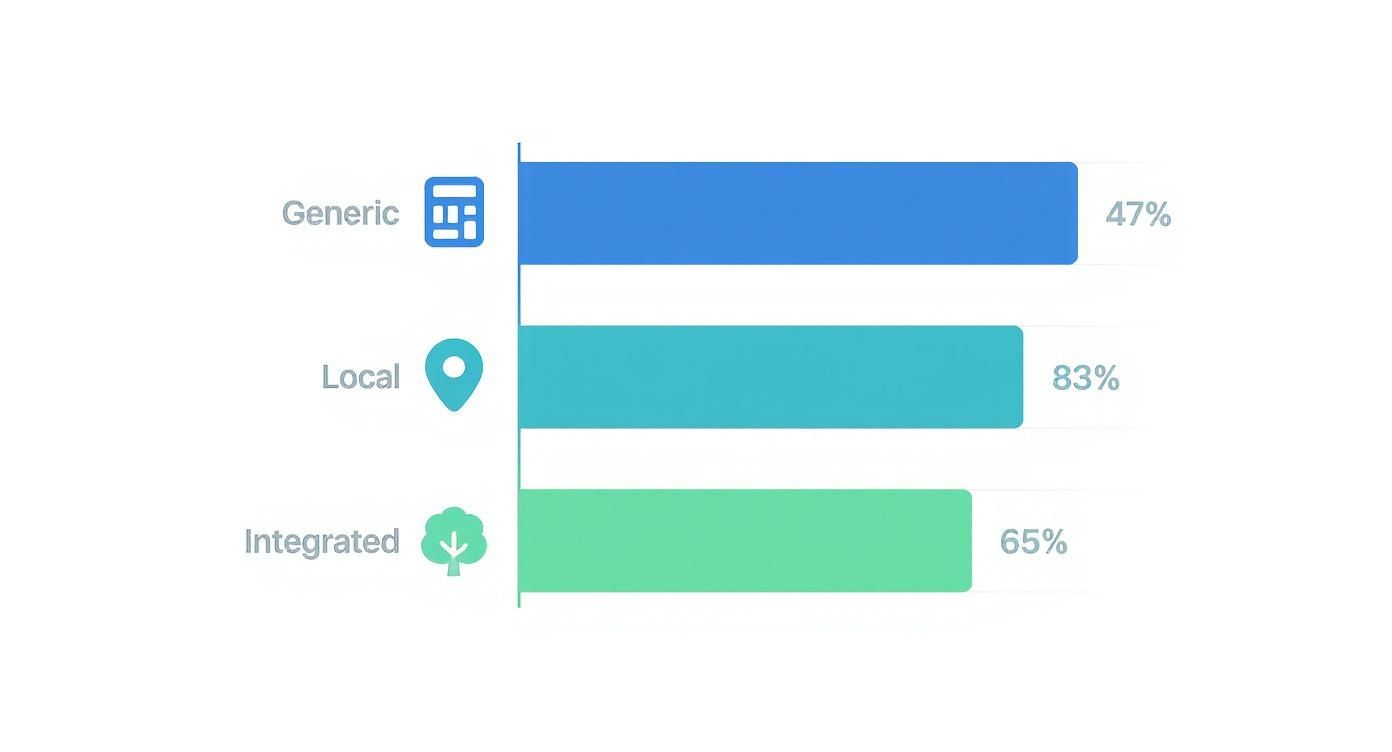
As you can see, a local approach is far more accurate. But what really works is an integrated plan—one that considers your landscape and your trees together. Let’s pull back the curtain on the key cost centers you should see on any transparent, professional quote.
The Upfront Work: Design and Planning
Long before a shovel ever touches the ground, critical thinking and planning must happen. This isn’t just about drawing pretty pictures; it’s about creating a plan that works, looks great for years, and won’t get you in trouble with the city.
- Site Analysis & Consultation: This is where we walk the property with you and get technical—measuring everything, mapping sun and shade patterns, figuring out drainage, and taking stock of what’s already there.
- Conceptual and Master Plans: Think of these as the blueprints for your new outdoor space. Getting this right on paper is an investment that saves a fortune in rework later.
- Wrangling Permits: If your project involves a new deck, a retaining wall over a certain height, or major grading, you’re going to need permits. This line item covers the nitty-gritty of preparing the paperwork and submitting it to the City of San Jose or your local municipality.
To help you see how this all fits together, here’s a sample breakdown for a typical mid-range project in our area. This isn’t a quote, but it gives you a solid feel for how a budget is allocated across the different phases of work.
Sample Landscape Budget Breakdown (Mid-Range South Bay Project)
| Budget Category | Typical Percentage of Total Budget | Key Cost Drivers |
|---|---|---|
| Design & Planning | 5% – 15% | Complexity of the plan, permit requirements, 3D renderings |
| Site Prep & Demolition | 10% – 20% | Amount of concrete/old landscaping to remove, soil condition |
| Hardscaping | 25% – 40% | Material choice (e.g., pavers vs. natural stone), square footage |
| Softscaping (Plants & Soil) | 15% – 25% | Plant size and maturity, quantity of soil amendments needed |
| Irrigation System | 5% – 10% | Smart controller technology, number of zones, drip vs. spray |
| Lighting & Special Features | 5% – 15% | Number of fixtures, custom elements like fire pits or water features |
| Labor & Project Management | (Included in above categories) | Crew size, project duration, specialized skill requirements |
| Contingency Fund | 10% – 15% (of subtotal) | Unforeseen issues like buried pipes or poor soil |
This table shows that hardscaping often takes the largest slice of the pie, but the foundational work of site prep and good soil is just as critical for a successful, long-lasting project.
The Groundwork: Site Preparation and Demolition
This is the heavy lifting that makes the beautiful “after” photos possible. It’s often more labor-intensive than people expect, but skimping here is a recipe for disaster. This is where we’re ripping out that old, cracked concrete patio, clearing out overgrown shrubs, and grading the entire area to ensure proper drainage.
If you want to get a feel for what goes into this part of a project, you can check out our landscape installation and general pricing information for more details.
The Bones of the Garden: Hardscaping
Hardscaping is the backbone of your landscape. It’s all the non-living stuff: the patios, walkways, retaining walls, and decks. These are the elements that create structure, define spaces, and make your yard usable.
Material choice is a huge fork in the road for your budget. Natural flagstone, for example, costs much more per square foot than high-quality concrete pavers. It’s not just the stone itself—the specialized labor needed to fit each unique piece perfectly adds to the cost, too.
The Green Stuff: Softscaping
Now for the fun part—the plants! Softscaping covers all the living, breathing elements of your garden. We’re talking trees, shrubs, vibrant perennials, groundcovers, and—most importantly—the rich soil they need to thrive.
- Plant Costs: Prices vary widely. A mature, 15-gallon Japanese Maple is a very different investment than a tray of 1-gallon lavender plants. It all comes down to size, species, and how mature you want it to look on day one.
- Soil Amendment: In the South Bay, this is non-negotiable. Our native clay is tough. Budgeting for quality compost and amendments to improve its structure is the single best thing you can do to ensure your plants don’t just survive, but flourish.
- Mulch: A thick, 3-inch layer of good mulch is your best friend. It keeps moisture in the soil, smothers weeds, and keeps soil temperatures even. It’s a simple step that pays dividends.
Smart Water: Irrigation and Management
In California, a beautiful landscape has to be a water-wise one. A modern, efficient irrigation system isn’t a luxury; it’s a core component of a sustainable landscape design.
The upfront cost of a smart, weather-based drip irrigation system is more than old-school spray heads. However, these systems can slash your landscape water use by up to 50%, saving you a bundle on your water bills for years to come.
Bringing It to Life After Dark: Landscape Lighting
Well-designed outdoor lighting completely changes how you use your space. It makes your yard usable and beautiful in the evening, and it adds a serious layer of safety and security. Costs here cover the LED fixtures, transformers, and the skilled labor to run all the low-voltage wiring discreetly.
The Wow Factor: Special Features and Finishing Touches
This is where you really get to put your personal stamp on the project. These are the elements that make your space unique, but they can also have a big impact on the budget. Think about things like:
- Water features
- A cozy fire pit or a full outdoor fireplace
- Pergolas and other shade structures
- Outdoor kitchens with built-in grills
- Custom-built seating and planter boxes
Putting Real Numbers to Your South Bay Landscape Budget
It’s easy to talk about a landscaping budget in theory, but things get real when you’re standing in your San Jose backyard. Online cost calculators almost never account for the nuances of our local market—the actual cost of pavers from a South Bay supplier, the going rate for skilled labor, or the specific challenges of your property.
A project’s difficulty is one of the biggest factors driving the final price. A flat, easy-to-access yard in Willow Glen is a completely different ballgame than a sloped property in the Los Gatos hills that needs serious grading and retaining walls.
Why an Itemized Quote is Non-Negotiable
This brings us to a crucial part of smart financial planning: getting a detailed, itemized quote from a professional South Bay landscaping company. This isn’t just a single number at the bottom of a page. It’s a transparent roadmap showing you exactly where every dollar of your investment is going. Your mindset should shift from “who is the cheapest?” to “who provides the most comprehensive and transparent value?”
The landscaping industry is a huge economic driver, valued at around $153 billion in the U.S. alone. Here, installation costs can run anywhere from $4 to $12 per square foot. Labor rates typically fall between $50 and $100 per hour, but that figure swings wildly based on the skill required. For a deeper dive, check out these lawn and landscaping industry statistics on GetJobber.com.
Always Plan for the Unexpected
I’ve been on enough job sites to know that even the most perfectly planned project can hit a snag once you start digging. That’s why a contingency fund isn’t just a nice-to-have; it’s an absolute must for any serious landscape installation.
Pro Tip: We always advise clients to set aside 10-15% of the total project cost for a contingency fund. This isn’t “extra” money. It’s your project’s safety net for dealing with the unknown.
Think of it as an insurance policy for your landscape. This buffer is what saves the day when you run into common on-site surprises, like:
- Finding old, undocumented utility lines
- Hitting a surprise layer of bedrock
- Uncovering hidden irrigation leaks
Without that cushion, these issues can force you into tough compromises on your design or even bring the whole project to a grinding halt.
Understanding Local Labor and Material Rates
Here in the South Bay, our regional economy dictates the cost of both labor and materials. Yes, skilled craftsmanship from experienced pros comes at a premium, but it’s an investment that pays you back for years in quality and durability.
- Skilled Labor: This isn’t just general labor. It’s the expertise of a mason laying a stone patio, an irrigation tech installing a water-wise system, or a certified arborist from a San Jose tree service working carefully around your prized oaks.
- Material Costs: The price for everything from pavers to mature plants can change with supply and demand. A good quote will always be based on current market rates.
- Equipment and Disposal: Your budget also has to cover the machinery needed for grading and digging, plus the fees for getting rid of old concrete and green waste responsibly.
At the end of the day, a realistic budget is an informed one. It’s built on a clear understanding of your property’s specific needs, it anticipates challenges, and it respects the expertise needed to create a beautiful, lasting landscape.
Smart Phasing: Building Your Dream Landscape Over Time
It’s a classic homeowner dilemma: you have a grand vision for your property, but the budget to do it all at once just isn’t there. This is where smart project phasing comes in. It’s about strategically breaking down your master plan into logical, manageable stages that fit your finances.
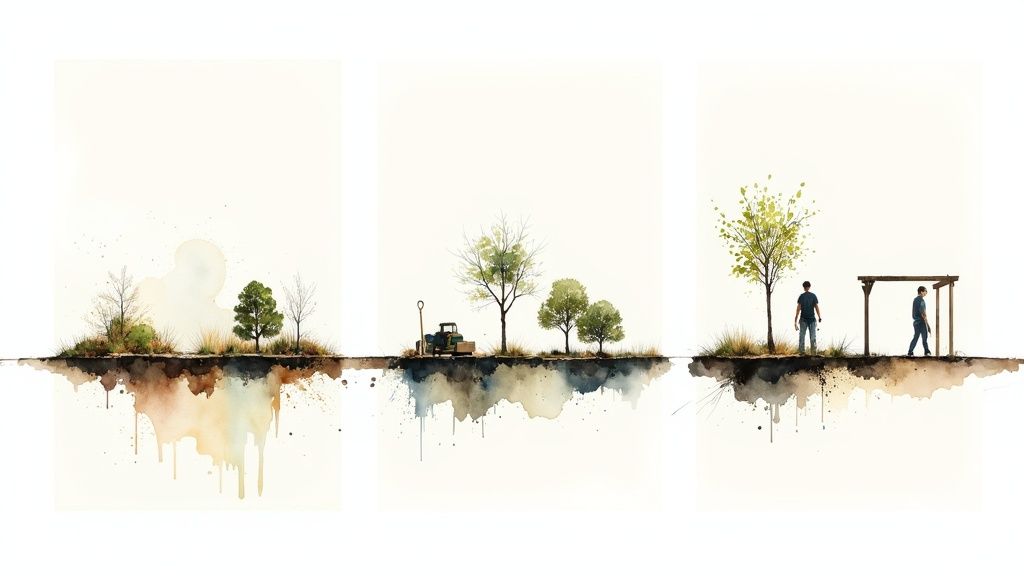
A well-thought-out phasing plan is your best defense against expensive rework. You’re building your landscape in a sequence that makes sense, both structurally and financially.
A Logical Sequence for Phased Projects
Think of it like building a house. You pour the foundation long before you start hanging drywall. Installing a delicate perennial bed before the bobcat arrives to grade for a new patio is just asking for heartbreak and wasted money.
Here’s how a sensible phased approach usually unfolds:
- Phase 1: The Heavy Lifting. This is all about the foundational work. We focus on clearing the site, doing any major grading for proper drainage, and getting the core hardscaping in place—think patios, retaining walls, and walkways.
- Phase 2: Installing the Bones. With the hardscape set, we move on to the core infrastructure. This is the perfect time to run the main irrigation lines and plant the larger, foundational trees and shrubs that will anchor your design.
- Phase 3: The Finishing Touches. Now for the fun part! This final phase brings everything to life. We’ll install the flower beds, lay down sod or groundcover, and add all those features that make a space truly yours, like landscape lighting or a fire pit.
The Integrated Planning Advantage
This is where having a team that understands the whole picture—from the soil up to the tree canopy—really pays off. As licensed landscape and tree service professionals (CSLB #985639 – C-27 + D-49), we see potential conflicts that others might miss. A standard landscaper might dig a trench for an irrigation line today without thinking about the root system of a specimen tree you plan to plant next year.
Our integrated approach means we plan for the entire project from day one, even if it’s built over five years. We map everything, from underground utilities to future tree root protection zones, ensuring the work we do in Phase 1 actively supports and protects what we’ll do in Phase 3.
This foresight makes even the most ambitious projects feel achievable. You can see how these complex plans come together by looking at our completed projects across the South Bay. This method turns a potentially overwhelming budget into a clear, step-by-step roadmap to the yard you’ve always wanted.
Integrating Tree Health and Landscape Design to Protect Your Investment
It’s one of the biggest, most expensive mistakes homeowners make when budgeting for a new landscape: completely forgetting about their existing mature trees. A beautiful, established tree is often the centerpiece of a property, yet many don’t realize that common construction work can be a death sentence for it.
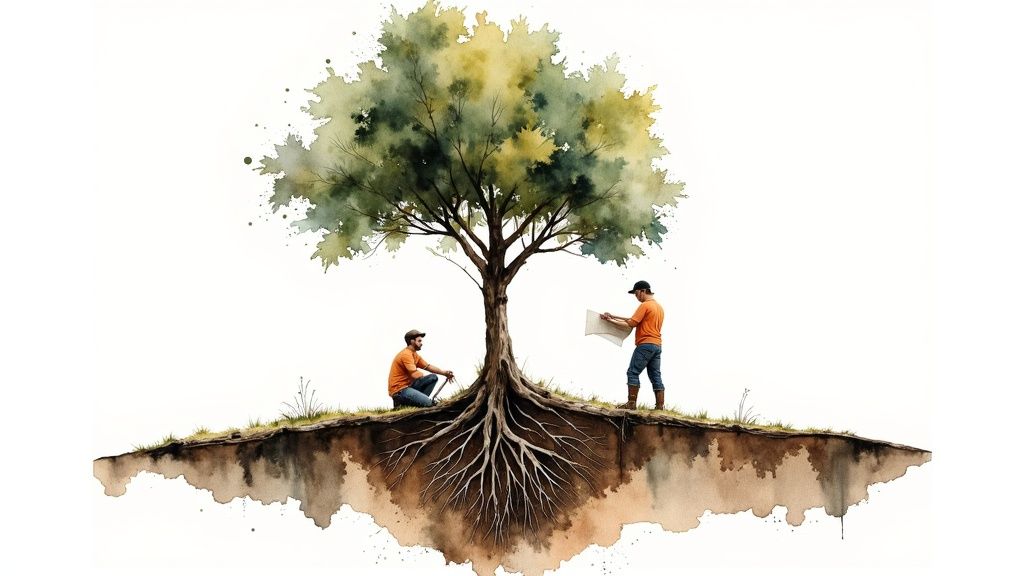
This is where our unique dual licensing (CSLB #985639 – C-61/D-49 Tree Service + C-27 Landscaping) makes a real difference for South Bay homeowners. We don’t just see a patch of dirt and some plants. We see a complete ecosystem where the health of your trees and the success of your new landscape are totally connected.
The Hidden Dangers in Landscape Construction
Even work that seems minor can fatally wound the delicate root systems of the heritage oaks and redwoods we love in this region. A tree’s root zone is its lifeline, and it often extends far beyond the edge of its leafy canopy.
Simple landscaping activities can cause irreversible harm:
- Excavating for Patios: Digging just a few inches too deep inside a tree’s critical root zone can slice through major roots, effectively starving the tree.
- Trenching for Irrigation: Cutting narrow trenches for sprinkler lines can sever a huge portion of a tree’s ability to feed itself.
- Changing Soil Grade: Piling on even six inches of new soil over a root system can suffocate it. Removing that much can expose sensitive roots to deadly conditions.
- Heavy Equipment Compaction: The sheer weight of a small tractor can compact the soil, crushing the fine feeder roots and blocking air and water from getting through.
A Real-World Scenario: We once consulted with a homeowner in Los Gatos who had just installed a gorgeous new paver patio. They had no idea the excavation had destroyed 40% of their mature oak’s root system. Two years later, the tree was a hazard. Now they were facing an unplanned $8,000 – $15,000 bill for a complex and dangerous removal—a situation that was entirely preventable.
An Integrated Approach to Long-Term Value
Our certified arborists and landscape designers work together from the very first meeting. This teamwork is the foundation of a smart plan that improves your property while protecting its most valuable natural assets. We physically map out critical root zones before any design is finalized.
This kind of integrated planning is more critical than ever. The global landscaping market is booming, and material costs have jumped an average of 39.5% since early 2020. You can dig into more landscaping industry statistics on RealGreen.com if you’re curious about the numbers.
By choosing a dually-licensed team, your budget becomes a tool for proactive protection. We help homeowners in San Jose, Willow Glen, and Almaden Valley make forward-thinking investments that prevent huge financial losses down the road, ensuring your new landscape and mature trees can thrive together for decades to come.
Conclusion: Your Roadmap to a Successful Landscape Project
Creating a realistic landscape budget is far more than just pulling a number out of thin air. It’s about building a thoughtful, comprehensive plan that’s customized for your specific South Bay property, accounting for local realities like our heavy clay soil and the long-term value of water-wise design.
Most importantly, you now understand the incredible value of partnering with an experienced, dually-licensed contractor. Our integrated approach ensures your entire property investment is protected, from the roots in the soil to the highest branches of your trees. The demand for professional landscaping is a global one, projected to grow at a 4.5% compound annual rate as homeowners embrace smarter, more sustainable outdoor design. You can find more insights on these landscape design trends at MarketResearch.com.
Your Next Step to a Beautiful Landscape
A truly successful outdoor space always starts with a budget built on solid local expertise and honest communication. When you plan well from the start, you’re not just adding beauty to your home—you’re preventing costly surprises and making sure your investment will flourish for years.
For homeowners in San Jose, Willow Glen, Los Gatos, and the Almaden Valley, it’s time to move from planning to doing. Contact San Jose Tree Service & Landscaping today for a professional, locally-informed budget consult that reflects our microclimate, soil conditions, and unique opportunities. Let’s build a realistic roadmap to the landscape you’ve always envisioned.
Frequently Asked Questions About Landscape Budgeting
How much should I budget for a landscape project?
A common guideline is 10% of your home’s value, but a realistic budget depends entirely on your project’s scope. A simple plant refresh will cost far less than a full overhaul with a patio, irrigation, and lighting.
How can I save money on my landscape installation?
Phasing your project is a great way to manage costs by building your dream yard over time. You can also save by choosing more affordable materials and planting smaller, younger plants that will mature over a few seasons.
Is drought-tolerant landscaping more expensive?
The initial investment in drought-tolerant landscaping in California can sometimes be higher due to smart irrigation tech and specific plants. However, it pays for itself through significant long-term savings on water bills and reduced maintenance.
Why do I need a 10-15% contingency fund?
A contingency fund is a crucial safety net for unforeseen issues like buried utility lines or poor soil conditions discovered during excavation. It prevents small surprises from derailing your entire project budget.
Does good landscaping really increase my property value?
Absolutely. Research shows that 98% of homeowners believe landscaping increases property value. A well-designed, professionally installed landscape is a major selling point that delivers a strong return on investment.
Ready to build a budget that brings your vision to life without the guesswork? The team at San Jose Tree Service & Landscaping is here with the expert, local guidance you need. Start the conversation on our website.