
As a tree service contractor in San Jose, I get this question all the time: “Do I really need an arborist for this?” It’s a fair question, and the answer comes down to one key difference: an arborist is a tree health specialist, almost like a tree doctor, who’s been trained in biology, safety, and the long-term science of tree care.
On the other hand, a “tree guy” is often someone who’s good with a chainsaw and focuses on cutting and removal, but might not have the credentials, insurance, or deep knowledge needed to protect your tree and your property. Getting this distinction right is the first step to making a smart investment in your landscape.
What Separates a Professional Arborist from a Tree Guy
When you see a dead branch or a leaning tree, it’s tempting to just call the first person who can cut it down. But many homeowners fear that arborists will push for expensive removal or upsell work they don’t need.
However, recent insights show that many homeowners fear arborists will push removal or upsell work, and they don’t understand certification requirements—like the 3 years of experience and rigorous exam needed to become ISA certified. This misconception leads homeowners to hire unqualified crews who over-trim, top trees, or ignore city permit rules. A true arborist’s primary goal is to preserve a tree’s health and life whenever possible. They diagnose problems rooted in biology, soil conditions, and disease.
To even sit for the exam to become an ISA Certified Arborist, for instance, you need a minimum of three years of documented, full-time experience in the field. A “tree guy” might just see a branch that needs to be lopped off, but an arborist understands how that single cut will affect the entire tree’s health for years to come.
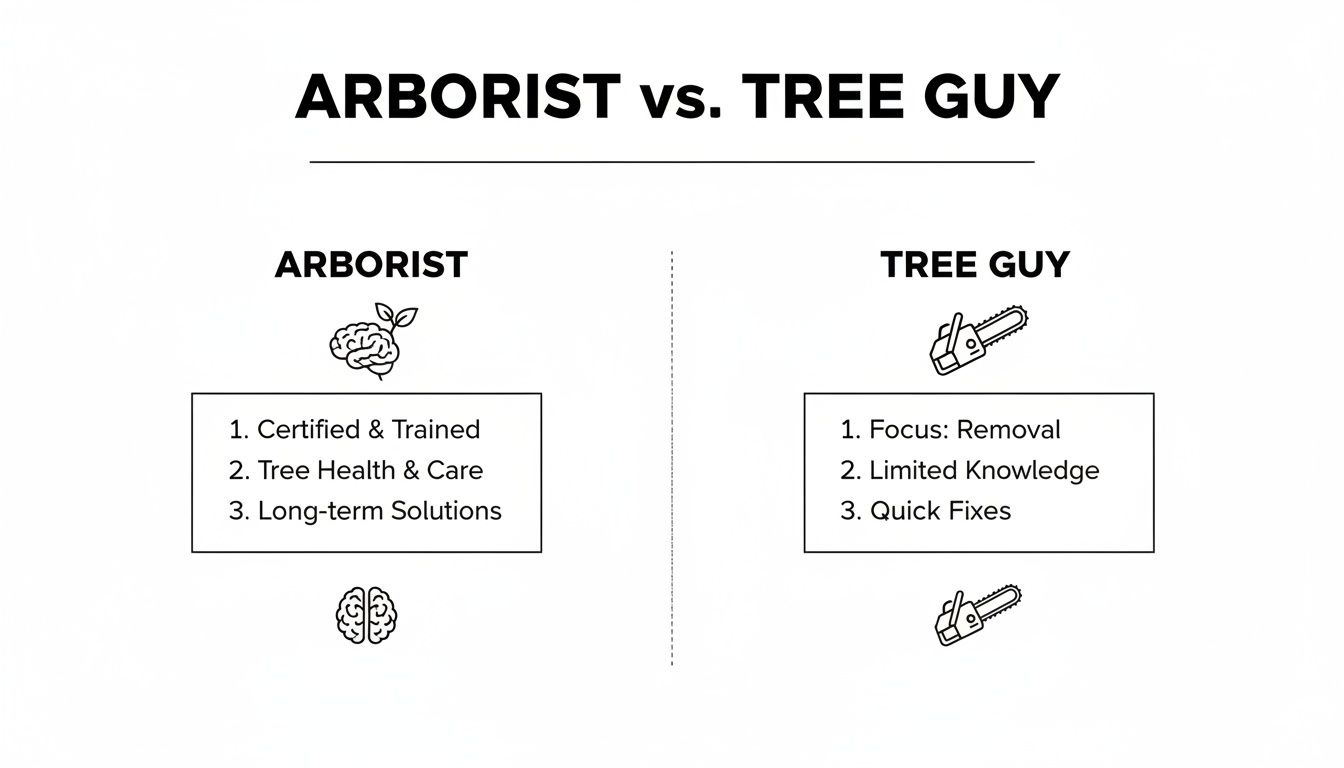
Arborist vs. Tree Guy At a Glance
To make it even clearer, here’s a quick breakdown of what you’re getting with each. This table sums up the major differences you’ll encounter.
| Attribute | Certified Arborist (Professional) | Typical ‘Tree Guy’ (Unlicensed/Untrained) |
|---|---|---|
| Qualifications | ISA certification, extensive training in tree biology, diagnostics, and safety. Often holds a C-27 or D-49 license in California. | Often uncertified, may lack formal training, and typically doesn’t hold required licenses. |
| Scope of Work | Comprehensive tree care: pruning for health, diagnosing diseases, soil management, structural support, risk assessment, and safe removal. | Primarily focuses on trimming branches and tree removal, often without considering the tree’s long-term health. |
| Safety & Insurance | Carries full liability insurance and workers’ compensation. Adheres to strict ANSI Z133 safety standards. | May be uninsured or underinsured, putting all liability on the homeowner. Safety practices can be inconsistent or non-existent. |
| Tools & Techniques | Uses specialized equipment and proper pruning techniques (e.g., thinning cuts) to promote tree health. | Often uses whatever tools are available (like climbing spikes on a tree that isn’t being removed), which can harm the tree. |
| Outcome | Healthier, safer, and more valuable trees. A long-term investment in your property. | Damaged trees, potential property damage, and significant liability risk for the homeowner. |
As you can see, the choice impacts everything from the health of your trees to your own financial protection.
Why This Distinction Matters for San Jose Tree Service
Here in the Bay Area, hiring the right professional is more than just a preference—it’s a necessity. We have unique challenges that demand a real expert.
- Storm-Damaged Trees: After an atmospheric river rolls through, a tree can look fine on the surface but have hidden structural damage. An arborist can spot this and prevent a catastrophic failure later. A “tree guy” will likely just clean up the broken branches you can see, leaving a ticking time bomb behind.
- Protected Species: Many of our local cities have strict ordinances protecting native species like coast live oaks and redwoods. A certified arborist knows the local codes, understands the permitting process, and can keep you from facing hefty fines.
- Property Value: This one is huge. “98% of homeowners believe landscaping increases property value” (Source: San Jose Tree Service & Landscaping Intelligence Report, 2024). Bad pruning, on the other hand, can tank that value in a single afternoon.
Ultimately, hiring a certified, licensed, and insured arborist isn’t just about getting a tree trimmed. It’s about protecting your home, your family, and what is likely one of the most valuable living assets on your property.
Decoding Certifications and Professional Qualifications
When you bring someone onto your property to care for your trees, you’re handing over the health of a valuable, living asset and the safety of your home. That’s why getting a handle on credentials is so important—it’s not just industry jargon, it’s your best tool for vetting true expertise.
The gold standard you should always look for is the ISA (International Society of Arboriculture) Certified Arborist designation.
What it Takes to Be an ISA Certified Arborist
This isn’t a weekend course. An arborist must have at least three years of documented, full-time, hands-on experience in professional tree care just to qualify to take the exam. That exam covers everything from tree biology and soil science to safe work practices and complex pruning standards.
I like to use a simple analogy: if you had a serious health concern, you’d want a board-certified specialist, not just someone who’s handy with a first-aid kit. The same exact logic applies to your trees.
Why California Licensing Matters
Beyond the ISA credential, there’s another layer of protection that’s critical for us here in California: the contractor’s license. Any legitimate tree service operating in the state must have a valid license from the Contractors State License Board (CSLB).
For a tree company, this will be a specialty license like our CSLB #985639 with the C-61/D-49 Tree Service classification.
This license is your shield. It confirms the company is bonded, insured, and legally accountable. It’s what separates the professionals from the fly-by-night operators who can do shoddy work and vanish, leaving you to clean up the mess.
If you want a deeper dive, our guide on hiring a tree service in San Jose covers all the essential checkpoints.
The Real-World Impact of Proper Training
What does all this training actually mean for your trees? It’s the difference between a long-term health plan and a quick haircut.
Here’s how a professional’s qualifications translate into direct benefits for you:
- Accurate Diagnosis: An arborist can spot diseases and pests common to the South Bay before they become a major, costly problem.
- Scientific Pruning: They use proven techniques to encourage strong, healthy growth. They will never “top” a tree—a harmful practice that can permanently damage its structure.
- Risk Assessment: They’re trained to identify hidden weaknesses in branches or trunks that could fail during a storm, protecting your home and family.
At the end of the day, these qualifications are your best guarantee that the person in your yard has the proven knowledge to make your trees healthier, safer, and more beautiful.
Understanding Your Protections: Safety and Insurance
Let’s be blunt: liability is a huge deal when you hire someone to work on your property. Tree work is one of the most dangerous jobs out there, and the person holding the chainsaw isn’t the only one at risk.
If things go wrong, your home, your finances, and even your legal standing are on the line.
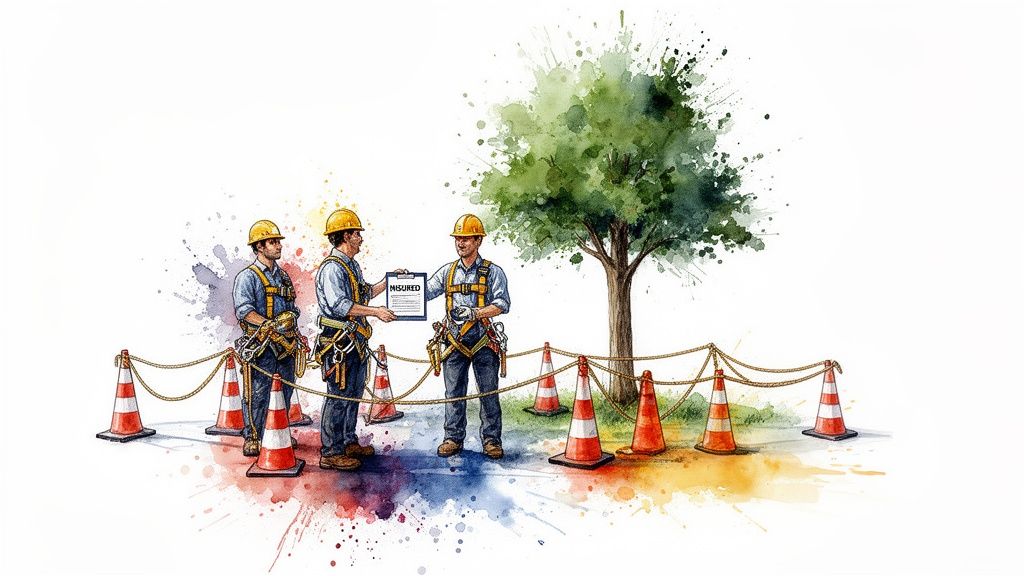
This is why verifying insurance isn’t just a good idea—it’s an absolute must. A professional arborist company knows this and will have no problem showing you their certificates for two critical policies.
The Two Policies You Must Verify
Before a single branch is cut, you need to see physical proof of both of these insurance policies. Ask them to email you or hand you the official certificate of insurance.
- Workers’ Compensation: This is the big one for your own protection. If a crew member gets hurt on your property and their boss doesn’t carry this policy, you could be on the hook for their medical bills and lost wages.
- General Liability Insurance: This is what protects your stuff. A core component for any real tree service is a solid, verifiable Commercial General Liability (CGL) insurance policy. If a heavy limb crashes through your roof or smashes your car, this is the insurance that pays for the repairs.
When a “tree guy” quotes a suspiciously low cash price, it’s often because they’re skipping these expensive but essential policies. That decision transfers all the risk directly onto you.
The Sobering Reality of Tree Work Dangers
The focus on insurance and safety protocols makes perfect sense when you look at the real-world risks. A professional arborist company directly addresses these dangers by strictly following ANSI A300 standards.
These are the nationally recognized best practices for tree care, and they aren’t just about looking professional—they are about life-saving procedures.
What Professional Safety Looks Like
You can spot a crew that takes safety seriously long before the first cut. Their commitment shows in their equipment, their training, and how they carry themselves on your property.
Here’s what to look for:
- Proper Personal Protective Equipment (PPE): Everyone should be wearing helmets, eye protection, and chainsaw-resistant chaps.
- Jobsite Safety Protocols: You should see cones set up, hear clear communication between the crew, and notice a designated ground person coordinating the work.
- Advanced Rigging Techniques: Professionals use specialized ropes and rigging systems to carefully lower heavy branches, preventing damage to your home and landscape.
As we cover in our guide on tree maintenance to prevent storm damage, proactive professional care is a safety measure in itself.
Moving Beyond Cutting to Comprehensive Tree Care
When we think of tree work, we often picture chainsaws and falling branches. While a typical “tree guy” might show up ready to trim or remove, a professional arborist looks at the bigger picture, offering a full suite of services that treat your tree like the living investment it is.
This holistic approach starts long before anyone even thinks about making a cut. It’s all about a detailed health assessment to understand what’s really going on with your tree from the roots up.
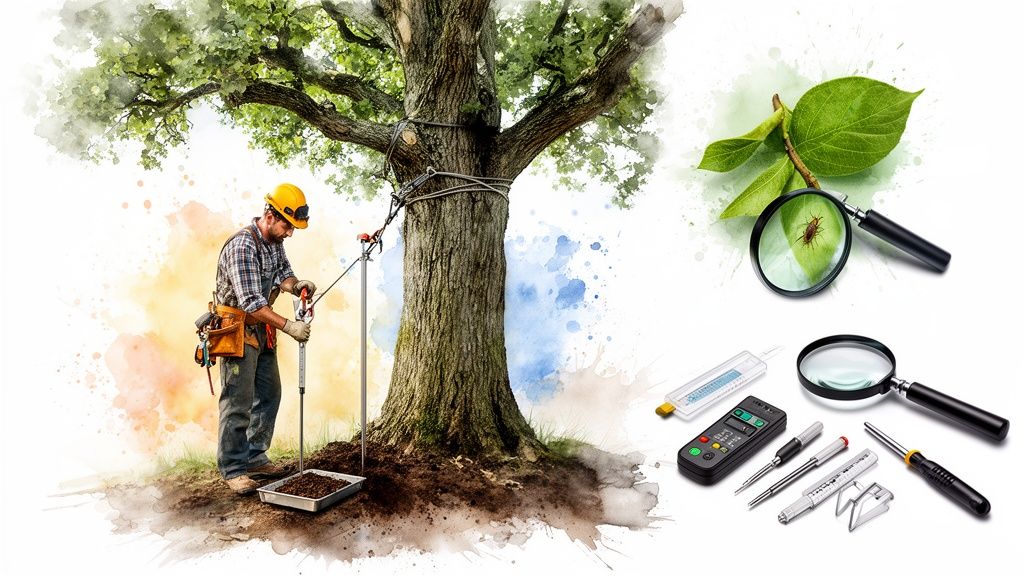
A Diagnostic Approach to Tree Health
Think of an arborist as a tree doctor. They use their expertise to spot and diagnose underlying problems an untrained person would easily miss. This is especially important here in the South Bay, where our trees deal with stresses like drought, dense clay soil, and specific local pests.
A proper evaluation from an arborist dives deep. They’ll look at things like:
- Disease and Pest Diagnosis: Are those spots on the leaves a sign of anthracnose? Is the tree struggling with oak root fungus? An arborist can identify these issues and lay out a real treatment plan.
- Soil Analysis: They’ll check for problems like compacted soil that chokes out roots or nutrient deficiencies that are essentially starving your tree.
- Structural Risk Evaluation: This is a big one, especially after an atmospheric river rolls through. They inspect the trunk, canopy, and root system for hidden weaknesses that could lead to failure.
This level of detailed investigation is the foundation of professional arborist services. A common misconception is that calling an arborist will lead to an expensive removal recommendation. The truth is, their diagnostic skills are aimed at saving trees.
Advanced Techniques to Preserve Valuable Trees
Once they have a full diagnosis, an arborist has a toolbox of advanced techniques that go way beyond simple trimming. These are strategic interventions designed to improve a tree’s health, strengthen its structure, and preserve its value for the long haul.
Instead of just lopping off branches, an arborist’s plan might include:
- Structural Pruning: This involves making very specific, selective cuts to guide the tree toward a stronger growth habit, which drastically reduces the risk of limbs breaking off down the road.
- Cabling and Bracing: For trees with weak branch unions or multiple trunks, they can install support systems that act like a safety net, giving the tree extra resilience against high winds and storms.
- Soil Decompaction and Fertilization: They can use specialized tools to carefully aerate compacted soil around the root zone and apply tailored nutrients to give the tree a much-needed health boost.
A “tree guy” might solve your immediate issue by cutting a branch that’s hanging too low, but an arborist provides a comprehensive care plan. This shift from reactive cutting to proactive care is what truly separates the two.
The True Cost of a Cheaper Quote
We all love a good deal. When one quote comes in significantly lower than the others, it’s hard not to be tempted. But in the tree care world, that “bargain” price almost always comes with hidden costs.
The cheaper quote from a “tree guy” often masks huge long-term expenses that can completely wipe out any initial savings. I’ve seen it time and time again.
What That Lowball Offer Really Means
Poor workmanship is a ticking time bomb for your wallet. Think about the eventual cost of removing a beautiful, mature oak that dies a few years after being “topped” or improperly pruned by someone who didn’t know what they were doing.
Or consider the repair bill for a crushed driveway or a punctured roof after a rushed and careless removal job. These are the real-world consequences of hiring based on price alone.
Investing in Value, Not Just a Service
A professional arborist’s quote is about more than just cutting branches. You’re investing in the safety, health, and even the value of your property. Well-cared-for trees are an asset that can boost property value, lower your summer energy bills, and prevent the astronomical cost of a tree falling on your house during a storm.
The real trap of a low quote? It often signals untrained work, which can lead to 40% higher long-term maintenance costs because you’re constantly paying someone else to fix the mistakes the first crew made. (Source: San Jose Tree Service & Landscaping Intelligence Report, 2024).
The Financial Fallout of a Bad Decision
The most devastating hidden cost, by far, is the financial disaster of an on-site accident. If an uninsured worker gets hurt on your property, you could be on the hook for their medical bills.
Understanding why tree service prices vary so much really boils down to this: a professional’s price includes the non-negotiable costs of proper insurance, safe equipment, and skilled training. A “tree guy’s” price leaves them out—and puts all the risk on you.
How to Hire the Right Tree Pro in the South Bay
Now you know the critical difference between a certified arborist and a “tree guy” with a chainsaw. The next step is putting that knowledge to use. Think of this as your practical checklist for vetting any tree service that comes your way in the San Jose area.
Going in armed with the right questions is your best defense. A truly professional company won’t just tolerate your questions—they’ll welcome them.
Your Vetting Checklist: Questions That Cut to the Chase
When you start making calls, run through these key questions. The answers (or lack thereof) will tell you everything you need to know.
- “Can you show me your ISA Certification and CSLB license?” Ask for the actual license number—ours is CSLB #985639, for example—so you can look it up yourself. A pro will have this information on hand.
- “Could you provide a copy of your current general liability and workers’ comp insurance certificates?” A simple “yes” isn’t good enough here. You need to see the official Certificate of Insurance to prove their coverage is active.
- “Do you follow ANSI A300 pruning standards?” This is the ultimate litmus test. Certified arborists live by these national standards for tree health and safety. A “tree guy” might not even know what you’re talking about.
- “Can you give me a few local references for jobs like mine?” Nothing speaks louder than a track record of happy clients right here in the South Bay.
Asking these direct questions empowers you to make a smart, safe choice for your property. For a deeper dive, check out our guide on finding the best licensed tree removal contractors.
Conclusion: Expertise Matters for Healthy Trees
Choosing between an arborist and a “tree guy” comes down to one thing: investing in expertise. While a lower price might seem appealing, it often comes at the cost of your tree’s health, your property’s safety, and your financial security. A certified arborist brings a scientific approach, proper insurance, and a commitment to long-term care that an untrained operator simply can’t match.
By asking the right questions about certifications, insurance, and safety standards, you empower yourself to make a wise decision. Proper tree trimming and care are not just about aesthetics; they are about protecting one of your home’s most valuable living assets.
Take the Next Step with a Professional Assessment
Don’t leave your tree’s health to chance. If you’re a homeowner or contractor in the South Bay, we invite you to request a no-pressure arborist assessment. See our diagnostic process firsthand and understand the difference between certified and uncertified advice.
Contact San Jose Tree Service & Landscaping today for a free estimate and expert consultation.
Frequently Asked Questions (FAQs)
1. Does “Certified Arborist” just mean more expensive?
Not in the long run. An arborist’s expertise helps prevent costly property damage, saves trees from needing removal later, and protects you from the massive liability of an uninsured accident.
2. It’s just a small trim. Do I really need an arborist?
Yes, even small cuts made incorrectly can harm a tree’s health and structure. An arborist understands tree biology and makes precise cuts to encourage strong, healthy growth, avoiding practices like “topping” that can be fatal to trees.
3. What’s the biggest red flag I should watch out for?
The biggest red flag is any company that hesitates or refuses to show you proof of their current general liability and workers’ compensation insurance. Hiring an uninsured contractor puts all the risk on you.
4. Can a sick tree in San Jose actually be saved?
Absolutely. Arborists specialize in diagnosing and treating local issues like oak root fungus or pest infestations, often developing a plan to restore the tree’s health and avoid removal.
5. How do I verify if someone is a certified arborist?
You can use the “Find an Arborist” tool on the International Society of Arboriculture (ISA) website. Just enter their name or certification number to confirm their credentials are active and legitimate.