
Direct Answer: Valley Water requires a pre-inspection and a written Notice to Proceed before you touch your lawn. The rebate is not retroactive, so work started before approval is disqualified.
Most homeowners who call me about a lawn conversion already know the rebate exists. What they want to know is the part nobody explains clearly: what order do I do this in, and what will get me denied?
That question matters, because this is one of the few home projects where doing the work first and asking later costs you the entire benefit. I have talked with people in Willow Glen and Almaden Valley who pulled the sod out in a weekend and then found out they had disqualified themselves.
So let’s walk the actual mechanics. The sequence, the design rules that trip people up, and the irrigation problem that shows up when there is a mature oak or redwood sitting inside the conversion area.
The Sequence Is the Whole Game
Valley Water runs the landscape conversion program for Santa Clara County, and the rule I want burned into your brain is this: you cannot start work until you have written approval.
That approval is called a Notice to Proceed. Before it is issued, Valley Water schedules a pre-inspection to confirm there is actually a living, irrigated lawn there and to measure the area you plan to convert.
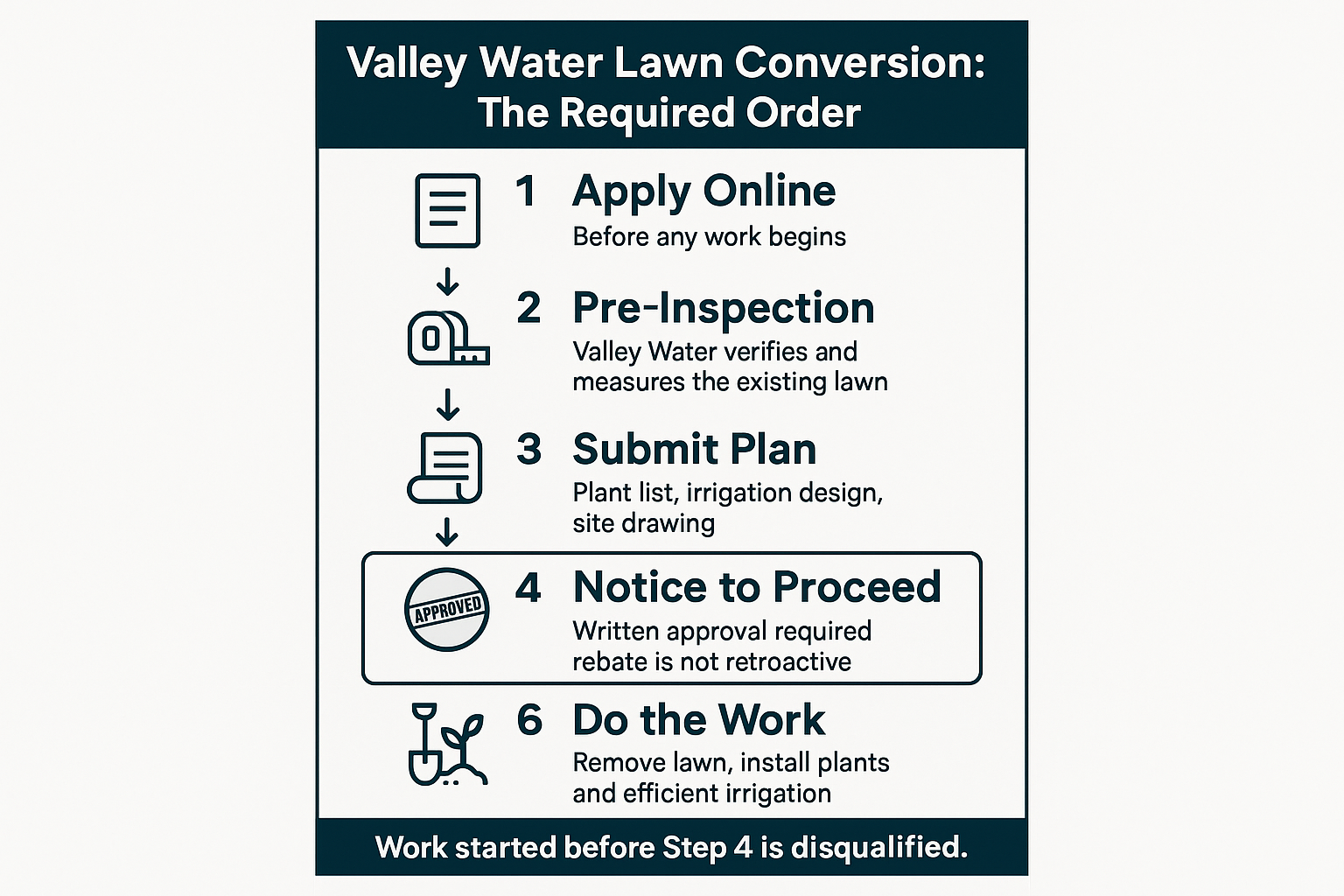
The order looks like this:
- Apply online through the Valley Water rebate program
- Sit for the pre-inspection of the existing lawn
- Submit your plant list, irrigation plan, and site drawing
- Receive the written Notice to Proceed
- Then, and only then, remove the lawn and install the new landscape
- Request the post-inspection and submit receipts
Skip step four and the application is dead. The rebate is not retroactive. No inspector can verify a lawn that is already in a green waste bin.
And the money is real. In a single quarter of fiscal year 2026, Valley Water issued 149 rebates totaling close to $490,000, covering more than 210,000 square feet of converted lawn across the county. Every one of those homeowners followed the sequence.
If you are still deciding whether the project makes sense at all, our overview of what a Valley Water lawn conversion really involves covers the bigger picture. This piece assumes you are past that and ready to plan.
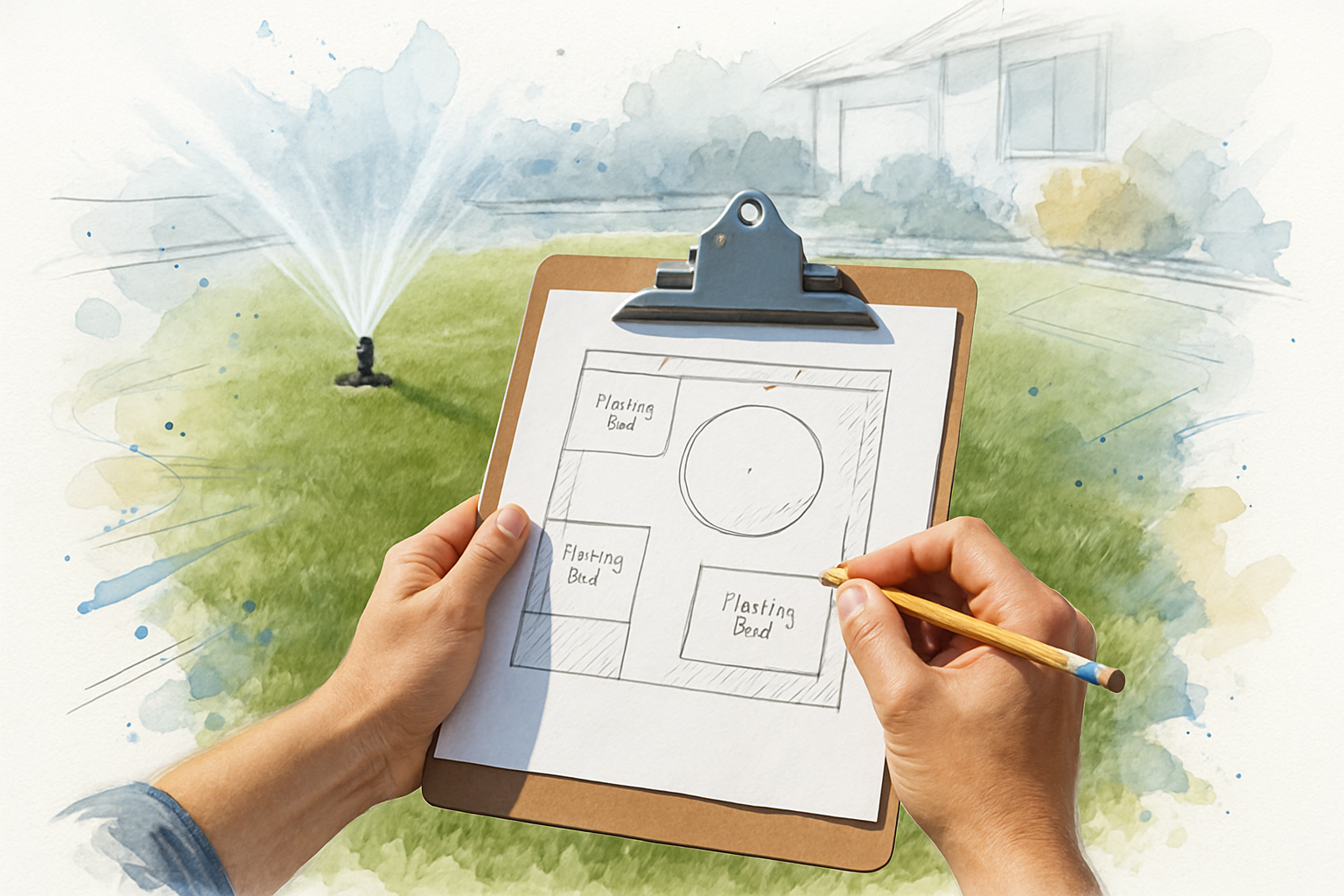
The Design Choices That Get Applications Denied
This is where well-meaning homeowners lose out. The program is not paying you to remove grass. It is paying you to install a low water landscape, and it defines that narrowly.
Here is what I see cause problems:
- Artificial turf is not eligible. Not partially, not with an exception. If your plan is plastic grass, the rebate is off the table.
- Plastic weed cloth and plastic sheeting are prohibited under program rules. Homeowners install these constantly out of habit. They also strangle soil and tree roots, so I would steer you away from them regardless.
- Pavers and flagstone are allowed, but capped at 50 percent of the converted area. Go past that and the design no longer qualifies.
The pattern I run into most often is the homeowner who wants a low maintenance yard and fills it mostly with decomposed granite, concrete, and a few boulders. That reads as hardscape, not conversion, and it usually gets flagged.
The current base rate is listed at around $2 per square foot, though rates and terms change and there are caps by property type. Confirm the current numbers on the Valley Water landscape rebates page before you budget around them.
The simple mental test: would a plant person look at your plan and see a planted landscape? If the answer is no, the rebate probably will not come through.
Eligible, Capped, or Disqualifying
A quick reference on how common lawn replacement materials are treated under the program.
| Material or Choice | Program Treatment | What to Know |
|---|---|---|
| Low water plants and natives | Eligible | The core of what the program is funding |
| Drip or other efficient irrigation | Eligible and expected | Must suit the plants actually installed |
| Permeable pavers and flagstone | Allowed, capped at 50 percent | Counts against your converted area |
| Mulch and compost | Eligible | Organic mulch over bare soil, not plastic |
| Artificial turf | Not eligible | Disqualifies the application |
| Plastic weed cloth or sheeting | Prohibited | Also bad for soil and tree roots |
| Mostly gravel or concrete design | Likely denied | Does not meet the low water landscape definition |
The Order of Operations, Start to Finish
If you remember nothing else, remember where the Notice to Proceed sits in this list.
The Irrigation Problem Nobody Warns You About
This is the part that gets complicated, and it is the reason I end up involved in lawn conversions at all.
The program expects the new landscape to have water efficient irrigation appropriate to the plants installed. Straightforward if you are planting a bed of sage and manzanita in open sun.
It is not straightforward when the conversion area sits inside the root zone of an established tree. And in older San Jose neighborhoods, it usually does. Coast live oaks, redwoods, and old backyard fruit trees are all over Willow Glen, Almaden Valley, Los Gatos, and Saratoga.
Here is the conflict. A mature valley oak or coast live oak often needs little to no supplemental summer water. Summer irrigation near the root flare is one of the more reliable ways to invite root and crown rot into a healthy oak.
So a plan that installs a tidy drip system for new shrubs, and runs a zone right up against an oak trunk, can do more damage than the lawn ever did. The lawn was at least a known stress the tree had adapted to. A new emitter line six inches from the root flare is a different problem.
What a good plan does instead:
- Maps the tree’s root zone before the planting layout is drawn, not after
- Keeps a dry, unirrigated buffer around the trunk and root flare
- Puts the tree’s footprint on its own valve so it can be shut off in summer
- Chooses understory plants that tolerate dry shade instead of fighting for water
- Protects roots during demolition, because sod cutters and mini excavators do real damage at shallow depths
This is where an arborist and an irrigation certified installer working the same plan beat a crew working alone. If you have an oak in the conversion zone, our piece on how to read what your oak is telling you is worth ten minutes before you commit to a layout.
What to Have Ready Before You Apply
The applications that move smoothly are the ones where the homeowner did some prep. The ones that stall are usually missing information.
Before you start the process, get clear on:
- Square footage of the lawn you actually intend to convert, measured, not guessed
- Whether that lawn is currently living and irrigated, since dead or already removed areas are a problem at pre-inspection
- A rough plant list with species names, not just “drought tolerant stuff”
- Where your existing irrigation valves and zones run, and what condition they are in
- Any trees inside or near the area and their approximate canopy spread
On that irrigation point, a lot of homeowners discover during this process that their existing system has been quietly failing for years. If that sounds familiar, what a broken sprinkler actually wastes puts real numbers to it.
And give yourself time. Between application, pre-inspection, plan review, and approval, this is not a project you start on a Saturday because the weather is nice. Plan on weeks, not days, before you are cleared to begin.
Frequently Asked Questions About the San Jose Lawn Conversion Rebate
I already removed my lawn. Can I still get the rebate?
No. The rebate is not retroactive. Valley Water has to inspect the living lawn before approval, and there is no way to verify what was there once it is gone. It is the single most common way homeowners disqualify themselves.
Can I use artificial turf for part of the yard and plants for the rest?
Artificial turf is not eligible under the program. If you want turf somewhere on the property, keep it entirely outside the area you are submitting for the rebate and be aware it will not count toward your converted square footage.
How much hardscape can I include?
Pavers and flagstone are allowed but capped at 50 percent of the converted area. Plastic sheeting and plastic weed fabric are prohibited outright. A design that leans heavily on decomposed granite and concrete usually will not meet the definition of a low water landscape conversion.
Do I need an arborist for a lawn conversion?
Not always. But if the conversion area falls inside the root zone of a mature oak, redwood, or old fruit tree, the irrigation and grading decisions carry real consequences for that tree. Trees that survived decades of lawn watering can decline fast after a poorly planned redesign. Proper assessment before action applies here as much as it does to pruning.
Does the rebate cover the full cost of the project?
It offsets part of it. The base rate has been listed at roughly $2 per square foot, with caps that vary by property type, and program terms change over time. Treat it as a meaningful offset rather than full funding, and confirm current rates directly with Valley Water.
Planning a Lawn Conversion Around a Mature Tree?
If you are mapping out a conversion in San Jose, Los Gatos, Saratoga, or Campbell and there is an established oak, redwood, or fruit tree in the middle of it, the irrigation plan deserves more thought than a standard drip layout. We handle both sides of that work under one license, arborist assessment and irrigation design, and we are happy to talk through what your site can support. You can reach us at (408) 422-1313 or at sanjosetreemaintenance.com.
