
If you’re a San Jose homeowner asking, “what tree maintenance helps prevent storm damage to my property?” the answer is simpler than you might think: proactive care. The best defense isn’t a frantic scramble as storm clouds gather; it’s a consistent, year-round strategy that builds strong, resilient trees.
When it comes to the atmospheric rivers and high winds we experience in the South Bay, your best defense is a smart offense. Key services like structural pruning, canopy thinning, and professional arborist assessments form the foundation of that offense. This approach shifts you from reacting to an emergency—like a fallen limb on your roof—to preventing it from ever happening.
This guide will walk you through the essential services that make a real difference. We’ll explain why a tree that looks perfectly healthy can still hide serious risks, such as a compromised root system from drought or poor branch structure that’s just one storm away from failing.
Key Strategies for Storm Resilience
One of the biggest missteps homeowners make is waiting until a tree is obviously dead or has already dropped a major branch. Research shows many trees fail not during storms, but because prior drought stress and poor structure went unaddressed.
Instead of waiting for a disaster, the focus should be on these preventive measures:
- Structural Pruning: This is about correcting problems before they start. A certified arborist can identify and fix weak branch connections and poor growth patterns that are common failure points in a storm.
- Canopy Thinning: Think of this as making your tree more aerodynamic. By selectively removing branches, we reduce the “sail effect,” allowing strong winds to pass through the canopy instead of pushing against it.
- Arborist Assessments: A trained eye can spot hidden decay, subtle signs of disease, or a compromised root system. A healthy-looking tree can still pose a significant risk.
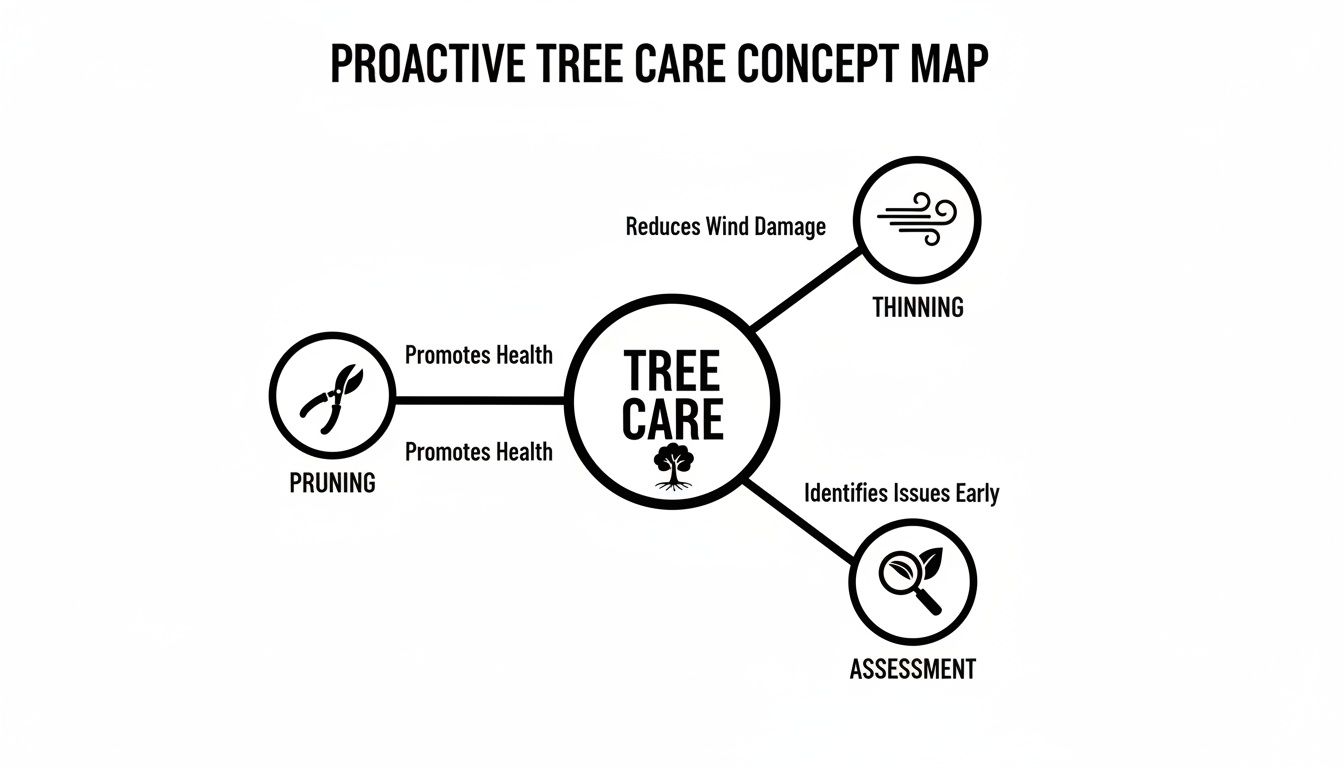
The takeaway here is that a comprehensive strategy is always best. Combining smart pruning, careful thinning, and a professional inspection is what truly prepares a tree for whatever the weather throws at it. For San Jose homeowners dealing with stronger winds and heavier rains, proactive service can be the difference between routine maintenance and a costly emergency. You can dive deeper into seasonal preparations in our guide on how to prevent tree failure this winter.
Key Tree Maintenance Actions to Prevent Storm Damage
| Maintenance Action | Primary Goal | Risk It Prevents |
|---|---|---|
| Structural Pruning | Correct poor branch structure | Sudden limb failure, branch breakage |
| Canopy Thinning | Reduce wind resistance | Uprooting, whole-tree failure |
| Deadwood Removal | Eliminate weak, hazardous limbs | Falling branches, property damage |
| Professional Assessment | Identify hidden structural issues | Unforeseen failure from decay or disease |
| Cabling & Bracing | Support weak limbs or co-dominant stems | Splitting trunks, major structural collapse |
Ultimately, a small investment in these services now can save you from major headaches and expenses down the road.
Build a Storm-Resistant Tree with Structural Pruning
Think of a young tree like an athlete in training. With the right coaching, it grows strong, balanced, and resilient. That’s exactly what structural pruning does—it’s a deliberate process that guides a tree to develop a solid, storm-proof framework. This isn’t just about snipping a few branches for looks; it’s about making strategic cuts to prevent catastrophic failures down the road.
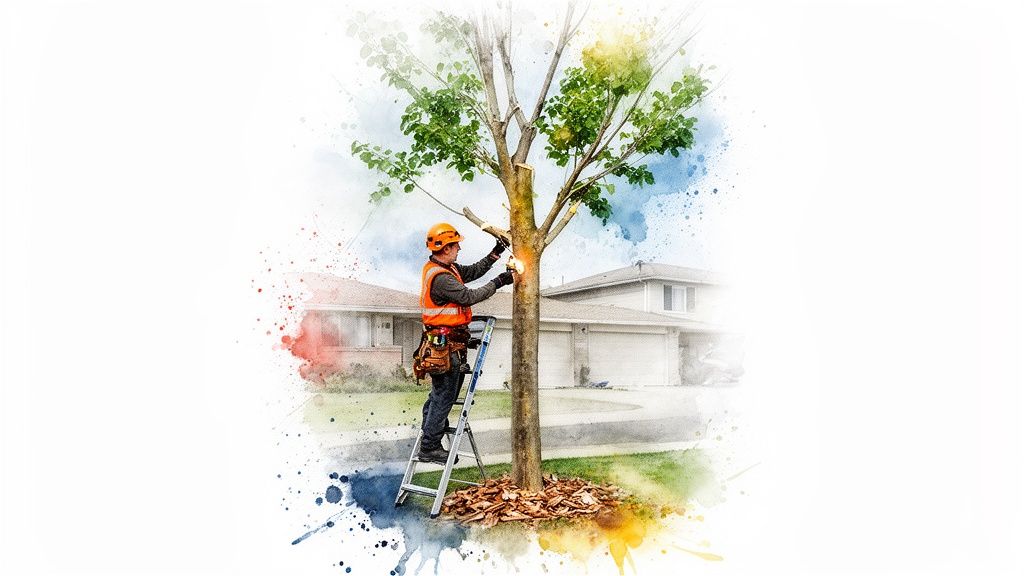
The idea is simple: we encourage the tree to form a single, sturdy central trunk and ensure its main branches are well-spaced and strongly attached. By correcting potential weak points early, we teach the tree how to stand up to the high winds and heavy rains we see here in the South Bay.
Correcting Common Structural Flaws
When we walk a property, our certified arborists have a trained eye for subtle defects that become major liabilities in a storm. Catching these issues early is always the best bet—it’s far easier and cheaper than cleaning up after a massive limb comes crashing down.
Here are the main culprits we look for:
- Weak Branch Unions: These are tight, “V-shaped” forks where a branch meets the trunk. Often, bark gets trapped inside, preventing strong wood from fusing. This is a top reason branches snap in high winds.
- Co-dominant Stems: This happens when a tree grows two competing main trunks, creating a weak point right down the middle. That central fork is incredibly prone to splitting apart under the force of a powerful gust.
- Crossing or Rubbing Branches: When branches grow into each other, they rub away protective bark, creating open wounds. These spots become entry points for decay and disease, weakening the limbs until they eventually fail.
By identifying and correcting these flaws, especially in the young and maturing trees common in San Jose, we set them up for a long, stable life. If you’re curious about the techniques, we break it all down in our complete guide to tree pruning.
The Long-Term Value of Expert Pruning
Investing in regular structural pruning is one of the smartest things you can do for your property’s safety. While it might be tempting to try it yourself, a bad cut can cause irreversible damage, creating new weak spots or inviting disease.
As a licensed and safety-focused San Jose tree service (CSLB #985639), we adhere to the highest industry standards. Every cut we make is designed to promote strength and health, building a tree that doesn’t just survive the next storm but thrives for decades. It’s the most effective answer to the question, “what tree maintenance helps prevent storm damage to my property?”.
Reduce Wind Resistance Through Canopy Thinning and Deadwood Removal
Picture a tree with a thick, dense canopy. Now, think of it as a massive sail. When a powerful storm rolls through the South Bay, that canopy catches the full force of the wind, putting incredible stress on the trunk and roots.
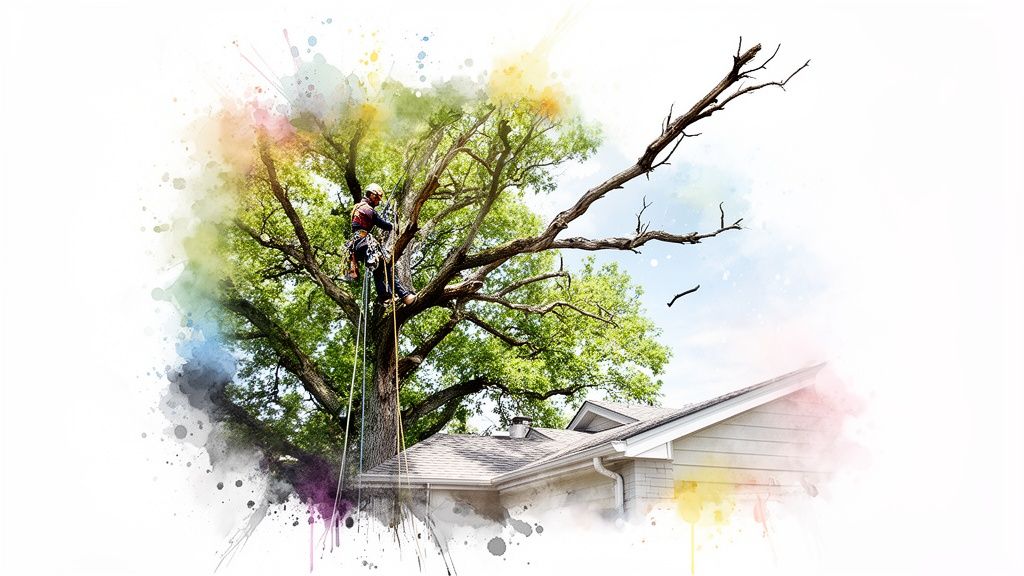
This is where canopy thinning comes in. It’s a specialized technique where an arborist selectively removes branches to reduce that dangerous ‘sail effect.’ The goal is to let the wind flow through the tree, not just push against it. By carefully opening up the canopy, we dramatically lessen the load on the tree’s structure, making it far more stable.
The Critical Role of Deadwood Removal
Just as important is getting rid of the dead stuff. Deadwood removal is non-negotiable for storm safety. Unlike healthy branches that can flex and bend with the wind, dead branches are brittle and waiting to snap.
In high winds, these dead branches become dangerous projectiles, easily capable of damaging your roof, car, or fence. Our licensed tree service crews are trained to spot these specific hazards and remove them safely, making your property much safer.
Why Professional Thinning Matters
Proper canopy thinning is a precise skill. A common and destructive mistake we see is “lion-tailing,” where amateurs strip out all the interior branches, leaving only tufts of leaves at the ends. This actually weakens the tree and creates new problems.
A true arborist knows how to thin a tree to improve airflow without harming its long-term health.
When done correctly, professional thinning delivers real advantages:
- Reduced Wind Load: This significantly lowers the risk of the tree blowing over in a storm.
- Improved Light Penetration: More sunlight can filter through to the inner branches and the lawn below.
- Enhanced Tree Health: Better air circulation throughout the canopy can help reduce the risk of fungal diseases.
Mistakes made during thinning can be expensive and permanently damage your tree. You can learn more about what not to do by reading about the common trimming mistakes that kill healthy trees. After any big tree job, you’ll need a plan to dispose of garden waste safely and legally to keep your property clean.
Identify Hidden Dangers with a Professional Arborist Assessment
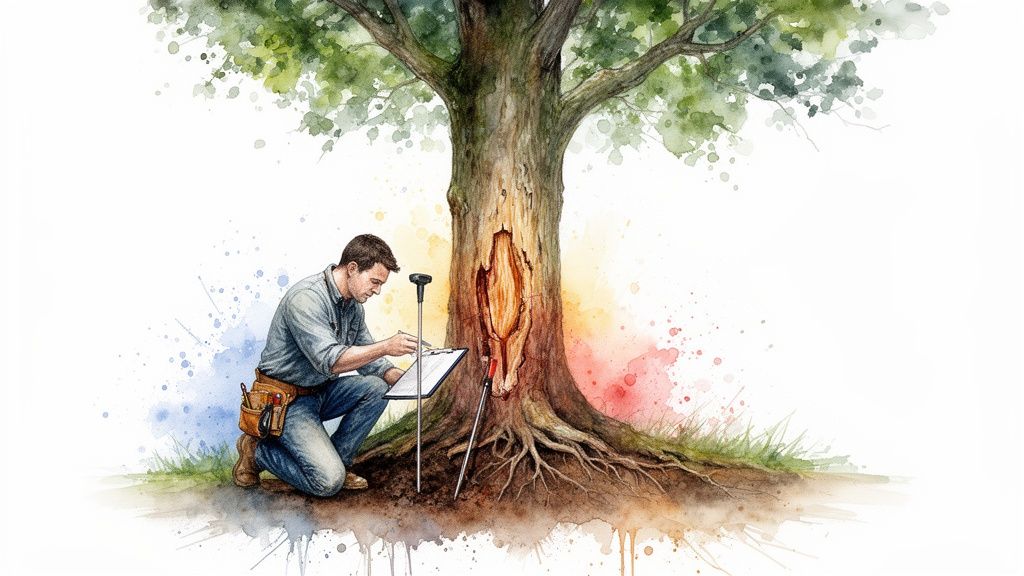
It’s easy to think a tree looks fine, but a quick glance from the ground can miss serious red flags. A professional arborist assessment is a complete health physical for your tree.
Our certified arborists are trained to look beyond the obvious. We’ll examine the root collar—the critical junction where the trunk meets the soil—for hints of decay. We check for compacted soil, a common issue in San Jose clay, and use specialized techniques to get a true read on a tree’s structural stability.
Uncovering Drought-Related Vulnerabilities
Living here in California, we see a dangerous cycle: years of drought followed by sudden, intense atmospheric rivers. Drought stress quietly kills off the small, essential feeder roots that anchor a tree. The canopy might still look lush, but below the surface, the foundation is crumbling.
An arborist assessment gives you a complete diagnosis, finding hidden weaknesses before they turn into major failures.
During an assessment, we methodically examine several key areas:
- Internal Decay: A tree can look solid on the outside while being dangerously hollow within. Our advanced tree decay detection services can pinpoint these unseen problems before they lead to a total collapse.
- Root System Health: We analyze the soil and look for issues like girdling roots or decay at the tree’s base, both of which compromise its ability to stay upright in high winds.
- Pest and Disease Pressure: Catching an infestation or disease early can stop it from weakening the tree’s structure.
- Past Damage: Old pruning wounds or storm damage can become entry points for decay, creating failure points years later.
Ultimately, a professional assessment moves you from guessing to knowing. It gives you the real information needed to make smart decisions and address the core issues that will keep your property safe during the next big storm.
How Proactive Tree Care Protects Your Property and Community
When a big storm rolls through the South Bay, a failing tree is rarely just one person’s problem. A single fallen tree can knock out power for a whole block, crush a neighbor’s fence, or block a street, preventing emergency vehicles from getting through. We see it happen every winter.
Nationally, fallen trees and limbs are responsible for over $1 billion in property damage annually. That staggering number shows why preventative care is a responsibility for every property owner in San Jose.
A Community-Wide Benefit
When you invest in professional care for your trees, you’re not just protecting your own roof. You’re contributing to a safer, more resilient neighborhood for everyone.
A healthy, well-maintained tree is a community asset. It boosts property values, provides shade, and cleans our air. But a neglected tree? That’s a liability waiting to happen, threatening your neighbor’s property, public sidewalks, and critical utility lines. Of course, a sturdy tree is just one piece of the puzzle; smart storm prep also includes other kinds of proactive home maintenance like gutter cleaning to prevent water damage.
Smart Investments for a Safer Neighborhood
At the end of the day, proactive tree care is a vital service that supports the well-being of our entire community. It eases the burden on first responders during severe weather and helps preserve the beauty and safety of the places we all share. It’s also worth keeping up with new techniques, so take a look at these five tree care trends protecting South Bay homes to stay ahead.
Ultimately, taking care of the trees on your property is one of the most practical ways to be a good neighbor. It protects your investment while helping keep the lights on and our streets clear when the next big storm hits.
Conclusion: Protecting Your Home and Investment
The message for San Jose homeowners is simple: being proactive is always smarter, safer, and easier on your wallet than waiting for an emergency. Answering “what tree maintenance helps prevent storm damage to my property?” isn’t about a secret formula; it’s about a consistent, common-sense strategy.
Focusing on the fundamentals—structural pruning, canopy thinning, deadwood removal, and a professional assessment—is what truly lowers your risk. Waiting until a big storm is on the forecast is like trying to buy insurance when your house is already on fire. It’s just too late.
Don’t wait for the next atmospheric river to become a headline. The team at San Jose Tree Service & Landscaping can help you build a care plan that makes sense for your property, your trees, and your budget.
We’re a licensed (CSLB #985639) and BBB Accredited company with deep roots right here in the community. Our commitment is to provide expert, safety-first solutions for our neighbors across the South Bay. Our licensed tree removal contractors and skilled pruning crews know what to look for and have the experience to fix potential problems before they become catastrophes.
Frequently Asked Questions (FAQs)
When is the best time of year to prune trees for storm safety?
The best time for major structural work is during dormancy in late fall or winter, as the branch structure is fully visible. However, removing dead or hazardous limbs is an urgent safety task that should be done by a professional immediately, regardless of the season.
My huge oak looks healthy. Does it really need an inspection?
Yes, absolutely. A tree can look healthy while hiding serious internal issues like decay, hollow cavities, or compromised root systems caused by drought. A professional arborist inspection identifies these hidden risks before they become a failure point in a storm.
Can I just trim my own trees to save money?
We strongly advise against it for any work requiring a ladder, chainsaw, or proximity to power lines. Improper cuts can permanently harm your tree, and working at height without proper training and safety gear is extremely dangerous.
How much does preventative tree maintenance cost?
The cost varies based on the tree’s size, species, health, and accessibility. However, proactive maintenance is consistently far less expensive than the cost of emergency removal and property repairs after a tree fails in a storm.
What’s the biggest mistake homeowners make before a storm?
The biggest mistake is waiting until a storm is in the forecast. By then, reputable tree services are fully booked, and it’s too late for strategic, preventative work. True storm preparedness is a year-round effort, not a last-minute reaction.
Don’t wait for the next storm warning to find out if your trees are a risk. The experienced team at San Jose Tree Service & Landscaping is ready to provide a professional evaluation and create a proactive maintenance plan to protect your home. Contact us today for a consultation and estimate.