
When a winter storm leaves a heavy branch dangling over your roof, your first instinct is likely to search for a "tree guy near me" fast. But is that who you really need? The distinction between a certified arborist and a general "tree guy" comes down to one crucial thing: certified expertise versus general labor.
That difference can have a huge impact on your property's safety, your home's value, and the future of your trees. This guide will clarify what separates a professional arborist from a general tree cutter, why credentials matter in the South Bay, and how to choose the right expert for your needs.
Why Homeowners Ask: The Arborist vs. Tree Guy Dilemma
Homeowners ask this question because they are often confused and cautious. They know tree work can be dangerous and expensive, but they don't always know who is actually qualified to do the job safely and effectively.
Many people worry that calling a certified arborist automatically means getting a sales pitch for an expensive tree removal. In reality, the opposite is often true. A real arborist is trained to preserve and save trees whenever possible, not just cut them down.
The Credentials Gap and Common Missteps
It’s easy to assume any tree service has the same level of training or that a cheaper quote means the same quality of work. This mindset often leads to disastrous results, like over-pruning, permit violations, or irreversible damage that kills a valuable tree.
A certified arborist is a trained specialist who has earned their title through extensive experience and rigorous testing. They need at least three years of full-time, hands-on experience just to sit for the International Society of Arboriculture (ISA) exam. It’s a serious profession, and you can learn more about how professional tree care is applied.
Data shows a growing trust gap: Homeowners increasingly search for certified arborists after storms and bad experiences, especially following viral stories of unqualified crews causing severe tree damage. This has raised awareness that credentials truly matter.
Quick Comparison: Arborist vs. General Tree Service
To make the choice crystal clear, let's break down what really separates a certified pro from a general tree worker. This table gets right to the point, highlighting the differences that matter most for protecting you and your property.
| Attribute | Certified Arborist | General 'Tree Guy' |
|---|---|---|
| Primary Focus | Tree health, preservation, safety, and risk assessment. | Primarily cutting, trimming, and basic removal. |
| Qualifications | ISA certification, ongoing education, and deep knowledge. | Experience varies; often no formal certification or training. |
| Approach | Diagnostic; identifies the root cause of issues to save trees. | Task-oriented; often defaults to removal as the solution. |
| Legal & Safety | Adheres to ANSI safety standards; understands local permits. | May lack proper insurance, licensing, or safety protocols. |
Looking at it side-by-side, you can see the value isn't just in the work itself, but in the knowledge, safety, and long-term planning an arborist brings to the table.
Comparing Credentials and Qualifications
When you're trying to figure out the real difference between a certified arborist and a local "tree guy," the answer almost always comes down to their paperwork. Credentials aren't just fancy titles; they're your best defense against shoddy work, property damage, and serious financial liability.
These qualifications are concrete proof of expertise and a commitment to safety. A person with a pickup truck and a chainsaw might offer a tempting price, but they can't provide the verifiable credentials that protect you.
ISA Arborist Certification: The Gold Standard
The single most respected credential in the tree care world is the International Society of Arboriculture (ISA) Certified Arborist designation. To even sit for the exam, a person needs a minimum of three years of full-time, documented experience in professional tree care.
The exam itself covers everything from:
- Tree Biology: How trees grow, respond to pruning, and heal.
- Pest and Disease Diagnosis: Correctly identifying what's ailing your tree.
- Soil and Water Relations: Understanding how our unique South Bay clay soils impact tree health.
- Safe Work Practices: Following strict, industry-mandated safety protocols.
An ISA Certified Arborist must also pursue continuing education to keep their certification active, ensuring they are always up to date on the latest science and safety standards.
California State Licensing Board (CSLB): A Non-Negotiable
Here in California, any tree work project valued at $500 or more legally requires the contractor to be licensed by the state. For tree services, look for a C-61/D-49 Tree Service Specialty license from the Contractors State License Board (CSLB).
A licensed contractor provides:
- Legal Recourse: A formal path to file a complaint if a job goes wrong.
- Proof of Bonding: A layer of financial protection for consumers.
- Vetted Experience: The CSLB verifies a contractor's experience.
Our own CSLB #985639 (C-61/D-49 + C-27) license is our public commitment to accountability. Always verify a contractor's license on the CSLB website before signing anything.
Safety Tip: Hiring an unlicensed "tree guy" for a major project means you have zero consumer protection. If they damage your property or vanish mid-job, you may have no practical way to recover your losses.
Insurance: Your Shield Against Financial Risk
Proper insurance is arguably the most important credential. A professional company must carry two specific types of insurance to protect you from catastrophic financial consequences.
1. General Liability Insurance: This covers damage to your property. If a limb drops and damages your roof or fence, their liability insurance pays for the repairs.
2. Workers’ Compensation Insurance: This is absolutely essential. If a worker gets injured on your property and their employer has no workers' comp, you could be held personally liable for their medical bills.
Always ask for proof of both insurance policies. A legitimate company will provide this information without hesitation, and it’s a clear sign of how to how to tell if an arborist is giving you honest advice about your tree.
Analyzing Safety Standards and Equipment
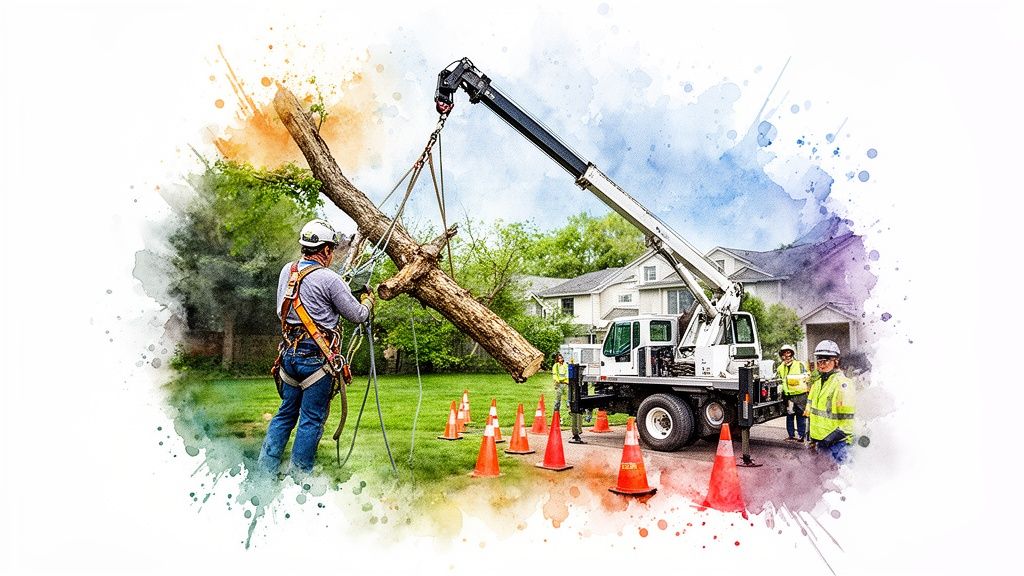
When someone is working high in the trees on your property, nothing matters more than safety. This is where the gap between a certified arborist and a general "tree guy" becomes a chasm.
True professionals live by a strict code, specifically the ANSI Z133 safety standards. This is the official rulebook for tree care operations, ensuring every move is designed to protect people and property. An untrained individual might just "eyeball" a complex job, which is a direct threat to your home.
The Right Tools for a High-Stakes Job
A certified arborist's rig is packed with more than just a chainsaw. They invest heavily in professional-grade, specialized gear built for the unique challenges of tree work in the South Bay.
You’ll see them using tools like:
- Specialized Rigging Systems: Complex systems of pulleys and high-tech lines that let crews lower massive pieces of wood with absolute control.
- Cranes and Aerial Lifts: A necessity for massive or hard-to-reach trees, allowing for safe, controlled removal in tight San Jose neighborhoods.
- Personal Protective Equipment (PPE): This is non-negotiable and includes chainsaw-resistant chaps, high-impact helmets, and advanced climbing saddles.
A less-qualified worker might show up with consumer-grade tools, which is a recipe for disaster. You can learn more about new equipment rules changing how tree services operate in California.
A Real-World San Jose Scenario
Imagine a huge eucalyptus in an Almaden Valley backyard with a cracked limb dangling over the house after a storm. A "tree guy" might try to free-climb and make aggressive cuts, risking a catastrophic fall.
An arborist approaches this like an engineering problem. They would install an advanced rigging system to secure the limb, carefully cut it into manageable sections, and lower each one safely to the ground. This methodical, safety-first process is the signature of a true professional.
Tree Preservation vs. Tree Removal
A common fear is that calling an expert means getting a death sentence for your tree. This is where the core philosophies of an arborist and a "tree guy" couldn't be more different.
A certified arborist leads with a preservation-first mindset. They see your tree as a living asset and perform a thorough diagnosis before even thinking about a saw. In contrast, someone who just "does trees" often sees cutting as the simplest solution, missing the opportunity to save a valuable tree.
An Arborist's Diagnostic Approach
Before making a cut, an arborist conducts a full assessment of your tree's health.
This includes:
- Health and Vigor Assessment: Checking leaf color, canopy fullness, and new growth.
- Structural Analysis: Hunting for weak branch unions, cracks, or signs of decay.
- Pest and Disease Identification: Correctly diagnosing issues that are often treatable.
- Site and Soil Evaluation: Looking at soil compaction, drainage, and root zone health.
An arborist’s goal is to create a long-term care plan. Methods like safe, non-destructive digging for your property show a commitment to doing the job right without causing collateral damage. This protects your property value, as 98% of homeowners believe landscaping increases property value (Source: National Association of REALTORS®).
For San Jose homeowners, this is crucial for meeting local standards, which is why our arborist preservation reports provide the necessary detailed analysis.
When Removal Is the Only Option
Of course, some trees cannot be saved. A certified arborist will always recommend removal if a tree becomes a serious risk, but it's always the last resort.
An arborist recommends removal only when:
- The tree has a major, unfixable structural flaw.
- It is dead or in severe decline with no chance of recovery.
- It poses an immediate danger to people or property.
- Its location guarantees future damage (e.g., too close to a foundation).
The difference is that an arborist's recommendation is backed by a scientific diagnosis and a clear explanation—an expert opinion based on solid evidence.
When to Hire an Arborist vs. a Tree Service
Deciding whether you need a certified arborist or a general tree service comes down to your goal. Are you diagnosing a complex problem to save a tree, or do you just need some branches hauled away?
Knowing the difference helps you get the right person for the job, saving you time and money.
Any time you're dealing with a tree’s health, structural integrity, or long-term value, the path leads to a certified arborist.
Call a Certified Arborist When…
Think of an arborist as a "tree doctor." You hire them for a diagnosis, a long-term care strategy, or an expert opinion on a high-stakes situation.
Hire a certified arborist for tasks like:
- Diagnosing a Sick or Dying Tree: An arborist can pinpoint the real problem and prescribe a treatment plan.
- Assessing Tree Risk: A formal risk assessment can identify hidden structural weaknesses and recommend actions to keep your home safe.
- Navigating Local Permits: An arborist is qualified to prepare the necessary arborist preservation reports that San Jose requires for protected trees.
- Planning for Construction: A tree protection plan can ensure construction crews don't accidentally kill your mature trees.
- Structural Pruning for Young Trees: An arborist can make precise cuts to encourage a durable structure, preventing future problems.
A General Tree Service May Suffice When…
For basic, straightforward jobs that don't need a deep diagnosis, a properly licensed and insured general tree service is often a practical choice. The key is ensuring they meet all legal and safety requirements.
A general tree service is a good fit for:
- Removing Small Trees or Shrubs: Taking out a small, non-hazardous tree is a perfect job for a qualified service.
- Clearing Brush or Hauling Green Waste: A tree service can efficiently chip and haul away yard debris.
- Stump Grinding: A tree service has the specialized equipment to grind stumps below the soil surface.
Important Note: Even for "simple" jobs, any company you hire for work over $500 must have a valid CSLB license (C-61/D-49) and carry both general liability and workers' compensation insurance.
How to Spot Red Flags and Protect Your Property
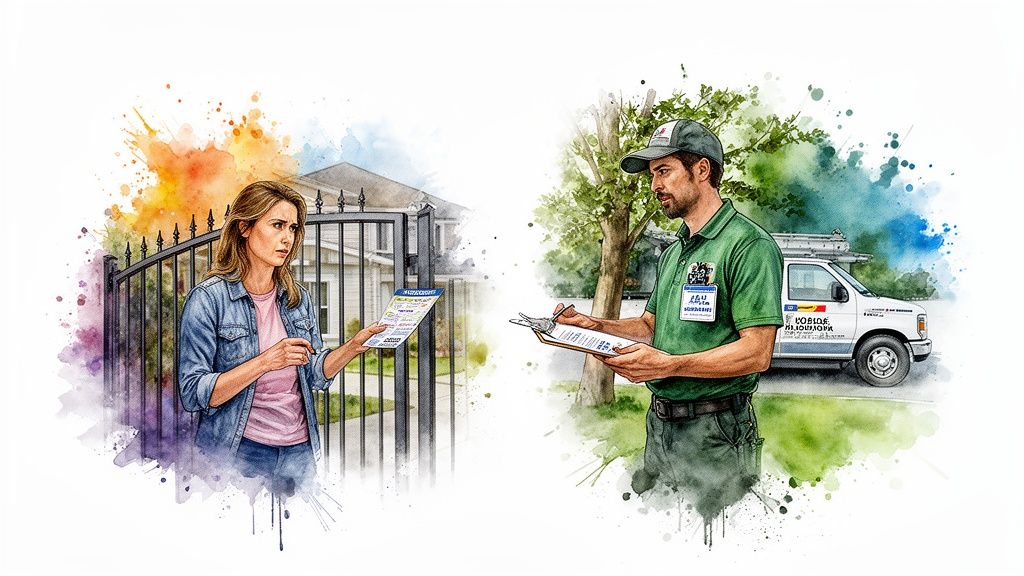
Knowing the warning signs of an unqualified operator is the best way to protect your property from harm. Homeowners are most vulnerable right after a storm when anxiety is high and questionable outfits start canvassing neighborhoods.
Common Warning Signs of an Unqualified Tree Service
An unqualified "tree guy" often reveals themselves through their sales pitch and the services they push. These are glaring signals of a lack of proper training and concern for your trees.
Keep an eye out for these classic red flags:
- Aggressive Door-to-Door Sales: Reputable companies don't need to use high-pressure tactics, especially after a storm.
- Offering to "Top" Your Trees: Tree topping is an outdated and incredibly damaging practice that no certified arborist would ever suggest.
- Using Climbing Spikes on a Healthy Tree: Spikes should only be used on a tree that is being completely removed, as they create open wounds.
One of the biggest red flags is a failure to provide credentials. A professional, licensed company will proudly display its CSLB number—like our CSLB #985639. If they hesitate when you ask, walk away.
Your Quick Vetting Checklist
Before you agree to any work, run the company through this quick checklist to ensure they are a true professional.
Ask for the following:
- Proof of a valid CSLB License: Get their license number and look it up on the CSLB's official website.
- Certificates of Insurance: Ask to see current proof of both general liability and workers' compensation insurance.
- A Detailed, Written Estimate: The estimate should clearly outline the scope of work, total cost, and company contact information.
- Local References: A well-regarded local company should have no problem providing references from happy clients nearby.
Taking these few extra minutes empowers you to hire with confidence and protect your South Bay property.
Conclusion: Choose Expertise for Your San Jose Trees
When you search for "what’s the difference between an arborist and a tree guy near me," the answer is clear: it’s the difference between a tree cutter and a tree care expert. While a "tree guy" might offer a quick fix, a certified arborist provides the knowledge, safety, and long-term vision needed to protect your property and preserve your valuable trees.
For homeowners in San Jose and the South Bay, choosing a licensed, insured, and certified professional is the first step toward responsible tree management. At San Jose Tree Service & Landscaping, our certified arborists are here to help you make informed decisions, whether you need a complex health diagnosis or a safe, permitted tree removal.
Ready to work with a team that prioritizes the health of your trees and the safety of your property? Contact San Jose Tree Service & Landscaping today for a professional consultation.
Frequently Asked Questions
What's the main difference between an arborist and a tree guy?
An arborist is a certified and trained professional focused on tree health, preservation, and safety, while a "tree guy" typically offers basic cutting and removal services without formal credentials.
Is hiring a certified arborist more expensive?
While an arborist's rate may be higher, their diagnostic approach often saves you money by preserving trees and preventing costly property damage from improper work.
Do I need an arborist just for tree trimming?
For structural pruning that affects a tree's long-term health and safety, yes. An arborist understands tree biology and makes precise cuts that promote strong growth, unlike a "tree guy" who might simply cut branches back.
How do I know if a tree service is legitimate?
Always ask for their California State License Board (CSLB) number (like our CSLB #985639), and request proof of both general liability and workers' compensation insurance before any work begins.
Why is local expertise important for tree care in San Jose?
A local arborist understands the South Bay's specific challenges, including protected tree ordinances, drought-stressed root zones, and risks from atmospheric rivers, ensuring your trees get the right care for our climate.
