
The way homeowners think about landscaping is undergoing a seismic shift. We're seeing a move away from purely cosmetic upgrades and toward smart, long-term investments. Homeowners now prioritize water efficiency, durability, and a clear return on investment (ROI), focusing on sustainable designs that actively lower their costs over time.
This guide breaks down how these new spending habits are changing landscape installation decisions and what it means for your next project. We'll cover why old models fail, how to plan for long-term value, and the importance of integrated expertise for a future-proof yard.
The New Era of Landscape Investment in the South Bay
Across the South Bay—from San Jose and Campbell to Willow Glen and Morgan Hill—the mindset has matured. A yard makeover is no longer a simple, one-off project. It’s now treated as a strategic part of managing your home as an asset.
In fact, current market data shows a significant shift: homeowners now treat landscape spending as non-discretionary, averaging $616 per year and rising. (Source: Homeowner Landscape Spending Report, 2023) This isn't pocket change. It's a consistent investment, which means homeowners rightfully expect more transparency and designs that actively reduce ongoing expenses.
From Aesthetics to Assets: ROI-Driven Decisions
This new way of thinking demands smarter, more resilient outdoor spaces. Homeowners are no longer willing to pay for pretty flowers that wilt in the first heatwave or a lush green lawn that sends their water bill through the roof.
They’re asking tough, practical questions before a single shovel hits the dirt:
- How will this design save me money over the next 5-10 years?
- What is the real, long-term value this project adds to my property?
- Is this landscape tough enough to handle our local climate and drought conditions in California?
This intense focus on ROI means contractors who just offer quick aesthetic fixes are missing the mark. Today's clients need a partner who can engineer a complete system built to perform. You can dive deeper into these priorities in our guide on the 5 trends shaping beautiful and water-smart yards in 2026.
The Demand for Future-Proof Designs
A "future-proof" landscape integrates durable, water-efficient elements right from the start. We're talking about proper soil preparation for our local clay, high-efficiency irrigation, and a plant selection leaning heavily on a sustainable landscape design with native and drought-tolerant species.
This approach ensures the landscape doesn't just survive—it flourishes, minimizing the need for costly replacements. As landscape spending becomes a predictable household line item, customers increasingly choose installers who reduce future costs rather than inflate them through short-term thinking.
Why Old Landscaping Models No Longer Make the Cut
There's a growing disconnect between what homeowners in the South Bay want and what old-school landscaping delivers. Installing a thirsty lawn with a few generic flower beds is like buying a gas guzzler—it might look nice at first, but it's guaranteed to lead to buyer's remorse.
This traditional, short-sighted approach just isn't working for San Jose homeowners anymore. The consequences are frustratingly predictable and create a cycle of dissatisfaction that drains your bank account.
The True Cost of Short-Term Thinking
Many homeowners have learned the hard way that a poorly planned landscape is a recipe for long-term headaches. The initial appeal of a "quick and easy" installation disappears fast once the real costs start showing up.
These are the common pain points we see with outdated designs:
- Soaring Water Bills: Traditional landscapes are incredibly thirsty. In a place like the South Bay where drought is a constant concern, that translates directly into shockingly high water bills.
- Failed and Dying Plants: If plants aren't chosen specifically for our local clay soils and blistering summer heat, they're set up to fail. This leaves you with withered shrubs and bare patches, forcing you to spend more money on replacements.
- Constant, Expensive Redesigns: When a landscape isn't designed for durability, it starts looking tired almost immediately. This traps homeowners in a frustrating loop of costly redesigns just to keep the yard presentable.
Simply put, a landscape that isn't built for our local climate isn't an investment—it's a liability. These outdated methods completely ignore the new spending habits changing landscape installation decisions, which now put resilience and long-term financial sense ahead of temporary curb appeal.
Contractors still pushing these one-time aesthetic upgrades are missing what customers now prioritize: durability, water efficiency, and financial ROI. To see just how much weather plays a role, you can read about how San Jose's storm seasons are reshaping landscape contractor demand.
Unlocking Long-Term Value and Real ROI
A landscape upgrade isn't just a short-term expense; it's a powerful, long-term asset. When approached strategically, your landscape doesn't just look great—it actively pays you back over time through lower water bills, less maintenance, and a serious boost to your property's value.
The secret is investing in the right components from day one. A modern landscape is built on a foundation of smart, durable elements designed specifically for South Bay living.
The Building Blocks of a High-ROI Landscape
A truly valuable landscape is a cohesive system where every element is chosen for performance and longevity.
Here’s what that looks like in practice:
- Climate-Appropriate Native Plants: This is non-negotiable. Choosing species naturally adapted to San Jose’s dry summers and clay soil means they need less water and fewer fertilizers, so they thrive for years, not just survive for a season.
- Advanced Soil Preparation: You can’t skip the groundwork. Proper soil amendment and grading are crucial for success, ensuring better water absorption, reducing wasteful runoff, and giving plant roots a healthy environment.
- High-Efficiency Irrigation: Old-school sprinklers are a budget-killer. Modern drip systems and smart controllers deliver water directly to the root zone, cutting waste. This simple change can reduce outdoor water use by up to 50%. (Source: EPA WaterSense)
This infographic drives home the common financial traps of outdated landscaping, which is exactly what a modern, ROI-focused approach is designed to prevent.
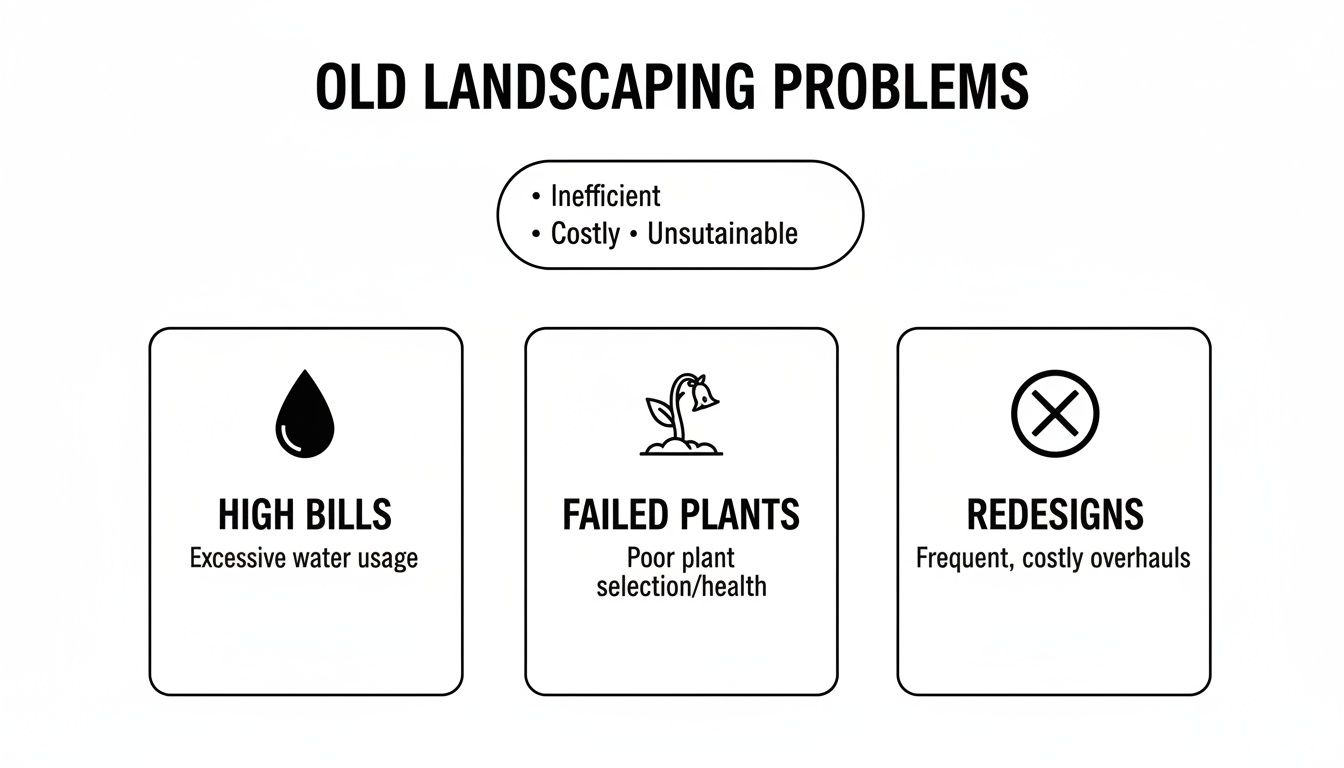
Every one of those issues—sky-high water bills, dying plants, and the need for constant redesigns—stems from a failure to invest in a durable, climate-smart system from the beginning.
Comparing Landscape Investments: Short-Term vs. Long-Term ROI
| Feature | Traditional (Short-Term) Approach | Modern (ROI-Focused) Approach |
|---|---|---|
| Plant Selection | Often based on aesthetics alone, using thirsty, non-native plants. | Drought-tolerant natives and climate-adapted species that thrive naturally. |
| Watering System | Inefficient spray sprinklers that waste water on pavement and through evaporation. | High-efficiency drip irrigation and smart controllers that minimize water use. |
| Maintenance | Requires frequent mowing, fertilizing, and replacing failed plants. | Low-maintenance design that reduces ongoing labor and material costs. |
| Long-Term Costs | High water bills, recurring plant replacement costs, and potential for redesigns. | Lower utility bills, minimal replacement needs, and a one-time investment. |
| Property Value | Minimal or temporary boost to curb appeal. | Significant, lasting increase in property value and buyer appeal. |
An overwhelming 98% of homeowners believe landscaping increases property value, and they're right. (Source: Homeowner Landscape Value Survey, 2023) Even basic lawn care on a 5,000 sq ft lot can recover 217% of its cost in home value, according to an in-depth industry report.
By focusing on these high-performance elements, you stop buying a "look" and start investing in a system that protects your budget. For help planning, see our advanced guide to planning a realistic landscape installation budget. This is how new spending habits changing landscape installation decisions are paving the way for sustainable outdoor spaces.
A Smarter Way to Plan Your San Jose Landscape
With this new focus on getting the most bang for your buck, how should you plan your landscape project? It starts with prioritizing foundational work and thinking in logical phases. This ensures every dollar you spend builds real, long-term value.
This strategic planning has become essential. We're seeing new spending habits changing landscape installation decisions across the board. Homeowners want a durable, cost-effective outdoor system that performs year after year.
Prioritize the Foundation First
Before picking out plants or pavers, a successful landscape begins with the elements you can’t easily see. These are key to creating a healthy, low-maintenance, and resilient outdoor space.
Focus your initial investment on these critical areas:
- High-Efficiency Irrigation: In the South Bay, modern drip systems and smart controllers are non-negotiable. They eliminate waste and dramatically lower your monthly water bills.
- Soil Health and Grading: Our local clay soil needs help. Proper soil amendment improves drainage and helps plants establish deep, healthy roots so they can thrive.
- Protecting Mature Trees: Your established trees are your landscape’s most valuable assets. Any installation plan must protect their root zones during construction to ensure they survive for the long haul.
By tackling these foundational elements first, you build a stable, efficient system. This lets you phase in other features like new plantings or hardscaping over time without having to backtrack and fix expensive underlying problems later.
Phased Projects and Realistic Budgeting
A complete landscape overhaul doesn't have to happen all at once. Taking a phased approach is a smart way to align the project with your budget, letting you execute a master plan over several months or even a few years.
When it comes to outdoor living spaces, investing in high-quality materials like charred decking solutions can be a savvy decision that pays off. This forward-thinking mindset is becoming more common, especially with younger homeowners who have a strong preference for water-efficient landscaping and native plants over old-school turf.
This is where working with a dually-licensed contractor is so important. An expert holding both a tree service (D-49) and a landscaping (C-27) license can develop a truly holistic plan. Learn more in our guide on how to choose a landscape design and installation contractor in San Jose. This integrated approach ensures your tree health, irrigation, and future plantings all work together.
The Advantage of Integrated Tree and Landscape Expertise
As South Bay homeowners get more deliberate with their landscape investments, who you hire matters more than ever. The focus on long-term value and durability calls for a skill set your average landscaper or standalone tree trimmer just doesn't have.
When you hire one company for trees and another for landscaping, you're almost guaranteed a disjointed project. The landscaper might trench for irrigation and unknowingly sever critical tree roots. The tree crew might prune a canopy without any thought for the sun-sensitive plants just installed below. It's a recipe for costly mistakes.
The Power of Dual Licensing: C-27 and D-49
A contractor who holds both a C-27 (Landscaping) and a C-61/D-49 (Tree Service) license brings a unified vision to your property. This dual expertise means every decision is made with a full understanding of how the entire ecosystem works together.
This integrated approach helps you sidestep common, expensive problems:
- Root System Damage: Ensuring a new patio or sprinkler system doesn't kill a mature oak tree.
- Poor Plant Placement: Choosing plants that will thrive in the shade of your trees, not wither away.
- Inefficient Water Use: Designing an irrigation system that gives both trees and plants what they need without waste.
A dually-licensed expert aligns tree health, planting layout, and landscape structure so clients get a system that lasts, not a short-lived facelift. This proactive approach turns your landscape into a cohesive, high-performing system.
Maximizing Your Investment from the Start
This comprehensive oversight is exactly what’s needed as new spending habits changing landscape installation decisions drive homeowners to demand more bang for their buck. A contractor who understands the complete ecosystem can design a project that’s built to last, saving you money on redesigns, plant replacements, and emergency tree work.
At San Jose Tree Service & Landscaping, our dual licensure (CSLB #985639) and BBB Accreditation since 2013 are the foundation of the value we provide. To see how these combined skills can protect your property, check out our guide on arborist landscaping. We ensure your new landscape is a durable, thriving investment.
Conclusion: Build a Yard That's Ready for the Future
It's clear where things are heading. The old ways of thinking about our yards just don't cut it anymore in the face of climate change and shifting economic priorities. We've seen a real shift in how new spending habits are changing landscape installation decisions, pushing all of us across the South Bay to think smarter about our outdoor spaces.
This is your cue to start thinking beyond quick fixes. It's time to build a landscape that works for you and our climate, not just for this season, but for years to come. For homeowners in San Jose, Campbell, Willow Glen, and Morgan Hill, now is the ideal moment to upgrade your yard with a long-term plan—not temporary fixes.
Take the Next Step Towards a Smarter Landscape
Focusing on a few key things ensures your project is a success:
- Real Water Savings: Start with smart, drought-tolerant landscaping in California and efficient irrigation systems.
- Durability and Low Maintenance: Choose materials and plants that can handle our specific climate without constant fuss.
- A Unified Vision: Your trees and landscaping must work together in a single, harmonious design.
When you focus on these core ideas, you create a space that actively saves you money and adds serious, lasting value to your home.
Don't settle for a short-lived facelift. Contact San Jose Tree Service & Landscaping for a professional consultation with our licensed experts. Let's build a beautiful, resilient, and financially smart landscape you can enjoy for years to come.
Frequently Asked Questions (FAQs)
1. Is a drought-tolerant landscape really cheaper in the long run?
Yes, absolutely. A well-designed drought-tolerant landscape can slash outdoor water use by up to 50%, leading to significant long-term savings on your utility bills. (Source: EPA WaterSense)
2. How do I know if a landscaping contractor is properly licensed in San Jose?
You should always ask for their California State License Board (CSLB) number. For landscape installation, they need a C-27 license, and for tree work, a D-49. Our license, CSLB #985639, covers both.
3. Can I install a new landscape in phases to fit my budget?
Yes, and it's a very smart approach. A professional can help you create a master plan that you can implement over time, starting with foundational elements like irrigation and hardscaping.
4. Why is protecting my existing trees so important during a landscape project?
Mature trees are valuable assets that provide shade, increase property value, and support the local ecosystem. Damaging their root systems during construction can lead to their decline and costly removal later, making protection a top priority.
5. What kind of ROI can I actually expect from a landscape upgrade?
The return on a smart landscape upgrade is one of the best in home improvement. A well-designed, water-wise yard is a powerful asset that makes your property stand out to buyers in the competitive South Bay market.
