 Skip to content

You’ve been there, right? One tree service tells you that majestic oak in your yard needs to come down—an expensive, heartbreaking prospect. Then another company says a simple trim will do just fine. Who do you believe?
It's a tough spot, and it can leave you feeling completely lost, especially when a beloved tree is hanging in the balance. A truly professional arborist should act more like a trusted advisor, someone whose first priority is the long-term health of your tree and the safety of your home.
Why Is It So Hard to Find Advice You Can Trust?
Your hesitation is completely understandable. The fear of being upsold on expensive, unnecessary tree removal or hiring an unqualified crew that could do more harm than good is very real. This is a common worry for homeowners all over the South Bay, where we're often dealing with valuable heritage oaks and other protected trees that require expert care.
Many homeowners mistakenly assume any tree service can diagnose diseases, evaluate hazards, or handle protected species. This guide is designed to give you a clear, practical checklist to cut through that confusion and feel confident in your choice.
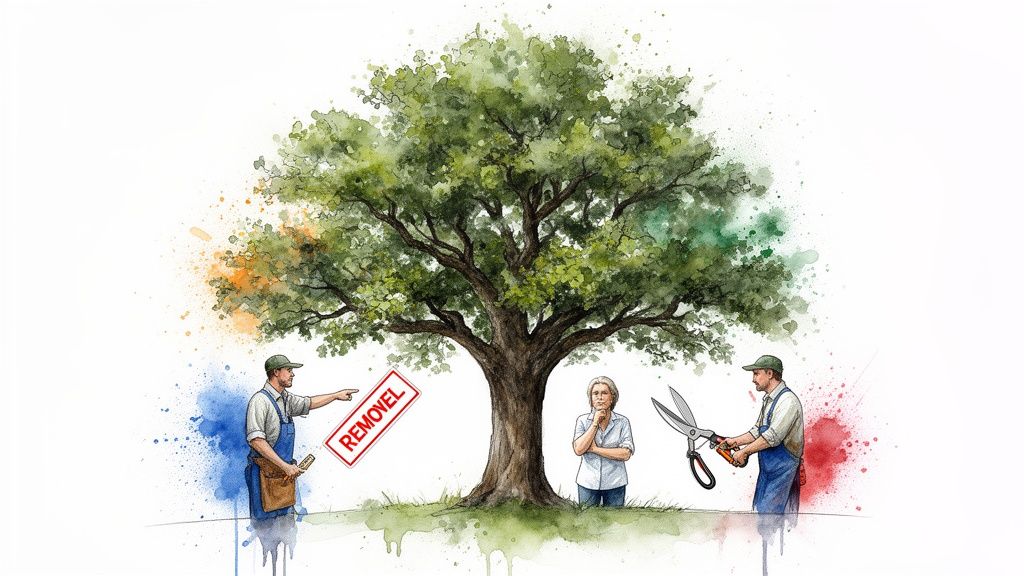
A lot of the confusion comes from a common misconception: that anyone with a chainsaw is qualified to diagnose tree diseases or assess complex structural risks. This often leads homeowners to hire a "tree guy" who might be great at cutting branches but lacks the scientific knowledge to give sound advice. If you're curious, we break down this critical distinction in our guide on the difference between an arborist and a tree guy.
Look for Verified Expertise—It Matters
An arborist’s advice is built on a foundation of education and hands-on experience, not just the ability to operate equipment. Professional certification is your first and best indicator of genuine expertise. Take the ISA Certified Arborist credential, for example. To even sit for the exam, an individual needs at least three years of full-time professional tree care experience.
Research shows widespread confusion about when a certified arborist is required, with many homeowners worried about being misled. This fear is valid, especially when unqualified workers skip critical city permit requirements, leading to potential fines for the property owner.
The Honest Approach: Preservation First, Removal Last
Here’s a big tell: a trustworthy professional will always look for ways to save a tree before recommending removal. They see removal as the absolute last resort, reserved only for trees that are dead, dying, or pose a risk that can't be managed.
They should be ready and willing to talk you through alternatives. An honest assessment might include options like:
- Cabling or bracing to provide structural support for weak limbs.
- Soil improvement and treatments to revitalize a struggling tree.
- Structural pruning to manage growth and reduce risk over time.
Here at San Jose Tree Service & Landscaping, our in-house ISA Certified Arborists are committed to giving you honest, transparent assessments. We believe in educating our clients, not just selling services.
Checking for the Non-Negotiable Credentials
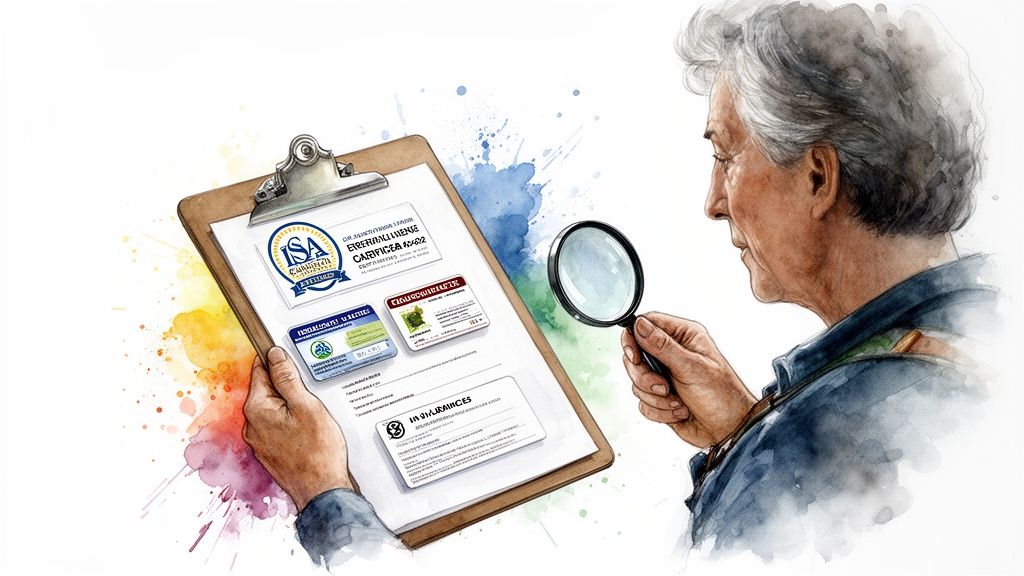
Before you even start thinking about the advice an arborist is giving you, there's some critical homework to do. Think of it as a background check. These foundational credentials aren’t just nice-to-haves; they are absolute must-haves.
Taking a few minutes to verify these details is the fastest way to weed out the unqualified players and protect your property, your trees, and your wallet.
The first and most important credential to ask about is their ISA (International Society of Arboriculture) certification. This isn't just a piece of paper. It proves they have years of solid, hands-on experience in the field and have passed a tough exam covering everything from tree biology to safe work practices.
Verifying Licenses and Insurance
Once you've confirmed their ISA certification, the next step is to check for the proper state and local paperwork. Any legitimate tree company working in the South Bay absolutely must have a California State License Board (CSLB) license, specifically the C-61/D-49 for tree work. This license is your assurance that they're a recognized, accountable business. We cover this in more detail in our guide on what to look for before hiring a tree service in San Jose.
Insurance is just as crucial. A professional arborist will carry two key policies, and they should be able to show you the certificates without any hesitation.
- General Liability Insurance: This is what protects your home and property if something goes wrong.
- Workers' Compensation Insurance: This policy is non-negotiable. It covers their crew if someone gets hurt on your property, shielding you from a potentially devastating lawsuit.
Never, ever just take their word for it. A reputable company will have no problem showing you their CSLB license (like our #985639) and proof of full insurance coverage. Transparency here is a huge green flag.
Think of it this way: large corporations use a robust contractor management service to ensure every vendor is properly vetted. You should apply that same level of diligence. If a company gets defensive or can't produce these documents right away, walk away. It’s a massive red flag.
Spotting Red Flags in Arborist Recommendations
After you've been in the tree care business long enough, you start to see the same questionable advice pop up again and again. Dishonest or simply unqualified "tree guys" often rely on a predictable playbook. Knowing what to look for is the best way to protect your trees.
The biggest giveaway? High-pressure sales tactics. If someone shows up and insists your tree has to come down today, you need to take a step back. A true professional understands that removing a mature tree is a significant decision and will give you space to think.
Outdated and Harmful Practices
Another massive red flag is a recommendation for a pruning technique that a qualified professional would never use. These methods are shortcuts that do long-term damage.
Keep an ear out for these terms:
- Tree Topping: This is the indiscriminate hacking off of a tree's main branches, leaving ugly stubs. It's a disaster for the tree's health, inviting decay and causing a dangerous explosion of weak, unstable new growth.
- Lion's Tailing: This involves gutting the inside branches of a tree, leaving foliage only at the very ends. It starves the tree and shifts all the weight to the tips of the limbs, making them far more likely to snap in a storm.
If someone suggests either of these, it's a clear sign they are not up-to-date with industry standards. You can learn more by reading our guide on how to know if a tree trimming company will ruin your tree.
A professional arborist’s goal is always preservation first. Removal is the last resort—reserved for trees that are dead, in irreversible decline, or pose a risk that can't be safely managed through alternatives like pruning or cabling.
Vague Plans and Zero Local Knowledge
Pay close attention to the details—or lack thereof. A vague, verbal-only estimate that glosses over the "how" is a problem. You should receive a written proposal that clearly spells out the scope of work, the equipment they'll use, and the steps they'll take to protect your home.
Finally, put their local expertise to the test. Here in the South Bay, navigating city-specific tree ordinances is non-negotiable. Ask them directly about permit requirements for a protected valley oak in San Jose, or a heritage redwood in Los Gatos.
Honest Arborist vs. Red Flag Behavior
To make it even clearer, here’s a quick comparison of what you should expect from a professional versus what should set off alarm bells.
| Scenario | Honest Arborist's Approach | Red Flag Warning Sign |
|---|---|---|
| Urgency | Provides a detailed risk assessment and explains the timeline without pressure. | "This tree has to come down today, or it will fall on your house!" |
| Pruning | Recommends structural pruning based on ANSI A300 standards to promote health. | Suggests topping or lion's tailing as a "solution." |
| Proposal | Delivers a written, itemized quote detailing the work, cleanup, and cost. | Gives a verbal-only price or a vague, one-line estimate. |
| Local Rules | Is knowledgeable about San Jose's permit process for protected trees. | "You don't need a permit for that," or seems unaware of local ordinances. |
| Justification | Explains why a specific action is needed, focusing on tree biology and safety. | Uses fear or makes broad, unsubstantiated claims to push a service. |
At the end of the day, a trustworthy arborist acts as an educator and a partner in caring for your trees, not just a salesperson.
Asking Questions That Reveal True Expertise
An arborist’s credentials on paper are one thing, but how they handle your questions in person tells the real story. This is where you can separate a genuine tree care expert from a salesperson just looking for the next job.
The right questions will cut through the noise. A truly professional arborist will welcome your curiosity and give you straight, confident answers.
Questions That Uncover Their Local Knowledge
Start by testing their knowledge of our specific South Bay environment. A pro who works here day in and day out will know our local rules and common tree issues like the back of their hand.
Try asking these questions to see how they respond:
- "Is this tree a protected species in San Jose, and what are the permit requirements for this work?" Someone who knows our area can immediately talk about heritage oaks, redwoods, and the specific ordinances in San Jose, Saratoga, or Los Gatos. They won't have to guess—they'll know the city's process.
- "What are the alternatives to removal?" This is a big one. An honest-to-goodness arborist always puts the tree's health first. They should be talking about solutions like cabling, bracing, soil treatments, or a strategic pruning plan long before they jump to removal.
- "Can you explain the specific pruning techniques you recommend and why?" Listen for terms like crown cleaning, thinning, or reduction. More importantly, they should be able to explain why that specific technique is right for your tree’s health and structure, and they might even mention the ANSI A300 standards they follow.
- "How will you protect my home and landscaping during the job?" A detailed answer is what you want. They should mention specific safety measures, like using specialized rigging to lower heavy limbs instead of just letting them drop, or putting down protective mats to avoid damaging your lawn.
A truly great arborist educates more than they sell. Their willingness to explain the "why" behind their recommendations is a powerful sign of honesty and expertise. They should sound like a tree doctor diagnosing a patient, not someone just quoting a price.
Their answers should show they’re familiar with the challenges we face right here. Think: drought stress on our native oaks, the heavy clay soil impacting root systems, and how to best prepare trees for the atmospheric rivers that roll through. For homeowners wanting a deeper dive into their tree's condition, our expert consultation and diagnostic services can provide a comprehensive health and risk assessment.
Don't Be Afraid to Get a Second (or Third) Opinion
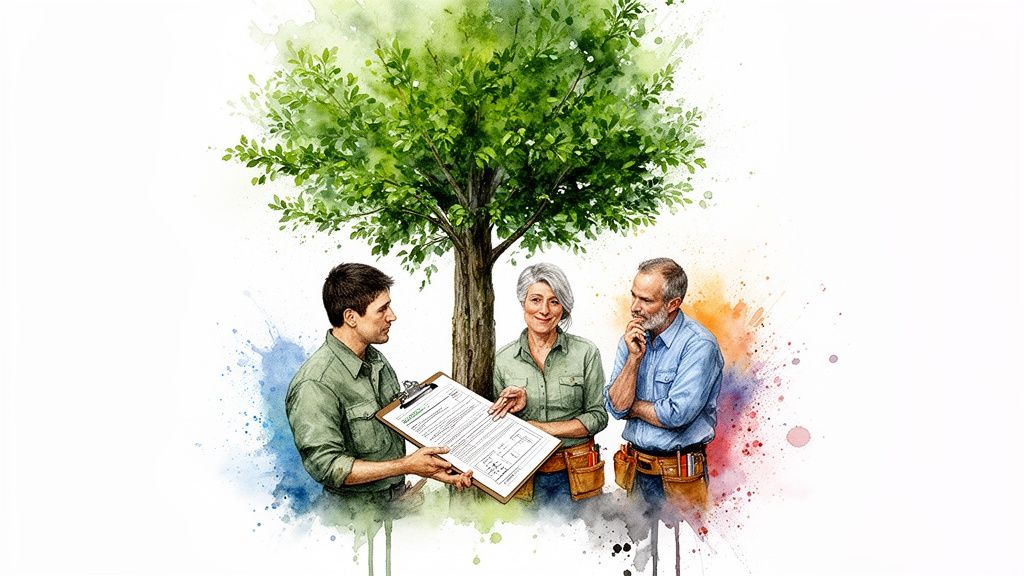
If you're staring down a major tree care decision, especially a full removal, don't let anyone rush you. It’s not just smart, it’s standard practice for savvy South Bay homeowners to get a second opinion. Any true professional will be confident in their diagnosis and should never have a problem with you seeking another perspective.
Think of it less as price shopping and more as gathering intelligence. When you lay out the different proposals, look beyond the bottom line. You're comparing their reasoning just as much as their rates.
Always, Always Get It in Writing
No matter which arborist you feel good about, insist on a detailed, written proposal before you agree to anything. A handshake and a verbal quote just don't cut it. This document is your shield—it’s the clearest sign you’re dealing with an honest, professional outfit.
Here's what it absolutely must contain:
- A clear scope of work, spelling out exactly what they'll do, from the specific pruning techniques to how they’ll handle the cleanup.
- The total cost and payment schedule.
- A realistic timeline for when the work will start and finish.
- Their CSLB license number (like CSLB #985639) and proof of current insurance.
This isn't just a suggestion; it’s non-negotiable. If a company hesitates to put everything on paper, that's a massive red flag. Proper documentation is the signature of a trustworthy and accountable San Jose tree service.
For more complicated scenarios, like dealing with protected trees or planning work near a construction site, you might need to take it a step further. In these cases, detailed arborist preservation reports provide an official assessment, ensuring every action is backed by expert analysis.
Why Deep Local Knowledge Is a Key Trust Signal
An arborist's advice is only as good as their grasp of the local environment. Hiring a company with deep roots right here in the San Jose area isn't just a nice-to-have; it's essential for getting honest, effective guidance.
A true local expert has seen it all. They know firsthand how to nurse a native oak through a long, dry summer and how to deal with the root problems that come with the heavy clay soil found all over the South Bay. This isn't something you learn from a textbook; it’s hard-won experience.
Navigating Local Rules and Climate
Familiarity with our specific microclimates is just as important. A local pro can give you practical, no-nonsense advice on how to prepare your trees for the powerful atmospheric river events we've been getting. That kind of localized guidance is a dead giveaway that you're dealing with an expert.
Even more critically, an expert on the ground will be an authority on the strict tree protection ordinances in cities like San Jose, Saratoga, and Los Gatos.
An out-of-area contractor who doesn't know the local heritage tree rules can get you into a world of trouble. Their ignorance could easily lead to hefty fines or a stop-work order from the city, leaving you with the mess.
This specialized knowledge is a powerful signal of a competent, trustworthy arborist. So, when you're trying to figure out if an arborist is being straight with you, pay close attention to their depth of local insight.
Conclusion: Partner with a Trustworthy Arborist
Trying to decipher tree care advice can feel overwhelming, but you don't have to navigate it on your own. The key is to look for clear indicators of expertise: ISA certification, a preservation-first mindset, transparent explanations, and deep knowledge of South Bay regulations. An honest arborist educates more than they sell, empowering you to make the best decision for your property.
For a transparent, expert assessment from certified professionals who live and work with South Bay trees every day, you can trust San Jose Tree Service & Landscaping. Our philosophy aligns with industry best practices: preservation first, removal only when necessary.
Contact us today for an honest consultation and a detailed, no-obligation estimate. Visit us at https://sanjosetreemaintenance.com/ to schedule your appointment.
Frequently Asked Questions (FAQs)
1. Should I just go with the cheapest quote for tree work?
The lowest bid can be a major red flag, often indicating cut corners on insurance, safety, or using unqualified labor. Always weigh credentials, the quality of their written proposal, and their demonstrated expertise over price alone.
2. Why would an arborist recommend removing a tree that looks healthy?
A tree can look fine from the outside while hiding serious internal decay, advanced root rot, or structural defects. A good arborist will show you the evidence and explain the specific risks that make removal necessary for safety.
3. What's the real difference between a "tree trimmer" and a "Certified Arborist"?
A Certified Arborist is a trained professional with proven expertise in tree biology, diagnostics, and safety standards. A tree trimmer may only have experience cutting branches and often lacks the scientific knowledge for proper tree care.
4. Why does ISA certification matter so much?
The ISA (International Society of Arboriculture) certification is the gold standard in our industry. It guarantees the arborist has met a high bar for professional knowledge and adheres to a strict code of ethics.
5. Do I actually need a permit for tree work in San Jose?
It depends on the tree. San Jose has ordinances protecting "heritage" or other significant trees, and working on them often requires a permit. A professional local arborist will know these rules and guide you through the process.
