
Direct Answer: A split or weak fork can often be managed with cabling or bracing rather than removal, but the right answer depends on the severity of the defect, the tree’s overall health, and what’s underneath it.
I hear some version of the same story pretty regularly. A homeowner notices a visible split or a Y-shaped fork in a mature tree, calls one contractor who says remove it immediately, calls another who says it’s fine, and ends up more confused than when they started. Both of those answers might be wrong, and the one that gets skipped in that conversation is almost always cabling and bracing.
This is a real structural option for trees with specific, manageable defects. It isn’t right for every situation, but for a large, otherwise healthy oak in Willow Glen or a mature redwood in Los Gatos, it can be the difference between saving a decades-old tree and taking it down unnecessarily.
What follows is how I think through these situations, what the defect actually is, what a support system does and doesn’t do, and how to figure out whether it makes sense for your tree.
What a Co-Dominant Stem Actually Is, and Why It Matters
A co-dominant stem forms when two roughly equal-sized stems grow from a shared union rather than one dominant trunk with subordinate branches. The problem isn’t the shape. The problem is what happens inside that union.
Where two stems meet at a narrow angle, bark gets trapped between them as the tree grows. That zone, called included bark, is where wood fibers from the two stems never properly interlocked. There’s no real mechanical connection there, just compressed bark tissue with wood growing on either side of it.
Under normal conditions, a tree with included bark can hold for years. But when you add wind load, saturated soil from a winter storm, or the weight of a wet canopy, that union becomes the most likely failure point in the entire tree. And here’s the thing about this kind of failure: it isn’t random. It’s predictable. That’s exactly why it can be managed before it becomes an emergency.
If you want to understand how your trees read environmental stress more broadly, reading the signs your oak is giving you is a good place to start, a lot of the same structural warning signs show up across species.
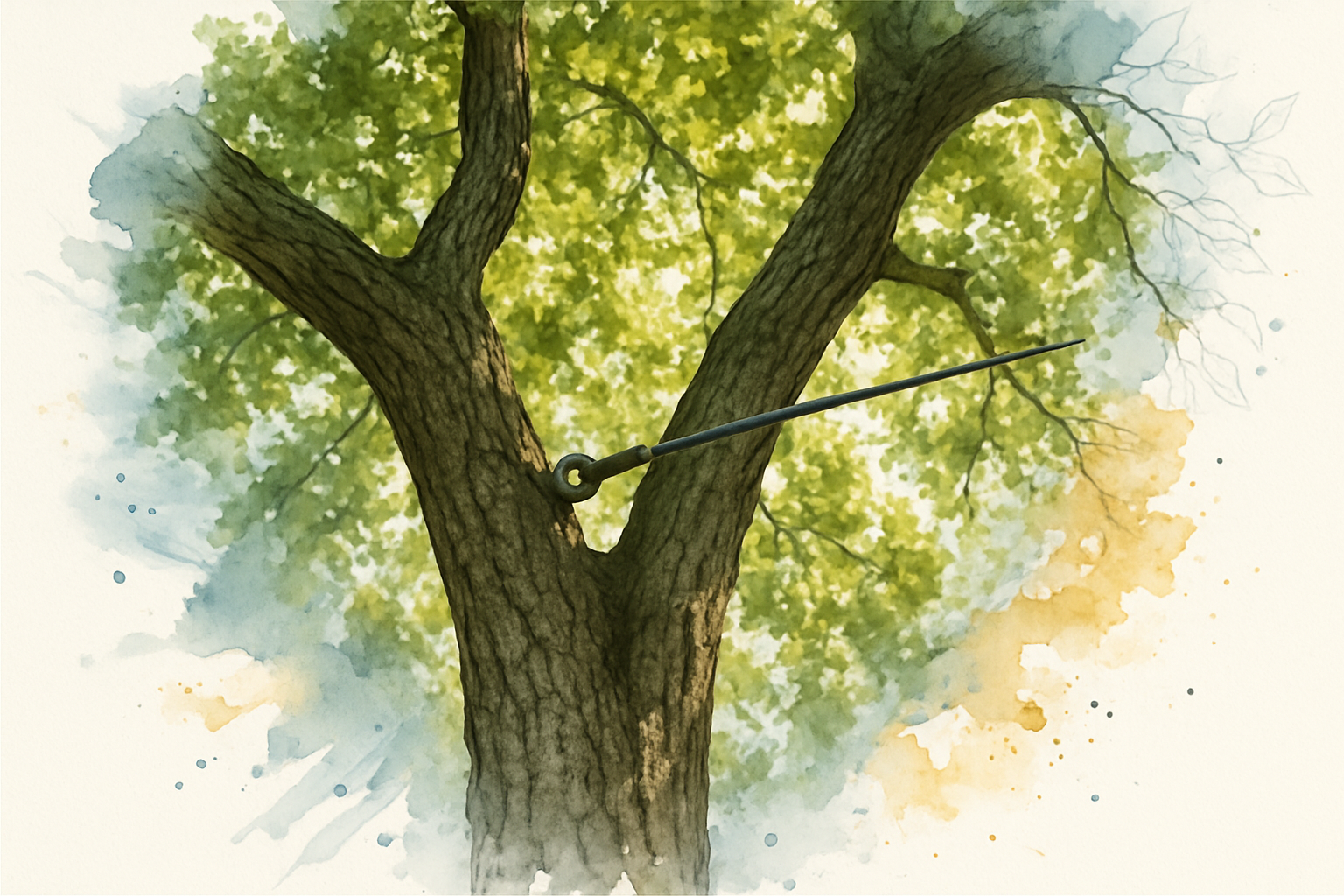
What Cabling and Bracing Actually Does, and What It Doesn’t
I want to be direct about this because there’s a lot of misunderstanding. Cabling does not fix the defect. It reduces the load on it.
A high-strength cable installed between two co-dominant stems limits how far apart those stems can move under wind load. When a gust hits a tree, the canopy acts like a sail, the stems want to flex outward in opposite directions. The cable resists that peak stress at the union without preventing normal movement entirely. That’s an important distinction: the goal is load reduction, not rigidity.
Bracing rods work differently. They’re typically used lower in the tree, when two stems have already begun to split and need physical reinforcement at the point of separation. A rod passes through both stems and is secured with hardware that holds the split from widening further.
Together, these are engineered systems installed to engineering standards. The ISA (International Society of Arboriculture) publishes guidelines that govern cable placement, hardware selection, and load calculations. This is not a zip-tie-and-hope solution.
Two things matter after installation:
– The system needs annual inspection to confirm hardware integrity and that the cable is still properly tensioned as the tree grows
– If the tree’s structure changes significantly, major pruning, storm damage, significant growth, the system should be re-evaluated
A cable that was correctly installed five years ago may need adjustment today. That’s normal, and it’s why ongoing monitoring is part of the service, not an afterthought.
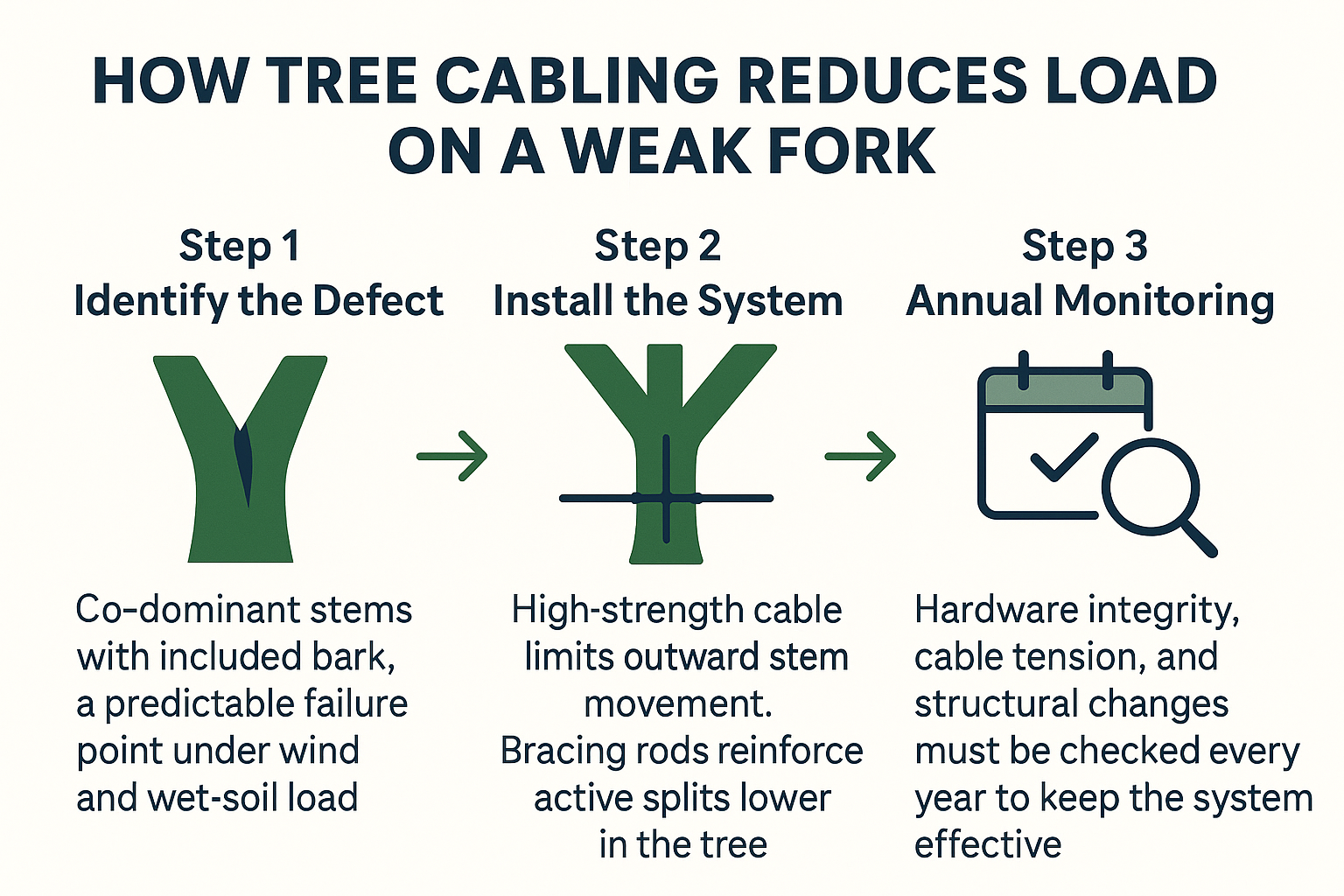
How a Cabling System Reduces Load on a Weak Fork
This shows the three-part logic of a cabling installation, from defect identification through system selection to monitoring.
When Cabling Makes Sense, and When It Doesn’t
Several callers I’ve spoken with described trees overhanging rooftops, driveways, or play areas and were trying to decide between heavy crown reduction and full removal. Cabling is often worth exploring before either of those, but only when specific conditions are met.
Cabling is a reasonable option when:
– The tree is otherwise healthy, no significant root decay, no major disease, no evidence of advanced internal decay at the union
– The defect is significant but hasn’t progressed to the point where the stems are already separating badly
– The tree has real value, a 60-year-old coast live oak or a mature redwood represents decades of growth, significant property value, and cooling benefits that can’t be replaced quickly
– What sits underneath it can be adequately protected with a support system plus reasonable canopy management
Cabling is not a solution when:
– Internal decay at or near the union has already compromised the wood’s ability to hold hardware
– The stems have already split to a point where the structural damage is too extensive to reverse
– The tree is under severe stress from disease or root failure unrelated to the fork
For that last category, a proper arborist consultation is the only way to know which side of that line you’re on. What looks like a borderline case from the ground can look very different once someone with structural assessment training evaluates it up close.
If you’re dealing with a tree that’s already showing stress signs beyond the fork itself, it may be worth reading about what El Niño wet seasons do to struggling trees, saturated soils change the risk profile significantly.
Cabling vs. Crown Reduction vs. Removal, A Quick Comparison
These are the three options homeowners most often consider when a structural defect is present. The right choice depends on the specific tree, but here’s how the trade-offs generally stack up.
| Option | What It Does | Best For | Key Limitation |
|---|---|---|---|
| Cabling and bracing | Reduces load on the defective union; limits peak stem movement | Healthy trees with a manageable fork defect and real preservation value | Requires annual monitoring; not effective if decay is already advanced |
| Crown reduction pruning | Reduces wind load and canopy weight above the defect | Trees where canopy weight is a contributing factor; often paired with cabling | Doesn’t address the structural defect directly; over-pruning causes its own problems |
| Tree removal | Eliminates the risk entirely | Trees where decay, disease, or structural failure is already too advanced for retention | Permanent; irreversible; higher cost for large specimens; may require a city permit |
Why the Assessment Matters More Than the Hardware
A general tree crew can install a cable. The harder part, and the part that determines whether the cable actually protects anything, is the assessment that precedes it.
Determining which defects warrant a support system, which have already progressed too far, and what monitoring schedule makes sense requires structural evaluation beyond basic field work. Robert holds the Board-Certified Master Arborist (BCMA) credential, which is the highest designation the ISA issues. That credential exists precisely for judgment calls like this, cases where the visible condition of the tree doesn’t tell the whole story.
For trees with a fork defect where internal decay is a question, we use decay detection methods including resistograph testing, a fine drill bit that maps wood resistance and gives a far more accurate picture of internal condition than visual inspection alone. That information directly affects whether a cabling system is appropriate or whether a different recommendation is warranted.
The goal, in every case, is proper assessment before action. If you’re trying to understand what that process looks like in practice, this breakdown of what a Board-Certified Arborist does that a standard crew doesn’t explains the difference clearly.
Frequently Asked Questions About Tree Cabling and Bracing
How much does tree cabling cost in the San Jose area?
Costs vary depending on tree size, how many stems need to be addressed, whether bracing rods are also required, and site access. For a single-cable installation on a mid-sized tree, market rates in the South Bay generally range somewhere in the low-to-mid hundreds of dollars, but large specimens with multiple attachment points can run considerably higher. The assessment itself is what drives the recommendation, contact us directly for an evaluation and accurate quote for your specific tree.
Can I just prune the weak stems back instead of cabling?
Sometimes, and the two approaches are often combined. Reducing canopy weight above a weak union does lower the load on it. But heavy pruning alone doesn’t address the included bark zone, and over-pruning creates its own structural problems by removing too much of the tree’s energy-producing growth. Whether pruning alone is sufficient or whether a support system is also needed depends on the specific geometry and condition of the fork.
Does cabling hurt the tree?
When installed correctly, no. Modern cabling systems use hardware that attaches to the tree without causing significant damage. The tree will grow around the attachment points over time, which is normal. Improperly installed hardware, wrong placement, wrong gauge, or hardware left without monitoring as the tree grows, can cause problems, which is one reason installation method and follow-up care both matter.
How do I know if my tree’s fork is actually dangerous?
A few indicators worth watching for: a visible crack or gap at the union, bark that appears to be peeling or separating where the stems meet, or one stem that seems to be leaning more noticeably over time. But the honest answer is that included bark is often not visible from the ground, a tree can look perfectly stable while carrying a significant structural defect at the union. If the tree is over a structure, a driveway, or an area where people spend time, a professional assessment is the only reliable way to know.
Does a tree permit in San Jose apply to cabling, or only removal?
Cabling and bracing is a preservation measure, not removal, so it generally doesn’t trigger the same permit requirements. However, if the assessment concludes that removal is ultimately warranted, San Jose does require permits for protected trees. We’re familiar with the city’s process and can help guide you through it if it comes to that. For more detail on what removal permits involve, this article covers what San Jose requires before a tree comes down.
Not Sure Whether Your Tree Needs Support or Something Else?
If you have a tree with a visible fork, a split that concerns you, or stems overhanging something you care about, the right starting point is an honest assessment, not a guess from a photo or a quick opinion from someone who hasn’t looked at the structure closely. San Jose Tree Service & Landscaping serves homeowners throughout San Jose, Willow Glen, Almaden Valley, Los Gatos, Saratoga, and surrounding communities. You can reach us at (408) 422-1313 or visit sanjosetreemaintenance.com to request a consultation.
