 Skip to content

Direct Answer: Most coast redwood limb failure in San Jose traces back to lion-tailing, where interior branches were stripped and weight was pushed to the branch tips. That is usually correctable, not a reason to remove the tree.
You walked out one morning after a windy stretch and found a limb on the lawn. Maybe it clipped the fence, maybe it landed a few feet from the patio. The tree is a coast redwood, 60 to 90 feet tall, planted decades ago by someone who had no idea it would get this big.
I hear this call every fall from Willow Glen, Almaden Valley, and Cambrian. One homeowner told me their tree had simply “seen better days.” Another filled out our form asking for nothing more than a root assessment on their coast redwood. Neither of them used the word failure, but that is what they were describing.
Here is what I want you to take away: a dropped limb is a symptom worth reading, not an automatic reason to take the tree down. In most of the redwoods I look at, the limb came down because of how the tree was pruned, not because the tree is dying.
Coast Redwood Limb Failure in San Jose Usually Starts With the Last Pruning Job
There is a pruning habit called lion-tailing, and it is behind more redwood limb failure in San Jose than any disease I diagnose.
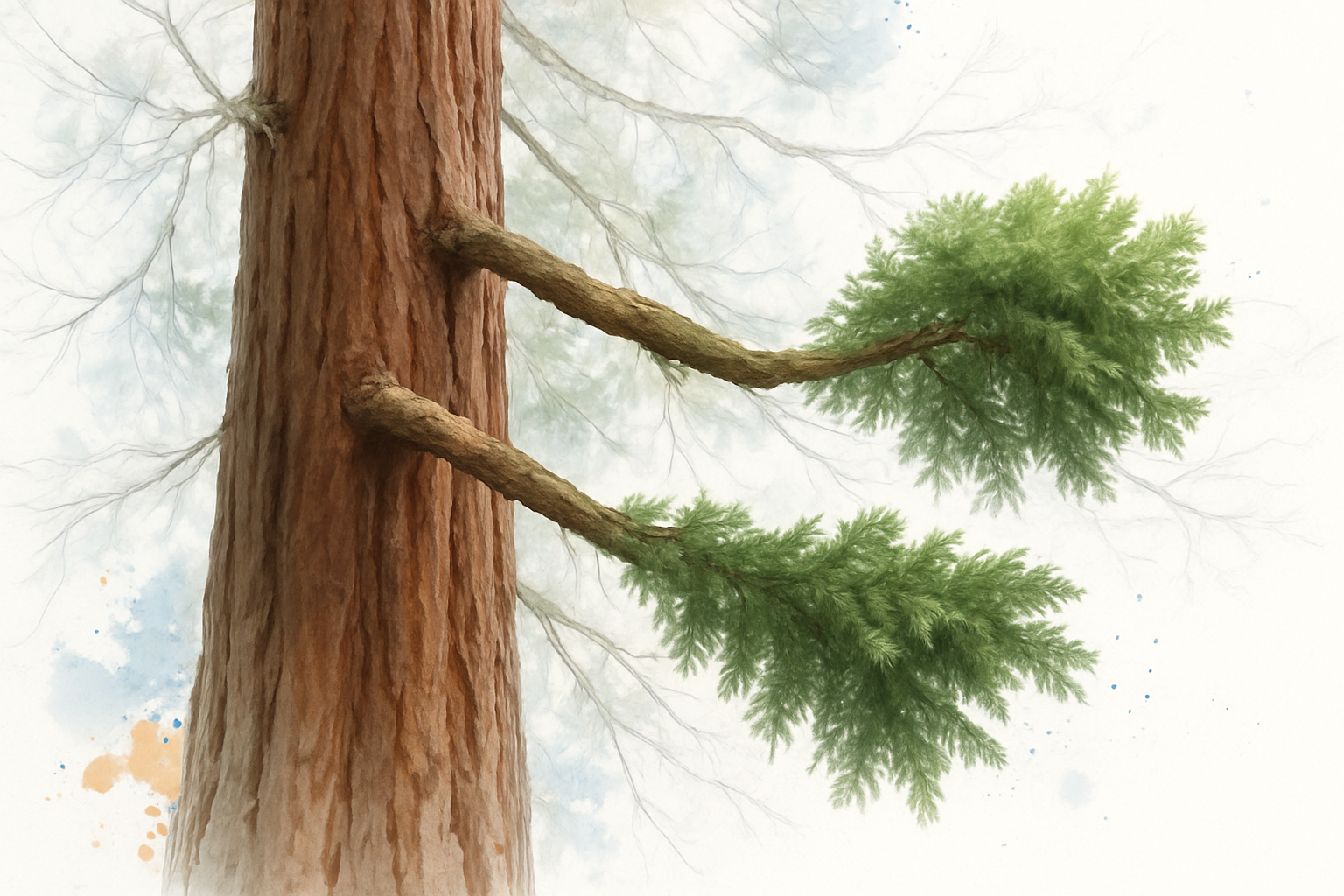
A crew gets up in the tree and strips out the interior branches. It is fast work, it opens the canopy, and it looks tidy from the driveway. The problem is what it leaves behind: long, bare limbs with all their foliage bunched at the very end.
Now every branch is a lever with the weight loaded at the tip. Add a January wind and those tufts of foliage act like sails. A customer who compared four different arborists on his 90 foot redwood put it better than I could:
> “Previous arborists, trimmed the inside of the Redwood leaving the edges bushy and full hence creating tremendous amount of weight on the branches which eventually lead them to break in heavy winds.”
The interior foliage that got removed was not clutter. It was feeding the tree and distributing load along the whole length of each limb.
Done correctly, redwood pruning looks like this:
- Reduce end weight by shortening the outer tips back to living lateral growth
- Remove genuine deadwood held in the crown
- Keep the interior foliage so the branch carries weight along its full length
- Never top the tree, which forces weak, fast regrowth that fails in the next storm
The good news is that a lion-tailed redwood is often recoverable. It takes a few seasons of correct pruning, but the structure comes back.
Redwoods Fail Differently Than Oaks, and It Starts Underground
A coast redwood has no deep taproot. What it has instead is a wide, shallow root plate that spreads out well past the canopy edge and holds the tree up by sheer footprint.
In the redwood’s native range that works fine. In San Jose, our soils are clay-heavy and hold water for days after a storm. Saturated soil loses its grip on the root plate, and that is how a tree that looked fine all summer ends up leaning in February.
Space is the other half of it. I see redwoods in Almaden Valley and Los Gatos planted three feet off a driveway, tight against a patio slab, or crowding a pool deck. Every square foot of hardscape over that root zone is space the root plate needed and does not have.
So when a limb comes down, I am not only looking at the canopy. I am looking at:
- Soil mounding or cracking on the side opposite a lean, which suggests the plate is moving
- How much of the root zone is under concrete, pavers, or compacted soil
- Whether drainage sends storm water toward the trunk or away from it
- Any recent trenching for irrigation, fences, or utility work inside the root zone
Timing matters here. NOAA forecasters have been pointing at a very strong El Niño for the November 2026 through January 2027 window, per the USDA Climate Hubs El Niño outlook. That makes September and October the sensible time to have a big redwood looked at, rather than the week after the first real storm when every crew in the county is already booked.
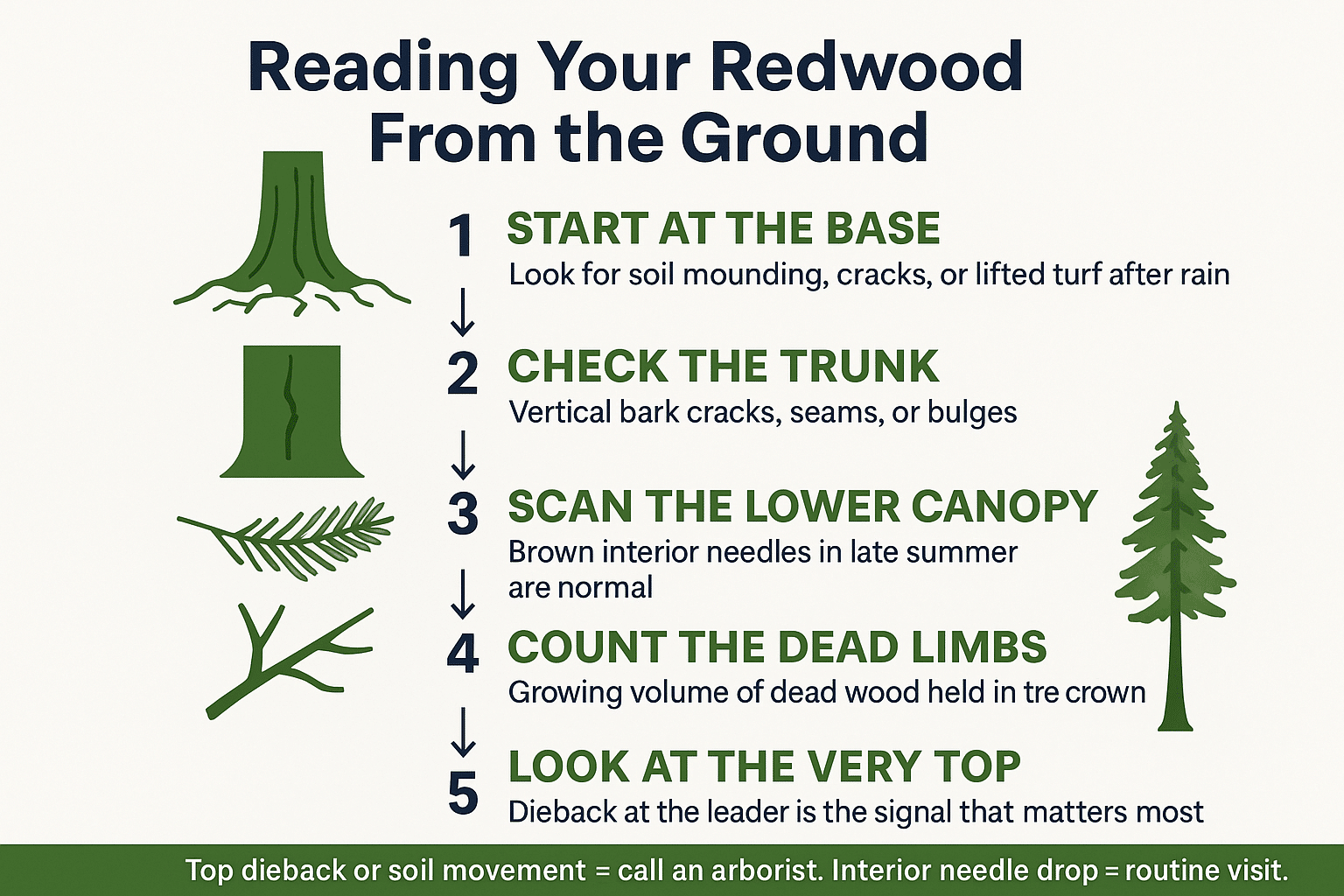
A Ground-Level Redwood Check You Can Do This Weekend
You do not need equipment to get a rough read on your tree. Here is the order I walk it in, from the base up.
The Water Problem Nobody Warns Redwood Owners About
Coast redwoods are fog belt trees. Their native range pulls a real share of its summer moisture out of coastal fog, and your tree is living inland in San Jose where that fog barely reaches.
Researchers studying Bay Area redwoods have documented declining summer fog alongside visible crown thinning and top dieback in urban trees. So a lot of these redwoods have been running on a moisture deficit for years without anybody noticing.
Here is where San Jose homeowners quietly go wrong. A redwood that has been surviving on lawn sprinklers for 30 years does not know the water is coming from a lawn. It just knows the soil stays damp.
Then the lawn comes out for a drought-tolerant conversion, the spray heads get capped, and the tree goes into steep decline the following summer. I have watched it happen more than once, and by the time the top browns out you are two seasons behind.
If you are converting turf under or near a redwood, plan for the tree separately:
- Water deep and infrequent, not light and daily
- Apply water out at the dripline, not at the trunk, because that is where the absorbing roots live
- Keep 3 to 4 inches of mulch over the root zone and pull it back off the trunk flare
- Keep new hardscape and driveway expansion out of the root zone where you can
There are rebate programs that reward turf removal, and they are worth doing. Just build the tree into the irrigation plan before the sod comes out, not after.
What You’re Seeing and How Soon It Needs a Look
Not every brown patch on a redwood is a problem. This is roughly how I sort what homeowners describe to me over the phone.
| What you see | What it usually means | How soon to have it looked at |
|---|---|---|
| Brown needles inside the canopy in late summer | Normal interior needle shed for the species | Mention it at a routine visit |
| Small branchlets dropping on the patio | Normal seasonal shedding for coast redwoods | Mention it at a routine visit |
| Canopy visibly thinner across two or three seasons | Chronic water stress or root zone restriction | Within a season, before winter |
| Dead limbs accumulating and staying in the crown | Often the aftermath of lion-tailing | Before storm season |
| Dieback at the very top of the tree | Significant stress, usually water or root related | Soon, this one matters most |
| Vertical bark cracks or seams on the trunk | Possible internal defect worth testing | Soon, needs hands on the tree |
| Soil mounded or cracked at the base after rain | Possible root plate movement | Right away |
What Sits Between Doing Nothing and Taking the Tree Out
Most homeowners who call me about a dropped limb assume the choice is live with it or remove it. There is a lot of ground in between, and on a healthy redwood that ground is where we usually end up.
Crown cleaning and end weight reduction. This is the direct fix for a lion-tailed tree. We pull the dead material out of the crown and shorten the heavy tips back to live laterals, which moves load back toward the trunk.
Cabling and bracing. If there is a weak union or a codominant stem, hardware can support it. That is a supplement to good pruning, not a substitute for it, and it needs periodic inspection once installed.
Decay testing instead of guessing. When the trunk looks questionable, we use percussion testing and a resistograph, which reads wood resistance with a fine drill bit and maps how far decay actually extends. Decay is common in mature trees. What matters is where it sits and how much sound wood is left.
What I will not do is top the tree. Cutting the leader out of a redwood never makes it safer. It forces weak, fast regrowth off the cut, and that regrowth is exactly what fails in the next wind event.
And if removal genuinely is the answer, know that a mature redwood almost always exceeds San Jose’s ordinance size threshold. That makes it a permitted process with an arborist report behind it, not a same-week decision. Which is one more argument for proper assessment before action.
Costs vary a lot on trees this size, and honestly anyone who quotes a redwood over the phone is guessing. Crane access, rigging requirements, drop zone, and haul-off all move the number. A verbal on-site consultation and a formal written arborist report are priced very differently too, so ask which one your situation actually calls for before you book.
Frequently Asked Questions About Coast Redwood Limb Failure
My redwood dropped one limb. Does that mean the whole tree is unstable?
Usually not. A single limb failure on a lion-tailed tree tells you about branch loading, not about whether the trunk or root plate is sound. The things that point to whole-tree instability are different: soil movement at the base, a new lean, or advanced decay at the root collar.
Can you tell what’s wrong from photos I email you?
Sometimes. Photos are genuinely useful for pests, foliage color, and obvious deadwood, and a lot of homeowners start there. But on a 60 to 90 foot redwood, decay testing and root plate evaluation need someone standing at the base of the tree with hands on it.
Is it too late to prune before the winter storms?
September and October are the window I push for, because that gets end weight off the limbs before the wind arrives. If you are reading this later than that, it is still worth an assessment. There is a difference between full structural pruning and pulling hazardous deadwood out ahead of a storm.
I’m removing my lawn for a rebate. Will that kill my redwood?
It can, if nothing replaces the water the lawn was providing. Put deep, infrequent irrigation at the dripline into the conversion plan from the start, and mulch the root zone. The trees that decline are the ones where the sprinklers were simply capped and nothing took their place.
The tree is close to my neighbor’s fence. Does that change anything?
It changes the rigging plan and it may change who needs to be involved. On tight South Bay lots we are often lowering pieces into a drop zone the size of a parking space, which is slower, more technical work. Trunk position relative to a property line can also affect who has a say in the decision.
Getting a Large Redwood Assessed Before Winter
Big redwoods are technical trees, and the work on them is only as good as the judgment behind it. Our assessments are led by a Board-Certified Master Arborist, and the two things customers mention most often are that we do not push work the tree does not need and that the rigging is careful enough that nothing underneath gets damaged. Assessments on large redwoods are available across San Jose, Los Gatos, and Saratoga at (408) 422-1313 or sanjosetreemaintenance.com if you want a second set of eyes on yours.
