
Direct Answer: Sprays reach adult psyllids but often miss nymphs feeding inside leaf pits, and no product heals already-damaged leaves. Shearing the whole hedge at once, then monitoring new growth, works better.
The message I get most often about eugenia goes something like this: fifteen plants, twenty feet tall, running the length of the back fence, and three straight years of treatment and spraying from a licensed company with no real improvement. One San Jose homeowner told me recently that it just did not seem to be helping, and that they already understood this pest is hard to treat.
That frustration is fair, and I want to say clearly that it is usually not a bad product or a bad crew. In almost every one of these cases, the gap is timing, coverage, and expectations, not chemistry.
Eugenia psyllid is one of the most common hedge complaints I see in Willow Glen, Almaden Valley, and along fence lines in Campbell and Los Gatos. Below is what actually changes the outcome, and why the most effective step costs nothing but a sharp set of shears.
Why Spray-Only Eugenia Psyllid Treatment in San Jose Keeps Disappointing You
Start with where the insect lives. Eugenia psyllid nymphs feed inside pit-like depressions on tender new leaves, which is exactly what makes them so hard to hit.
A contact spray lands on adults sitting out in the open. The nymphs doing most of the damage are tucked into those pits, shielded by the leaf tissue itself.
Then there is the size problem. On a 20-foot hedge with a dozen or more plants, getting real coverage into the interior canopy is close to impossible without high-volume equipment and the right nozzle pressure. What usually happens is the outer shell gets treated and the interior keeps producing insects.
The third issue is the one nobody explains up front: no treatment restores foliage that is already pitted, cupped, and distorted. Those leaves are permanently scarred. They will hang on the plant for months looking exactly as bad as they did before the work was done.
So the honest measure of whether a treatment worked is simple:
- Did the next flush of new growth come in clean and flat?
- Are new pits forming on that fresh growth, or only on old leaves?
- Is the damage concentrated on terminals, or spread through older interior foliage?
If you judge success by whether last spring’s damaged leaves recovered, every program will look like a failure. Because every program is a failure by that standard.
The Part Almost Nobody Tells Homeowners: Shear the Whole Hedge at Once
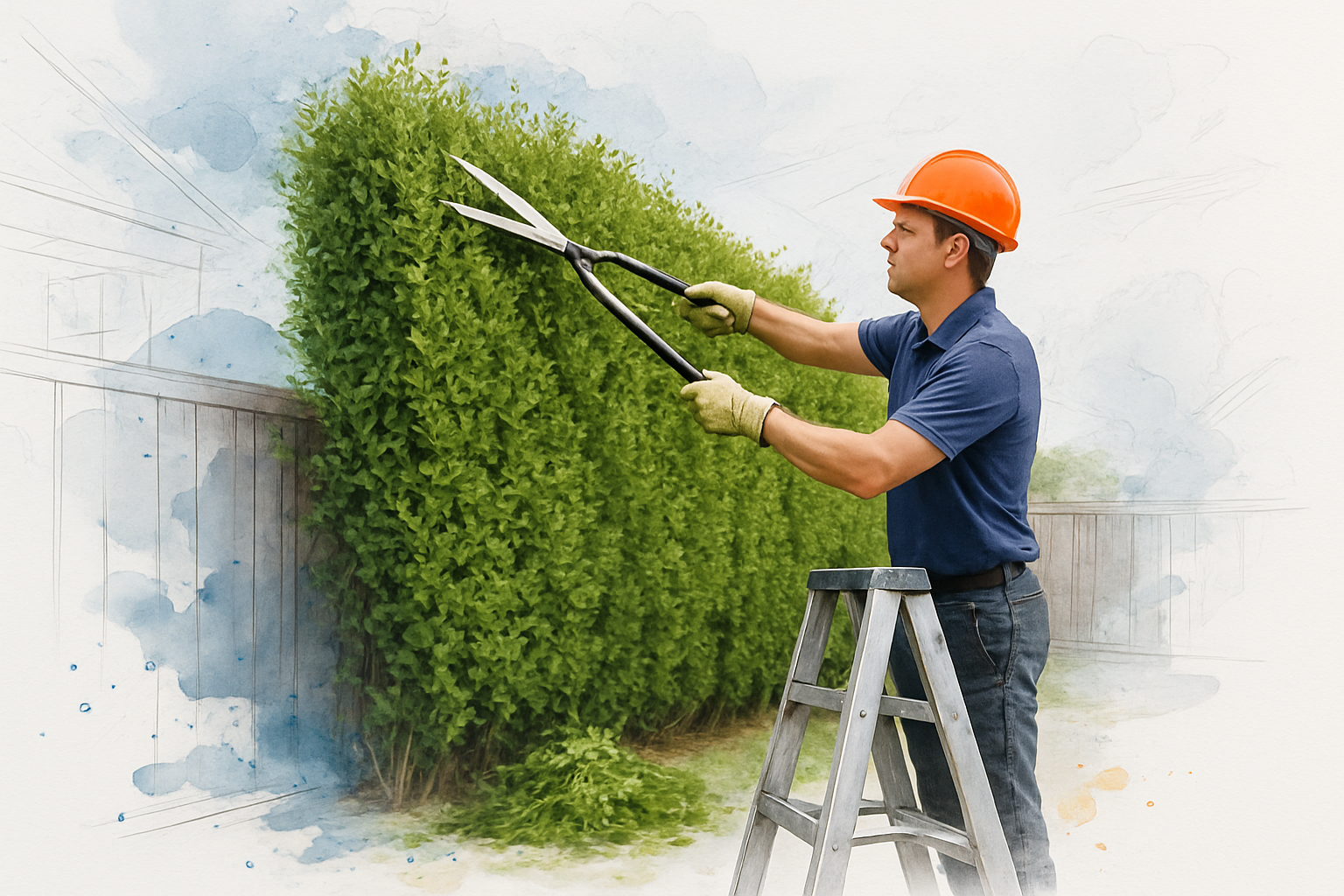
Shearing strategy matters more than product choice. That is the single most useful thing I can tell a homeowner with a struggling eugenia screen.
Research on California landscapes found that pruning one shrub at a time did very little, while shearing an entire hedge at the same time caused psyllid populations to drop sharply. The reason is straightforward: the insect depends on tender new growth, and cutting the whole planting at once removes that food source everywhere simultaneously.
Shear one plant and the psyllids simply move next door to the untouched growth. Shear all fifteen and there is nowhere to go.
There is a second step that gets skipped constantly. Leave the clippings on the ground near the shrubs for roughly three weeks before hauling them off.
Tiny parasitic wasps developing inside those nymphs need time to emerge. Bagging the green waste the same afternoon throws out the free labor you were about to get for the rest of the season.
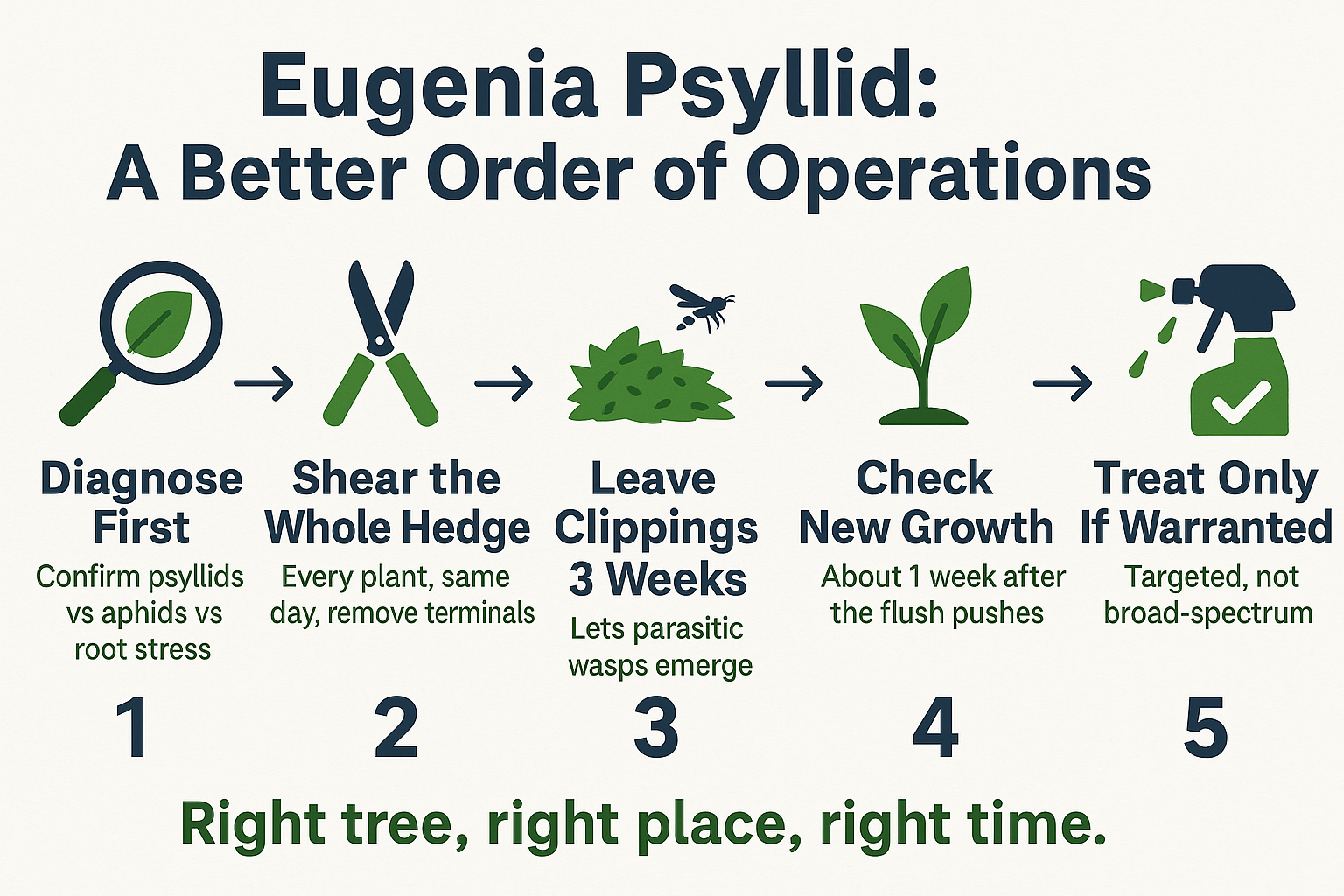
Here is the sequence I use on a mature hedge:
- Shear all plants in the run on the same day, removing the terminals
- Leave clippings at the base of the shrubs for about three weeks
- Check the new flush roughly a week after it pushes and look for fresh pitting
- Only then decide whether a targeted treatment is warranted at all
Proper assessment before action is not a slogan here. It is the difference between one well-timed intervention and another three years of spray bills.
Is It Really Psyllids? How the Symptoms Differ
Misdiagnosis is what drives wasted seasons. These three situations look similar from the patio and call for completely different responses.
| What you see | Most likely cause | What that changes |
|---|---|---|
| Pitted, cupped, discolored new leaves on terminals | Eugenia psyllid | Shearing timing and monitoring new growth matter far more than product choice |
| Sticky residue on the patio or car, black sooty film on leaves | Aphids or scale insects | Honeydew-producing pests, a different life cycle and a different treatment window |
| Overall thinning and dieback with clean, undamaged leaf surfaces | Root zone, drainage, or irrigation problem | No insect treatment will help; the fix is in the soil and the water schedule |
| Powdery white coating on branches and leaves | Fungal issue such as powdery mildew | Airflow, pruning, and moisture management come before any spray decision |
The Natural Enemies Quietly Working for You in Santa Clara County
A parasitic wasp was released in California decades ago to target eugenia psyllid, and it now occurs here on its own without anyone introducing it. In warmer inland pockets it can hold populations at levels most homeowners never notice.
But it does not work everywhere equally. According to University of California IPM guidance on eugenia psyllid, parasite populations in cooler, coastal-influenced areas often do not build fast enough to control spring outbreaks.
That detail matters across the South Bay, because a hedge in a shaded, cool backyard near Los Gatos Creek behaves differently than one baking on a south-facing fence line in Almaden Valley. Same species, different pest pressure, different plan.
It also explains why broad-spectrum spraying can backfire over time:
- It knocks down the beneficial insects that would otherwise work through summer for free
- The hedge becomes more dependent on treatment each year, not less
- Populations rebound faster after each application, which reads to the homeowner as “the spray stopped working”
This is the pattern I see in three-year spray histories. Nothing was done wrong, exactly. The program just slowly removed its own best allies.
A Better Sequence Than Spray, Wait, Repeat
Here is the order of operations I walk homeowners through when a eugenia hedge has been treated for years with no improvement.
Your Irrigation and Fertilizer Habits May Be Feeding the Problem
This is the quiet one. Heavy watering and routine feeding push soft, fast new growth, and soft new growth is precisely what psyllids lay eggs on.
A eugenia hedge sitting on the same overhead spray schedule as the lawn is running an all-you-can-eat buffet from February through June. I see this constantly on Willow Glen and Almaden Valley properties where the hedge doubles as a privacy screen along a fence and was simply added to whichever zone was closest.
Two changes tend to do more over two seasons than another round of spraying:
- Move the hedge run to drip on its own zone, separate from turf
- Ease off nitrogen, especially spring feedings that force a heavy flush
- Water deeply and less often rather than shallow daily cycles
Silicon Valley’s long dry summers complicate the read. By August a stressed hedge on a failing line looks pest-ravaged when part of what you are seeing is heat and inconsistent water. A broken or misaligned head on a fence-line zone can go unnoticed for months, and the water a single failed sprinkler quietly wastes adds up faster than most homeowners expect.
Fix the water before you buy another treatment. It is cheaper and it lasts.
What a Realistic Plan Looks Like, and When to Consider Replacing the Hedge
A mature eugenia screen is worth a two to three season plan, not a single fix. That plan is built around shearing timing, monitoring each new flush, protecting the natural enemies already on site, and using treatment only where it is genuinely warranted.
Expect the hedge to look rough during the first season while old damaged foliage ages out. The signal you are watching for is a clean flush, not a recovered leaf.
On cost, I would rather explain the drivers than throw a number at you, because hedge work varies enormously. Height, plant count, access along a narrow side yard, whether there are overhead lines, and haul-off volume all move the price, and the same factors that shape what goes into tree trimming pricing here apply to a long eugenia run. A verbal on-site arborist consultation in the South Bay generally lands in the low hundreds, with formal written reports running significantly more, but you should get a direct quote rather than trust a general figure.
And there is a point where honesty means saying the hedge is done. If a planting has declined for years, thinned to bare stems, and lost its screening value, replacing it with a species better suited to that exposure is the better investment. Right tree, right place, right time applies to hedges just as much as it does to oaks.
Every treatment program on our side is overseen by a Board-Certified Master Arborist who also holds a California Qualified Applicators License, and the diagnosis always comes before any product is chosen. One longtime customer put the approach better than I could: “They’re super knowledgeable and never push work that doesn’t need to be done.”
Frequently Asked Questions About Eugenia Psyllid Treatment
When is the best time to shear a eugenia hedge for psyllid control?
Shearing works best when you time it to remove the tender terminals the insect depends on, and the whole hedge has to be cut on the same day for it to matter. In most South Bay yards that means acting when a new flush is pushing rather than waiting until the damage is obvious. An on-site look is worth it, because a shaded Los Gatos hedge and a sun-exposed Campbell fence line flush on different schedules.
Why do my leaves still look terrible months after treatment?
Because no product restores pitted or distorted foliage. Those leaves are permanently damaged and will stay on the plant until they are sheared off or drop naturally. Judge the treatment by the next flush of growth, not by last year’s leaves.
Is my problem psyllids or something else?
If the damage is pitting and cupping on new leaves at the tips, psyllids are the likely answer. If you are seeing sticky residue on the patio and black film on the foliage, that points toward aphids or scale. And if the leaf surfaces are clean but the hedge is thinning and dying back, I would look at the root zone and irrigation before assuming any insect is involved.
Can you tell what is wrong from photos, or does someone need to come out?
Photos help more than people expect for a first read, especially clear close-ups of new growth and a wide shot of the whole run. For a long hedge with a multi-year treatment history, though, I usually want to see the irrigation layout and the interior canopy in person before recommending anything.
Will skipping sprays make the infestation worse?
Not necessarily, and sometimes the opposite. Broad-spectrum applications reduce the parasitic wasps that keep psyllid numbers down through summer, so pulling back and shearing on the right schedule can leave you in better shape a season later than another round of chemicals would.
Thinking Through a Eugenia Hedge Plan?
If you have a long eugenia run in San Jose, Campbell, Los Gatos, or Saratoga that has been treated for years without improvement, a diagnosis-first look at the hedge, the new growth, and the irrigation zone is usually where the real answer lives. Our team handles this kind of assessment across the South Bay, and we are happy to talk it through at (408) 422-1313 or at sanjosetreemaintenance.com. The goal is safety, health, and longevity, not another season of guesswork.
