
Direct Answer: In three growing seasons, limbs get longer and heavier at the tips, interior deadwood builds up, and clearance closes in. The tree is not neglected. It is simply loaded differently.
Most of the time, the call is not an emergency. It is a homeowner saying some version of “you were out here a few years ago, and the trees need attention again.”
That feeling is accurate, and it is worth paying attention to. A two to three year gap between arborist visits is completely normal for a healthy mature tree in Willow Glen, Almaden Valley, or anywhere with a canopy that has been in the ground for decades.
What I want to explain here is not a schedule. It is what physically changed during the gap, so you can look at your own tree and understand what you are seeing.
Why the Gap Itself Is Not the Problem
Noticing that your trees have gotten ahead of you is a sign you are paying attention. It is not a sign you let something slide.
A well-pruned mature tree in San Jose does not need annual work. Good structural pruning is supposed to hold for a few years. If someone is back in your yard every twelve months doing the same cuts, something is wrong with the approach, not the tree.
What happens instead is slower and quieter:
- Each spring flush adds length to the ends of limbs you cannot easily see from the ground
- Interior twigs that lost their light quietly die back over a run of dry summers
- Clearance you used to have over the roof, the fence, or the driveway closes in a few inches at a time
- Any pruning done by someone else in the meantime changes the structure you started with
None of that shows up on a single day. It shows up when you walk out one morning and the tree reads differently than it used to.
So the honest first question after a long gap is not what work does this need. It is what is different now.
Three Growing Seasons Is a Weight Problem, Not an Overgrowth Problem
This is the part most homeowners never get explained to them, and it is the one that actually matters.
Trees add new growth at the ends of limbs. Not along the middle, not at the base. Every spring, the tip extends a little further and puts out another season of leaves.
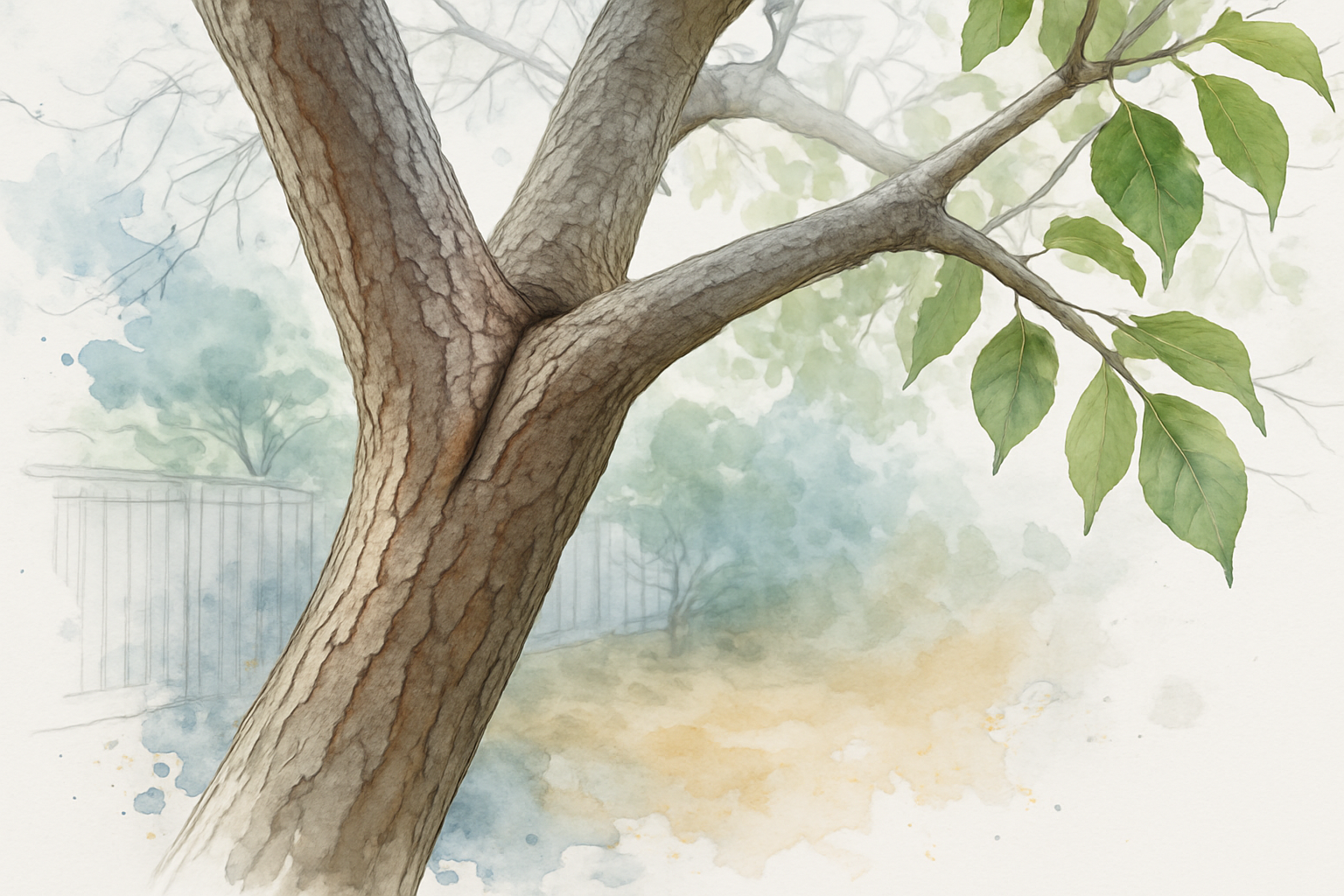
So picture the same branch you looked at three years ago. It is now maybe two to three feet longer, and it is carrying three more years of foliage out at the far end. The attachment point back at the trunk has not changed at all.
That is a longer lever arm pushing on the same union. Same anchor, more weight, further out.
Add what is happening inside the canopy at the same time. After a run of dry Silicon Valley summers, the shaded interior twigs die off, and deadwood accumulates where you cannot see it from the patio. The crown gets heavier at the outside and more brittle on the inside.
That combination explains most of what returning homeowners describe to me:
- Redwood limbs that have worked their way into a fence line
- Oak branches that now touch the house when they never used to
- A liquidambar that drops a large limb across the sidewalk on a hot afternoon in late July
- River birches that lean further over the lawn after every wet winter
- A camphor that has lost the shape it had after the last trimming
Liquidambars in particular have a local reputation for shedding limbs in late summer and fall. It is not random. It is end weight on a long limb during the hottest, driest stretch of the year.
What Common South Bay Species Do Over a Three Year Gap
These are the species that show up most often when a returning homeowner calls after a few years. Every tree is individual, but the patterns are consistent enough to be useful.
| Species | What typically changes in three years | What it usually needs first |
|---|---|---|
| Coast live oak | Lower limbs extend toward the roof or driveway; interior deadwood builds | Deadwood removal and clearance, worked in the dry summer window |
| Liquidambar | Long outer limbs gain significant end weight; late-season limb drop risk | End weight reduction on the longest limbs, not a full crown cut |
| Coast redwood | Lower branches push into fences, sheds, and neighboring yards | Clearance pruning and removal of dead lower branches |
| River birch | Thin, flexible limbs sag further with each wet season | Light thinning and dead limb removal |
| Crape myrtle | Dense sucker growth and crossing interior branches | Structural cleanup, never topping |
| Camphor | Canopy fills back in and loses the shape from the last pruning | Continued shaping, usually lighter than the first visit |
| Cedar | Heavy interior deadwood; weight builds on wide lower limbs | Deadwood removal and an honest look at limb attachments |
Why This Particular Winter Is Worth a Look
I want to keep this calm and factual, because it gets overblown elsewhere.
Forecasters have been raising the odds on a very strong El Nino for the 2026-27 winter all summer. NOAA’s Climate Prediction Center moved from roughly a 63 percent chance of a very strong event in June to above 90 percent heading into fall and winter, with a real chance of the strongest event on record going back to 1950.
Here is why that intersects with everything above. Much of San Jose sits on heavy clay soil. When clay saturates, it loses the grip it had on a root plate during the dry months.
At the same time, a canopy carrying three extra years of growth catches more wind than it did at the last visit. Wetter ground plus a heavier, longer-levered crown is simply two conditions meeting at once.
That does not mean your tree is in trouble. Plenty of mature trees in Almaden Valley and Los Gatos will go through a wet winter without a single issue.
It does mean that if you have been meaning to get eyes on something, this is a reasonable fall to do it. One homeowner wrote in this summer asking specifically for a large cedar to be looked at because of the rainy season they had heard was coming. That is a sound instinct. If you want to know what that kind of visit actually involves, we covered it in detail in what a tree risk inspection actually covers.
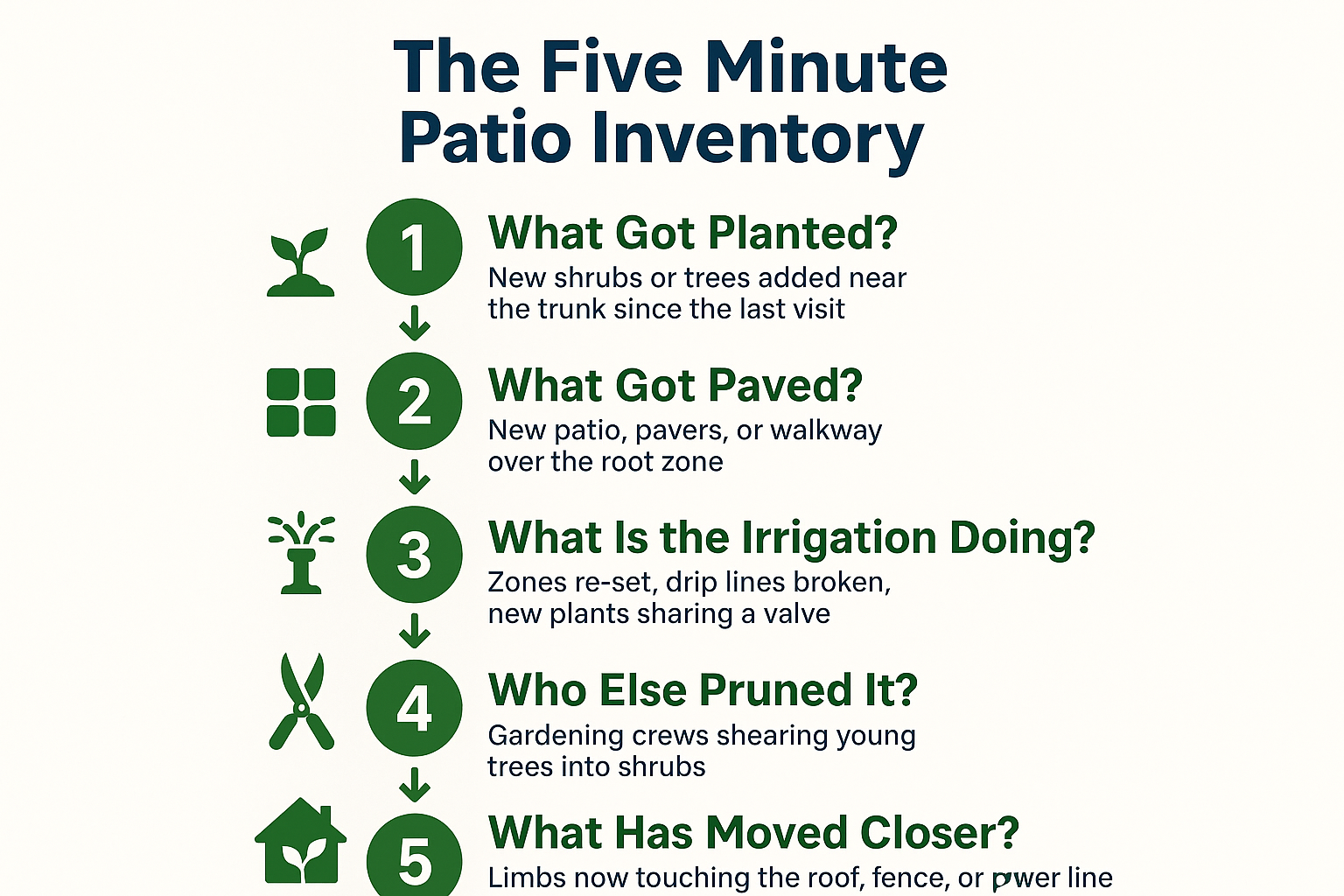
The Five Minute Patio Inventory
Before you call anyone, stand on your patio and run through this short mental list. It often explains more than the canopy does.
Often the Property Changed More Than the Tree Did
Returning homeowners rarely think to mention this part, and it frequently explains the symptom better than the canopy does.
Three years is long enough for the ground conditions around a mature tree to shift completely. Some of the most common changes I see:
- Irrigation drift. Zones get adjusted, controllers get replaced, and nobody re-checks what the tree is actually receiving.
- New plantings on the wrong valve. A young tree that needs deep, infrequent water ends up grouped with shallow-rooted annuals that get a short cycle every day.
- Broken drip lines. A line that failed quietly after a landscape install can starve one side of a root zone for a full season.
- Settled hardscape. Pavers lift or sink as roots expand underneath, which changes where water runs and where it pools.
- Routine hedge shearing. A general gardening crew shaping a young tree every few weeks turns it into something structurally different from what it was.
That last one comes up more than you would expect. One homeowner this summer described laurel trees that a regular crew had gradually sheared into shrubs, and asked whether the individual structure could be brought back.
Sometimes it can. It takes several seasons of patient corrective pruning, not one aggressive visit. And if you are planning any work around the base of a mature tree, how landscape design works when you have mature trees to protect is worth reading first.
After a Long Gap, a Look Comes Before a Plan
The instinct after three years is to ask for the same job again. A full re-trim, same scope, same invoice.
Honestly, that is often more than the tree needs. A good share of the time, the correct scope after a long gap is deadwood and clearance only. The structural work done last time is still holding, and the real issue is weight at the ends of a few specific limbs and some interior dieback.
Proper assessment before action is not a slogan. It is the difference between removing 200 pounds from the right four limbs and over-thinning a canopy that was fine.
Timing matters too, and it is species-driven:
- Most deciduous trees are best addressed in the dormant late winter window, roughly January through March, when the structure is visible and cuts heal cleanly
- California oaks are generally pruned in the dry summer months, so fresh cuts are not exposed to wet-season pathogens
- Spring bloomers like magnolias are pruned right after the flowers fade, since they set buds on last year’s wood
- Clearance and deadwood work can usually be done sooner if something is genuinely over a walkway or against a roof
If you have oaks, the rules are different enough that it is worth reading why an oak in Cupertino or Almaden plays by different rules before you book anything.
One longtime customer, Kathryn P., put the standard well in her review: “They’re super knowledgeable and never push work that doesn’t need to be done.” The goal is safety, health, and longevity, not repeating the same job on the same calendar.
Frequently Asked Questions About Mature Tree Care Between Arborist Visits
How often should a mature tree in San Jose actually be pruned?
For a healthy, well-structured mature tree, every three to five years is common, and some go longer. Young trees being trained for structure benefit from more frequent, lighter attention. If a tree genuinely needs cutting every single year, that usually points to a structural problem or to poor pruning in the past, not to a normal maintenance need.
Can I just send photos instead of paying for an on-site visit?
Photos are a reasonable starting point and we use them often. They work well for clearance questions, obvious deadwood, and giving you a ballpark. What they cannot show is what is happening at the root collar, inside a union, or under the bark. We wrote a full breakdown of where photos are enough and where they are not in this article on photo assessments versus on-site visits.
Is there a fee for an arborist to come out?
It depends on what you are asking for. A straightforward estimate for defined work is different from a diagnostic consultation where a Board-Certified Master Arborist evaluates tree health, structure, and risk and gives you specific recommendations. Consultation fees in Santa Clara County commonly run into the low hundreds, but the exact figure depends on scope, so ask when you call. Here is how we draw the line between the two.
Will a heavier canopy really make a difference in a wet winter?
It can, because the two factors work together. Saturated clay soil reduces how firmly a root plate is held, and a larger canopy presents more surface area to wind. Neither one alone is usually enough to cause a failure on a sound tree. The reason to look now is to find the trees where something else is also going on, like decay at a major union or a lean that has changed.
Do I need a permit to prune my own tree?
Sometimes, yes. In San Jose, trees in the strip between the sidewalk and the street fall under city jurisdiction, and that includes pruning, not just removal. Certain ordinance-size trees on private property also trigger requirements. Checking before any cutting happens is far cheaper than sorting it out afterward.
Picking Up Where We Left Off
If we have walked your property before, you should not have to re-explain it. Our work is overseen by Robert Apolinar, a Board-Certified Master Arborist, and we have been BBB accredited since 2013 with a 4.96 average across 70 Google reviews, which mostly means a returning homeowner in San Jose, Los Gatos, or Saratoga is continuing a conversation rather than starting one. When you are ready to have someone look at what changed, we are at (408) 422-1313 or sanjosetreemaintenance.com.
