
Direct Answer: Oaks in San Jose need pruning in late fall or winter, almost no summer irrigation, and often a city permit before major work. Most oak decline traces back to water, not disease.
A returning customer in Cupertino sent in a form about an oak in their backyard. The whole message came down to one question: what services should we do?
I get some version of that question every month from oak owners in San Jose, Almaden Valley, Willow Glen, and up into Saratoga and Los Gatos. It is a fair question, because oaks are the most protected and the most misunderstood tree in this market.
The short version is that an oak does not follow the same care calendar as your liquidambar or your Chinese pistache. Different pruning window, nearly opposite watering rules, and a separate layer of city permit requirements. Here is how each of those three actually works.
Oak tree care in San Jose runs on a different calendar
Most deciduous trees in the South Bay get pruned in late winter, when they are dormant and the branch structure is easy to read. Oaks are their own case, and the reason is disease pressure, not aesthetics.
Fresh pruning cuts on an oak are open doors. Two things in particular are looking for them:
- Phytophthora ramorum, the pathogen behind Sudden Oak Death, which has confirmed detections in Santa Clara County
- Oak bark beetles, which carry fungal pathogens between trees and are drawn to fresh wounds and the scent of cut oak wood
- General fungal canker organisms that move during warm, humid stretches
As a general best practice in the South Bay, we schedule oak pruning late fall through winter, when beetle activity drops off and the tree is not carrying peak stress. That timing is about lowering the odds of infection, not about the tree healing faster.
If a crew already pruned your oak in the middle of summer and did not seal the cuts, do not panic and do not start spraying anything. Watch the cut sites through the next two seasons for oozing, dark staining, or sudden dieback in the branches above the cuts. That is the point to have someone look at it, and it is worth reading what your oak is signaling before you assume the worst.
The watering rules for a Coast Live Oak feel backwards, and that is the point
This is the one that surprises people most. Overwatering is one of the most common ways Coast Live Oaks decline in Silicon Valley yards.
These trees evolved in a Mediterranean climate with a long dry summer. They are built to go quiet from roughly June through October. Adding regular irrigation water during that stretch, especially anywhere near the root collar, creates warm and wet soil conditions that favor Phytophthora root and crown rot.
The pattern I see over and over in Almaden Valley and Willow Glen goes like this. A homeowner renovates the landscape, puts in a lawn or a bed of thirsty plants under the oak, and the oak quietly ends up inside an irrigated zone it was never meant to be in. Nothing looks wrong for two or three years. Then the canopy thins from the top down.
Here is how to check whether your irrigation plan is working with or against your oak:
- Walk the drip lines and look for any emitter within about six feet of the trunk. That zone should stay dry.
- Dig two inches into the soil at the root flare in August. If it is damp, something is watering it.
- Look at what is planted under the canopy. Lawn, annuals, and tropical foliage all demand summer water an oak does not want.
- Check for a sprinkler head spraying directly onto the trunk, which is a slower version of the same problem. A single misaimed head can also waste a surprising amount of water before anyone notices.
If the oak has been on summer water for years, do not cut it off overnight. Taper it back over a couple of seasons so the fine roots that adapted to that water have time to adjust.
Normal seasonal behavior vs. something worth looking at
A lot of what homeowners read as decline is an oak doing exactly what an oak does. This is the rough sorting I use on a first walk-through.
| What you are seeing | Usually normal | Worth an assessment |
|---|---|---|
| Leaf drop in late spring | Coast Live Oaks shed old leaves as new ones push, often May into June | Leaf drop paired with bare twig tips and no new growth |
| Dull, slightly curled summer leaves | Normal dry-season conservation in July and August | Leaves browning from the edges inward across whole branches |
| Deadwood in the interior canopy | Shaded inner branches naturally die back on mature oaks | Deadwood concentrated in the upper canopy or on one side |
| Dark seepage on the trunk | Minor sap or insect activity happens | Dark bleeding at the root collar or bark cracking with staining |
| Mushrooms near the base | Some fungi are harmless decomposers of old mulch | Conks growing directly on the trunk, root flare, or major roots |
Which oak work needs a San Jose permit and which does not
This is the practical question behind almost every oak call I take. Here is the general line, with the reminder that your specific tree size and status decide the answer.
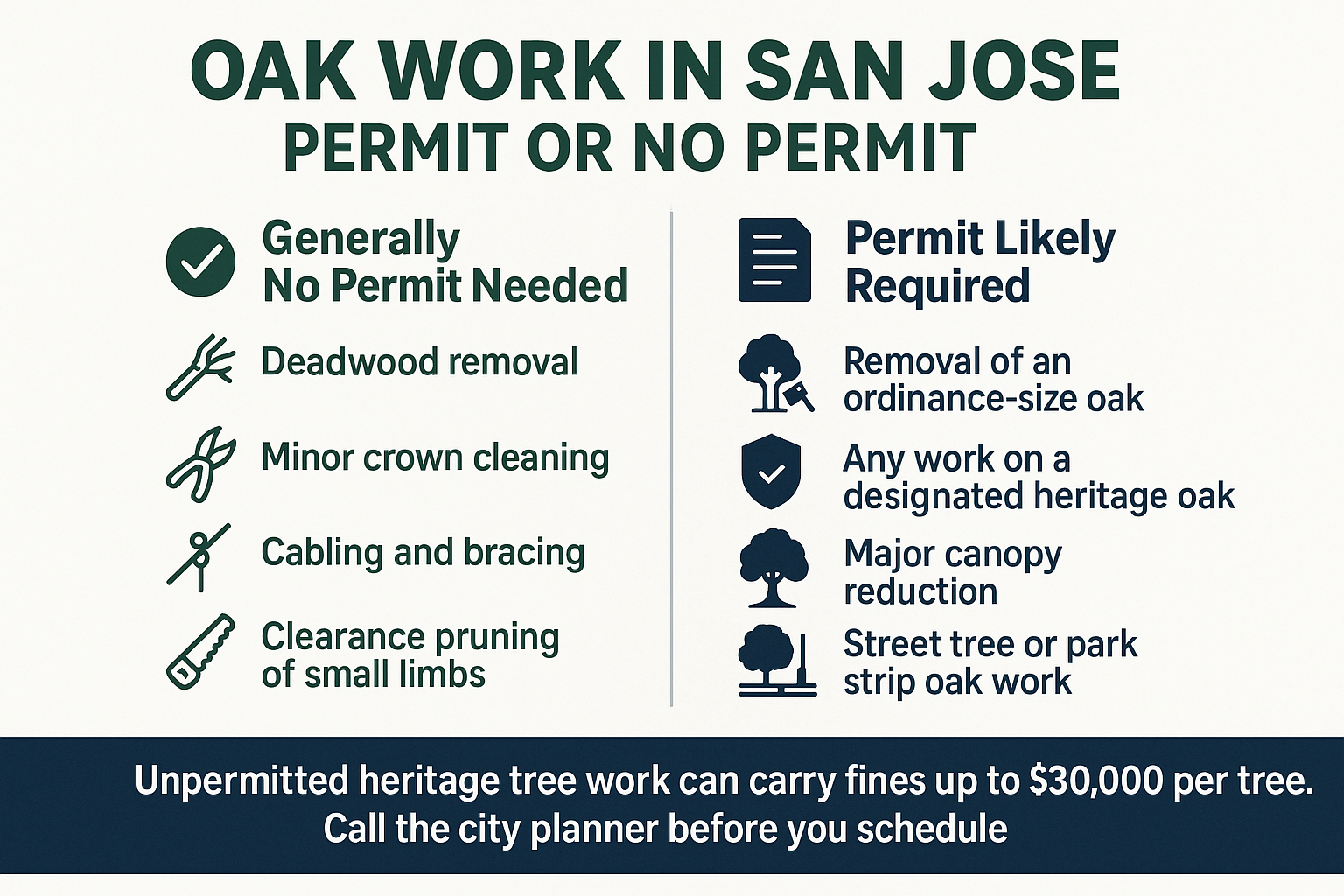
What you can do to an oak without a permit, and what you cannot
San Jose’s tree ordinance specifically protects oaks above the ordinance-size threshold, and heritage oaks carry their own protection layer with fines that can reach $30,000 per tree for unpermitted work. That is a real number, and it is the reason I tell people to make one phone call before they schedule anything.
The general shape of it:
- Deadwood removal on a protected oak typically does not trigger a permit
- Minor crown cleaning to take out crossing or broken branches usually does not either
- Cabling and bracing to support a weak fork generally falls outside permit requirements
- Removal, and often significant canopy reduction, on an ordinance-size or heritage oak does require approval
The gray area is where homeowners get burned, because “minor pruning” means different things to a homeowner and to a city planner. If you are unsure, the San Jose planning line at 408-535-3555 will tell you whether your tree is on the protected list before any work happens.
It also helps to understand what actually triggers the ordinance-size rule on your property, since diameter at breast height, not height, usually decides it. Cupertino, Saratoga, and Los Gatos each run their own version of this, so a rule you learned at your last house may not apply here.
Sudden Oak Death is a reporting question, not just a treatment question
Here is the layer most homeowners find out about too late. In California, Sudden Oak Death is handled as a regulated pest, and county-level rules can include notification of the county agricultural commissioner when it is suspected or confirmed. You can read how the state frames the program through the California Department of Food and Agriculture.
That matters for a practical reason. If you call a crew, they cut, and infected material moves off your property without the right handling, you have created a problem that is harder to unwind than the original diagnosis.
So when an oak in San Jose or Saratoga is showing bleeding cankers or fast canopy dieback, the first step is a diagnostic visit, not a treatment plan. A proper assessment before action tells you two things at once: what the tree actually has, and what obligations come with it.
And plenty of symptoms that look like Sudden Oak Death are not. Drought stress, root rot from irrigation, and beetle activity all mimic each other in the canopy, which is why pest and disease guessing tends to cost people more than the diagnosis would have.
Frequently Asked Questions About Oak Tree Care in San Jose
My oak dropped a huge amount of leaves in May. Is it dying?
Probably not. Coast Live Oaks are evergreen but they shed a year’s worth of old leaves as the new flush comes in, and late spring is exactly when that happens. The signal to watch for is not leaf drop by itself, it is leaf drop with no new growth replacing it.
Can I water my oak during a heat wave?
A deep, infrequent soak well out toward the dripline is different from daily drip near the trunk. Keep water away from the root collar, water in the early morning, and space it out by weeks rather than days. Frequent shallow water at the base is the pattern that causes trouble.
What does an arborist assessment on an oak cost?
It depends on what you need. A verbal on-site consultation is a much smaller number than a formal written report used for a permit, a neighbor dispute, or a hearing, and formal reports run considerably higher because of the site measurements and documentation involved. Photo review is often a free first step. Call for an exact figure on your situation.
A neighbor’s crew topped an oak that overhangs my yard. What now?
Topping never makes an oak safer. It forces weak regrowth that is more likely to fail in a winter storm, and on a protected tree it may also have been unpermitted work. Get the condition documented before the regrowth hides what was cut.
Does every oak in San Jose need a permit before pruning?
No. Size, species, and whether the tree has heritage status all factor in, and routine deadwood removal on most oaks does not require one. The 408-535-3555 planning line can confirm your specific tree in a short call.
Not sure what your oak actually needs?
If you have an oak in San Jose, Cupertino, Almaden Valley, or up in Saratoga and you are not sure whether it needs pruning, a watering change, or just to be left alone this season, an assessment answers that before anyone touches it. Our office can walk you through timing, permit questions, and the photo review option at (408) 422-1313. The goal is safety, health, and longevity, in that order.
