 Skip to content

Direct Answer: Sudden Oak Death spreads from California bay laurels to oaks, not oak to oak. Rain washes spores off infected bay leaves onto oak trunks. Proximity to bay laurel is the biggest risk factor.
In May and June of this year, one call came in over and over with almost the same wording. A homeowner had an oak that looked wrong, and they wanted to know one thing: can it be saved, or does it need to come out?
My honest answer usually starts with a question back. Do you have California bay laurels growing near that oak?
That single detail can change the whole diagnosis. Sudden Oak Death does not move oak to oak. It moves from bay laurels to oaks, and if nobody asks about the bay trees, the most important variable on the property gets missed.
Why the First Question About a Sick Oak Is About a Different Tree
Sudden Oak Death is caused by Phytophthora ramorum, a water-mold pathogen that has been confirmed in Santa Clara County. It is not a beetle and it is not a drought problem, even though it can look like both.
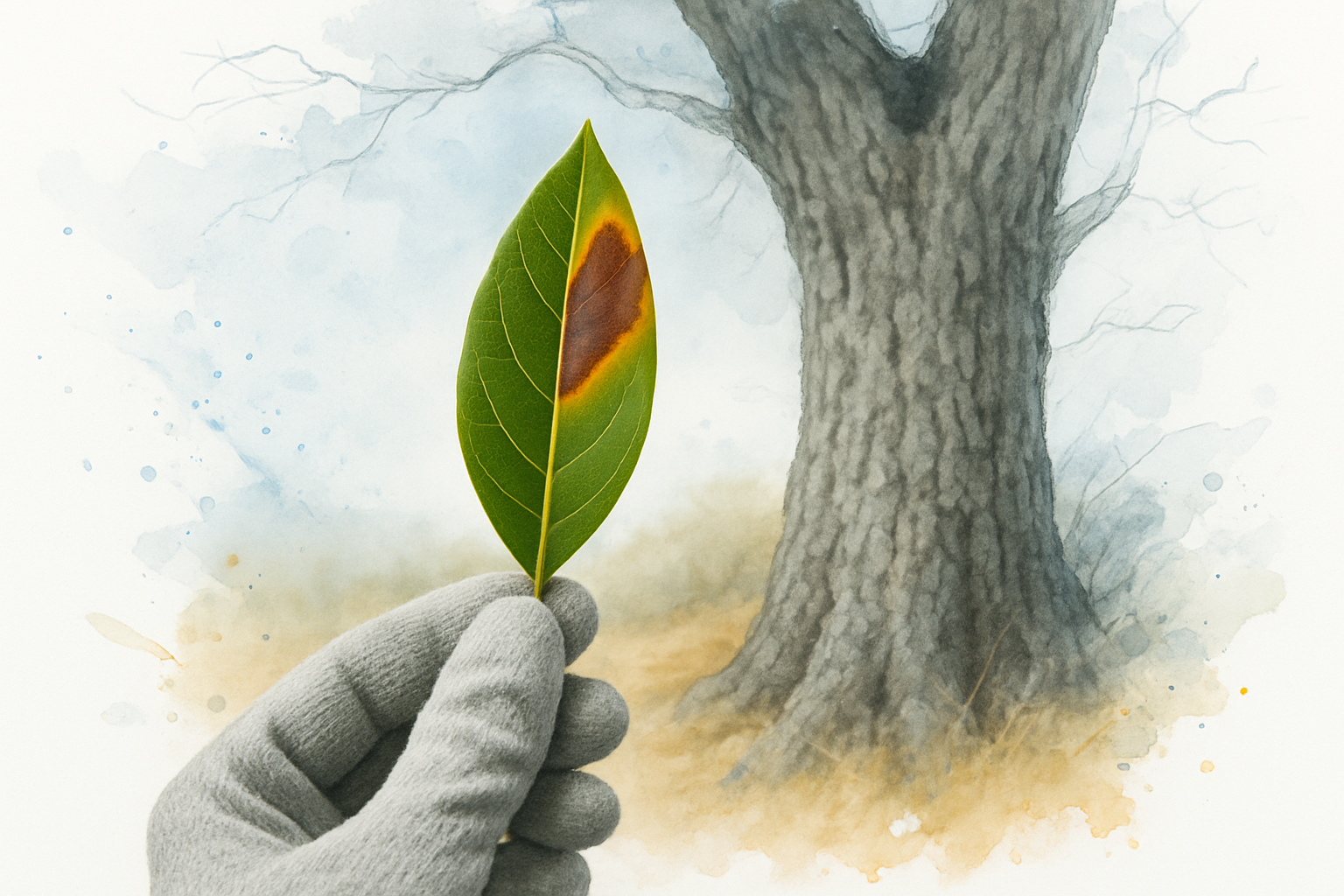
Bay laurels are the engine. Spores build up on infected bay leaves, and when rain hits those leaves, the splash carries spores onto the bark of nearby oaks. According to UC IPM’s research on Sudden Oak Death, proximity to California bay laurel is the strongest predictor of infection risk in coast live oak.
That matters a lot here. Coast live oaks are among the most susceptible species, and they are also one of the most common and most valued trees in Saratoga, Almaden Valley, and the Willow Glen foothills.
The 2025 SOD Blitz survey data for the Peninsula zone, which covers communities bordering our service area like Los Altos Hills, Portola Valley, and Woodside, found bay laurel infection rates well above the 20% mark that researchers treat as the point where spread to true oaks becomes likely.
And this disease is quiet. It often works inside a tree for a long stretch before anything shows on the outside, which is why so many homeowners feel blindsided when symptoms finally appear.
What You Actually See on an Infected Oak
Most homeowners do not call and say “I think this is Sudden Oak Death.” They call and describe something that looks like stress. Here is what I look for on the tree itself:
- Dark bleeding cankers oozing reddish-black sap on the lower trunk, often in a few spots rather than one
- Staining under the bark in a distinct pattern when a small area is scratched back
- Thinning or browning that starts high in the crown and works its way down
- Fruiting bodies from secondary fungi, which move in after the pathogen has already weakened the tree
Now the hard part. Every one of those signs overlaps with something else. Bleeding sap can come from other Phytophthora species, borers, or physical wounds. Crown thinning can be drought stress from a long dry summer, or root rot from overwatering, which I see constantly on oaks surrounded by irrigated lawn.
So I will say this plainly: visual symptoms are not a diagnosis. They are a reason to look closer. Oaks in this region already play by their own rules, and I have written before about how an oak in Cupertino or Almaden is judged differently than a landscape tree planted last decade.
Same Symptom, Different Causes
This is the overlap that makes guessing expensive. Each of these signs has more than one likely explanation.
| What you see | Could be Sudden Oak Death | Other common explanations |
|---|---|---|
| Dark sap bleeding from lower trunk | Yes, a classic sign | Other Phytophthora species, borer activity, old bark wounds |
| Crown thinning from the top down | Yes, often mid-stage | Long dry summer stress, damaged irrigation, girdling roots |
| Sudden browning of all leaves | Yes, in later stages | Root failure, trenching or grading near the root zone |
| Mushrooms or conks at the base | Sometimes, from secondary fungi | Advanced internal decay, chronic overwatering |
| Bark beetle holes and sawdust | Sometimes, as a follow-on pest | Primary beetle attack on an already stressed tree |
The Bay Laurel Problem Changes How You Think About Your Property
Here is the part that surprises people most. Bay laurels usually do not die from Phytophthora ramorum. They host it and they spread it, especially through wet winter weather when spores travel in moisture and rain splash.
Which means the tree that looks perfectly healthy right next to your struggling oak may be the source. Homeowners often point me toward the sick tree and walk right past the one doing the damage.
The pathogen can also persist in soil and leaf litter. So removing a bay laurel after an oak is already infected does not undo the infection that has taken hold.
A few things worth knowing before any assessment:
- If you have both species on your lot, say so up front
- If a neighbor’s bay laurels overhang your fence line, that counts too
- Note where water collects and where rain drips off the bay canopy
- Bay laurel management is a judgment call, not an automatic removal
Thinning or removing bay laurels can reduce spore pressure around healthy oaks, but it is a decision that depends on layout, distance, slope, and what else is growing there. Right tree, right place, right time applies to the bay just as much as the oak.
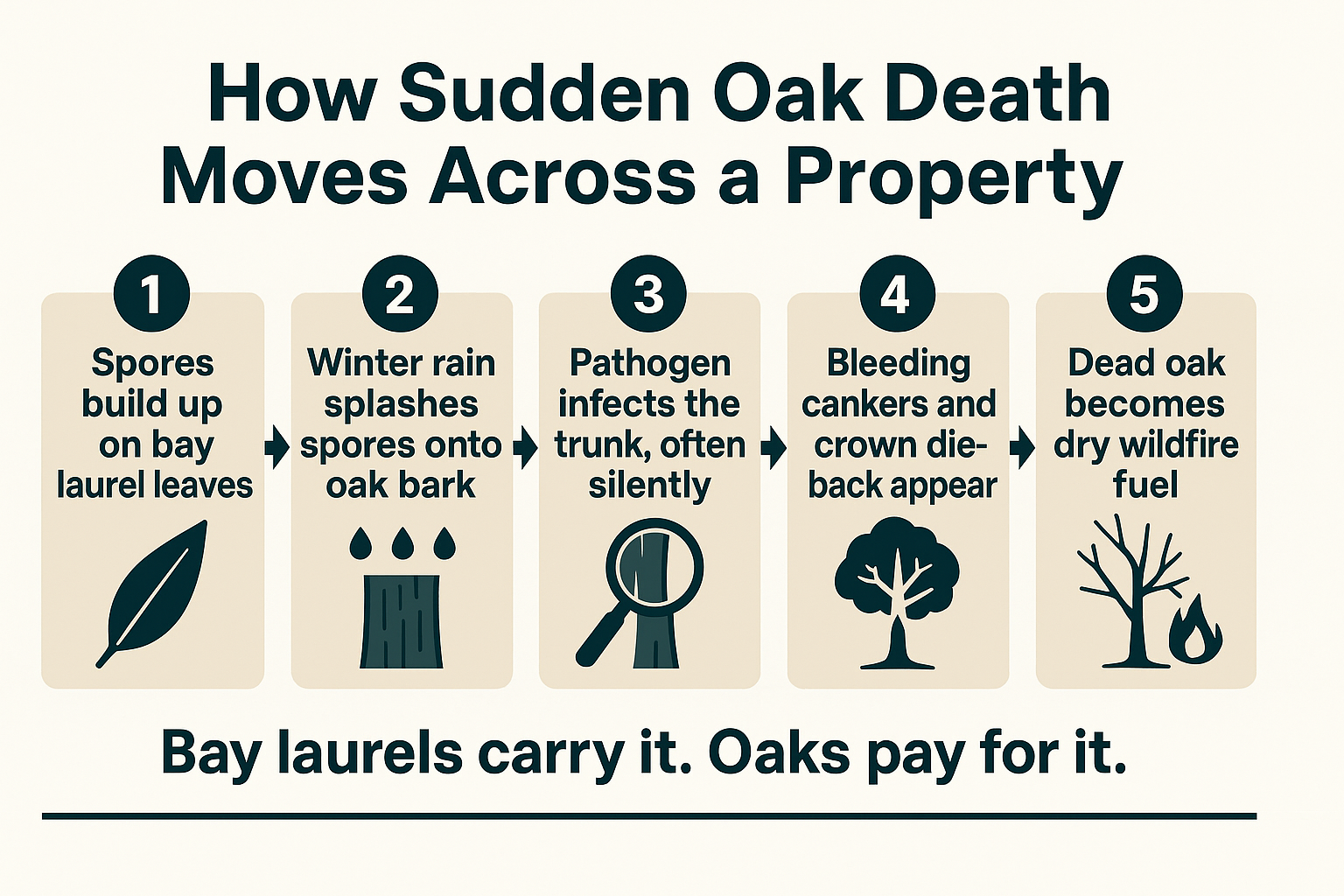
How the Disease Moves Across a Yard
A simple walk-through of the path this pathogen takes from a healthy-looking bay laurel to a failing oak.
Save It or Remove It? Why This One Is Harder Than Most
One caller put it about as clearly as anyone could. It might need to be removed, or it might just need treatment, and they simply needed someone to tell them whether it could be saved.
That is a fair question, and with this disease the answer is harder than usual. There is no cure for Sudden Oak Death.
What does exist is a phosphonate-based treatment, applied as a trunk injection or bark application. It can help protect healthy oaks from infection and may slow progression in early-stage cases.
But two conditions apply:
- It requires a licensed applicator handling the product correctly
- It has to be done on the right timeline, not whenever it is convenient
A tree already showing advanced cankers and heavy crown die-back may be past the point where treatment changes anything. This is not a do-it-yourself decision, and store-bought products applied at the wrong time mostly waste money.
The honest framing I give people: early action on an oak that still has structural integrity and limited canopy loss gives you real options. Waiting until the tree is visibly failing usually does not. If you want a plainer starting point on reading your own trees, learning what your oak is asking for is a good habit to build.
Costs vary widely based on trunk diameter, access, and how many trees are involved, so the only reliable number comes from someone who has stood at the base of your tree.
In the Saratoga and Almaden Hills, This Is Also a Fire Question
If you live in the hillside neighborhoods above Almaden Valley, or up in Saratoga and Los Gatos, there is a second layer here. Dead and dying oaks turn into dry fuel.
The Midpeninsula Regional Open Space District has noted directly that trees killed by Sudden Oak Death raise wildfire risk because they add to the fuel load. In areas sitting in or near CAL FIRE’s wildland-urban interface zones, that is not an abstract concern.
So a declining oak on a slope is two problems at once:
- A tree health question about whether it can be saved
- A defensible space question about what it becomes if it dies standing
Getting a documented inspection before storm season is a reasonable step, not an overreaction. It is the same logic behind Santa Clara County’s vegetation rules, and if you are unfamiliar with those, what the county’s weed abatement program costs when you miss a deadline is worth a read.
The goal is safety, health, and longevity. Not a chainsaw first and questions later.
Frequently Asked Questions About Sudden Oak Death in Santa Clara County
Should I just remove my bay laurel to protect my oaks?
Maybe, but not automatically. Reducing bay laurel canopy near valued oaks can lower spore pressure, and it works best as prevention before an oak is infected. Distance, slope, wind, and how the rain drips off the bay all factor in, so it is a judgment call made on site rather than a blanket rule.
Can I send photos instead of paying for a visit?
Yes, we do review photos at no cost, and it is a good first filter. But I will be straight with you: photos cannot confirm this disease. Bleeding cankers, bark staining, and root collar condition need hands and eyes on the tree, and often lab confirmation.
My oak looks bad. Is it definitely Sudden Oak Death?
No. Drought stress, overwatering, root rot, borers, and grading damage near the root zone all produce similar symptoms. That is exactly why proper assessment before action matters here more than with most tree problems.
Do I need a permit to remove an oak in San Jose?
Often yes, depending on species, size, and location on your lot. Street trees in the park strip between sidewalk and curb are regulated separately, and city fines for unpermitted work can be steep. Removal permits typically require a written arborist report documenting condition, species, size, and justification.
What does an arborist report cost?
It depends on scope. A verbal on-site consultation is generally the lower-cost option, while a formal written report suitable for permits, insurance, or a neighbor dispute costs considerably more because of the documentation and liability involved. Ask for the current fee structure up front so there are no surprises.
Want an Honest Read on Whether Your Oak Can Be Saved?
If you have an oak that looks off and bay laurels anywhere nearby, an on-site assessment is the only way to know what you are dealing with and whether early treatment is still an option. San Jose Tree Service & Landscaping works with homeowners across San Jose, Willow Glen, Almaden Valley, Saratoga, Los Gatos, and Campbell, and our assessments are led by a Board-Certified Master Arborist. You can reach us at (408) 422-1313 or at sanjosetreemaintenance.com when you are ready to have someone take a look.
