
Direct Answer: In the South Bay, prune deciduous fruit trees like peaches, plums, apples, and pears in January through early February, after leaf drop but before buds swell. Citrus should not be pruned in winter.
You bought the house and the fruit trees came with it. Nobody left a note about when they were last pruned, what they are, or what to do next.
I hear this constantly from homeowners in San Jose, Sunnyvale, and Campbell. One recent one stuck with me: a family that bought an Eichler with mature fruit trees already established in the backyard and no history on any of them.
The tricky part is that most fruit tree pruning advice online was written for places with real winters. Fruit tree pruning timing in the South Bay runs on a shorter, shallower dormancy, and the calendar shifts because of it. Below is how I think about timing here, what happens when you prune too early or too late, and how I’d approach a tree that has gone years without attention.
Why the South Bay pruning window is narrower than the books say
Standard advice says “prune in winter dormancy.” That works when dormancy lasts four months. Here it does not.
Silicon Valley winters are mild. Our trees drop leaves later, wake up earlier, and the true dormant window between leaf drop and bud swell can be six to eight weeks instead of four months.
For most deciduous fruit trees in San Jose, that lands in mid-January through early February. Some years, with a warm run in late January, buds start swelling before the calendar says they should.
Here is what I look for instead of a date:
- Leaves are fully off and the branch structure is visible
- Buds are still tight and flat against the wood, not fattening
- No rain in the forecast for a few days after the work
- The tree is not actively pushing new growth anywhere
That last one matters more than people expect. Once a tree has committed energy to bud break, cutting that growth off is throwing away work the tree already paid for.
If you are new to the property and still figuring out what you inherited, our guide on what to do with the trees after you buy the house covers the wider walkthrough.
What pruning too early or too late actually costs you
Both mistakes are common, and they fail in different ways.
Pruning in November or December feels productive. The leaves are down, the weekend is free, the tree looks messy. The problem is that fresh cuts sit open through the wettest stretch of our year.
Wet wood and open wounds are how fungal problems get a foothold. Waiting until January shortens that exposure window considerably, and it lets you cut on the back end of the rain rather than the front.
Pruning after bud break, usually late February into March here, has a different cost. The tree has already moved stored energy into that new growth. Removing it stresses the tree and often triggers a flush of weak, upright water sprouts you will be dealing with next year.
A few field notes from South Bay yards:
- Apricots are the exception most people miss. They are prone to a canker disease that enters through winter cuts, so many growers here prune apricots in late summer when the wood is dry.
- Cherries dislike wet-season cuts for the same reason.
- Figs and persimmons are more forgiving but still do best late in dormancy.
- Walnuts bleed heavily from late-winter cuts, so late summer into early fall is usually the better call.
The University of California statewide IPM program publishes species-level guidance for California home orchards if you want to go deeper on a particular tree.
A South Bay pruning window by tree type
This is the general calendar I work from for backyard fruit trees in San Jose, Willow Glen, and Almaden Valley. Individual trees and microclimates shift it.
| Tree type | Typical South Bay window | What drives the timing |
|---|---|---|
| Peach, nectarine, plum | Mid-January to early February | Full dormancy, before bud swell; shortest wound exposure to winter rain |
| Apple, pear | January to early February | Dormant structure is visible; fruiting spurs are easy to identify |
| Apricot, cherry | Late summer, often July to September | Dry wood reduces canker and fungal entry through cuts |
| Fig, persimmon | Late dormancy, late January onward | Forgiving, but avoid cutting into a wet stretch |
| Citrus (lemon, orange, mandarin) | After frost risk passes, generally late winter into spring | Cold-sensitive new growth; heavy winter pruning invites damage |
| Walnut | Late summer to early fall | Heavy sap bleeding from late-winter cuts |
Citrus does not follow the same rules at all
Citrus shows up in a huge number of San Jose and Sunnyvale backyards, and it is the tree I most often see pruned at the wrong time.
Citrus is evergreen. It does not go dormant the way a plum does, and it responds poorly to heavy dormant-season cutting.
Worse, pruning pushes tender new growth. If that growth appears right before a frost event, it gets damaged.
Frost risk is not uniform across the South Bay. Foothill properties in Saratoga, Los Gatos, and the upper end of Almaden Valley run several degrees colder on clear winter nights than yards closer to downtown San Jose, where pavement and buildings hold heat overnight.
So my rule for citrus is simple:
- Light shaping and removal of dead or crossing wood can happen almost any time of year
- Avoid any meaningful pruning in the weeks before an expected cold snap
- Save larger structural work for after frost season has passed, generally late winter into spring
- If the tree is in a colder foothill pocket, wait longer than your friend in Willow Glen does
If the tree is dropping leaves, showing sticky residue, or has a sooty black film on the foliage, timing is not your main issue. That is a health question, and our rundown of the pest and disease questions we hear most is a better starting point.
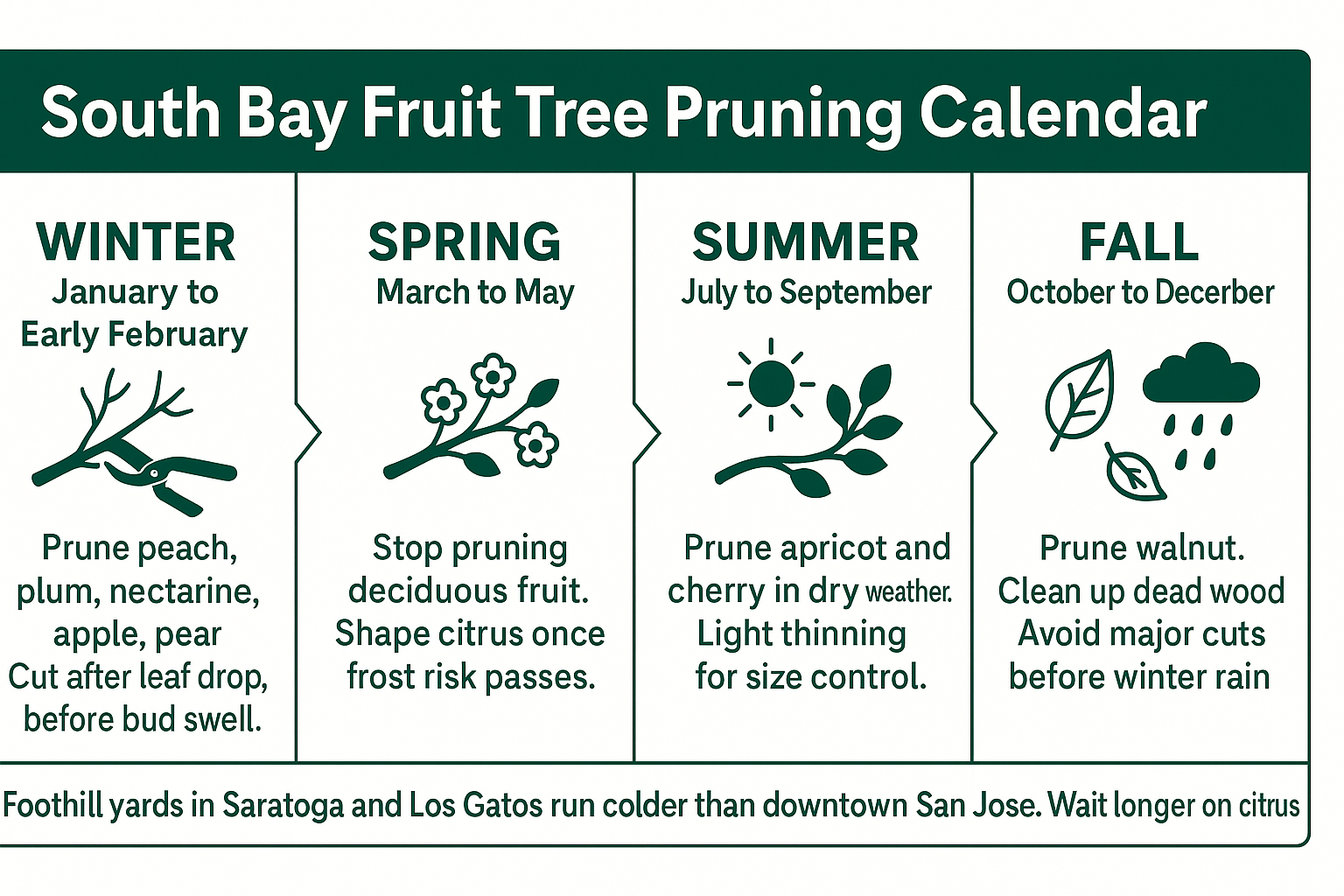
The South Bay fruit tree year at a glance
Here is the same calendar laid out as a simple year-round view for the trees most common in Silicon Valley yards.
If you inherited a neglected tree, do not try to fix it in one visit
This is the part I most want homeowners to hear. A fruit tree that has gone five or ten years without pruning cannot be corrected in one January.
I have watched people take a badly overgrown apple down to a fraction of its canopy in a single session. The tree survives, but it answers with a wall of water sprouts the following spring and you end up further behind than when you started.
A phased two-year approach works better. Year one is not about form.
Year one goals:
- Remove dead, broken, and clearly diseased wood
- Open the interior enough for light and air to reach the center
- Take out the worst crossing and rubbing limbs
- Assess the underlying structure so you know what you are working with
Year two is where you refine: reduce height where it makes sense, balance the scaffold limbs, and shape for fruit you can actually reach.
As a general guideline, taking more than about a quarter of the living canopy in one season is where stress responses start showing up. On a badly neglected tree, spreading that over two winters is the difference between a recovering tree and a struggling one.
And if a tree has structural problems that go past overgrowth, split forks, a heavy lean, or decay at the base, that is a separate conversation. Knowing when a tree problem needs an arborist rather than a trimmer is worth reading before anyone starts cutting.
One longtime customer put it well in a review: we “never push work that doesn’t need to be done.” On fruit trees especially, restraint in year one is usually the right call.
Common Questions About Fruit Tree Pruning Timing in the South Bay
I missed the January window. Should I just prune it now anyway?
It depends on how far past you are. If buds are swelling but have not opened, light work is usually fine. Once the tree has leafed out and is putting energy into new growth, I’d hold off on structural pruning until next winter and limit yourself to removing dead or broken wood, which you can do any time.
Does it matter that my yard is in the foothills instead of flat San Jose?
For deciduous fruit trees, not much. For citrus, yes. Properties up in Saratoga, Los Gatos, and the higher parts of Almaden Valley get colder overnight temperatures than yards near downtown San Jose, so frost-sensitive new growth is more at risk and you want to wait longer before doing meaningful citrus work.
How much does fruit tree pruning cost around here?
Costs vary quite a bit and I won’t quote a number without seeing the tree. What drives it: tree size and height, how long it has gone unpruned, access to the yard, how close it is to structures or wires, and how much debris comes out. A backyard peach and a 30-foot walnut are not the same job. We break down the factors behind tree trimming pricing in more detail, and an on-site look is the only way to get an accurate figure.
Do I need a permit to prune a fruit tree in my own backyard?
Backyard fruit trees are usually not the issue. Permits in San Jose come into play with street trees in the park strip and with trees that hit ordinance size, and those rules can cover pruning, not just removal. If your tree is near the sidewalk or is unusually large, it is worth checking before anyone cuts. See our explainer on what triggers a permit on your property.
My fruit tree has not produced much in years. Will pruning fix that?
Sometimes, and sometimes not. Poor production can come from a crowded canopy that blocks light, but it can also come from irrigation problems, soil issues, pests, or an aging tree that has passed its productive years. Proper assessment before action applies here as much as anywhere. I’d rather find out why before recommending a cut.
Working out a pruning plan for trees you inherited?
If you have fruit trees in San Jose, Sunnyvale, Campbell, or the surrounding South Bay and you are not sure what they are or when they were last touched, a walkthrough before the January window is a reasonable place to start. Our arborist-led team is available for assessments across the area at (408) 422-1313 or sanjosetreemaintenance.com. The goal is safety, health, and longevity, and with fruit trees that usually means fewer cuts made at the right time rather than more cuts made at the wrong one.
