
Direct Answer: Inside a San Jose corner sight triangle, shrubs must stay low and trees need a single clear trunk through the regulated band, with canopy above it. Confirm exact heights with the city first.
The letter is usually short. It gives you a height, a compliance date, and a line saying the property will be re-inspected. And suddenly the corner of your yard, the part you planted twenty years ago for privacy, is a code problem.
I talk to San Jose homeowners in this exact spot every year, mostly on corner lots in Willow Glen, Almaden Valley, and older streets in Campbell where the hedges have had decades to fill in. The question they ask me first is almost always “how short do I have to cut it.”
That is the wrong first question. The better one is what will still pass when the inspector comes back, because a cut that satisfies the letter today and grows back over the sightline in three summers is just a second notice with a delay on it.
A Sight Triangle Notice Is a Measurement Problem, Not a Landscaping Opinion
The sight triangle is the wedge of ground at a corner where a driver pulling up to the intersection has to be able to see cross traffic and people on foot. Cities protect that wedge with numbers, not taste. Nobody at the counter cares whether your hedge is attractive.
One homeowner on a San Jose corner lot described the standard to us in their own words, and it is the clearest summary I have seen from a non-professional: “per city code, trees in the corner triangle need to be single-stem with the trunk clear of foliage between 3 ft and 8 ft high (canopy can be above 8 ft).”
So you are usually dealing with two separate measurements at once:
- A maximum height for shrubs, hedges, and ground-level planting inside the triangle, often around three feet
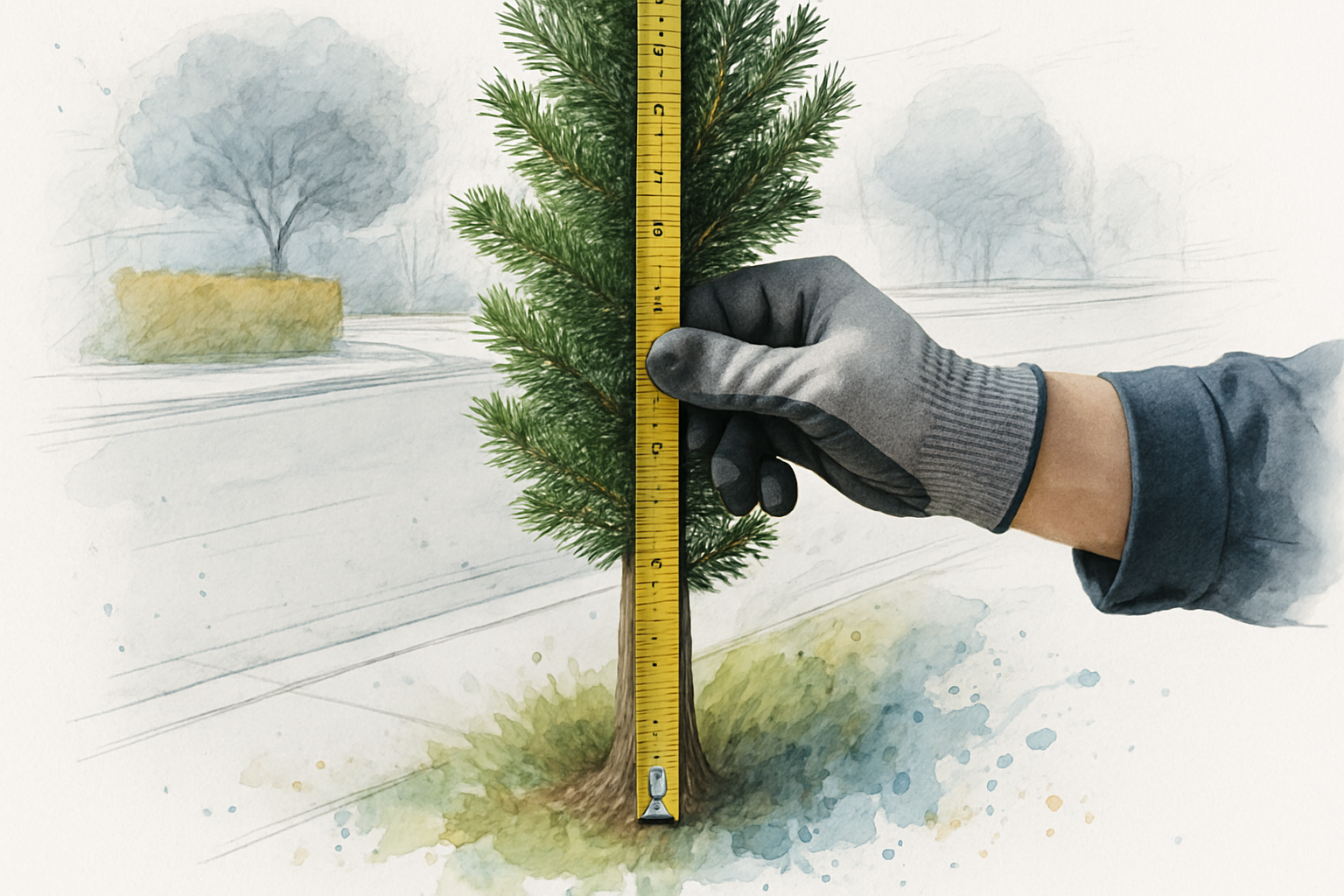
- A clear trunk band on any tree in that triangle, with no foliage or low limbs between roughly 3 and 8 feet
- A single leader, meaning one trunk, not a multi-stem shrub habit that fills the visible gap
- A canopy that starts above the regulated band, so you keep shade without blocking the view
Exact numbers and triangle dimensions vary by street type and by city. Verify yours with the city before anybody starts cutting, because the whole point is passing the re-inspection on one pass.
Two Rule Sets Can Land on the Same Twenty Feet of Corner
Here is where people get burned. The visibility standard governs how tall vegetation can be on your private property. San Jose’s tree rules are a completely different system, and they cover pruning, not just removal.
That means you can satisfy the code enforcement letter in the morning and be in violation of a tree ordinance by lunch, on the same corner, with the same saw.
The trees most likely to cause that are:
- Street trees planted in the park strip between sidewalk and curb, which fall under city jurisdiction for trimming as well as removal
- Ordinance-size trees on private property that have reached the trunk diameter that triggers a permit
- Heritage trees, where the city expects you to consult the City Arborist and get a permit first
San Jose’s own tree removal permit guidance lays out the heritage tree process, and penalties for working on one without approval can reach into the tens of thousands of dollars per tree. If you are not sure which category your corner tree falls into, start with who actually owns the tree in front of your house and San Jose’s ordinance-size tree rule.
Checking costs nothing. Guessing can cost a lot.
Who Controls What in Your Corner Triangle
Before you decide what gets cut, identify what is actually growing there. This is the sort it out step, and it takes about ten minutes.
| What is growing there | Who sets the rules | What to confirm first |
|---|---|---|
| Hedge or shrubs on your property | Code enforcement visibility standard | Maximum height and the exact triangle dimensions |
| Tree in the park strip by the curb | City, for pruning and removal | Whether a permit is needed before any cut |
| Large tree on private property | City, if it meets ordinance size | Trunk diameter measured at the right height |
| Designated heritage tree | City Arborist, permit required | Permit status before touching a single limb |
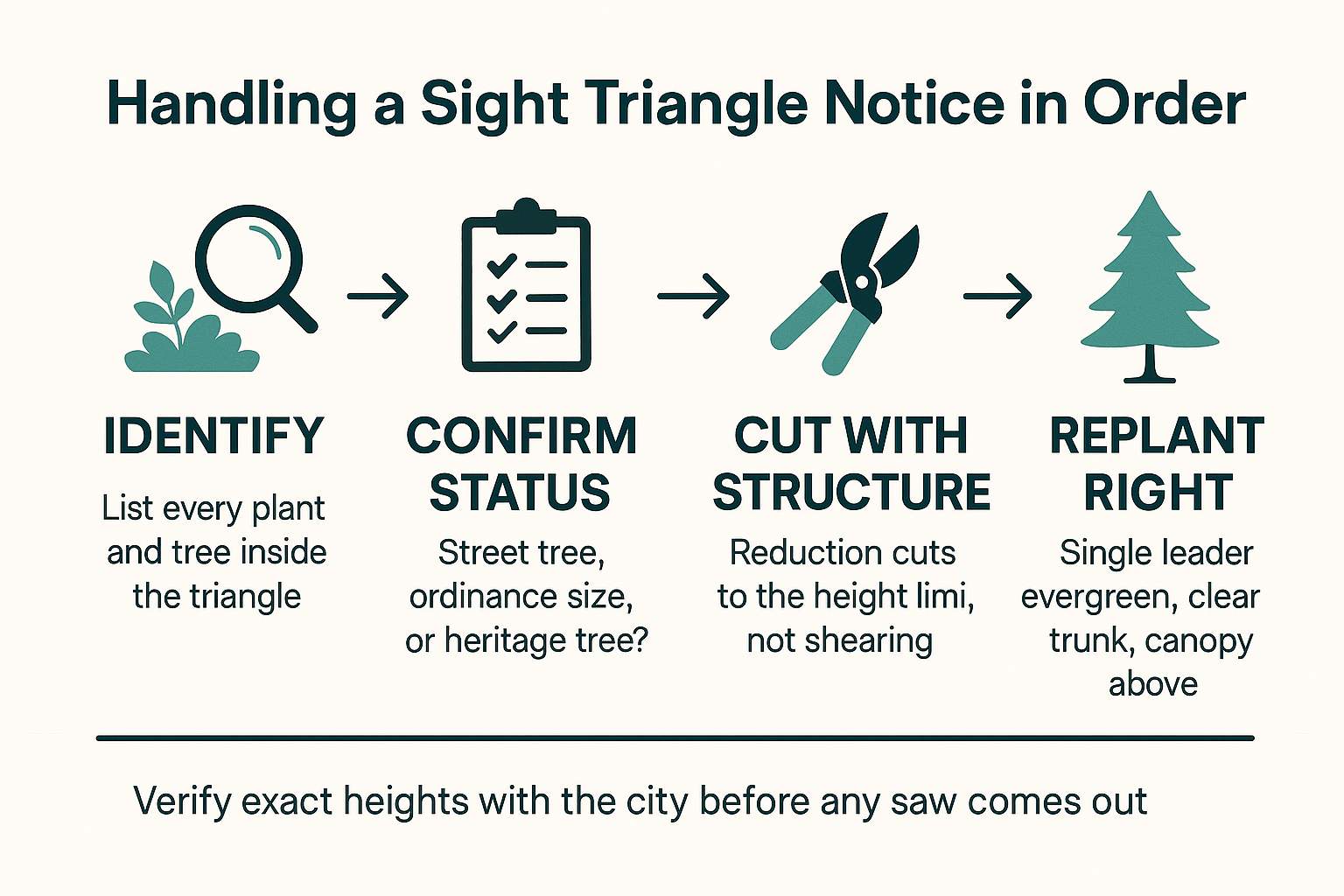
The Order to Handle a Corner Notice In
Doing these in order is what keeps one city letter from turning into two.
What to Plant So It Still Passes in Year Five
This is the part most homeowners skip, and it is the part that decides whether you ever get another letter. A corner planting has to clear the sightline permanently, not just on inspection day.
When I am picking something for a regulated corner in San Jose, I am screening for:
- Evergreen, so the screen holds in January and the clearance holds in July
- A single leader, one dominant trunk rather than a bushy multi-stem habit that refills the clear band
- A trunk that takes limb-up pruning well, so the 3 to 8 foot band stays open without repeated heavy cuts
- A mature size that suits a park strip, not a tree that will spend thirty years fighting the sidewalk and the overhead lines
- Tolerance for heavy clay soil, which is what most of San Jose, Santa Clara, and Campbell are sitting on
We treat a new tree as long-term infrastructure. Root flare depth, drainage, and site conditions matter more than the shape of the tree in the nursery pot, and a tree planted wrong can look fine for a year or two before the decline shows up underground.
One note on species lists. The city may have preferences or an approved list for park strips, so confirm species and clearance numbers with them before you buy anything. Right tree, right place, right time.
A Compliance Cut and a Shearing Job Measure the Same. They Do Not Age the Same.
Under deadline pressure, the instinct is to cut everything flat to the number in the letter. I understand it. But the height limit sets a ceiling, not a method.
Shearing a hedge or topping a tree to a line forces fast, weakly attached regrowth and leaves large open wounds. On a street corner, that regrowth is dense, it is upright, and it will be back in the sightline faster than the growth you just removed.
Reduction cuts made back to the right growth points hit the same measurement with far better results. Slower regrowth, better attachment, and a plant that still looks like a plant.
I have seen the alternative plenty of times. One Willow Glen homeowner reached out after a neighbor hacked one of their large crepe myrtles and asked whether the canopies could be brought down properly without losing the trees. Another asked whether laurel trees that gardeners had sheared into shrubs over the years could ever regain their individual structure.
Both of those are recoverable with patience. Neither one had to happen. Safety first, without destroying the plant.
Document It, and Know the Narrow Cases That Need Paperwork
Most visibility notices never require a report. You cut to the standard, the inspector comes back, and it closes. Keep it simple and keep records:
- Photograph the corner before the work, from the street and from the driver’s viewpoint at the stop
- Photograph it after, from the same two angles
- Keep the notice, the compliance date, and the photos together in one place
A written arborist opinion only earns its keep in two situations. The first is when the vegetation in the triangle turns out to be a regulated tree and the city needs documentation of condition and justification. The second is when you disagree with the city’s read.
That second one is real. A San Jose homeowner told us their street tree removal application was denied, with a letter stating the tree did not appear hazardous and noting they could submit a risk rating from an ISA Certified Arborist for reconsideration.
On cost, a quick photo review is the lowest-commitment first step and is typically free, while an on-site arborist consultation and a formal written report are separate fee tiers that vary with scope. Rather than guess at a number, call and ask what your situation needs. Our article on when a tree visit is free and when it comes with a fee walks through the difference, and what an arborist can tell from a photo covers the limits of the free option.
Frequently Asked Questions About Corner Lot Sight Triangle Rules in San Jose
Can I just cut my hedge down to three feet and be done with it?
Sometimes, yes. But check two things first. Confirm the exact height and the triangle dimensions that apply to your street, and confirm nothing in that wedge is a street tree, ordinance-size tree, or heritage tree. If it is, pruning may need a permit even though you are responding to a city notice.
Will I lose all my privacy screening?
Not necessarily. The regulated band is usually between about three and eight feet. A properly limbed-up evergreen tree can carry a canopy above that band that still screens upper windows and casts shade, while the ground-level view stays open. The screening you lose is the low wall of foliage right at driver eye level.
What happens if I miss the compliance date?
That depends on the city and the specific notice, so ask the inspector directly rather than assuming. In the related world of county weed abatement, missing a deadline can mean the county sends its own contractor and bills the homeowner as a special property-tax assessment. The general lesson holds: it is cheaper and calmer to handle it on your own schedule.
Do these rules apply the same way in Los Gatos or Saratoga?
The concept does, the numbers do not. Each city sets its own sight triangle dimensions and its own tree ordinance. A corner lot in Saratoga, Los Gatos, or Cupertino is governed by that city’s code, not San Jose’s, so verify locally before you plan the work.
Can the tree I plant be multi-stem if I keep it trimmed?
I would not plan on it. A multi-stem habit wants to refill the clear band every season, which means you are back out there with pruners constantly and still risking a second inspection. A single leader is far less maintenance over twenty years and far more likely to stay compliant on its own.
Handling a Corner Notice Without Starting a Second One
A sight triangle notice usually needs two kinds of work on the same twenty feet: a structural cut on what is already there, and a replanting that holds the screening without re-blocking the view. We carry both Tree Service and Landscaping classifications under CSLB #985639, so pruning is overseen by a Board-Certified Master Arborist and the planting, plant selection, and irrigation are handled by the same crew, with one point of contact for the whole corner. We have been BBB accredited since 2013, and reviewers across San Jose, Willow Glen, and Almaden Valley regularly note that the crews are “very careful not to damage any of the landscaping” around the work. If you want a second set of eyes on your notice before the deadline, we are reachable at (408) 422-1313 or sanjosetreemaintenance.com.
