 Skip to content

Direct Answer: Often yes. Most sheared or topped trees can be guided back toward a natural form through restoration pruning, done in stages over three to five years. Full original shape is not always possible.
You walked out back this weekend and something finally clicked. The trees do not look like trees anymore. They look like big green boxes, and nobody ever explained what was being cut or why.
I hear this a lot from homeowners in Willow Glen, Almaden Valley, and the older parts of Campbell. You hired a gardening crew to keep the yard tidy, they came every month with hedge shears, and over several years the structure of the tree disappeared.
You did not do anything wrong. Trimming sounded like trimming. Below I will explain what actually happened to the tree, whether it can come back, and what the repair work looks like year by year.
Can a Topped or Sheared Tree Recover? Usually, But Not Overnight
In many cases, yes. A tree that has been sheared flat or topped can often be guided back toward a more natural form, and that work has a name: restoration pruning.
It is not one corrective visit. It is a staged plan that usually runs three to five years, sometimes longer on a big specimen.
One homeowner wrote to us about three laurels that a gardening crew had gradually squared off into shrubs, asking whether the individual shape could come back if an arborist agreed that was healthy for the trees. Another in Willow Glen asked how far crepe myrtle canopies could be brought in without losing the trees altogether.
Both questions are the right ones. Here is the honest answer:
- Young and vigorous trees respond best. More energy, faster response, more usable shoots to work with.
- Mature trees with large topping wounds can often be made safer and healthier, but may never look like they did.
- Species matters. A crepe myrtle or laurel tolerates reshaping far better than a redwood or a conifer that does not resprout from old wood.
And the goal shifts a little along the way. Perfection is off the table. Safety, health, and longevity are not.
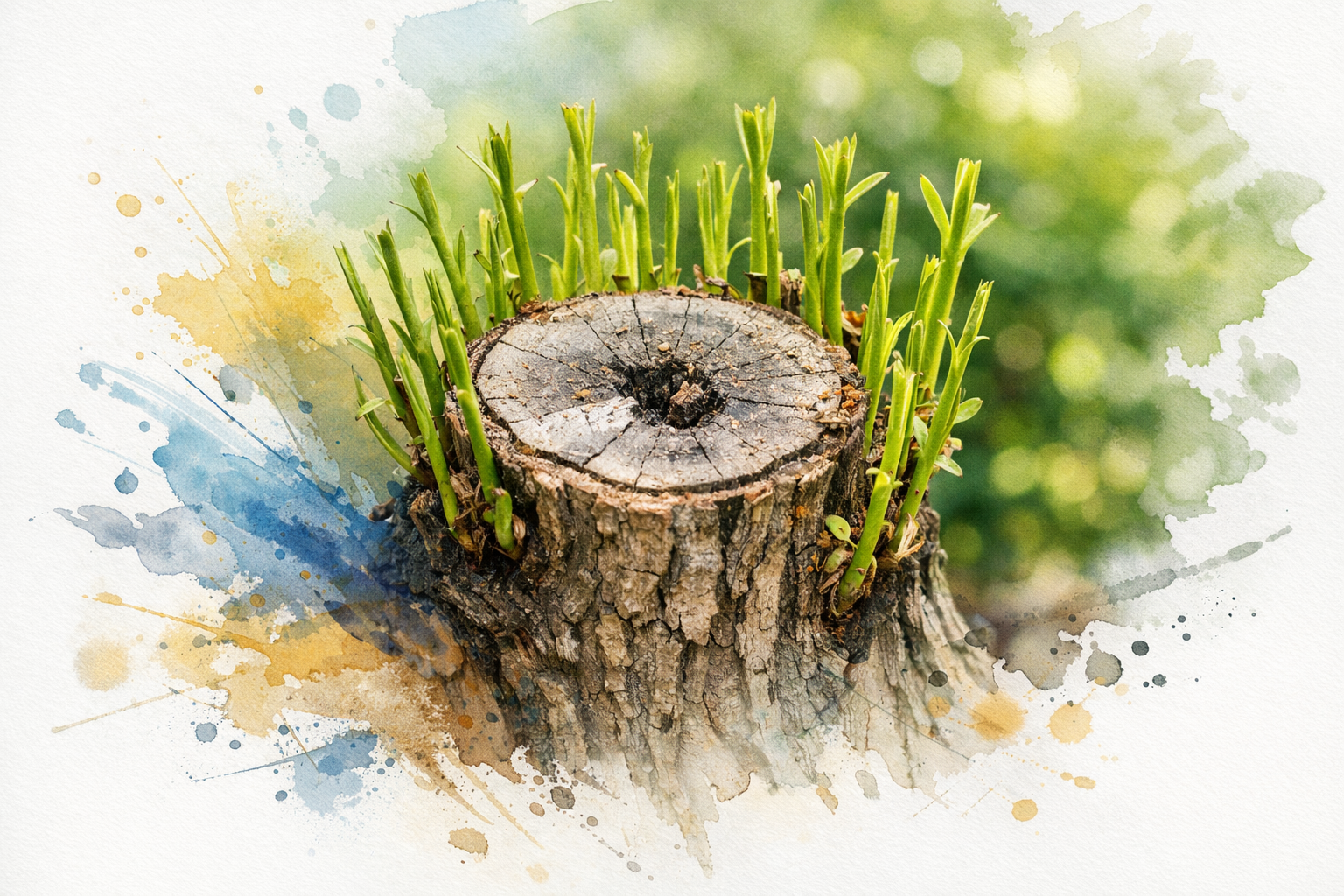
Those Thick Clusters of New Growth Are Not Recovery
This is the part most homeowners misread, and I do not blame anyone for it. Within two seasons of a hard shearing, the tree looks fuller than ever. Dense. Green. Seemingly fine.
It is actually the tree in survival mode.
Leaves are how a tree makes food. Strip most of them off at once and the tree has to spend stored reserves firing up dormant buds just to get leaves back in the air. University extension researchers have covered this well, noting that topping removes a tree’s food-making capacity and forces energy-draining latent bud growth that returns the tree to its original height within a few years anyway.
The problem is where those shoots attach:
- Normal branches grow from a branch collar with layers of wood knitting them to the trunk.
- Shoots from a topping cut grow from buds just under the bark, so they are attached at the surface only.
- They grow fast, long, and whippy, carrying most of their leaf weight way out at the tips.
- Meanwhile the large open cut underneath often cannot seal, so decay works its way down into the limb.
So you end up with heavier, longer growth sitting on top of a weakening attachment. The tree looks better and is structurally worse than it was before. One customer described a redwood a previous crew had trimmed hollow on the inside while leaving the edges heavy, which pushed all the weight to the branch tips and eventually led to limb failures in wind.
What Restoration Pruning Actually Looks Like, Year by Year
Proper pruning works with tree biology instead of cutting to a shape. Every cut lands in a specific place for a specific reason, closer to how a surgeon works than how a hedge trimmer works.
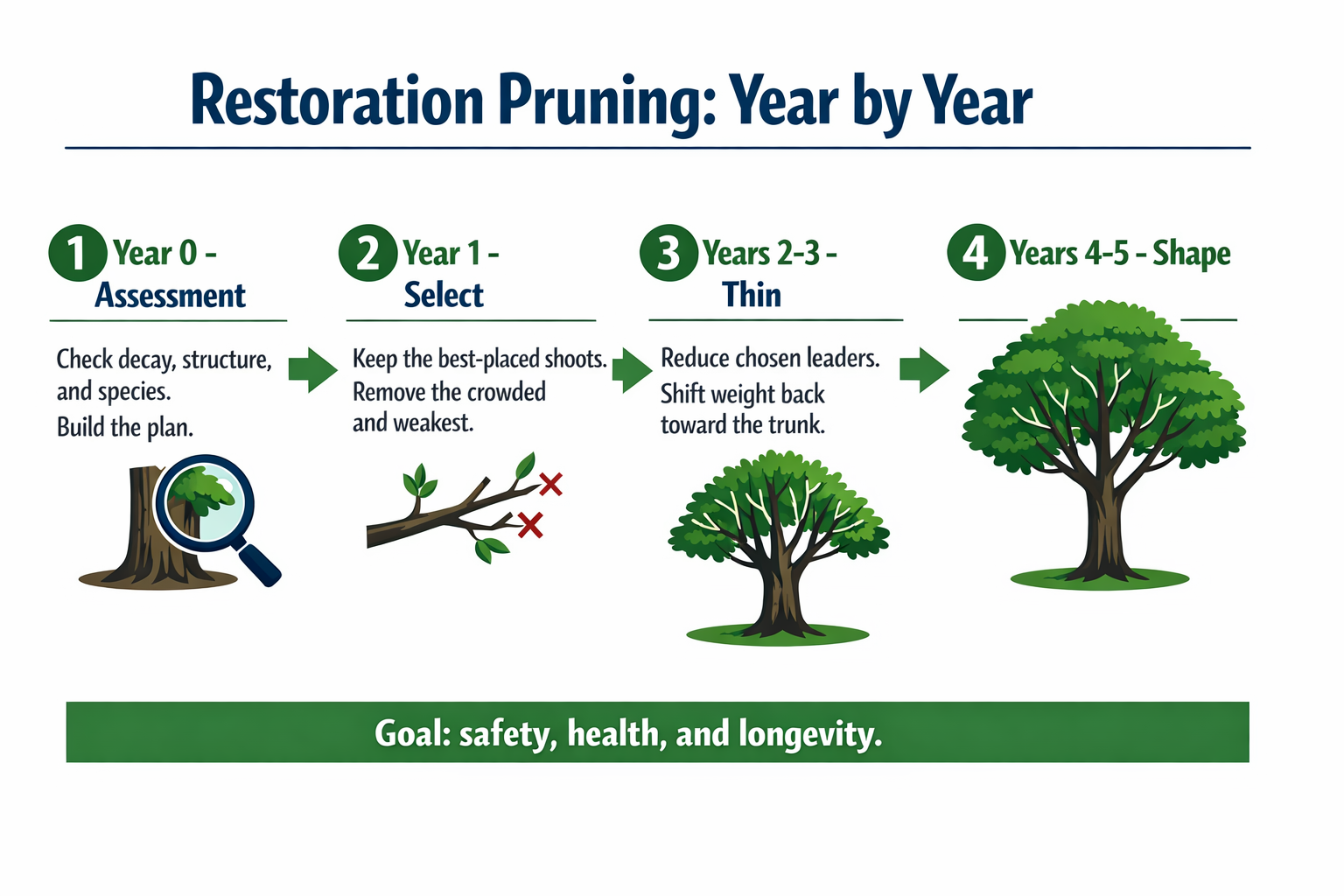
On a sheared or topped tree, the plan usually runs like this:
- Visit one: Assess structure and decay, then remove the weakest and most crowded sprouts. Select a handful of well-placed shoots per limb to become future branches. Take off a modest share of live growth, not a hard cutback.
- Visit two, roughly 12 to 24 months later: Thin the survivors again. The chosen leaders are now larger and better attached. Reduce any sprout that is outrunning the rest.
- Visit three and beyond: Shape the developing canopy, keep weight closer to the trunk, and clear deadwood as the old wounds continue to compartmentalize.
Cutting it all back again at once undoes the progress and restarts the sprout cycle. That is the single most common mistake I see on these trees.
Timing matters just as much as technique, and it is species-specific here in the South Bay. We work on mature canopies that have gone a few years between visits constantly, and the calendar drives the plan.
Pruning Windows for Common South Bay Trees
Restoration work gets scheduled around when each species can best handle cuts. These are the general windows we plan around in San Jose, Los Gatos, and Saratoga.
| Tree type | General pruning window | Why that window |
|---|---|---|
| Most deciduous trees (liquidambar, Chinese pistache, maple) | Roughly January through March | Dormant, sap flow slowed, branch structure clearly visible |
| California oaks (coast live oak, valley oak) | July through October | Oaks rest in summer; wet-season cuts expose them to moisture-loving pathogens |
| Spring-flowering trees (magnolia, flowering plum) | Right after blossoms fade | Buds are set on last year’s wood, so winter cuts remove next year’s bloom |
| Crepe myrtle | Late winter before bud break | Allows gradual reduction of knuckled regrowth instead of another hard cut |
| Evergreen screens (laurel, photinia) | Spring through early fall, in light passes | Reshaping works best in small steps rather than one heavy reduction |
The Restoration Timeline at a Glance
Here is how a sheared tree moves from survival growth back toward usable structure over several years.
Why I Would Not Wait Through Another Wet Season
Not out of alarm. Out of physics.
Forecasters have flagged a strong El Niño pattern for the November through January stretch, and our clay soil behaves a specific way when it gets saturated. It holds water, loosens its grip on roots, and then the wind arrives.
Now picture those long, whippy sprouts. Leaf weight sits at the far ends, the attachments are shallow, and wind and rain load them in the worst possible direction.
One caller put it plainly: they wanted the work done before the rain season started. Another wrote in about heavy branches breaking off a large tree behind their property and landing near the house.
Reducing that end weight is a different job from cutting the tree back again. Done right, it takes load off the risky attachments while leaving the tree enough canopy to feed itself. If storm readiness is your main concern, it is worth understanding what a tree risk inspection actually covers before anyone starts cutting.
How to Tell Structural Pruning From Another Shearing
This is the decision that determines whether the tree keeps declining. You do not need to be an arborist to sort it out. You just need to ask better questions.
Before anyone touches the tree, ask:
- Where will each cut land? A real answer names branch collars and laterals, not “we’ll take it down about three feet.”
- Which limbs become the permanent structure? If there is no answer, there is no plan.
- How much live canopy comes off this year? A specific percentage is a good sign.
- What happens at the next visit, and when? Restoration is staged by definition.
- Is the work being overseen by a certified arborist? General gardening crews are not set up for this kind of work, and that is not a knock on them.
Two other things worth knowing. Anyone advertising topping as a service is telling you everything you need to know about their approach. And an unusually low bid often means something was left out, whether that is skilled labor, proper cuts, debris disposal, or insurance, which is worth reading up on when you look at what goes into the price of tree trimming.
One longtime customer summed up what good practice looks like from the homeowner’s side: “They’re super knowledgeable and never push work that doesn’t need to be done.” Proper assessment before action, every time the saw comes out.
Frequently Asked Questions About Sheared and Topped Trees
Will my tree have to be removed because it was topped?
Usually not. Removal is a last resort, reserved for trees that have lost structural integrity or have advanced decay at the root collar or main scaffold limbs. Most sheared trees are candidates for restoration, not removal. A proper assessment should tell you which category yours falls into.
How long until the tree looks normal again?
Plan on three to five years for a noticeable change in form, longer on a large mature tree. The first visit often makes the tree look thinner, not fuller, because we remove crowded sprouts. The payoff shows up in years two through four.
Can I just do nothing and let it grow out?
You can, and on a small ornamental in a low-risk spot that is a reasonable choice. The trade-off is that the sprouts keep getting longer and heavier on weak attachments. If the tree is near the house, a driveway, or a utility line, letting it run is the riskier option.
Do I need to pay for an arborist visit, or can I send photos first?
A lot of homeowners start with photos to get a rough read, and that works fine for simple questions. For decay, structural doubt, or a multi-year restoration plan, an on-site look is far more reliable. Costs vary by scope, so ask what an assessment includes before you book.
Does a sheared street tree in San Jose change anything?
It can. Trees in the strip between the sidewalk and the street fall under city jurisdiction, and that often covers pruning, not just removal. Confirm the tree’s status before scheduling any work on it.
Thinking About What to Do With a Sheared Tree?
If you have trees in San Jose, Los Gatos, Saratoga, or Campbell that were shaped into boxes over the years, a staged restoration plan is usually worth understanding before another crew touches them. We do arborist-led assessments throughout the South Bay and are glad to walk a homeowner through the options, including leaving a tree alone for a season. Our team can be reached at (408) 422-1313 or at sanjosetreemaintenance.com whenever you want a second read.
