Skip to content

Direct Answer: Starting January 1, 2027, SB 342 lets a contractor who was licensed when the contract was signed keep payment for work done while licensed, and disgorge only pay for unlicensed work.
Most homeowners in Willow Glen or Almaden Valley never think about a contractor’s license after the first phone call. It comes up later, usually when a job stalls, a crew changes, or an invoice shows up that does not match what was discussed.
California just narrowed one of the remedies property owners had in that situation. Senate Bill 342 (Umberg) was signed on September 30, 2026, became Chapter 967, Statutes of 2026, and takes effect January 1, 2027.
My position on this is plain. The old all-or-nothing rule was never a sensible thing to rely on, and starting January 1 it will protect you less, so the real safeguard is checking the license yourself before you sign and again before each phase of work. That takes about two minutes and it is worth doing properly.
What SB 342 changes about contractor license lapse disgorgement in California
SB 342 amends Business and Professions Code section 7031, the statute that controls what happens when a contractor’s license is not in place during a project.
The old rule was blunt. A contractor who was unlicensed at any point during performance could be barred from collecting, and an owner could claw back everything paid, including the work done while fully licensed.
Under the new structure, a contractor who was licensed at contract execution may recover for work performed while licensed, and must disgorge only the compensation for work performed while unlicensed.
That is a real shift for property owners in San Jose and the rest of Santa Clara County. An administrative lapse, a missed renewal, a bond that fell out of place for a few weeks, no longer wipes out the contractor’s entire right to payment.
A few things to hold onto:
- The change applies to contracts and claims going forward from January 1, 2027.
- It is written for a contractor who held a license when the contract was executed.
- It does not make unlicensed work legal. It changes how much money is on the table afterward.
I am an arborist, not an attorney. If you have an active dispute or a large project underway, run the details past your counsel. Industry write-ups from Coastal Pipeline and Vortech Technologies in October 2026 both read the bill the same way, and both flagged the January 1 effective date.
Old rule versus new rule, side by side
Here is the practical difference for a homeowner weighing a tree or landscape contract that will run across the winter.
| Situation | Before January 1, 2027 | Starting January 1, 2027 |
|---|---|---|
| Contractor licensed for the entire project | Normal payment, no disgorgement claim | No change |
| Licensed at signing, lapses for part of the work | Owner could claw back everything paid, including the licensed work | Contractor keeps pay for work done while licensed, disgorges pay for work done while unlicensed |
| Not licensed when the contract was executed | Barred from collecting | SB 342’s relief is written for a contractor licensed at execution, so have your attorney look at the specifics |
| Right license number, wrong classification for the work | A licensing question your attorney should review | Still a licensing question your attorney should review |
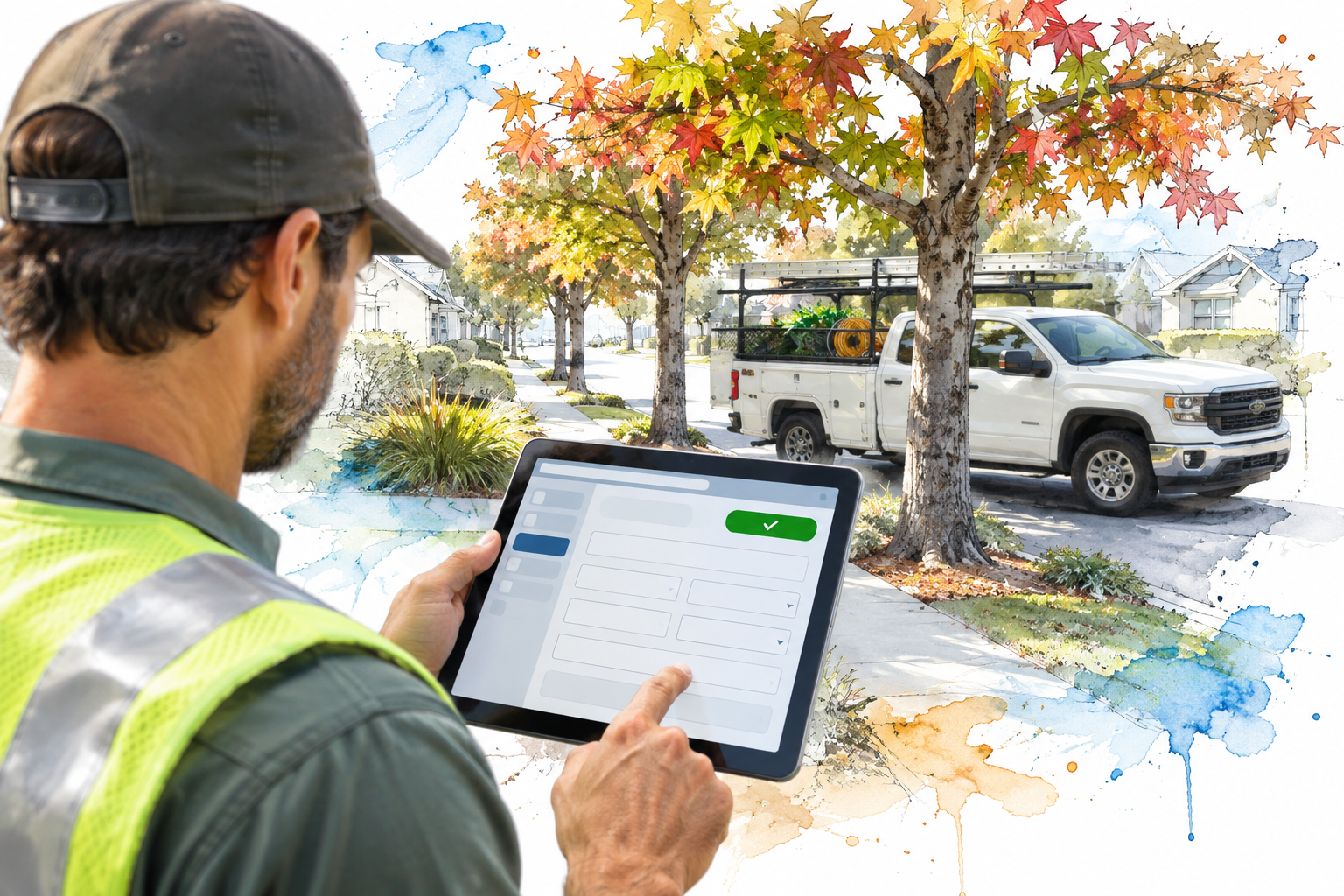
Who this affects, and from when
This applies to anyone in California hiring a licensed contractor, which in our service area means homeowners, HOA boards, and small commercial property owners in San Jose, Saratoga, Los Gatos, Monte Sereno, Campbell and the surrounding cities.
The date that matters is January 1, 2027. Unless a bill says otherwise, new California laws take effect on January 1, 2027, and SB 342 is on that list.
The owners most affected are the ones running longer projects. Tree and landscape work in the South Bay often stretches across months by design:
- Oak pruning is held for the July through October dry window, while deciduous structural pruning waits for January through March.
- A landscape installation may be phased, with drainage and grading in fall and planting the following spring.
- Permit review for a protected or heritage tree in San Jose can add weeks before anyone touches the tree.
A project that spans a license renewal date is exactly the scenario SB 342 addresses. The longer your timeline, the more it is worth a quick re-check between phases.
How I would verify a license before signing
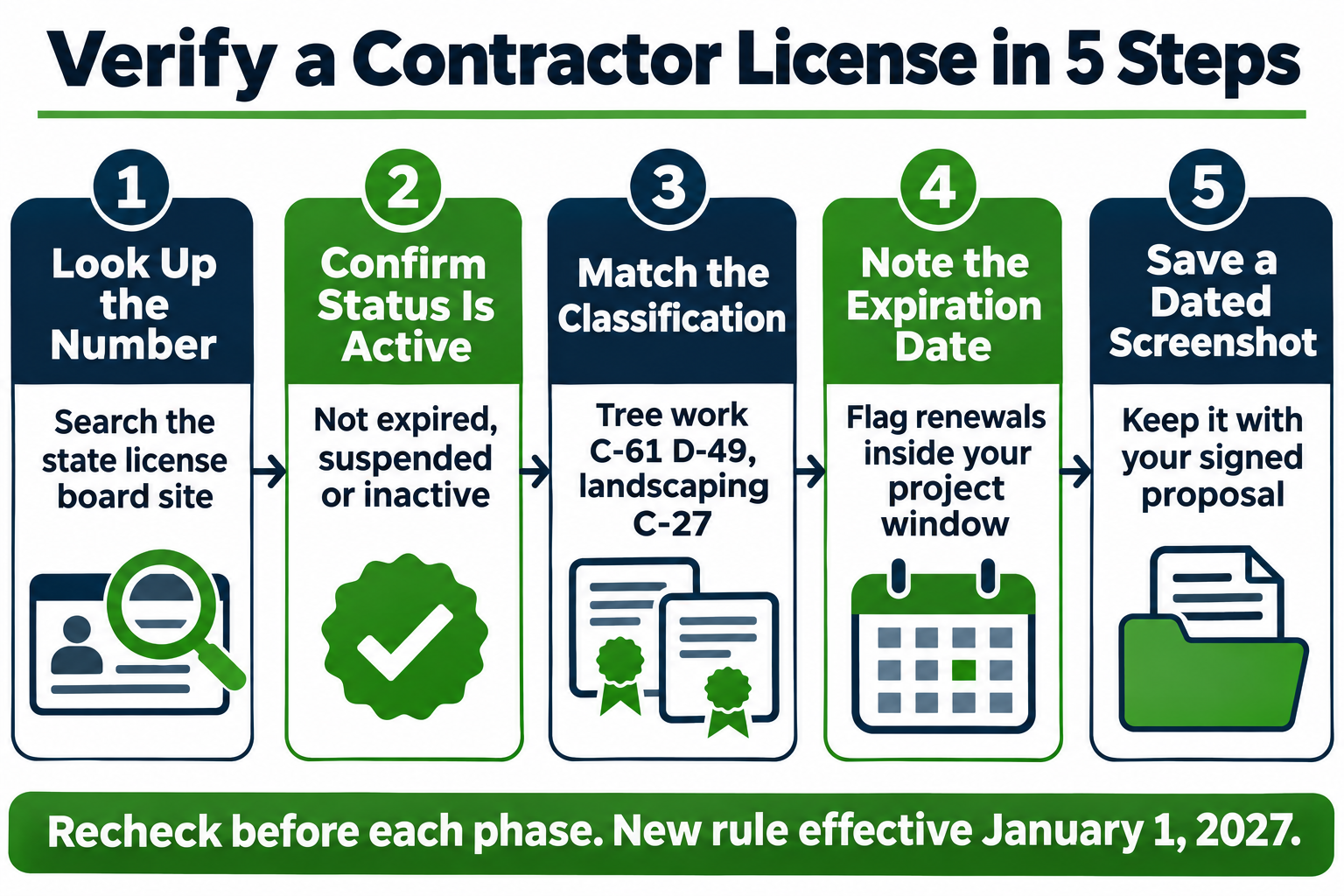
You can do this yourself in a couple of minutes, and I would rather you did. Use the CSLB license lookup and search by license number or business name.
Four things to look at:
- Status. It should read active, not expired, suspended or inactive.
- Classifications. Tree work falls under C-61/D-49. Landscaping falls under C-27. A company doing both should carry both.
- Workers’ compensation and bond. Both should show current.
- The expiration date. If it falls inside your project window, note it and check again later.
Then save what you found. A dated screenshot of the lookup page, kept with your signed proposal, is the cheapest record you will ever create.
Classification matters more than people expect on our kind of work. If your project pairs crown reduction on a valley oak with a French drain and a new drip system, that is two license classifications and a licensed applicator for any herbicide involved. Poison oak that keeps returning every spring is a good example, because the treatment sequence depends on a California Qualified Applicators License, which is a separate credential from the CSLB license entirely.
The verification routine, start to finish
This is the sequence I would follow on any project that runs longer than a single visit.
What I would put in the contract itself
Because the remedy after the fact is narrower now, the paperwork up front does more work. None of this is unusual to ask for, and any established company will hand it over without hesitation.
- The license number and classifications printed on the proposal, not just on a truck door.
- A phase breakdown with dates, so it is clear which work happened when.
- Current certificates of insurance and workers’ compensation, sent to you directly.
- Written scope naming species and the reason for the work, for example thinning a Chinese pistache for structure rather than a vague line item for trimming.
That last one protects you in a way licensing law never will. Vague scope is how a homeowner in Saratoga ends up with laurels sheared into hedges year after year, which is a horticultural problem, not a legal one. If that has already happened on your property, a sheared or topped tree can sometimes recover with several seasons of corrective pruning.
And if you are simply waiting on paperwork, that is a different issue. Here is how long a tree estimate usually takes and why.
Frequently Asked Questions About SB 342 and Contractor Licensing
Does SB 342 apply to a contract I signed in 2026?
The law takes effect January 1, 2027. How it applies to an existing contract or a pending dispute is a question for your attorney, not for me. If you have money at stake, get that reviewed before the date passes.
Can I still get everything back if a license lapses mid-project?
Not in the same way. Starting January 1, 2027, a contractor who was licensed when the contract was executed can keep compensation for the work performed while licensed, and has to disgorge only the compensation for work performed while unlicensed.
What license classifications should a tree and landscape company carry in Santa Clara County?
C-61/D-49 covers tree service and C-27 covers landscaping. If your project involves both pruning and installation work such as grading, a French drain or planting, you want both classifications held by the same license, not two separate companies pointing at each other.
Does a tree removal permit have anything to do with the license?
They are separate. San Jose and the surrounding cities regulate protected, heritage and street trees independently of CSLB licensing, and pruning a street tree in the park strip can require approval just like removal does. Check both before any cutting starts.
Do I have to pay for an assessment just to get a price?
No. Photo quotes and on-site estimates are free. The $250 Level 1 Arborist Assessment is a different thing, a formal diagnosis for a tree that is declining, infested or structurally questionable, and it is credited toward the work if you move forward.
Planning tree or landscape work that crosses into 2027?
If your project in San Jose, Willow Glen, Los Gatos or Saratoga will run across the winter and into the new year, it is a reasonable time to look at licensing, scope and phasing together rather than one at a time. We keep an active CSLB license in both tree service and landscaping, and every project here is guided by a Board-Certified Master Arborist. If you would like to talk it through, we are at (408) 422-1313 or sanjosetree.com.