 Skip to content

Direct Answer: The thin line running from the pole to your house is the service drop, and clearing vegetation around it falls to the property owner. The heavier lines along the street are PG&E’s to clear.
You walk out to the driveway, look up, and there it is. A branch resting right on the wire that feeds your house, and no clear idea whether that is PG&E’s problem, the city’s problem, or a bill headed your way.
Here is the part most homeowners never get told: the wire matters more than the tree. The line running from the pole to the side of your house is a completely different animal from the heavy lines strung along the street, and that single difference decides who shows up and who pays.
I also want to take the pressure off one common move. A lot of people in Willow Glen and Almaden Valley stop everything and wait on the utility before they spend a dollar. That wait is reasonable, but the utility is answering a narrow question that is not the one keeping you up at night.
A Tree Near Power Lines in San Jose Starts With One Question: Which Wire Is It?
Go stand in your driveway and trace the wire with your eyes. You are looking for where it starts and where it ends.
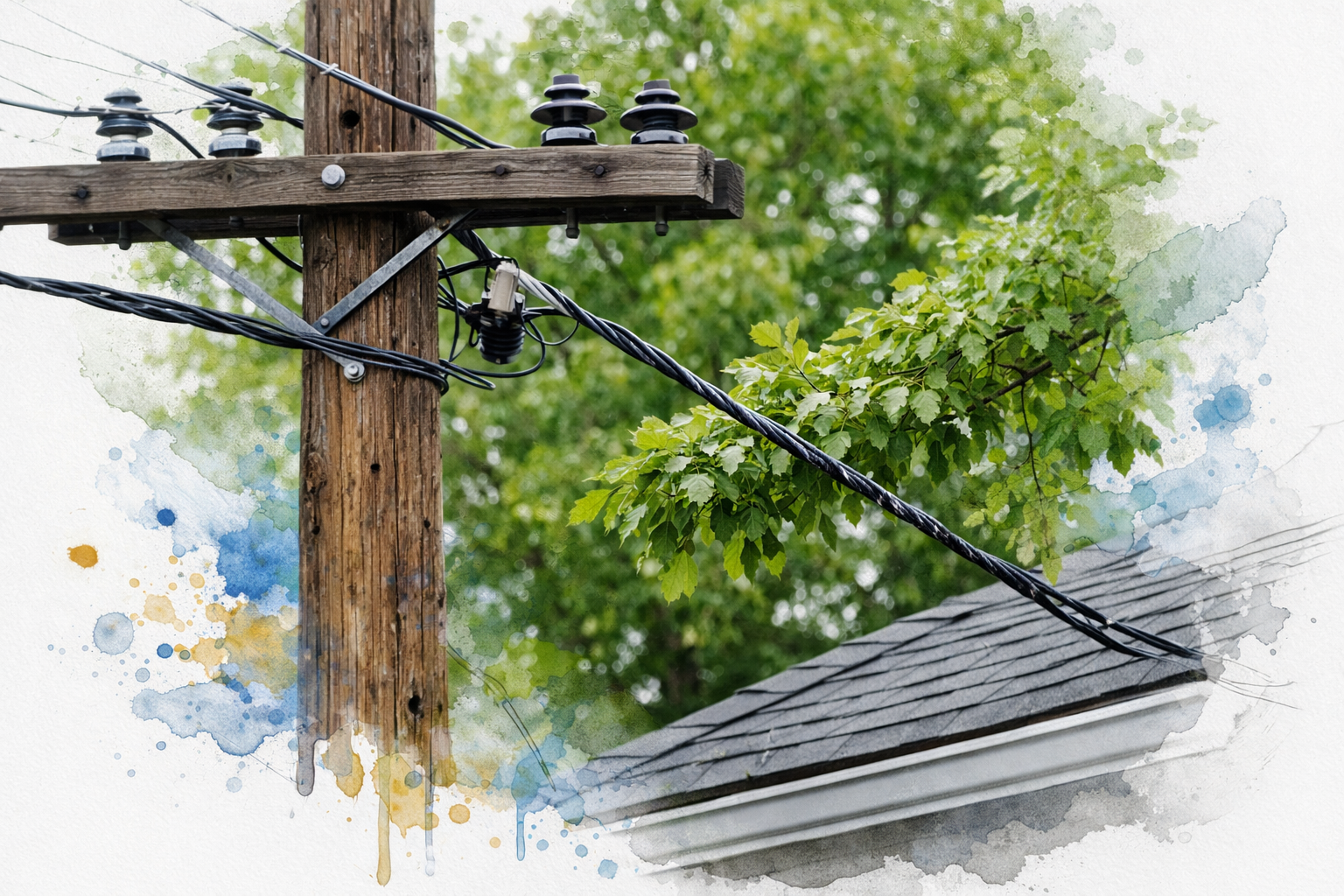
If it runs from a pole directly to a mast or bracket on your house, that is your service drop. It is usually thinner than the lines on the street, often a twisted bundle, and it serves one building: yours.
PG&E’s published vegetation management material is clear that property owners are responsible for keeping service drop wires clear of vegetation and of dead or hazardous trees. You can read the utility’s own breakdown on the PG&E vegetation management page.
If instead the wire runs pole to pole down the block, usually mounted on crossarms above everything else, that is a distribution line. PG&E works on clearance around those year round, with published minimums of roughly 18 inches in normal areas and about 4 feet in designated high fire threat districts. Transmission lines on steel towers carry wider clearances, roughly 4 to 15 feet depending on voltage.
One hard rule either way. Never put a ladder, a pole saw, or your own hands anywhere near any of it. Service drops carry enough current to kill, and I have never met a branch worth that risk.
Three Kinds of Wire and Who Keeps Them Clear
This is the chart I wish every homeowner had before the first phone call. Identify the wire, and most of the confusion sorts itself out.
| Type of line | How to spot it | Who handles vegetation clearance |
|---|---|---|
| Service drop | Runs from a pole straight to a mast or bracket on your house, thinner than the street lines, often twisted together | The property owner. PG&E’s material puts clearing vegetation and dead or hazardous trees around the service drop on you. |
| Distribution line | Heavier lines running pole to pole down the street, usually on crossarms above the service drops | PG&E, working year round. Published minimums run about 18 inches in normal areas and roughly 4 feet in high fire threat districts. |
| Transmission line | Very large conductors carried on steel towers with long spans between them | PG&E. Clearance distances run roughly 4 to 15 feet depending on voltage. |
Why Waiting on the Utility Does Not Answer Your Real Question
Several homeowners a month tell me the same thing: they put in a request with the utility and they are holding off on anything else until someone comes out. That is a fair instinct and nobody should be rushed into paying for an opinion.
But it helps to know what each party is actually looking at.
- The utility crew is answering one question: is there wood too close to our equipment? They measure clearance, they cut what is in the way, and they move to the next address.
- An arborist is answering a different question: is this tree sound? That means the root collar, the trunk, the attachment points, the lean, and how the canopy will carry wind load in a February storm.
Those two answers can point in opposite directions. I have seen trees get clean clearance pruning from a line crew while a significant defect sat untouched at the base, because the base was never the crew’s job.
An independent read on the tree stands on its own no matter what the utility decides. If the utility prunes, you still want to know whether what is left is stable. If the utility says the wire is their line and not your concern, you still have a tree leaning over your roof.
The Free First Step: Send Photos Before You Spend Anything
The single most common question we field is some version of “can I just send pictures first to get an idea?” Yes. And good photos answer more than people expect.
Often we can tell from images alone whether something needs eyes on site this week, this season, or not at all.
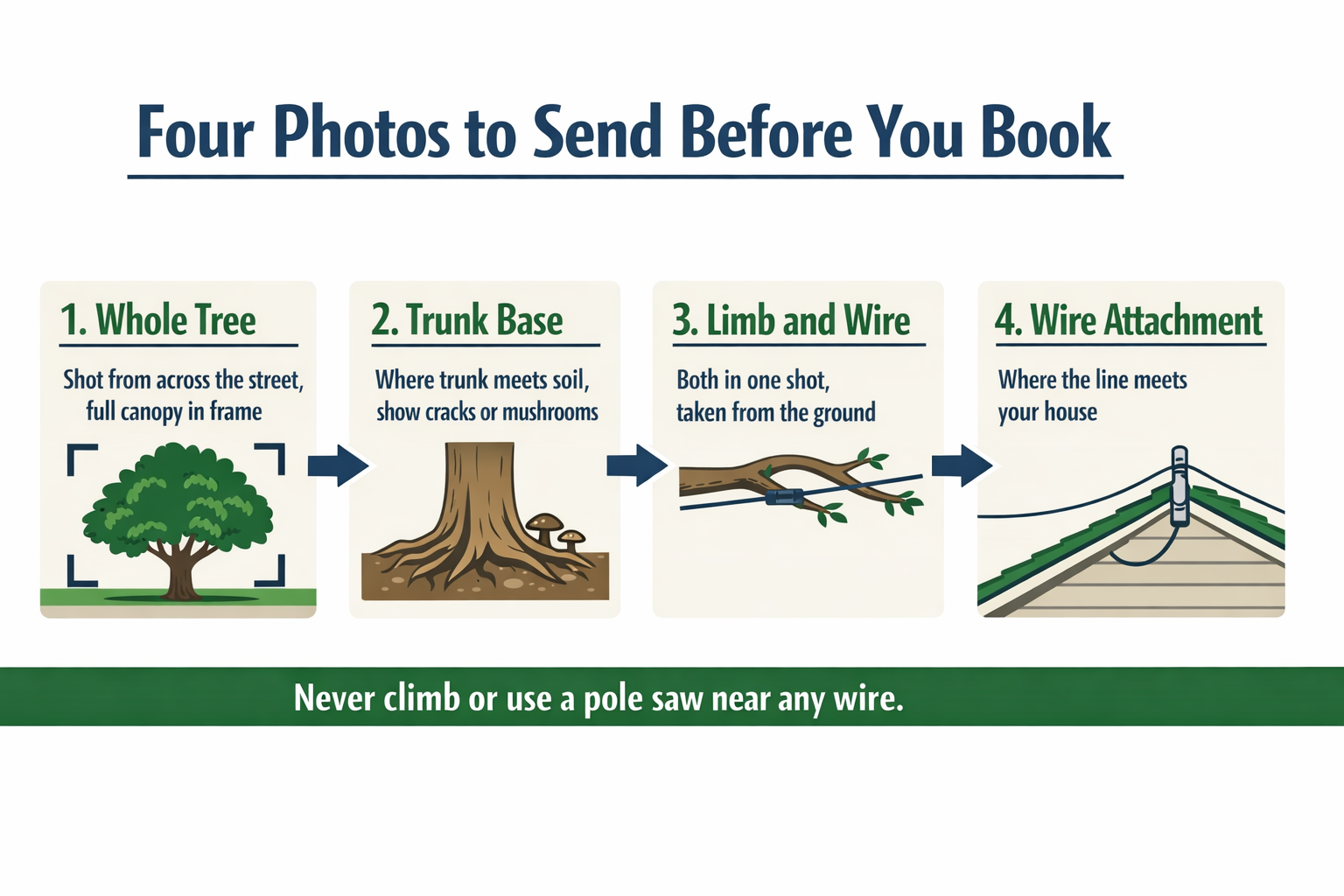
Photos that actually help:
- The whole tree from across the street, so the full canopy and the lean are in frame
- The base of the trunk where it meets the soil, including any mushrooms, cracks, or soft bark
- The limb and the wire together, shot from the ground, far enough back to show the gap
- Where the wire attaches to your house, so we can confirm it is a service drop
Photos that tell us almost nothing:
- A single leaf held up to the camera with no tree behind it
- Blurry zoom shots taken straight into the sun
- Tight crops that cut off the trunk and the ground
If a site visit does make sense, on site arborist consultations in San Jose generally land in the low hundreds of dollars depending on scope, and it is always worth asking whether that fee gets credited toward the work. We break down when a tree visit is free and when it comes with a fee in more detail, and there is a separate piece on what a photo can and cannot tell an arborist.
Four Photos That Answer Most Questions
Before you book anything, these four shots give an arborist enough to tell you whether this is urgent.
Clearance Pruning and Tree Care Are Not the Same Craft
This is where trees get wrecked, and it is worth understanding before anyone starts cutting.
Clearance work has one goal: keep wood away from a conductor. Structural work has a different goal: keep the canopy balanced so it carries wind load without tearing itself apart.
A tree cut hard on the wire side and left heavy on the yard side goes into a wet winter lopsided. We saw that pattern on a redwood where earlier crews had stripped the interior and left the outer edges loaded, which put all the weight at the branch tips. The limb failures stopped once the canopy was rebalanced. There is more on that in our piece on redwoods dropping limbs after a bad pruning job.
The real alternatives to hacking one side are crown reduction, shortening limbs back to proper lateral branches, and selective thinning, removing specific branches to reduce sail without gutting the interior. Topping is never one of them. It forces weak, fast growing shoots that are more likely to fail in wind than what you started with.
Timing matters too. Most deciduous trees here prune best in late winter, roughly January through March. California oaks are the exception and should be pruned in the July through October window, when they are dormant and wet weather pathogens are less active.
Balance work on the yard side of a tree is a normal scheduled project. It is not an emergency.
Check Jurisdiction Before You Schedule Anything
Two San Jose rules catch people off guard, and both are easy to check in advance.
If your tree sits in the park strip between the sidewalk and the curb, the city has a say in pruning, not just removal, and penalties for unpermitted work on street trees run into the thousands. And on private property, San Jose’s Tree Removal Controls Ordinance covers trees measuring 38 inches or more in circumference at 4.5 feet above the ground, which is smaller than most people assume.
Foothill addresses around Saratoga and Los Gatos sit in higher fire threat designations, which means wider required clearance around utility lines than a flat block in Campbell would see.
A quick look at the city’s permit page before you schedule is usually all it takes. We also walk through what triggers a permit on your own property if you want the detail.
What to Listen For When Someone Finally Looks at the Tree
If you suspect a tree near a wire is about to be sold to you as a removal, listen for restraint.
The arborists worth keeping around are the ones who look at everything and then tell you which parts do not need work. One homeowner who has used us yearly for six years put it this way: “They’re super knowledgeable and never push work that doesn’t need to be done.”
Proper assessment before action, every time. The goal is safety, health, and longevity, and in most cases that is reached without taking the tree down.
Frequently Asked Questions About Trees and Power Lines in San Jose
Will PG&E trim the branch touching the wire to my house?
Usually not. PG&E’s published material puts vegetation around service drop wires on the property owner, including removing dead or hazardous trees near them. The utility’s year round clearance program focuses on its distribution and transmission lines. Call them to confirm your specific situation, but plan on the service drop being yours.
Can I cut the branch myself if I use a pole saw from the ground?
No. Service drops carry enough current to be fatal, and a pole saw does not change that. Any pruning within striking distance of an energized line needs trained crews with the right equipment and clearances.
The utility already pruned it. Do I still need an arborist to look?
That depends on what you are worried about. A line crew answers whether wood is too close to equipment. They are not evaluating root collar decay, trunk defects, or whether the remaining canopy is balanced for winter wind. If the tree leans toward your house or you have noticed deadwood, a separate look is worth it.
How fast does this need to happen?
Most of these situations are not emergencies. If a limb is actively resting on a line, arcing, smoking, or down after a storm, that is a utility emergency call and you should stay well back. Otherwise, sending photos this week and scheduling work before the winter rains is a reasonable pace.
Does a tree near a power line automatically need to be removed?
No, and removal should rarely be the first conversation. Crown reduction and selective thinning solve most conflicts while keeping a mature tree that adds real value in neighborhoods like Willow Glen and Almaden Valley. Removal belongs on the table when a tree has lost structural integrity or has advanced decay that cannot be stabilized.
Not Sure Which Wire You Are Looking At?
If you are in San Jose, Los Gatos, Saratoga, or Campbell and you have a branch sitting against a line, photos are a fine place to start and they cost nothing. San Jose Tree Service & Landscaping has been BBB accredited since 2013, holds CSLB license #985639 in both tree service and landscaping, and every assessment is led by a Board Certified Master Arborist. You can reach us at (408) 422-1313 or sanjosetreemaintenance.com when you are ready for a second set of eyes.
