 Skip to content

Direct Answer: Liquidambars shed limbs in late summer because long horizontal branches carry heavy end weight on weak unions while the tree is moisture stressed. It is common species behavior, not proof the tree is dying.
It is a hot Saturday in late August. No wind, no storm, nothing unusual. Then a limb the size of a small tree comes off your liquidambar and lands across the sidewalk.
I hear this every year from homeowners in Willow Glen, Almaden Valley, and the older tracts off Meridian. One homeowner put it plainly after a branch blocked their sidewalk: they already knew this type of tree is prone to breaking in late summer and fall, because it had happened to them before.
So here is what I want you to walk away with. A liquidambar shedding a limb in August or September is a known pattern in this species, and it is not automatic proof the tree is failing. But there is a real difference between normal species behavior and a tree with a structural problem, and that difference is worth knowing before anyone picks up a chainsaw.
Why a liquidambar drops branches on a windless day
Liquidambar styraciflua, the American sweetgum, is planted all over San Jose. It grows fast, colors beautifully in fall, and builds a canopy shape that works against it as it ages.
Three things stack up by late summer:
- Long horizontal limbs with heavy ends. Liquidambars push growth outward, so the leaves, seed balls, and small wood all sit far from the trunk. That is a long lever arm on a single attachment point.
- Weak branch unions. Many of these trees carry tight, narrow forks with included bark, where the branch is pinched into the trunk instead of truly grafted to it. Old heading cuts make this worse.
- Moisture stress. By August, a tree in our dry stretch has been pulling water hard for months. Cell walls lose some flexibility, and wood that would have bent in March simply lets go.
Add a canopy carrying more leaf mass than the union was ever built to hold, and you get a quiet failure on a calm day. No wind required.
This is the same mechanical story I describe when a redwood drops limbs after a bad pruning job. Different species, same physics.
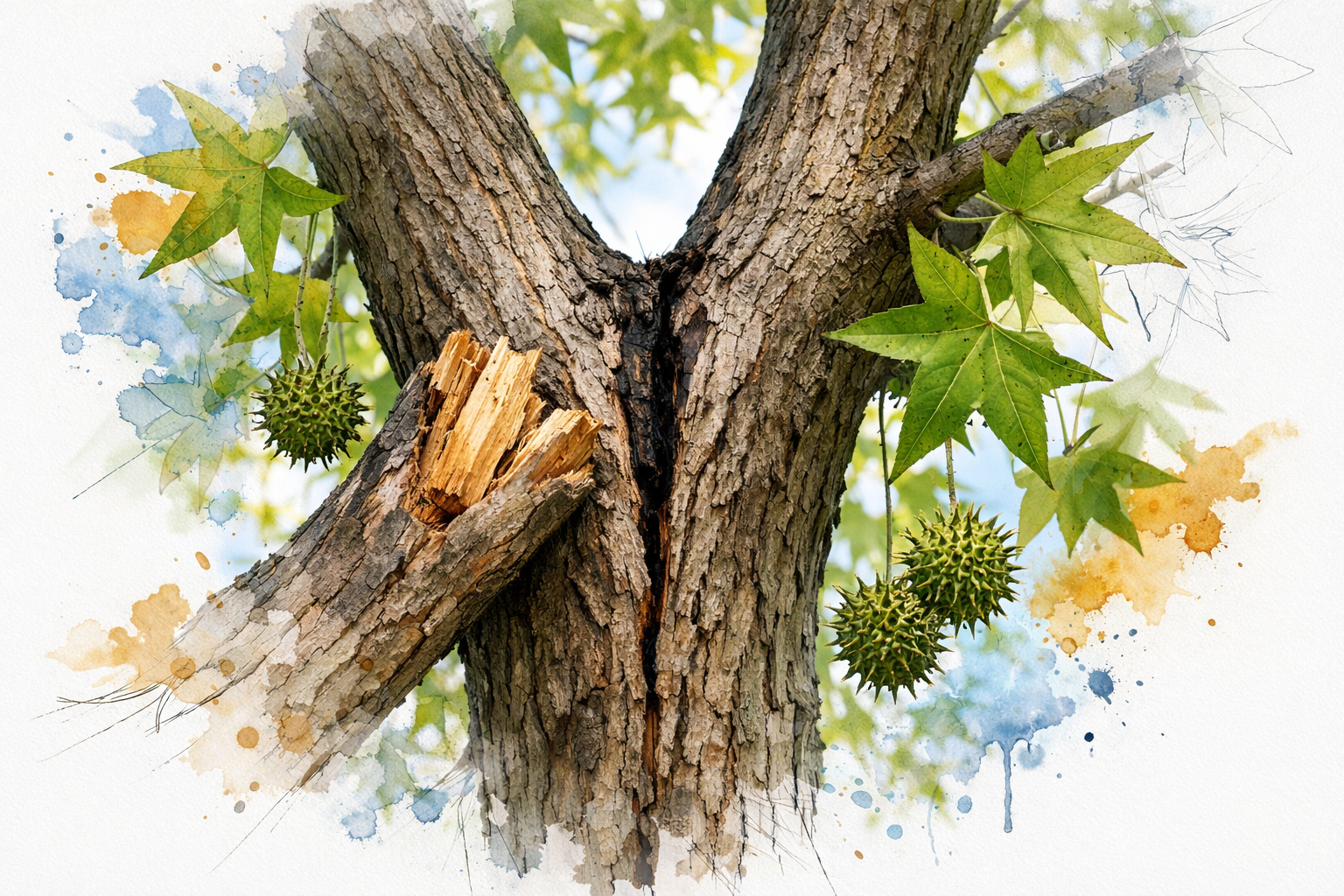
Normal species behavior versus a tree with a real problem
Losing one limb does not put a liquidambar on the removal list. What matters is where the break happened, what the wood looked like inside, and what the rest of the canopy is doing.
When I look at a fresh break, I want to see clean, light-colored wood with long torn fibers. That tells me a sound branch was simply overloaded.
What concerns me more:
- Dark, crumbly, or hollow wood at the break point
- A cavity or decay pocket behind an old pruning stub
- Multiple failures from the same area of the canopy in two or three seasons
- Deadwood concentrated on one side rather than scattered through the interior
- Bark cracking or bulging where a limb meets the trunk
- Mushrooms or conks at the root collar, which is a separate conversation entirely
A tree can be structurally fine and still drop a branch. A tree can also look full and green while decay runs through a main scaffold limb. Those two trees need very different plans, and you cannot tell which one you have from the ground in thirty seconds.
Reading the break: what each sign usually means
This is roughly how I sort what I see when a homeowner shows me the limb that came down.
| What you are seeing | What it usually points to | Reasonable next step |
|---|---|---|
| Clean pale wood, long torn fibers, limb was heavy at the tip | Overload on sound wood, common in late summer | End weight reduction on similar limbs |
| Dark, soft, or hollow center at the break | Internal decay in that limb | Assessment of nearby unions and the trunk |
| Break at a tight fork with dark seam between stems | Included bark union failure | Evaluate remaining codominant stems; cabling may be an option |
| Break right above an old flat-cut stub | Weak regrowth from a past topping or heading cut | Corrective pruning over several visits |
| Second or third limb from the same side in a few years | Pattern, not coincidence | Full structural assessment of the canopy |
| Lots of fine deadwood throughout the interior | Normal shading-out plus accumulated neglect | Deadwood removal and selective thinning |
The pruning history matters more than the weather
Most liquidambars in older San Jose yards have already been cut badly at least once. That history is usually the real reason a limb came down.
Topping and heading cuts, where big limbs get chopped back to a stub, do three things at once. They take away the leaf area the tree feeds itself with, they open wounds too large to seal cleanly, and they trigger a flush of fast shoots attached only to the outer layer of wood.
Those shoots grow dense and bushy at the branch tips. Five or ten years later, you have a heavy mop of growth hanging off a decaying stub. One homeowner described the same failure chain on another tree: pruned only on the inside while the outer edges were left heavy, until the tips loaded up and broke in wind.
Pruning that actually lowers risk looks different:
- Reducing end weight on the longest limbs by cutting back to a lateral branch that can take over
- Removing deadwood so there is less loose material to fall
- Selective thinning so wind moves through the canopy instead of pushing against a solid wall of leaves
- Leaving enough live canopy that the tree can keep feeding itself
The goal is safety first without destroying the tree. A liquidambar with a rough pruning history can often be brought back toward reasonable structure over two or three visits across a few years. That is slower than a chainsaw, and it is usually the honest answer. If your tree has already been sheared hard, this piece on whether a topped tree can recover covers what that process looks like.
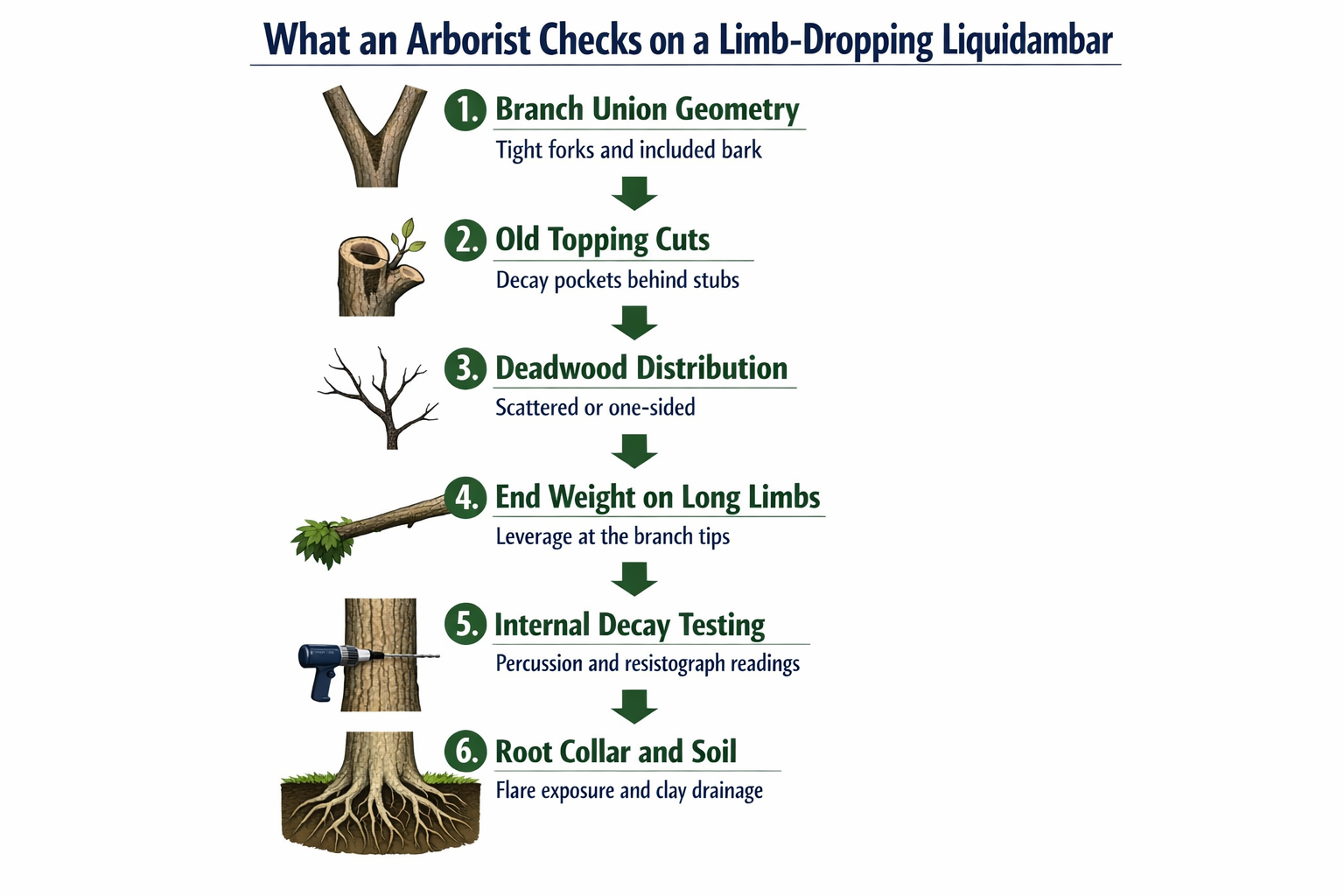
What an arborist actually checks on a limb-dropping liquidambar
An assessment is not a quick glance at the canopy. Here is the sequence I work through on a tree that has already dropped a limb.
Why fall is the better window, and what the rain does next
The same long limbs that fail in dry heat are the ones that load up with rain weight later. Our clay soil holds water, root plates soften, and an end-heavy canopy turns into the tree’s biggest liability during a storm week.
NOAA issued an El Nino advisory in mid-2026 with a strong chance of a significant event through the winter. I am not telling you that to rush you. I am telling you because the work is simply better done in calm weather.
Structural pruning in October or November means we can take our time, make good reduction cuts, and set the canopy up for the season. Storm response in January means working around saturated ground, limited access, and whatever already broke.
One caller summed up the mindset well: they wanted it handled before the rain season started. That is the right instinct, and it is why our calendar fills through fall across San Jose, Campbell, and Los Gatos. Booking a few weeks out is normal during that stretch.
Is it even your tree? Park strip versus private lot
Liquidambar is one of San Jose’s most widely planted street tree species, and a lot of them sit in the park strip between the sidewalk and the curb.
Here is the quick way to tell. If the trunk is in that strip, or between the sidewalk and the street, the city almost certainly has jurisdiction, and that covers pruning, not just removal. If the trunk sits inside your property line behind the sidewalk, it is your tree, subject to the city’s own rules.
On private property, a tree hits ordinance size at 38 inches of trunk circumference measured 4.5 feet above the ground, per the City of San Jose Planning Division’s permit requirements. Heritage trees are handled separately. Those rules can apply even when a tree is dead or clearly declining, which surprises people.
If you are not sure which category your tree falls into, our guide to what triggers an ordinance-size tree permit walks through it. Worth checking before you schedule a trim.
What you are actually buying with an assessment
The objection I hear most is that an assessment fee feels like paying a toll just to be told the tree has to come down. Fair concern. So let me spell out what gets examined and what you walk away knowing.
On a limb-dropping liquidambar, the inspection covers branch union geometry and included bark, old topping cuts and the decay behind them, how deadwood is distributed, end weight on the longest limbs, the root collar, and the soil condition in the root zone.
Where visual inspection cannot confirm what is inside the wood, we use percussion testing and resistograph readings to map the extent of decay. Decay in a mature liquidambar is common. The real questions are how much, where it sits, and whether it is in a part of the tree that carries load.
You leave with a condition picture, a priority order, and a plan that may span more than one visit. Many of those conversations end with pruning and monitoring, not removal. If a weak fork is the issue, cabling and bracing is sometimes a better answer than cutting.
Fees vary by complexity, and an on-site arborist consultation in Santa Clara County commonly runs in the low hundreds. In our case that fee is credited toward the work if you move forward, and a quick photo review can give you a rough read first. The difference between the two is explained in when a tree visit is free and when it comes with a fee.
A species with a reputation still deserves a diagnosis
Liquidambar sits alongside Coast Live Oak, sycamore, redwood, and Chinese pistache on the short list of species I prune constantly around here. Each one fails in its own way, and each one needs a species-specific approach rather than a standard trim.
That is the part I want anxious tree owners to hear. A reputation for dropping limbs is a reason to assess the tree carefully, not a reason to assume the worst.
As one longtime customer, Kathryn P., put it: “They’re super knowledgeable and never push work that doesn’t need to be done.” Proper assessment before action. The goal is safety, health, and longevity.
Frequently Asked Questions About Liquidambars Dropping Branches
My liquidambar dropped a big branch. Does the whole tree need to come out?
Usually not. One failure on an end-heavy limb is common in this species during late summer. Removal becomes the conversation when there is advanced decay at the root collar or in main scaffold limbs, or when the same section of canopy keeps failing year after year.
The branch fell across the public sidewalk. Who clears it?
If it is a street tree in the park strip, the city handles it. One San Jose homeowner reported calling the city’s tree emergency line early on a Saturday and having a crew out within about an hour to clear the branch. If the tree is on your private property, the cleanup is yours.
When should liquidambars be pruned in San Jose?
Late fall through late winter works well for structural pruning, when the leaves are off and the branch architecture is visible. Doing it in October or November also gets ahead of the rain. Liquidambars do not carry the strict summer-only restriction that California oaks do.
Can you tell what is wrong from photos?
Photos help a lot for a preliminary read, especially if you can capture the break point, the whole tree, and the base. For questions about internal decay or union strength, we need to be on site with testing equipment. Photos narrow things down; they do not replace a hands-on look.
Will thinning the canopy stop limbs from breaking?
Selective thinning helps by letting wind pass through instead of pushing against a solid canopy, but reducing end weight on the longest limbs does more of the work. Over-thinning the interior while leaving heavy tips is exactly the mistake that causes breaks later.
Wondering whether your liquidambar is stressed or structurally compromised?
We work on mature canopies throughout San Jose, including Willow Glen and Almaden Valley, along with Los Gatos and Campbell. If you want a read on a tree that has already dropped a limb, you can reach us at (408) 422-1313 or send photos through sanjosetreemaintenance.com to start with a preliminary look.
