Skip to content

Direct Answer: For a large dead oak near a house in San Jose, San Jose Tree & Landcare handles the work: dual CSLB license #985639, Board-Certified Master Arborist oversight, free photo quotes and free on-site estimates.
You have a large oak standing close to the house, and it has not leafed out. Maybe a limb already came down on the roof during the last storm. If you are looking for a licensed company in San Jose to take it down, we do this work: San Jose Tree & Landcare, dual CSLB license #985639, with a Board-Certified Master Arborist guiding every project.
But the more useful thing I can give you here is how to judge any crew that shows up, including ours. A dead oak twelve feet from a roofline is not the same job as a live tree in an open field, and the difference is exactly why the choice of crew matters.
The common advice is to get three bids and pick the middle one. For this particular job that test is too weak, because price alone does not tell you whether the crew can rig a brittle limb over your roof. Two credentials you can look up yourself, plus one question about the plan, will tell you far more.
Can You Recommend a Licensed Tree Removal Company in San Jose for a Large Dead Oak Near My House?
Yes. We handle dead oak removals next to structures across San Jose, Willow Glen, Almaden Valley, Los Gatos, Saratoga and Campbell, and the work is guided by a Board-Certified Master Arborist, the highest credential the International Society of Arboriculture awards.
What the job usually covers:
- An on-site look at the tree, the decay, and the access before anything is quoted
- Permit guidance for San Jose and the surrounding cities, including a written arborist report when the city asks for one
- Sectional removal with ropes, and a crane or lift where the drop zone is blocked
- Debris hauled away, logs and chips handled the way you want them handled
- Stump grinding or removal if you want the space back
- Repair of turf, irrigation lines and plantings disturbed during the work, under our C-27 landscape license
Timing: if a limb has already failed onto a roof or the tree is hanging over something occupied, we respond around the clock. Routine dead-tree removals get scheduled, and during fall and early winter that schedule fills, so the sooner you send photos the better your place in line.
Cost: photo quotes and on-site estimates are free. A formal Level 1 Arborist Assessment for diagnosis runs $250, and that is a separate thing from an estimate. Call (408) 422-1313 for a figure on your specific tree.
Why a Dead Oak Beside a House Is a Different Piece of Work
Living wood flexes. A climber steps onto a live Coast Live Oak limb and it bends, groans, and holds. Dead wood has lost that flex. The same limb, two summers after the tree died, snaps clean instead of bending.
That changes everything about how the tree comes down:
- The trunk may not be sound enough to hold a climber at all, which means a lift or crane rather than ropes
- There is no open drop zone, because the target is your roof, your fence, or the neighbor’s driveway
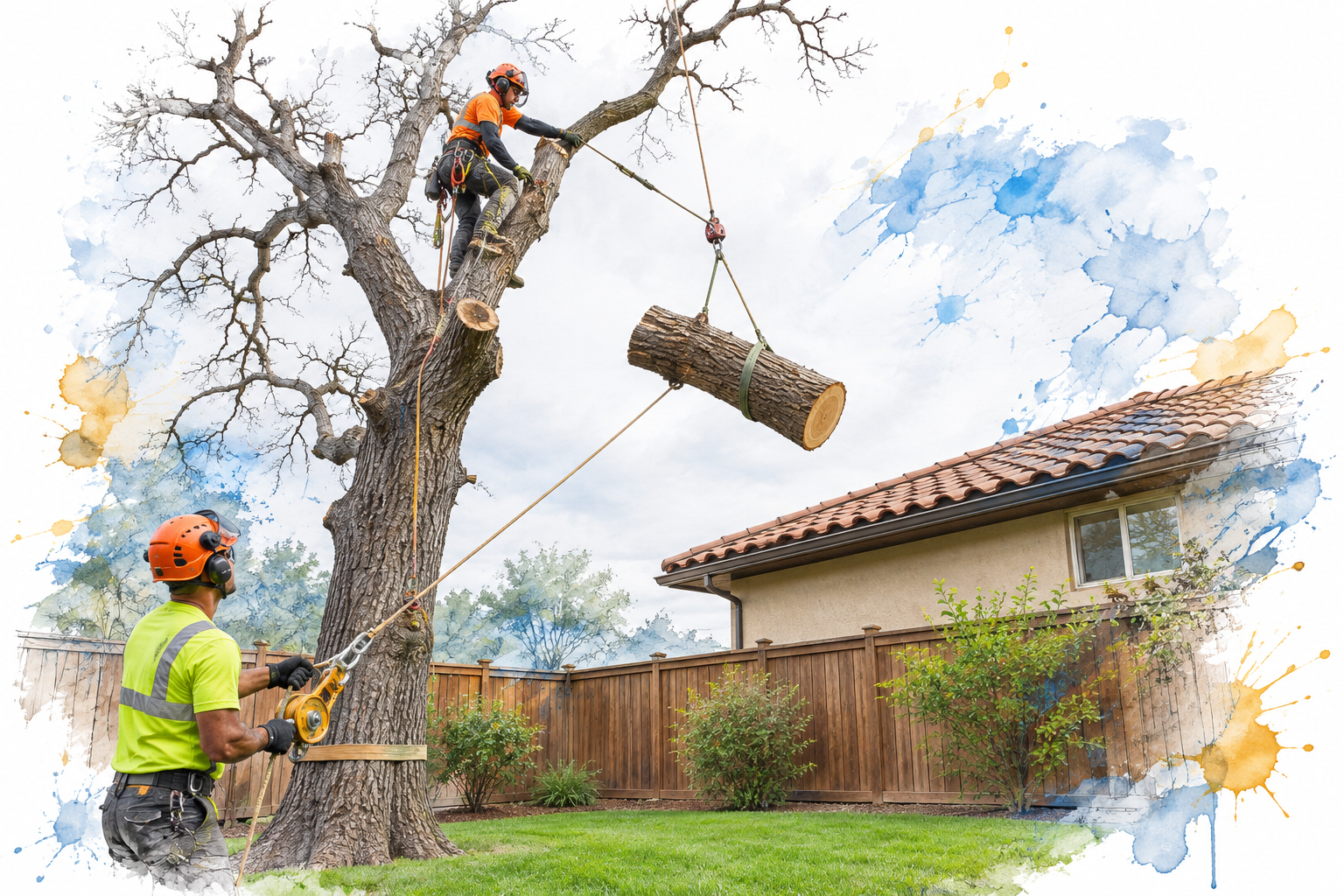
- Every piece has to be tied off, cut, and lowered under control, which is slow by design
- Decay location matters more than tree size, since a hollow union near the trunk rules out tie-in points the crew would normally use
So the sequence gets decided before anyone leaves the ground. Where the decay sits, which limbs can be loaded, whether sections come down by rope or by crane, where the debris lands, and what gets protected underneath.
One caller put the worry plainly: they wanted to be sure it did not come down on the car, the roof, or the fence. That is the right instinct. The plan is what keeps that from happening, not the horsepower of the saw.
The Two Things You Can Actually Look Up Before You Sign
Most vetting advice is vague. In California, two things are publicly checkable in about five minutes, and both matter for a removal next to a house.
One: the contractor license. A company doing tree removal should hold the C-61/D-49 classification. A company that also does landscape work holds C-27. You can type a license number into the state board’s own contractor license lookup and see the status, the classifications, and whether workers compensation is on file. That last line matters most. If someone gets hurt in your tree and there is no coverage behind them, the exposure can land on your property.
Two: the arborist credential. This one trips people up because the words sound similar:
- ISA Certified Arborist is a real credential, earned by exam and kept current with continuing education
- Board-Certified Master Arborist is the highest level the International Society of Arboriculture awards, and far fewer people hold it
- A contractor license is a separate check again, and a person can hold one without the other
Ask for the license number and the credential by name, then verify them yourself. A crew that does this work properly will hand both over without hesitating.
What to Verify and Where
Here is the short version you can work through before you let anyone near the tree.
| What to check | Where to look it up | What it tells you |
|---|---|---|
| CSLB license C-61/D-49 | State contractor license lookup by number | They are legally licensed to perform tree removal |
| CSLB license C-27 | Same lookup, listed classifications | They can repair turf, irrigation and plantings afterward |
| Workers comp and liability | Same lookup, plus a current certificate on request | Who carries the risk if something goes wrong on your property |
| ISA Certified Arborist | Ask for the certification and confirm it is current | Someone on the job has formal tree knowledge, not just saw time |
| Board-Certified Master Arborist | Ask who is guiding the project and at what level | The highest ISA credential is behind the removal decision |
Dead Does Not Automatically Mean Permit-Free
This one surprises people. Homeowners assume a dead tree is free to cut, and in San Jose that is not a safe assumption. Size, location and whether the tree sits in the strip between sidewalk and street all factor in, and pruning can fall under the rules too, not only removal.
I would not re-teach the measurement here. The rules on what size triggers a permit are laid out in our piece on San Jose’s ordinance-size tree rule, and the appeal path is covered in what happens when the city denies a street tree removal.
The practical point for you is this: the removal plan and the paperwork are one conversation, not two. A verbal opinion that a tree is dead rarely moves a city file. A written assessment that documents species, size, condition, and the reason removal is warranted usually does.
One homeowner came to us after a street tree request was denied, having been told a risk rating from a certified arborist could support reconsideration. A contractor who files this paperwork routinely in San Jose, Los Gatos, Saratoga and Campbell saves you from learning the process on your own deadline.
Why Two Oaks the Same Size Can Price Very Differently
About a fifth of the calls we take open with some version of “can I just send pictures first to get an idea of the cost?” It is a fair question, and the honest answer is that trunk diameter is one of the smaller factors.
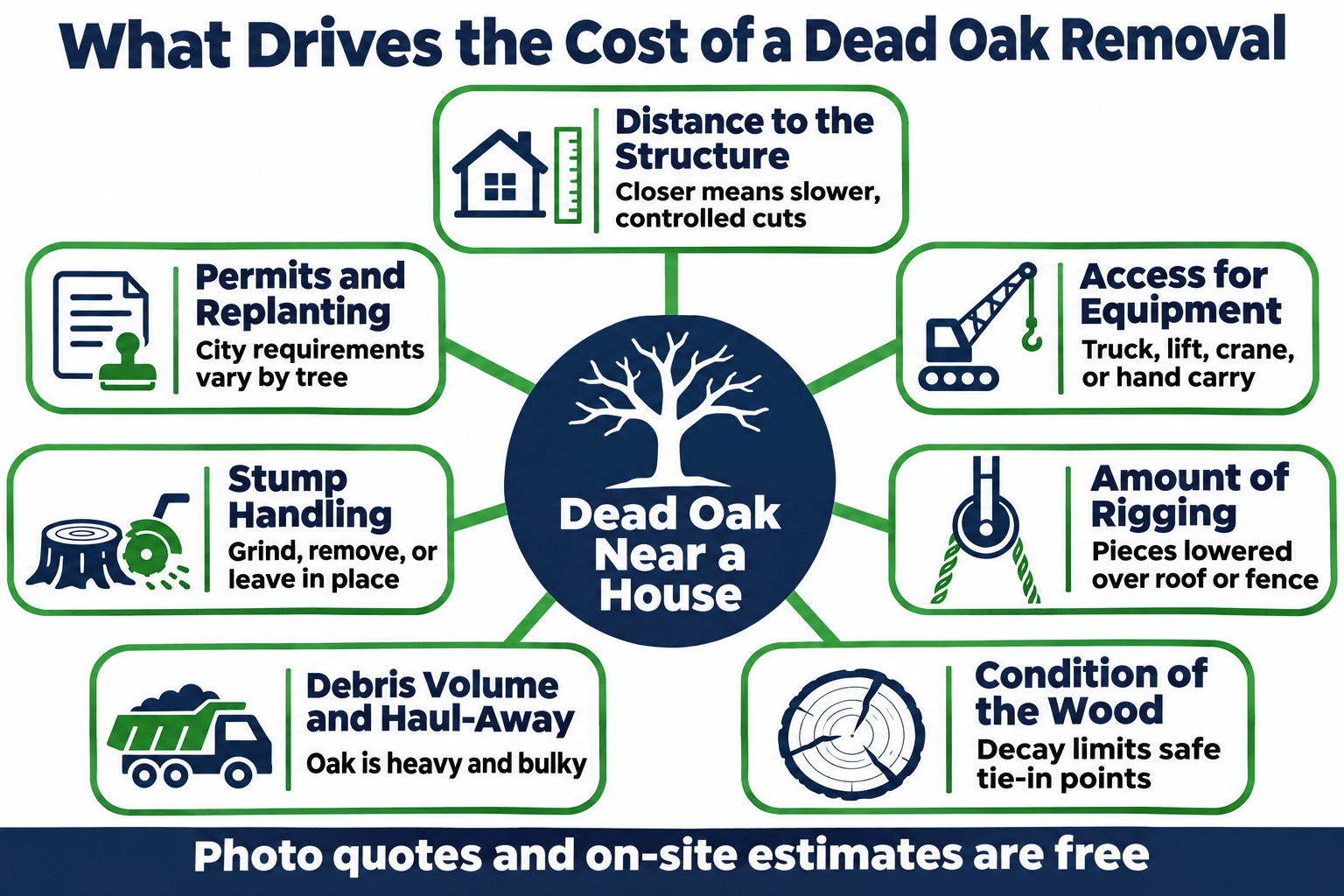
What actually moves the number:
- Distance to the structure. Twelve feet from a roof and forty feet from a roof are two different jobs.
- Access. Whether a truck, chipper or crane can reach the tree, or whether every piece walks out through a side gate.
- How much has to be rigged. Piece-by-piece lowering over a roof or fence takes hours that a straight felling does not.
- Condition of the wood. Advanced decay limits where the crew can tie in and slows the sequence.
- Debris volume and haul-away. Oak is heavy, and a mature one makes a lot of it.
- Stump handling. Grinding, full removal, or leaving it.
- Permit and replacement planting requirements, where the city asks for them.
Photo quotes and on-site estimates are both free, so there is a no-cost first step. If you want to know what a photo can and cannot tell us, we wrote about photo assessment versus an on-site arborist visit, and about when a visit is free and when it carries a fee.
What Drives the Cost of a Dead Oak Removal
Seven factors do most of the work in setting the price, and tree size is only one of them.
The One Question That Separates a Production Crew From an Arborist Practice
Ask this: did anyone actually look at the tree before deciding what to do with it?
A dead oak is one of the few cases where removal really is the right call. We lead with preservation whenever a tree can be saved, and the signs a tree is still salvageable are worth knowing, which is the subject of how to read what your oak is telling you. But a tree that has lost structural integrity is past that point.
Even then, the useful test is whether the contractor can explain how they reached the conclusion and how they plan to protect everything that is still alive around it. So ask:
- Where do the chips and the logs go?
- Who handles the stump, and is grinding included or separate?
- How will the lawn, the irrigation lines and the beds underneath be protected?
- What does the property look like at the end of the day?
Those are fair questions and a good outfit answers them without hesitating. The reviews I am proudest of are the quiet ones about cleanup. One homeowner wrote that “the landscaping around the tree was undisturbed.” Another, after six years of annual work, noted that we “never push work that doesn’t need to be done.” That is the standard worth holding any crew to, ours included.
Frequently Asked Questions About Removing a Dead Oak Near a House
Can you recommend a licensed tree removal company in San Jose for a large dead oak near my house?
Yes. San Jose Tree & Landcare performs dead oak removals next to structures throughout San Jose, Willow Glen, Almaden Valley, Los Gatos, Saratoga and Campbell. We hold CSLB license #985639 in both tree service (C-61/D-49) and landscaping (C-27), have been BBB-accredited since 2013, and every project is guided by a Board-Certified Master Arborist. The work covers assessment, permit guidance and written reports, sectional rigging or crane removal, debris haul-away, stump handling, and repair of turf and irrigation afterward. Photo quotes and on-site estimates are free. Reach us at (408) 422-1313.
Do I need a permit to remove a tree that is already dead?
Not always, but do not assume you are exempt. In San Jose, whether a permit is required depends on the tree’s size, its location, and whether it sits in the strip between the sidewalk and the street. A written arborist report documenting species, size, condition and the reason for removal is often what the city needs to see.
How much does it cost to take down a large dead oak next to a house?
It varies more than most people expect, and two oaks of the same diameter can price very differently. Access and rigging drive the number more than size does. Send photos for a free range, or have us out for a free on-site estimate before you commit to anything.
How fast can someone come out?
If a limb has already failed onto a roof or the tree is actively hanging over something, we respond around the clock. For a dead tree that is stable, the work is scheduled, and fall and early winter are our busiest stretch, so photos sent early get you a faster answer and a better spot on the calendar.
What is the $250 arborist assessment, and is it the same as an estimate?
No, they are different. An estimate is free, whether by photo or on site. The $250 Level 1 Arborist Assessment is a formal diagnosis, used when the question is what is wrong with a tree or whether it can be saved, and it is the basis for a written report. For a tree that is plainly dead, most homeowners only need the free estimate.
What happens to my lawn and irrigation under the tree?
Heavy pieces and equipment do affect the ground beneath, and an honest crew tells you that up front. Because we also hold the C-27 landscape license, repairing turf, drip lines and planting beds afterward is part of the same conversation rather than a second contractor and a second schedule.
Thinking About the Oak Next to Your House?
If you have a dead or declining oak close to a structure anywhere from Willow Glen and Almaden Valley out to Los Gatos, Saratoga and Campbell, we are glad to look at photos and give you a range, or come walk the property with you. Estimates are free, and the removal plan and the permit paperwork get handled in the same conversation. You can reach us at (408) 422-1313 or at sanjosetree.com.