 Skip to content

Direct Answer: If San Jose denies your street tree removal request, the usual next step is a written risk rating from an ISA Certified Arborist that documents the specific defect, giving the city something concrete to reconsider.
A homeowner called me this summer with a sequence that made no sense to him. On a Friday evening, a large branch tore off the liquidambar street tree in front of his house and landed across the sidewalk.
He called the city’s tree emergency line around 7:20 Saturday morning, and a crew showed up about an hour later and cleared it. So he requested the removal application, filled it out, and sent it back.
The letter that came back said the tree “does not appear to be in hazardous condition.” Fast emergency response, then a flat denial. I want to walk through why those two things are not a contradiction, and what actually moves the needle after a street tree removal is denied in San Jose.
Why a Denial Is Not the City Brushing You Off
The tree in the strip between your sidewalk and the curb, the park strip, sits in the public right of way. That means San Jose has a say in what happens to it, including pruning, not just removal.
It also means the city is making a decision about public property, and it uses a public standard to make it. That standard is hazard, and hazard is a higher bar than most homeowners expect.
Here is the gap that frustrates people. These are all real problems, and none of them meet a hazard standard on their own:
- Branches that drop repeatedly and have to be hauled off
- Leaves, gumballs, and sap that take weekends to clean up
- Sidewalk or curb lifting from surface roots
- Years of accumulated frustration with the same tree
The emergency crew that cleared the sidewalk was solving a blocked right of way that morning. They were not performing an evaluation of the tree’s structure. Those are two separate city functions, and the second one judges the tree as it stands today.
If you want the background on who controls that strip of ground in the first place, I wrote about who actually owns the tree in front of your house.
What the City Inspection Actually Weighs
A city street tree inspection is usually a visual pass from the ground. An inspector looks at the trunk, the root collar, the visible canopy, and the overall lean, and judges whether the tree presents a clear and present hazard.
That is a legitimate assessment, and inspectors who do it all day are good at catching obvious failures. But a short ground-level visit cannot reasonably evaluate everything:
- Internal decay that has not yet broken the bark
- The specific load on a long horizontal limb reaching over the sidewalk
- Failure history on that individual tree over the past several years
- Branch attachment quality up in the upper canopy, where the eye cannot resolve detail from 40 feet below
- Root-zone conditions under pavement
So a denial often means “nothing visible from the ground met the hazard threshold on the day I looked.” It does not mean the tree has been cleared for the next ten years.
The city’s broader permit framework sits in the City of San José tree removal permit packet, which also covers the ordinance-size threshold of 38 inches in circumference measured at 4.5 feet for trees on private property, plus the separate rules that govern street and heritage trees.
The Reconsideration Path: A Written Risk Rating
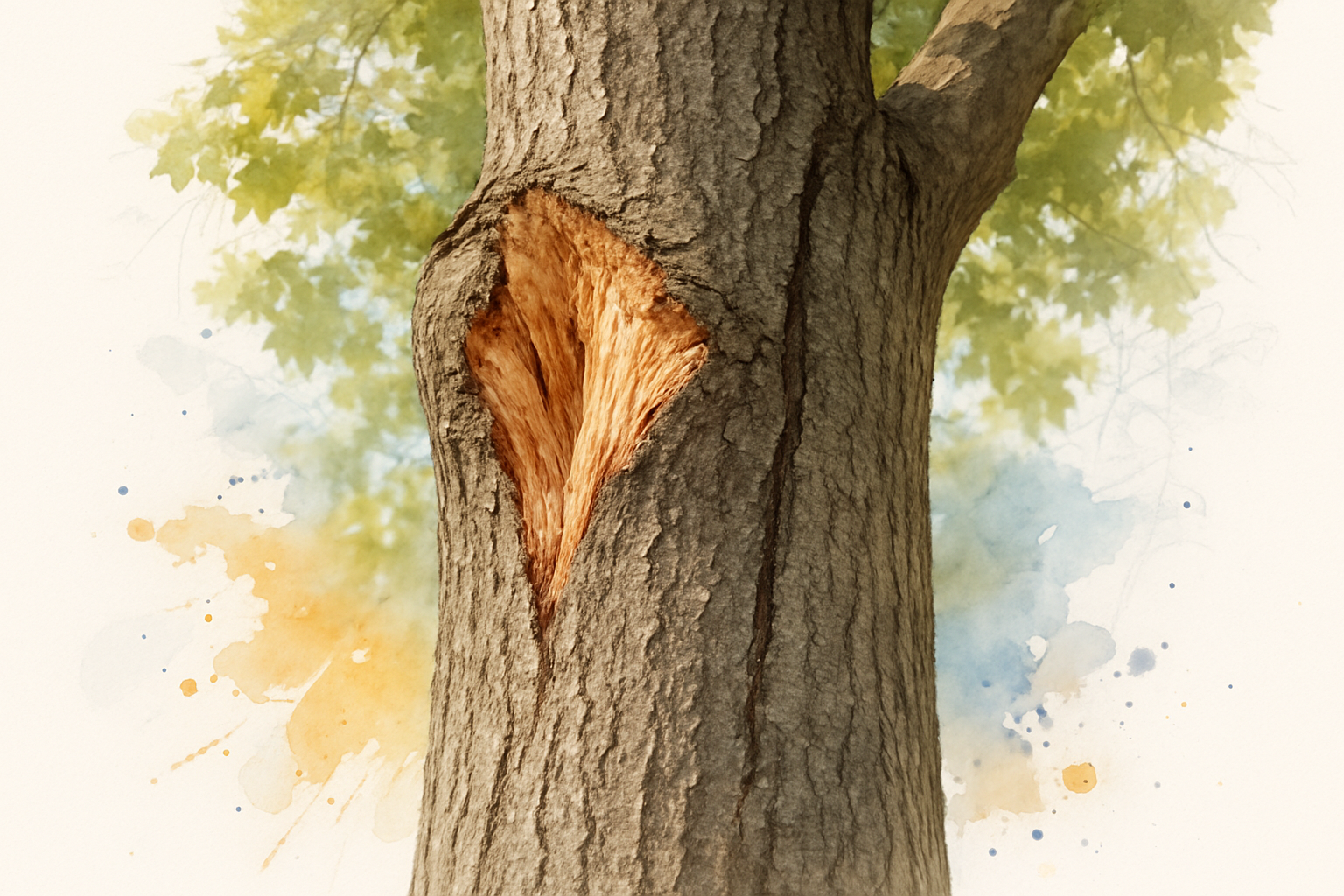
Most denial letters name the next step themselves, and it is almost always the same thing: a risk rating prepared by an ISA Certified Arborist. One caller put the need about as plainly as it can be put. He said he needed someone who could write a report for the city.
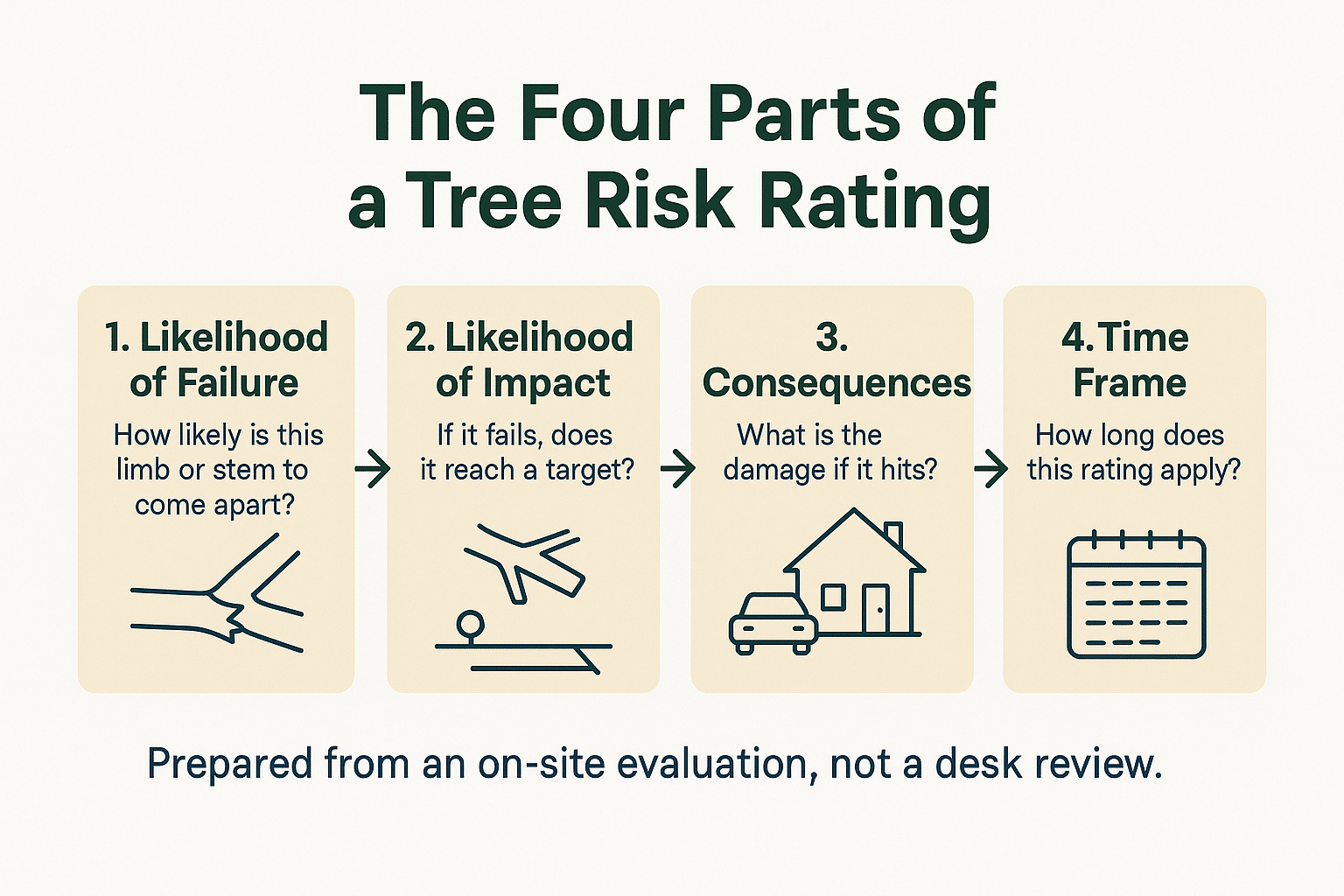
A risk rating is not a general opinion that the tree looks bad. It is a structured evaluation with four parts, and the city reads all four:
- Likelihood of failure. How likely is this specific part, that limb, that union, that stem, to come apart.
- Likelihood of impact. If it does come apart, how likely is it to hit a person, a car, a sidewalk, or a house.
- Consequences. What happens if it hits. A limb over a bare lawn and a limb over a sidewalk used by school kids are rated differently.
- Time frame. Risk ratings are scoped to a stated window, commonly a year or a few years, because trees change.
Two honest points. A documented professional opinion gives the city something specific to reconsider instead of a homeowner’s frustration, and that is genuinely different from reapplying with the same form.
But it is not a guarantee of a different answer. Sometimes the honest finding is that the tree is retainable with work, and I would rather tell you that before you pay for a report than after.
City Inspection vs. Arborist Risk Rating
This is the practical difference between what the city saw and what a written assessment puts on the record.
| Question | City visual inspection | Arborist risk rating |
|---|---|---|
| Is there an obvious hazard today? | Yes, this is the core question | Yes, plus the degree and the target |
| Is there internal decay? | Only if visible from the ground | Can be probed with decay detection tools |
| Has this tree failed before? | Usually not documented | Documented with dates and photos |
| What happens if the limb falls? | Judged broadly | Rated against specific targets and use |
| Can the defect be reduced by pruning? | Rarely addressed | Addressed as a recommendation |
| How long does the finding apply? | Point in time | Stated assessment time frame |
Liquidambar Is a Species Habit Problem as Much as a Defect Problem
This is not one homeowner’s bad luck. Liquidambar, also called sweetgum, was planted street after street in older San Jose neighborhoods like Willow Glen and the Rose Garden, and it is well known locally for dropping limbs in late summer and early fall when the tree is carrying heat and water stress.
Homeowners who have watched branches come down two or three times read that history as proof the tree is dangerous. I understand that read completely. But part of my job is separating a species habit from a structural defect, because they lead to very different recommendations.
What I look at to tell them apart:
- Where the failure happened. A clean break out on a long slender limb is different from a tear at the trunk union.
- Whether the wood at the break was sound or already discolored and soft.
- Whether the same limb type keeps failing, which points to habit, or whether failures are spreading toward the trunk, which points to decline.
- End weight on long horizontal limbs, which is the single biggest driver of summer limb drop in this species.
- Root collar condition, which tells you more about whole-tree stability than the canopy does.
If the finding is habit plus correctable end weight, the city is very likely to stay with retention. If the finding is advancing decay at a structural union, that is a different conversation and a different report.
The Four Parts of a Tree Risk Rating
Every written risk rating a city will take seriously answers these four questions in order.
The Options That Sit Between Doing Nothing and Removal
Preservation is usually the outcome the city is pushing toward, and on a mature street tree I usually agree with it. Taking a 50-year canopy off a block is permanent, and the shade and property value it provides in Willow Glen or Almaden Valley are real.
There is a wide middle ground that lowers the odds of the next failure:
- End weight reduction on heavy horizontal limbs, which takes load off the attachment without gutting the canopy
- Deadwood removal, which clears the parts most likely to come down first
- Selective crown reduction to shorten the lever arm on overextended branches
- Cabling or bracing in some cases, where a weak union can be supported rather than cut out
What this is not is topping. Cutting back major limbs to stubs forces weak regrowth that fails harder later.
One detail people miss: pruning a street tree in San Jose generally needs city approval too, not just removal. This is not work for a homeowner with a pole saw or a general gardener. Safety first, without destroying the tree.
If a weak fork is what you are dealing with, there is more detail in when a tree has a weak spot, removal is not the only answer.
What to Gather Before Anyone Writes Anything
If you are going to pursue reconsideration, the quality of your record matters more than how strongly you feel about the tree. Pull this together first:
- The denial letter and any case or application number on it
- Dates and photos of every past branch failure, even the ones you cleaned up yourself
- The emergency service call record from the city, including the date and time you called
- Photos of the sidewalk or curb if lifting is part of your concern
- Any prior pruning or maintenance records on the tree
On cost, I will be straight with you. A written risk rating is priced by the tree, the complexity of the defect, and how much documentation the city wants, so the range is wide and the only reliable number comes from asking directly about your specific tree. A basic estimate visit and a paid arborist consultation are also two different things, which I covered in when a tree visit is free and when it comes with a fee.
One more thing worth knowing. Even if the tree stays, the documented history follows the tree into the next inspection. A record of failures with dates is far stronger ground than starting over from memory in two years.
Frequently Asked Questions About a Denied Street Tree Removal in San Jose
The city cleared the fallen branch the same morning. Doesn’t that prove the tree is hazardous?
No, and this trips up almost everyone. The emergency crew cleared a blocked public sidewalk, which is a maintenance response. The inspection that follows judges the standing tree against a hazard standard, and those are two separate decisions made by two separate processes.
Does an arborist report guarantee the city changes its mind?
It does not. What it does is give the city a documented, specific professional finding instead of a general complaint. Sometimes the finding supports removal, and sometimes the honest conclusion is that the tree is retainable with pruning.
Can I just have the tree pruned myself to stop the limb drop?
Not on a street tree. Work in the park strip, including pruning, generally requires city approval, and doing it without approval is how homeowners end up with an expensive surprise. Assessment comes first, permits come second.
Why do liquidambars drop limbs in late summer here?
Long dry summers put the tree under heat and water stress right when long horizontal limbs are carrying their heaviest leaf load. It is a known habit of the species across older San Jose, Campbell, and Santa Clara streets, not necessarily a sign the whole tree is failing.
Can you tell what’s wrong from photos I email?
Photos are useful for a first read and for narrowing things down, but a risk rating the city will act on is built from an on-site evaluation. You cannot measure a branch union or check a root collar from a phone picture.
Questions About a Denied Street Tree Request?
Robert Apolinar is a Board-Certified Master Arborist, the highest ISA credential, and the reports we write come from an on-site evaluation of the actual tree, not a desk review or a template. We have been BBB accredited since 2013 and hold a 4.96 average across 70 Google reviews, and the theme that keeps showing up in them is restraint. As one longtime customer put it, “They’re super knowledgeable and never push work that doesn’t need to be done.”
If you have a denial letter from the city and you are not sure what it means for your tree, you are welcome to bring the question to us at (408) 422-1313 or sanjosetreemaintenance.com. The goal is safety, health, and longevity, and sometimes that means the tree stays.
