 Skip to content

Direct Answer: Often no. If the tree faces the street and can be reached from the curb, an arborist can assess it without you. Locked gates, dogs, or backyard trees usually mean someone should be home.
The office offers you a window and it lands at 1 p.m. on a Tuesday. You want the tree looked at, but now you are quietly doing math on whether this is worth half a day of PTO.
I get this question constantly from homeowners in Willow Glen, Almaden Valley, Campbell, and Los Gatos. It is one of the most reasonable questions a person can ask, and it deserves a straight answer instead of a vague “it depends.”
So here is the real rule, plus a thirty second checklist you can run before you rearrange your workday. I will also tell you exactly what to ask for if you decide not to be there.
Do I Have to Be Home for a Tree Estimate? Sometimes Yes, Often No
The honest answer is that it depends on access and history, not on policy. We do not have a rule that says a homeowner must stand in the yard with us.
If the tree is in the front, reachable from the sidewalk, and the job is something like deadwood removal on a single liquidambar, I can walk it, measure it, and write it up without you. Plenty of San Jose estimates happen exactly that way.
What I cannot do is open your locked side gate or tell you what the tree did during the January storms. Those two things are the whole ballgame.
One more thing worth saying out loud: it is completely normal to ask for two or three specific time windows before you commit. If the person on the phone cannot give you a real time, that is useful information. A good office gives you options and then sends a written confirmation the same day.
A Thirty Second Checklist to Decide
Run through this list before you touch your calendar. It takes less time than reading your email.
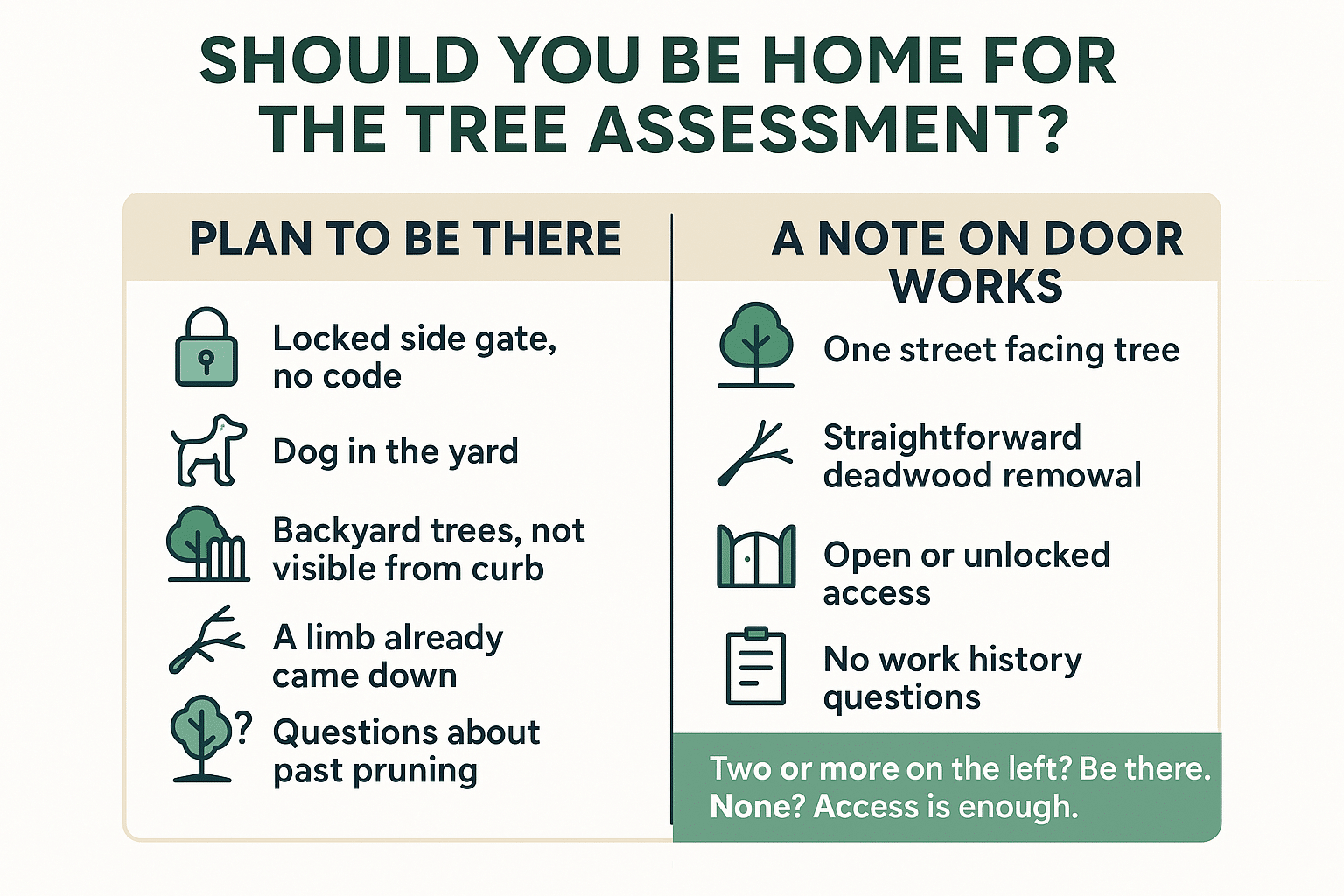
- A locked side gate with no lockbox or code
- A dog that would need to be put inside
- Backyard trees that cannot be seen from the curb
- A limb that already came down, or a tree that has dropped wood before
- Questions about what a past crew did, like a neighbor’s gardener who sheared your laurels into shrubs
Two or more of those and I would plan on being there. None of them and a note on the door with your questions usually covers it.
That fourth item matters more than people expect. History is invisible on a site visit. One homeowner told us a Japanese maple had never been pruned in the nine years they had owned the house, and nothing about the tree announced that. That single sentence changed the whole recommendation.
Why Access Beats Attendance: What I Physically Have to Touch
This is the part most homeowners have never heard, and it is the real reason a locked gate costs you more than an empty house does.
A proper assessment is hands on. On a typical visit I am doing three things that cannot happen through a fence:
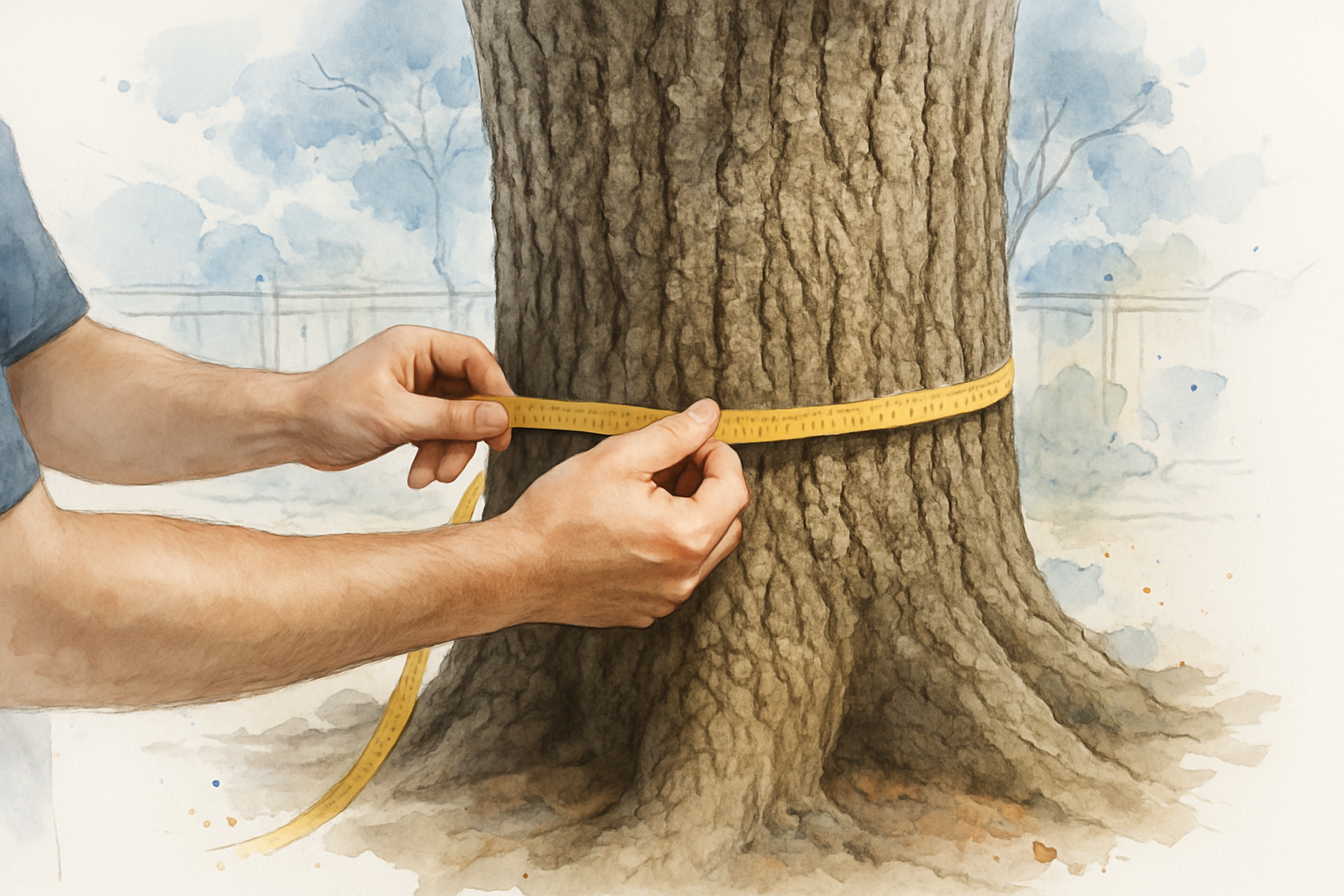
- Measuring the trunk at 4.5 feet above the ground. This is the standard measuring height, and in San Jose it is what determines whether a tree is protected.
- Looking at the root collar where the trunk flares into the soil. Buried flares, decay, and girdling roots all show up here and nowhere else.
- Sounding the bark with a mallet to listen for hollow spots, which tells me whether a decay detection follow up is worth doing.
That trunk measurement is not academic. The City of San Jose Planning Division determines protected tree status by trunk measurement at 4.5 feet above ground, and a signed certified arborist report is part of the removal permit process.
In mature canopy neighborhoods, trees land on the protected side of that line all the time without the owner suspecting it. If I cannot reach the trunk, the permit question stays open and you get a partial answer plus a second appointment. Proper assessment before action starts with being able to walk up to the tree.
When Being Home Actually Changes the Outcome
Here is how I sort the common scenarios we see across San Jose, Campbell, and Saratoga.
| Your situation | Should you be home? | Why |
|---|---|---|
| Single front yard tree, deadwood or light pruning | No | Fully visible and reachable from the curb |
| Backyard trees behind a locked gate | Yes, or leave a code | No access means no trunk, no root collar, no answer |
| Dog in the yard | Yes | Crew will not enter, and the visit ends at the gate |
| A limb already came down | Yes | The failure history is not visible on the remaining tree |
| Questions about past pruning by another crew | Yes | Only you know who did what and when |
| Possible protected or ordinance size tree | Helpful | Permit path decisions go faster with you there |
The Thirty Second Rule
A quick visual version of the checklist above, built so you can decide in under a minute.
Send Photos First, but Pin Down the Turnaround
About one in nine callers asks some version of “can I just send some pictures first to get a ballpark?” That is a fair ask, and photos are genuinely useful.
I treat photos as the step that happens before the calendar, not instead of the visit. They help narrow the scope, flag whether this is a quick look or a full consultation, and often settle the question of whether anyone needs to be home at all.
What they cannot do is replace the trunk measurement or the root collar check. We have covered what photos can and cannot tell an arborist in more detail elsewhere.
The practical tip: before you hang up, ask for a specific turnaround on the photo review, something like a response within two business days. Callers who skip that step are usually the ones calling back a week later asking where the response went.
What You Should Walk Away With If You Were Not There
An unattended visit is only fine if the write up is specific enough to stand in for the walkthrough. This is where things go sideways, and “I have not heard back on my estimate yet” is one of the most common follow up calls any tree company gets.
Ask for these five things up front, on the booking call:
- Which trees were looked at, by location on the property
- The species of each one
- What is being recommended and why, in plain terms
- What is being left alone, which is just as important
- A date the write up arrives
Asking for that is normal. A good crew expects it and has it ready. If you want a sense of realistic timing, we have written about how long a tree estimate usually takes.
It also helps to know ahead of time whether your visit is a free estimate or a paid arborist consultation, because the deliverable is different. Paid consultations in Santa Clara County generally run in the low hundreds depending on scope, and the difference between the two visit types is worth understanding before you book. Ask for the exact figure on the call.
When You Cannot Be There, Who Walks the Yard Matters
Here is the part I would want to know as a homeowner. If you are not standing next to the person assessing your tree, the entire value of that visit rests on their judgment and their write up.
Assessments at our company are performed by owner Robert Apolinar, a Board-Certified Master Arborist, which is the highest ISA credential. We have held BBB accreditation since 2013 and carry a 4.96 average across 70 Google reviews.
One longtime customer put it the way I would want it put: “They’re super knowledgeable and never push work that doesn’t need to be done.” That is the standard an unattended visit has to meet. The goal is safety, health, and longevity, not a bigger invoice.
Frequently Asked Questions About Tree Estimate Appointments
Can I just leave the gate unlocked and go to work?
Yes, and that is the single most helpful thing you can do. An unlocked gate or a code gets us to the trunk, the root collar, and the canopy, which is where the real assessment happens. Just put the dog inside.
How long does the arborist need to be on my property?
For a few trees, usually 30 to 60 minutes. Larger properties with mature canopy, multiple species, or a possible permit question can run longer because each trunk gets measured and each root collar gets looked at individually.
What if I want to be there but every window is during work hours?
Ask for two or three specific slots rather than accepting the first one offered. Many homeowners end up with an early morning window that costs them an hour instead of an afternoon. It is a normal request and nobody is going to be annoyed by it.
Will the arborist talk to me if I am not there?
Usually by phone right after, and then in the written recommendation. If a tree turns out to be more complicated than expected, I would rather walk you through it on a call than let you read about it cold in an email.
I just bought the house and know nothing about the trees. Should I be there?
Yes, I would. Not because you have history to share, but because this is the visit where you learn the property. New owners get the most out of being present, and we have written a separate guide on what to do with the trees after you buy.
Still Deciding Whether to Take the Afternoon Off?
If you are weighing a workday against a tree assessment in San Jose, Willow Glen, Almaden Valley, Los Gatos, Saratoga, or Campbell, it is fair to ask for a few specific windows and a clear turnaround before you commit to anything. Our office can walk you through which path fits your property, including whether photos are enough to start. San Jose Tree Service & Landscaping can be reached at (408) 422-1313 or at sanjosetreemaintenance.com.
