
Direct Answer: San Jose Tree & Landcare runs 24-hour emergency tree service in Los Gatos. Call (408) 422-1313. A limb lying flat with nothing above it is usually a morning job, not a midnight one.
The wind picks up around nine, you hear a crack that sounds like it came from inside the house, and when you open the back door there is a limb lying across your fence. The first question almost everyone asks is who to call. The better first question is whether this is a tonight problem or an eight in the morning problem.
If you are in Los Gatos, we handle emergency tree work around the clock at San Jose Tree & Landcare, and the number is (408) 422-1313. We cover Los Gatos, Saratoga, Monte Sereno, Willow Glen, Almaden Valley and the rest of the South Bay.
Here is my honest position after a lot of storm nights: most fallen limbs are not emergencies. A limb flat on the ground with nothing hanging above it can wait for daylight, and waiting usually gets you safer, better work. The ones that cannot wait have specific signs, and I will walk you through them.
A Big Limb Fell on My Fence During the Storm in Los Gatos. Who Offers Emergency Tree Service Nearby?
We do. Our crews respond 24 hours across Los Gatos and the surrounding foothill towns, and every job is guided by a Board-Certified Master Arborist, the highest credential the International Society of Arboriculture awards.
What storm response actually covers:
- Taking down limbs that are hung up in the canopy or resting on a fence, shed or roof
- Cutting and removing the fallen wood, including limbs under tension
- Clearing driveway, gate and walkway access so you can use your property
- Hauling debris and raking the work area clean
- Looking at the parent tree to see why the limb failed and what is left up there
What moves the price and the timing:
- Size and species of the wood, and whether a crane or climber is needed
- Whether the limb is loaded with stored tension or sitting loose on the ground
- Access, which matters a lot on narrow Los Gatos hillside driveways
- Night work versus daylight work
- Whether it is touching a structure, a line, or just the fence
Storm pricing varies with all of that, so I will not quote you a number here. Photo quotes and on-site estimates are free, and a few pictures sent before the truck rolls often gets you a realistic range the same evening.
The Flashlight Check: Is This Tonight or Morning?
Stand at your back door with a flashlight. You do not need to walk under anything to answer this.
Stay back and call tonight if:
- A piece is hung up in the canopy and has not reached the ground
- The limb is resting on your roof, a shed, a car or a gate you need to use
- Anything is touching, resting near, or draped over a line running to the house
- The trunk has a fresh split or crack, or the tree is leaning differently than it did yesterday
- Soil is lifted or cracked on the uphill side of the trunk, which happens on saturated Los Gatos slopes
It can usually wait for morning if: the limb is lying flat, nothing is suspended above it, it is clear of every line, and nobody has to walk under the damaged canopy to get in or out.
One more thing. If there is any chance a line is involved, treat it as live and call the utility first. We will not work near a line until the utility has cleared it, and neither should anyone else.
Three Different Jobs That Get Tangled Together on a Storm Night
The fastest way to lose an hour is calling the wrong organization. There are really three separate situations, and they are handled by three different groups.
Your tree, your yard, your fence. This one is yours to arrange directly with a tree company. Nobody else is dispatching a crew for it.
Anything touching a utility line. That belongs to the utility, full stop. They clear the line first, then a tree crew can work.
A limb in the public right of way or from a street tree. That runs through the town or city. A San Jose homeowner once told us a liquidambar limb blocked the sidewalk on a Saturday morning, and the city’s tree emergency line had a crew out in about an hour. That same call for a limb in your own backyard would have gone nowhere, because the right of way is the only part they own.
If the tree is not yours, the money question is separate from the clearing question. We cover that in detail in our piece on when a neighbor’s tree lands on your fence, and street tree rules get their own treatment in what happens when the city denies a removal request.
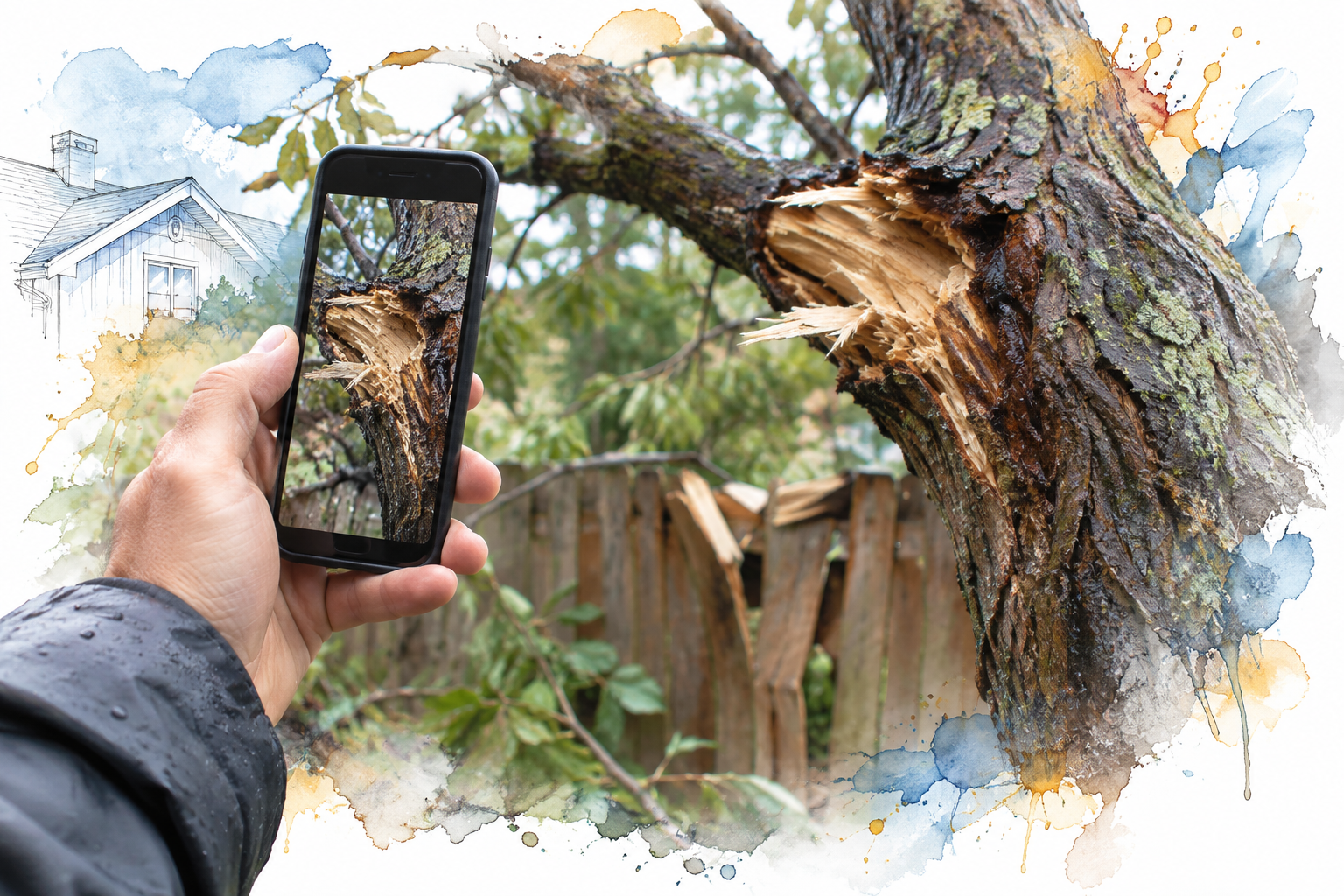
Before anything moves, take photos. Wide shots and close shots, from two or three angles. It takes two minutes and it matters if a fence repair or an insurance claim follows.
Who Handles What After a Storm
A quick reference for the first call, so you are not routed between three places.
| Situation | Who to call first | What usually happens |
|---|---|---|
| Limb from your tree on your fence or yard | A licensed tree company | Assessment, cut and removal, debris hauled, work area cleaned |
| Limb touching or near any line to the house | The utility, before anyone else | Utility clears or de-energizes the line, then tree work can proceed |
| Limb blocking a sidewalk or street, or from a street tree | Town or city public works | Crew clears the right of way; your private yard is not included |
| Tree down on the house or blocking an exit | 911 first, then a tree company | Life safety handled first, stabilization after |
| Limb hung up in the canopy over a walkway | A tree company, same night | Crew secures or lowers the piece, finishes in daylight |
What a Storm Night Looks Like From the Crew Side
The complaint I hear most after a storm is not about price. It is about not knowing when someone is coming.
So here is how a reasonable company runs the queue. Calls get sorted by risk to people and structures first, then by access and daylight. A tree on an occupied bedroom outranks a limb on a fence, every time, and it should.
On a bad night a crew will often stabilize a situation after dark and finish the work the next day. Lowering a hung-up limb at midnight in the rain is sometimes the right call. Grinding a stump by headlamp never is.
What speeds your spot in the line:
- Photos sent before the truck rolls, including one wide shot showing the whole tree
- Exactly what the limb is touching: fence, roof, line, car, nothing
- Whether a truck and chipper can get down your driveway, and the gate width
- Whether anyone needs to pass under the damaged canopy to leave the house
Ask for a specific window rather than a vague one. A good answer sounds like “between seven and nine tomorrow” or “we will stabilize tonight and return Thursday morning.” If the answer stays fuzzy after you have given the details, keep calling.
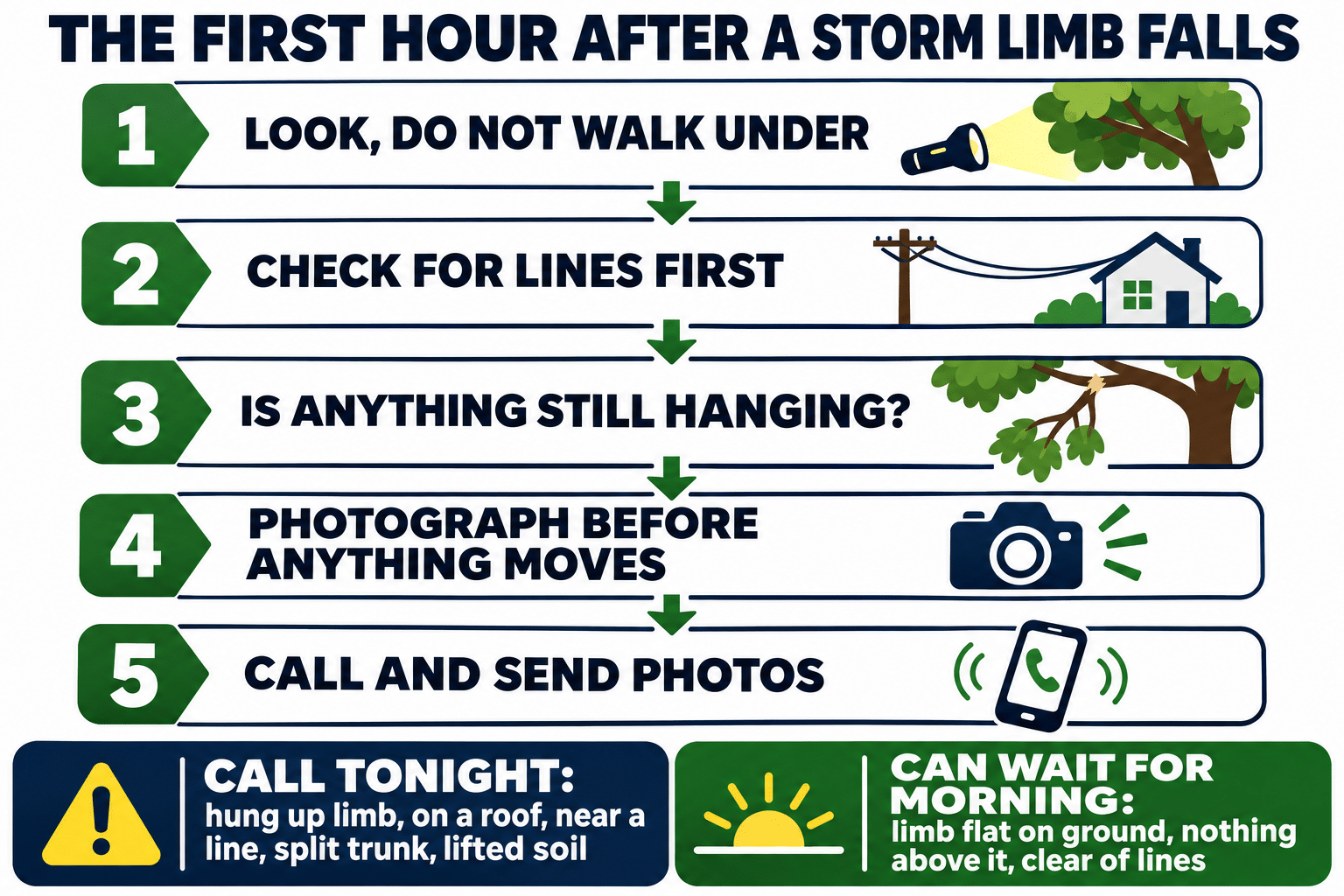
The First Hour, Step by Step
The short version you can follow from your back door while the rain is still coming down.
What Not to Touch While You Wait, and Why
Most of the people who call us are perfectly capable with tools. That is exactly the instinct that gets people hurt on a storm night, so let me give reasons instead of warnings.
- A limb hung up in a canopy holds stored energy. One cut in the wrong place releases all of it at once, downward.
- A split trunk can let go when weight shifts. Removing the fallen piece can be what triggers it.
- Ladder work under a damaged canopy is the common way homeowners get seriously injured in these situations. The ground is soft, the footing is bad, and your hands are busy.
- Cutting the wrong piece first drops the rest onto the fence, the shed, or the plants you were protecting.
Chainsaw and tree work injuries are common enough after storms that OSHA publishes safety guidance specifically for tree care operations. It is worth two minutes of reading if you are tempted.
What is fine to move by hand: small debris already on the ground and clear of the canopy. Twigs, leaves, bark. If you cannot lift it comfortably with one hand, leave it.
One Week Later: What the Limb Was Telling You
The storm passes, the fence gets fixed, and the thing most people never do is look up again. The limb that failed is usually reporting on the rest of the canopy.
Once the ground dries a little, walk the tree in daylight and look for:
- Fresh cracks at branch unions, especially where two stems meet in a tight V
- Soil lifting or cracking on the uphill side of the trunk, which matters on the saturated clay under Los Gatos, Saratoga and Monte Sereno
- A trunk that has shifted since the last dry day
- The stub where the limb tore out, because a ragged tear holds water and invites decay if it is left that way
That torn wound is the part people underestimate. A clean cut back to the proper point gives the tree a shot at sealing it over. A ragged stub often becomes the next failure point three or four winters out.
If the same tree has dropped limbs before, the pattern is worth investigating rather than repeating. Our guides on what a tree risk inspection actually covers and what helps three days out from a storm go deeper on that. The goal is safety, health and longevity, in that order.
Frequently Asked Questions About Storm Limbs and Emergency Tree Service
A big limb fell on my fence during the storm in Los Gatos. Who offers emergency tree service nearby?
We do. San Jose Tree & Landcare responds 24 hours in Los Gatos, Saratoga, Monte Sereno and the surrounding South Bay towns, at (408) 422-1313. Emergency work covers securing hung-up limbs, cutting and removing fallen wood, clearing access, hauling debris, and assessing the parent tree. If the limb is lying flat with nothing suspended above it and nothing near a line, it is usually safe to wait for a daylight crew, which is almost always the better job.
Do I have to pay for an arborist visit just to get storm damage cleared?
No. Photo quotes and on-site estimates are free. The $250 Level 1 Arborist Assessment is a different thing: a formal tree diagnosis for health, decay or stability questions. Storm cleanup does not require it, though people often ask for it afterward when the same tree keeps dropping limbs.
How fast can a crew actually get here on a storm night?
It depends on what else is in the queue. Calls are triaged by risk to people and structures first, so a tree on an occupied room gets moved ahead of a limb on a fence. Sending photos up front makes a real difference, because it lets us judge urgency without guessing. Expect a specific window rather than an immediate truck, and expect stabilization tonight with completion the next day on busy nights.
Should I cut the limb up myself to save money?
I would not. Limbs resting on a fence are often still under tension, and one cut in the wrong spot releases it all at once. Small loose debris on the ground is fine to pick up. Anything connected to the tree, suspended, or requiring a ladder is worth leaving alone.
Does losing a limb mean the whole tree has to come down?
Usually not. Plenty of mature oaks and liquidambars in Los Gatos shed a limb in a hard winter and go on for decades. Removal is the right call when a tree has lost structural integrity or decay has moved into the root collar or main scaffold limbs. Preservation comes first, and that decision deserves a proper look at the whole tree, not a judgment made in the dark.
Looking at a Downed Limb Right Now?
If there is a limb on your fence in Los Gatos, Saratoga, Willow Glen or Almaden Valley, our crews are reachable around the clock at (408) 422-1313, and photos sent ahead help us judge how urgent it really is. Free photo quotes and on-site estimates are available, and every job is guided by a Board-Certified Master Arborist. You can find more at sanjosetree.com whenever you are ready.