 Skip to content

Direct Answer: In the 72 hours before a storm, clear gutters and street drains, move cars and bins out from under limbs, secure loose items, and photograph your trees. Structural pruning takes weeks, not days.
You saw the forecast. A storm system is lining up over the Pacific, it lands in three days, and now you are standing in the yard looking up at a tree you have not thought much about since summer.
That is the exact window this article covers: the 72 hours between seeing the storm and the morning after it passes. Not the whole winter, not pruning schedules. Just the short stretch where a few practical moves actually help.
And this winter there will be a lot of those windows. NOAA’s Climate Prediction Center put the odds of a very strong El Nino for fall and winter 2026-27 above 90 percent in its August 13, 2026 discussion, which means South Bay homeowners will watch storm after storm come across the forecast. Longer-range winter prep and pruning timing are separate conversations, and we cover those elsewhere on the site.
Be Honest About What Three Days Can and Cannot Do
I would rather tell you the truth than sell you a rush job. Structural pruning, crown reduction, and cabling are not last-minute work. They take planning, an assessment, and a crew with time on the calendar.
By October and November our schedule and most reputable schedules in San Jose are booked weeks out. On top of that, making a big reduction cut on a saturated day can leave a tree in worse shape than if you had left it alone, because you have changed how it carries wind load without giving it time to respond.
So treat these three days as triage, not treatment. Here is what genuinely fits in the window:
- Clear your gutters and the street drain in front of the house. A clogged curb drain is how a Willow Glen block ends up with standing water against root collars.
- Move cars and trash bins out from under heavy limbs. This costs you five minutes.
- Secure patio furniture, umbrellas, empty pots, and anything else that becomes a projectile.
- Walk the property in daylight before the rain starts. You cannot assess a tree with a flashlight at 9 p.m. in the wind.
- Note anything already hanging, split, or leaning so you know what changed after the storm.
That is the honest list. Everything else is a conversation for a drier week.
Look at the Base of the Tree, Not Just the Canopy
Most homeowners look up. In San Jose, winter failures usually start at the ground.
Our soils are heavy clay. Clay holds water, and a tree that sailed through a bone-dry summer can quietly lose its grip once the root plate sits in saturated soil and a full canopy starts catching wind like a sail.
On your daylight walk, look for these at the base of each mature tree:
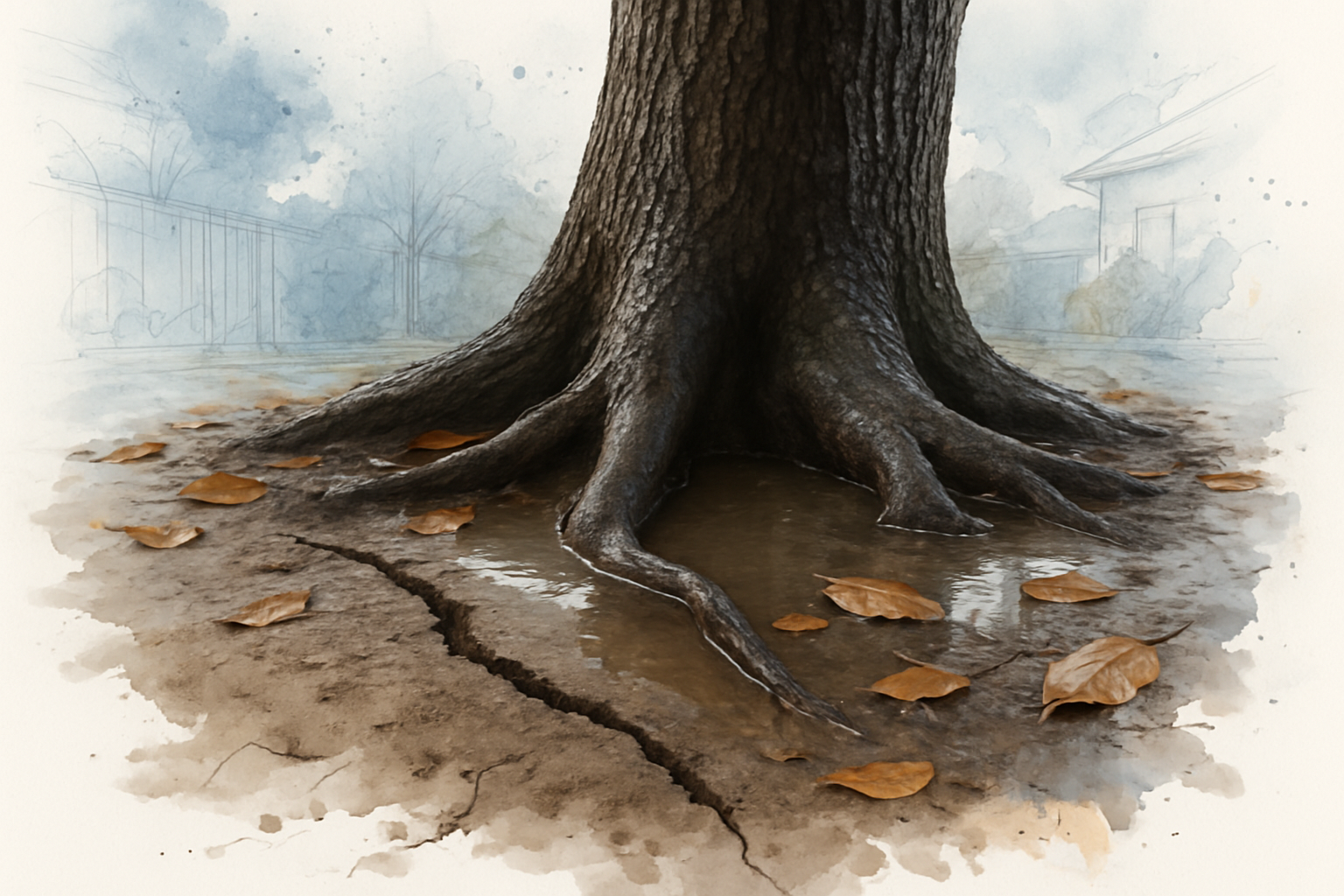
- Fresh cracking in the soil near the trunk, especially in an arc
- A raised or mounded ring of soil on the side opposite the lean
- Roots that are exposed now but were buried last year
- A new gap between the trunk and the surrounding soil
- Standing water that never drains near the root collar
Any one of those is worth a photo and a call after the weather clears. A raised soil mound on the off-lean side is the one I pay the most attention to, because it often means the root plate is already moving.
This matters most on the older canopies in Willow Glen and Almaden Valley, and on the sloped lots in Los Gatos and Saratoga, where gravity and saturated ground work in the same direction. If you are already unsure about a tilt, figuring out whether a lean is actually a problem is a good next read.
Sort Out Who Handles What Before You Need To
This is a real point of confusion in San Jose, and it costs people time when minutes matter. Earlier this year a caller reached us about a tree sagging onto power lines and had to be told we are a private company, not the city. That homeowner had to start over with the right agency.
So learn the order now, while nothing is on fire:
- Anything touching or near a power line is a utility call. Nobody else touches it. If a line is down or arcing, call 911 first, then the utility.
- A limb or tree blocking a street or sidewalk goes to San Jose’s 3-1-1 line, which runs 24 hours.
- The city forestry emergency line is 408-794-1900.
- The City Arborist, at 408-794-1901, handles street trees and heritage trees.
- Trees on private property, clear of lines, are where a licensed tree contractor comes in.
The city’s forestry page at sanjoseca.gov confirms those numbers. Save them in your phone tonight, not at 6 a.m. after the wind. If you are not sure which category your tree falls into, who actually owns the tree in front of your house sorts that out.
Storm Response: Who to Call for What in San Jose
Print this or screenshot it. The wrong first call is the most common delay we see after a storm night.
| Situation | Who to call | Notes |
|---|---|---|
| Limb or tree touching a power line | 911 if a line is down or arcing, then your utility | No contractor should touch it, and neither should you |
| Tree or limb blocking a street or sidewalk | San Jose 3-1-1 | Available 24 hours |
| Storm damage to a city tree, after hours | City forestry emergency line, 408-794-1900 | For urgent public-tree hazards |
| Street tree or heritage tree questions | City Arborist, 408-794-1901 | Also the right start for permit questions |
| Tree on private property, clear of lines | Licensed tree contractor | Verify the license number and classification with CSLB |
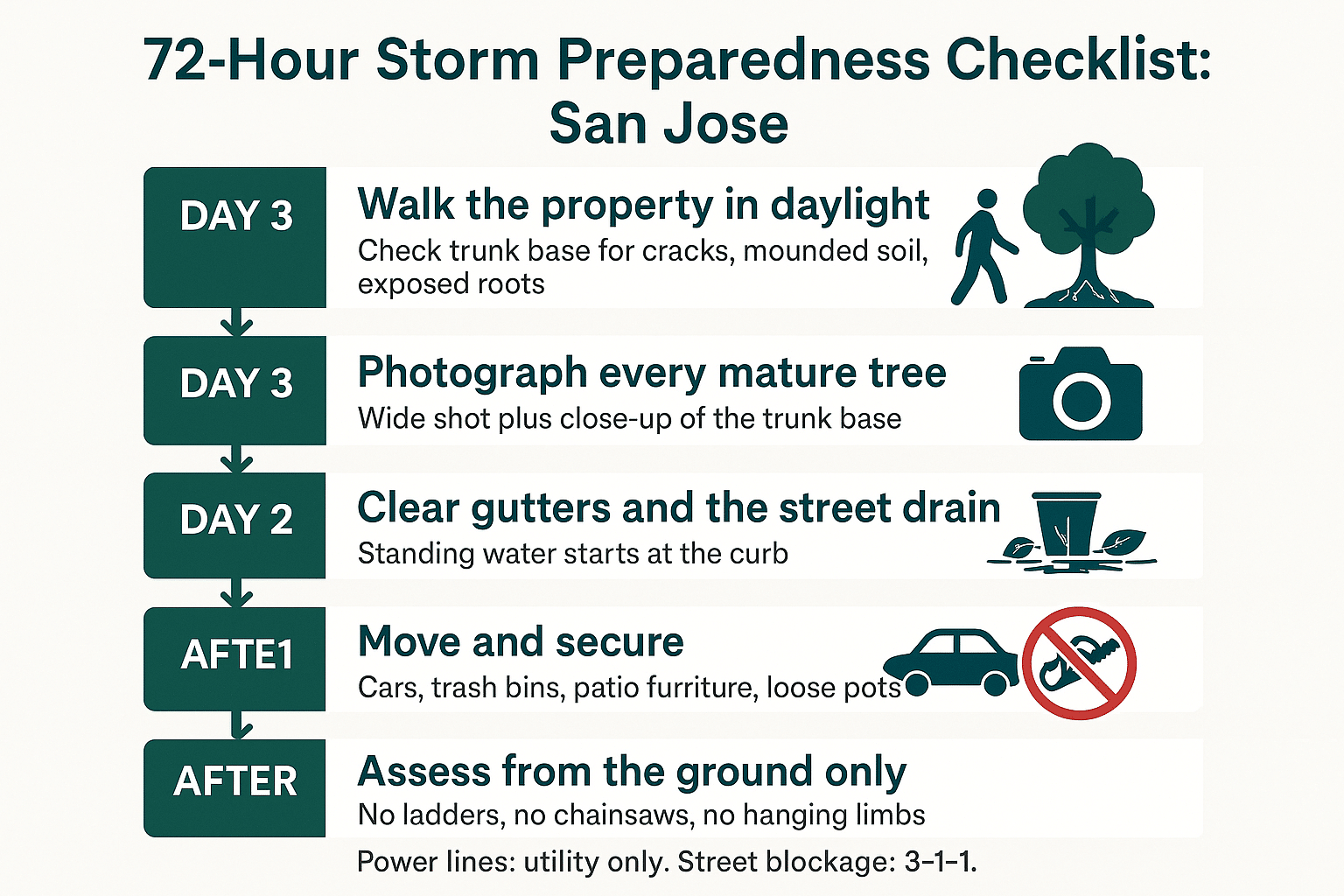
Your 72-Hour Super El Nino Storm Preparedness Checklist
This is the short version of everything above, in the order I would actually do it.
Take the Photos. This Is the Step Everyone Skips.
Photograph your trees before the storm. Wide shot of the whole tree, then a close shot of the base of the trunk. Do it with your phone, and do not delete them.
After a failure, those pictures are the only proof of prior condition an insurer or the city will accept. Without them you are describing a tree that no longer exists.
We hear from homeowners constantly after storms. One returning customer in Los Altos wrote in after a tree came down on their fence and simply asked for someone to come assess it. Others have called this year saying their insurer was threatening to cancel over limbs hanging on a roof.
Photos with dates turn a stressful claim conversation into a documented one. They also give whoever assesses the tree a before-and-after to work from, which changes what we can tell you about why it failed.
Permits Still Apply the Morning After
San Jose does not waive its rules because a tree failed overnight. The homeowners who get into trouble are the ones who cut first and ask later.
The city offers same-day, over-the-counter emergency permits on weekdays during set morning and afternoon windows, roughly 9 to 11 and 1 to 3. The useful way to think about it is that the process is expedited, not skipped.
If the storm hits on a Saturday, the answer is simple. Make the site safe, keep people away from it, document everything with photos, and file Monday. A hazard that is fenced off and photographed is a manageable situation.
For the full picture on approvals, what San Jose requires before a tree comes down walks through the standard process.
What Not to Do in the Hours After
Post-storm injuries in residential yards come from a short list of mistakes, and they repeat every winter.
- Do not touch a hanging limb caught in the canopy. It is under load and can release without warning.
- Do not cut a limb pinned under tension. It will move when the saw goes through, and it will not move where you expect.
- Do not combine a ladder and a chainsaw. There is no version of this that is worth it.
- Do not work under or near anything within reach of a power line.
One more practical note. Storm weeks bring door-knocking crews with no license and a truck full of urgency.
You can check any California contractor’s license number and classification through the CSLB in about a minute before you agree to anything. Tree work requires a C-61/D-49 classification. That one-minute check is the cheapest protection available to you. If a tree is already down or looks unstable, our guide to what to do when a tree looks dangerous after a storm covers the next steps.
Frequently Asked Questions About Storm Preparedness in San Jose
Can I get a tree trimmed before a storm that is three days away?
Sometimes a small deadwood removal fits. A real structural reduction usually does not, because crews are booked out weeks in October and November and rushed reduction cuts on a saturated day can leave a tree less stable, not more. If the tree is a genuine hazard, an assessment comes first.
A limb is resting on my roof. Who do I call first?
If it is anywhere near a power line, the utility, and 911 if a line is down. If it is clear of lines and entirely on your property, a licensed tree contractor. Photograph it before anything moves, because your insurer will want that.
Do I need to be home for a storm damage assessment?
Often no. Many assessments can be done without the homeowner present, though for anything involving access to a backyard or a decision about a specific tree it helps to be there. Just ask when you call.
Is a tree that survived the dry summer safe for winter?
Not automatically. Summer drought stress and winter root plate failure are different problems. A tree can hold up fine in dry clay and lose its grip once that same clay is saturated and the canopy is catching wind.
The storm knocked a tree down on a Sunday. Can I just remove it?
Make the area safe and document it, but hold off on cutting if the tree is protected or is a street tree. San Jose’s emergency permit counter runs on weekdays, and filing Monday is far better than explaining a removal after the fact.
Questions About a Tree Before the Next Storm?
One customer described it plainly after a rough winter night: “During the massive rain and wind storm two weeks ago two large limbs broke from our giant mountain ash tree.” When that happens here, our storm response is arborist-led rather than crew-led, with a Board-Certified Master Arborist assessing before anyone starts cutting, and a dual license covering both tree work and landscaping so root plate failures, drainage issues, and the repair afterward stay with one contractor. If you want a set of eyes on a tree in San Jose, Willow Glen, Almaden Valley, Los Gatos, or Saratoga this storm season, we are reachable at (408) 422-1313.
