
When you need a tree taken down, especially a big one, you’re not just hiring someone with a chainsaw. You’re bringing in a specialized professional who is licensed to handle a dangerous job safely and legally.
This isn’t a task for a general landscaper. A true tree removal contractor has the heavy-duty equipment, proper insurance, and hard-won expertise to manage high-risk work without damaging your property.
Why Hiring the Right Tree Removal Contractor Matters
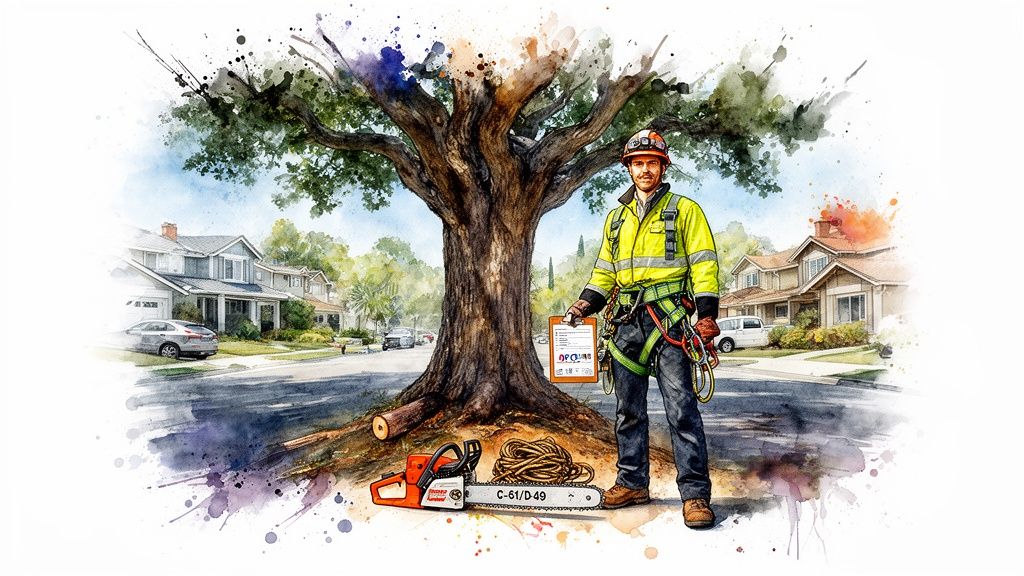
Taking down a tree in the San Jose area is a serious operation. It demands precision, especially when dealing with our region’s mature oaks and redwoods standing just feet from homes and power lines. This decision is critical for managing your liability and ensuring safety.
Choosing the right expert means finding someone who understands the unique challenges we face in the South Bay. They know how our dense clay soil impacts root stability and how an atmospheric river can turn a compromised tree into a major threat. That local knowledge is priceless.
The Dangers of Unqualified Work
Hiring someone unlicensed or uninsured to save a few dollars can end in disaster. If an accident happens on your property, you could be on the hook for medical bills and property damage. It’s a massive financial and legal risk.
A professional tree removal contractor protects you by carrying the right credentials. Here’s what you must verify:
- Proper Licensing: In California, any tree work valued over $500 requires a C-61/D-49 Tree Service specialty license. This is non-negotiable.
- Workers’ Compensation Insurance: This is crucial. It covers the contractor’s crew if they get hurt on your property. Without it, you could be sued for their injuries.
- General Liability Insurance: This policy protects your home, driveway, and other property from accidental damage during the removal.
Industry analysis projects the global Tree Felling Services market will jump from $3.9 billion in 2025 to a staggering $9.5 billion by 2033 (Market.us, 2024). This massive growth is driven by increasing development and more frequent, severe storm events.
After a big storm, damaged and unpredictable trees become ticking time bombs. This is when expertise matters most, and knowing who to call is crucial. You can learn more about why San Jose residents search for qualified arborists after every storm to see why having a pro on speed dial is a smart move.
Verifying Your Contractor’s Credentials

Before any work begins, your most important job is to confirm your contractor is legitimate. This is your best defense against property damage, legal headaches, and poor workmanship.
Any true professional will expect you to ask for their credentials and should provide them readily. If they get defensive, that’s a major red flag.
Your first stop should be the California State License Board (CSLB) website. It’s a free, public database that lets you check a contractor’s license status in seconds. For instance, our CSLB #985639 shows we’re active and in good standing—simple verification for complete peace of mind.
What to Look for in a California Contractor License
Tree work in California is strictly regulated, and not all licenses are the same.
- C-61/D-49 Tree Service License: This is the key credential. It’s legally required for any tree service job costing more than $500, covering removal, pruning, and other specialized care.
- C-27 Landscaping License: This license is for creating and maintaining landscapes. While it may cover minor tree trimming, any significant removal requires the D-49 specialty license.
When a company holds both, like San Jose Tree Service & Landscaping, it shows a deeper level of expertise. It means we understand how individual trees fit into your property’s entire ecosystem. You can view our licenses and certifications to see our qualifications.
Insurance: Your Financial Safety Net
A license proves qualification, but insurance protects you from financial catastrophe. If a heavy limb crashes through your neighbor’s roof and the contractor lacks proper general liability insurance, you could be dragged into an expensive dispute.
Worse, if a crew member gets hurt without workers’ compensation coverage, you—the homeowner—could be liable for their medical bills and lost wages. This nightmare scenario can lead to lawsuits and devastating financial strain.
Pro Tip: Don’t just take their word for it. Always ask for a current Certificate of Insurance (COI) to be sent directly from their insurance agent. This document proves their coverage is active.
Contractor Vetting Checklist
Use this quick-reference table to cover all your bases before hiring a tree removal contractor in California.
| Credential to Verify | Why It Matters | How to Check It |
|---|---|---|
| CSLB License (D-49) | Confirms they are a legally recognized and specialized tree service professional. | Look them up on the official CSLB website using their name or license number. |
| General Liability Insurance | Protects your property (and your neighbor’s) from accidental damage during the job. | Request a Certificate of Insurance (COI) sent directly from their insurance provider. |
| Workers’ Compensation | Protects you from liability if a worker is injured on your property. | This should also be listed on the COI. The CSLB site also notes if they are exempt (owner-operator only). |
| Local Business License | Shows they are registered to operate legally within San Jose or your specific city. | Ask for a copy or check with your local city’s business licensing department. |
The Professionalism Test
Pay attention to how the company operates. Are they organized and communicative? A contractor who invests in their business processes will likely treat your project with the same care.
Many modern, professional outfits use tools like the best CRM for contractors to keep everything running smoothly. It’s a small detail that points to a bigger commitment to quality.
Understanding San Jose’s Tree Removal Permit Rules
You can’t always remove a tree just because it’s in your yard. Here in San Jose and across the South Bay, local ordinances protect our urban canopy. An experienced tree removal contractor will be fluent in these rules, but it’s good for homeowners to know the basics.
Trying to sidestep these regulations can lead to hefty fines and legal hassles. The city aims to preserve valuable trees, so some are protected based on species, size, or location.
When Do You Actually Need a Permit?
You’ll almost certainly need a permit if your tree meets one of these criteria:
- Is it a Protected Species? Many native trees, especially our beautiful Coast Live Oaks, are protected. Removing one requires city approval.
- How Big Is It? Large, mature trees are often protected, regardless of species, if their trunk diameter exceeds a certain size.
- Where is it Located? Trees in a front yard setback or on a steep slope often have extra protections to help with erosion control and neighborhood aesthetics.
A licensed contractor can quickly identify the species, take measurements, and tell you if a permit is needed before providing a quote.
The U.S. tree trimming and removal industry is a massive field, expected to bring in $39.5 billion in revenue in 2025 (IBISWorld, 2024). This highlights the economic importance of professional tree care services.
Navigating the Permit Process
If you do need a permit, your contractor should handle the application. This involves providing specific details about the tree, a valid reason for removal (like disease or risk), and a clear site plan. The city arborist reviews the application to ensure the removal is necessary.
Unpermitted tree removal can lead to stop-work orders and serious fines. Hiring a licensed, local tree removal contractor is your safety net. We handle the city’s red tape so your project is done safely, professionally, and legally.
What a Professional Tree Removal Really Looks Like
When you hire a true professional, you’re getting a meticulously planned operation. It all starts with a tree removal contractor conducting a thorough site assessment.
They aren’t just looking at the tree; they’re analyzing everything around it—your house, your neighbor’s fence, landscaping, and power lines. This detailed risk analysis forms the bedrock of a safe removal plan.
In the tight-knit neighborhoods of San Jose, there’s rarely room to just yell “Timber!” The plan will dictate the exact method, whether felling the tree in a single drop or dismantling it piece by piece from the top down.
The Removal Process Unpacked
When the crew shows up, you’ll see the difference. They arrive with specialized gear: climbing ropes, a wood chipper, and sometimes a crane. The first step is to establish a secure drop zone.
Safety is non-negotiable. Every crew member will be in personal protective equipment (PPE)—helmets, chaps, and more. This is a sign you’re dealing with a team that respects the dangers of their work.
Expert Insight: In most urban settings like the South Bay, taking a tree down limb by limb is the gold standard for safety. It eliminates guesswork and ensures every piece is lowered gently to the ground. This precision separates pros from costly accidents.
A legitimate contractor will also navigate the city’s permitting process for you. Here’s how it generally works in San Jose.
This clear path ensures a safe and legal removal from start to finish.
From Stump Grinding to Final Cleanup
Once the tree is on the ground, an efficient crew kicks into high gear. Branches are fed into the chipper, and larger trunk sections are cut into manageable logs and hauled away.
Then there’s the stump. A professional service will always offer stump grinding, which chews the stump and its roots down below your lawn’s surface. You can see the details of professional tree stump removal to learn how it restores your yard.
The final sign of a pro is the cleanup. They rake, blow, and haul away every last twig, leaving your property looking immaculate.
Decoding Your Tree Removal Quote
Once you have a few estimates, you’ll notice prices are all over the place. A real quote from a professional tree removal contractor is a detailed breakdown of a complex job.
The tree’s size is the most obvious factor, but its location is just as critical. A massive oak leaning over your roof or tangled in power lines requires a surgical approach, which is reflected in the price.
What a Professional Estimate Should Look Like
A transparent, itemized quote is the first sign you’re dealing with a professional. A vague, one-line price is a major red flag. If you’re curious about the format, looking at landscaping construction estimate samples can give you a solid idea of what to expect.
At a minimum, the quote should clearly break out the cost for each major part of the job:
- Tree Removal: The actual work of safely taking down the tree.
- Stump Grinding: Is it included? This will specify the cost to grind the stump.
- Debris Hauling & Cleanup: This details who is responsible for hauling away all the wood and mess.
Red Flag Warning: Be extremely cautious of cash-only demands or high-pressure sales tactics. These are classic signs of an uninsured or shady operator trying to rush you into a bad decision.
Access is also a huge factor. If the crew can’t get their bucket truck into your backyard, the job becomes more labor-intensive and costly. For a deeper dive, check out our guide on why tree service prices vary so much in San Jose.
Conclusion: Your Partner for Safe Tree Care in San Jose
Choosing the right contractor is about protecting your home and ensuring peace of mind. The core principles are non-negotiable: always hire a licensed and insured professional.
Verify their credentials, insist on a detailed written estimate, and ensure they handle San Jose’s local permit requirements. With more intense storms, demand for emergency tree services is rising. The global tree services market is projected to grow significantly, fueled by storm cleanup and urban expansion. You can read more on these tree service market trends here.
Partnering with a reputable, experienced company transforms a dangerous project into a safe, seamless process. If you’re ready to talk to a San Jose tree service expert who puts safety first, we’re here to help.
Contact San Jose Tree Service & Landscaping today for a free, no-pressure estimate from a licensed and insured local professional.
Frequently Asked Questions (FAQs)
1. What’s the average cost of tree removal in San Jose?
The cost varies widely from a few hundred dollars for a small, accessible tree to several thousand for a large, hazardous tree over a structure. Key factors are the tree’s size, location, and the complexity of the job.
2. Will I need a permit to remove a tree on my property?
Possibly. San Jose protects certain trees, especially native species like oaks or any tree over a certain trunk diameter. A qualified tree removal contractor will assess your tree and handle the permit process for you.
3. What’s the difference between tree removal and stump grinding?
Tree removal takes down the tree to a low-cut stump. Stump grinding is a separate service that grinds the stump and its main roots into wood chips below ground level, leaving the area ready for replanting.
4. How can I tell if my tree is dangerous and needs to be removed?
Look for warning signs like large dead branches, deep cracks in the trunk, a sudden lean, or fungus growing at the base. However, only a certified arborist can perform a professional risk assessment to give you a definitive answer.
5. How long does a typical tree removal take?
Most straightforward removals can be completed in a single day. However, very large trees, difficult access, or jobs requiring a crane can extend the project to two or more days.
Have more questions? You can always explore our comprehensive FAQ page for more insights.