
Tree service estimates in San Jose can jump by hundreds or even thousands of dollars. That wide swing comes down to the tree’s size and shape, the gear required, any tricky access points, local permit fees, insurance requirements—and the time of year you book.
Did you know 74% of consumers begin landscaping research on search engines before hiring a pro (Source: Content Intelligence Report)? In this guide, we’ll cover:
- Key cost drivers that impact your final bill
- How to compare itemized tree service quotes
- Seasonal and local factors unique to South Bay landscaping
- Real-world job breakdowns for context
- Expert tips for securing a fair, transparent estimate
Spotting these factors ahead of time helps you avoid unwelcome surprises on your final bill.
Understanding Key Price Factors
I break down five key considerations that drive your final estimate:
- Tree Size And Complexity
A towering oak or a multi-trunk maple can double the hours and crew needed. - Equipment And Rigging
Tools like cranes, aerial lifts or specialized rigging gear often carry a daily rental fee.
Many companies now invest in battery-powered outdoor equipment, reflecting that 69% of homeowners prefer quieter, emission-free gear (Source: Content Intelligence Report). - Site Accessibility
Steep slopes, high fences or narrow yards slow crews down and raise labor costs. - Permits And Insurance
San Jose removal permits typically run $60–150, and liability coverage protects everyone. - Seasonal Demand
Peak periods—like fall storm prep—see crews booking up fast, which pushes rates higher.
Below is a quick visual on how these factors interact:
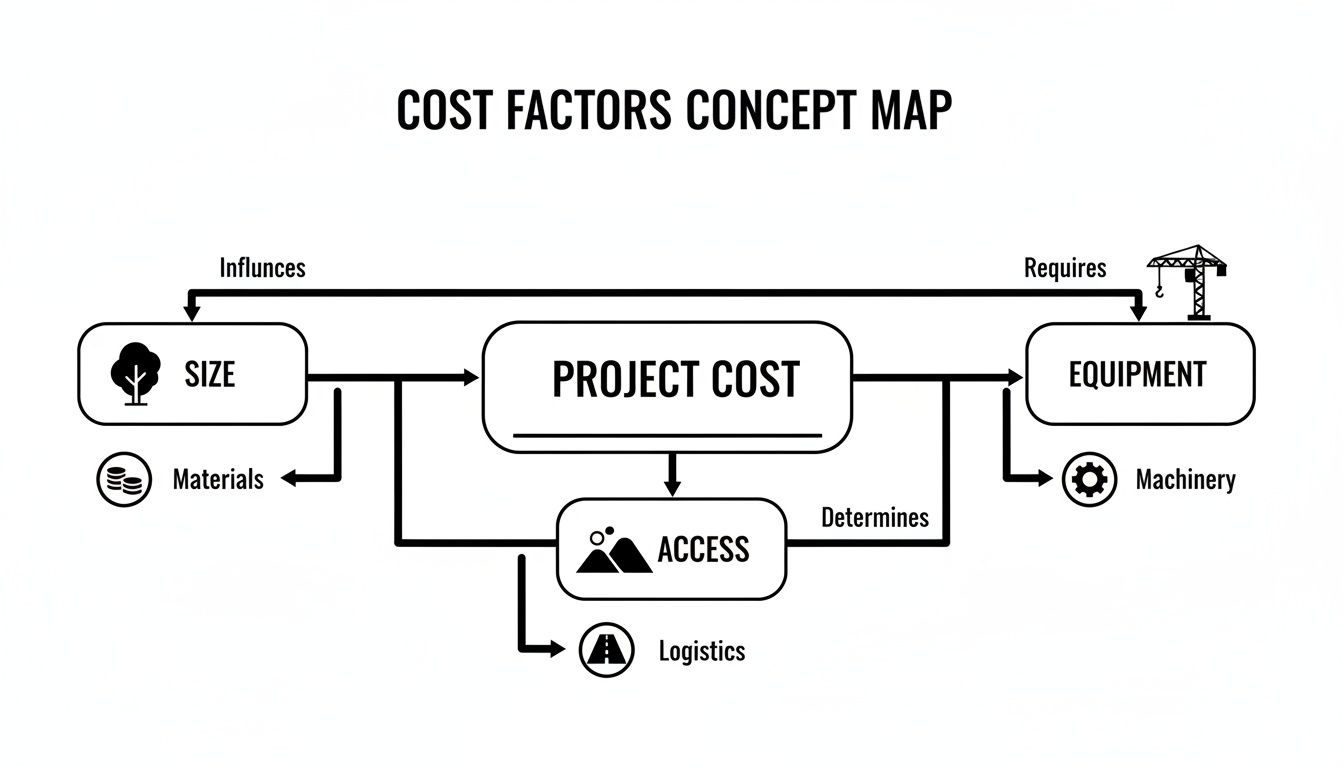
This graphic highlights that tree size, the right equipment and site access hurdles often carry the largest share of costs.
Key Factors Summary
Here’s a concise at-a-glance comparison of the major variables influencing San Jose tree service pricing:
| Factor | Impact On Cost | Typical Example |
|---|---|---|
| Tree Size | High | Tall redwood removal uses extra hours |
| Equipment | Medium-High | Crane rental adds ~$500/day |
| Access | Medium | Hillside or fenced yards require more labor |
| Permits And Insurance | Low-Medium | City removal permits ~$60–150 |
| Seasonal Demand | Variable | Fall storm prep increases rates |
Keep this snapshot handy when you review estimates—it’ll help you spot outliers at a glance.
For deeper tips on planning and negotiating tree work in San Jose, check out our guide to San Jose tree services.
Tree Size usually claims the biggest slice of your budget, while permits and seasonal demand fine-tune your spending forecast.
When you line up multiple bids, dig into each line item. A bargain-basement price can hide extra fees for gear, permits or after-hours work.
Scaling back the scope—like removing only deadwood instead of felling the entire tree—can trim costs substantially.
Always ask for an itemized proposal and question any fee that seems out of place. A transparent crew will explain every charge, giving you confidence in the final tally.
Understanding Key Cost Drivers
When you see two quotes for the same oak tree and one is double the other, it’s tempting to think you’re being ripped off. In reality, every branch, slope, and permit adds a new line item on that estimate.
Imagine trying to trim a potted houseplant versus scaling a 60-foot redwood. That contrast highlights why firms charge more for taller trees with sprawling canopies—each cut demands extra hands, gear, and safeguards.
- Tree Height bumps up risk and stretches crew hours.
- Canopy Spread means more rigging points and longer drop times.
- Crew Size grows alongside complexity, inflating labor fees.
- Equipment Time covers aerial lifts, chipper rentals, and fuel.
With that in mind, let’s explore how these factors stack up in real jobs.
Crew Size And Equipment Time
Sorting out a quote often starts with crew and gear. In California, every arborist needs special licensing and ongoing safety training. That’s not just paperwork—it’s extra hours and insurance premiums your contractor must cover.
A two-person crew might take an hour to prune a small holly. But set them under a 60-foot oak and you’re looking at four people, an aerial lift, and several days of work. Each piece of equipment carries its own cost in maintenance, insurance, and fuel.
“Larger trees don’t just cost more, they demand more crew and specialized gear,” notes Robert Apolinar of San Jose Tree Service & Landscaping.
Cost Drivers Comparison
Below is a snapshot of common cost factors and how heavily they influence your bill.
| Cost Driver | Relative Impact | Example Scenario |
|---|---|---|
| Tree Height | High | 60-ft oak needs 4-person crew |
| Canopy Spread | Medium-High | Wide cedar demands extra rigging |
| Accessibility | Medium | Hillside removal doubles labor fee |
| Stump Grinding | Low-Medium | Chipping adds equipment fee |
| Crane Usage | High | Crane rental adds $500 per day |
Every job is unique. In Almaden Valley, for example, steep slopes and heritage-tree rules often force contractors to design one-off rigging plans before chainsaws ever start.
Site Accessibility Challenges
When yards narrow down to 5-foot alleyways, equipment can’t roll in on wheels. Crews haul gear by hand, tacking on extra hours under California’s strict safety standards.
- Narrow Paths slow down every load and double labor time.
- Steep Grades require ropes, harnesses, and extra safety lines.
- Thick Underbrush might need pre-pruning just to reach your main target.
Those obstacles aren’t just inconvenient—they translate into real dollar figures on your invoice.
Removal Extras And Cleanup
Cutting is just the first act. Once limbs hit the ground, you face stump grinding, chipping, hauling, and disposal fees.
- Stump Grinding typically adds $3–$8 per inch of stump diameter.
- Debris Removal covers chipping and haul-away costs.
- Chip Size affects how long a chipper stays on site and dump fees.
A full-site cleanup can tack on several hundred dollars, but it also boosts curb appeal and lowers trip hazards.
Specialized Rigging And Cranes
Trees teetering near power lines or rooftops need more than bare hands and ladders. That’s when pulley systems, block-and-tackle setups, or even a crane come into play.
- Crane Rental often runs about $500 per day.
- Custom Rigging demands extra labor, safety gear, and planning time.
Seeing these line items spelled out helps you compare bids without missing hidden markups.
Learn how new equipment regulations affect your service costs in California by reading our article on California’s Equipment Regulations.
Permit And Insurance Expenses
San Jose’s local rules add a few extra line items to every tree care estimate. Think of each permit like a toll booth on your path; every checkpoint adds a small charge that keeps the project safe and compliant.
Removal and trimming permits generally run between $60 and $150 apiece, covering the city’s processing and a routine inspection slot. Many jobs trigger heritage-tree approvals or require mitigation plantings—sometimes adding hundreds or even thousands of dollars more.
Permit Fee Breakdown
- Administrative Processing: Covers filing, review, and basic inspections.
- Heritage Approvals: Ensures protected trees meet preservation standards.
- Mitigation Plantings: Adds extra permitting when new landscaping offsets removals.
Disposal and haul-away services typically tack on $70 to $150 more. That sum bundles chipper rental, truck transport, and landfill or recycling fees.
Insurance And Liability Costs
A fully insured proposal folds commercial liability and workers’ comp premiums into the total. Carrying these policies often adds several hundred dollars to monthly operating costs.
“A licensed contractor protects you from unexpected liability and compliance fines.” —Robert Apolinar.
San Jose Tree Service & Landscaping is licensed (CSLB #985639 – C-61/D-49 + C-27) and BBB Accredited since 2013, ensuring projects run smoothly with minimal risk. Learn more on our about page.
Cost Categories Comparison
| Fee Type | Typical Cost Range |
|---|---|
| Permit | $60–$150 |
| Inspection | $100–$300 |
| Mitigation | $200–$1,000+ |
| Haul-Away | $70–$150 |
| Insurance Premiums | $300–$600/month |
Budget Planning Tips
- Ask for fully itemized estimates that highlight permit and insurance fees.
- Compare quotes by category instead of just the bottom-line number.
- Book during off-peak months to speed up permit processing.
- Verify the contractor holds C-61/D-49 and C-27 licenses for complete coverage.
A licensed, insured bid can cost more initially but prevents costly disputes later on. San Jose Tree Service & Landscaping puts all these fees in writing from the start. That transparency makes it easy to pick a fair, reliable estimate.
Seasonal Demand Effects
Between routine tasks and emergency storm calls, San Jose’s tree care market never sits still. You’ll see prices spike in busy months and soften when demand eases.
Demand Peaks And Pricing
Industry data shows monthly demand indices swinging from about 78 in November to 100 in September–October—a nearly 28% variation that directly impacts lead times and bids.
Learn more about seasonal demand trends on LawnStarter
At peak times, you could pay up to 20% more per hour. Conversely, off-peak months like February and November often bring discounted rates and quicker scheduling.
Rate Comparison Table
| Crew Type | Off-Peak Rate (per hour) | Peak-Season Rate (per hour) |
|---|---|---|
| Small Local Crew | $200 | $240 |
| Specialized Firm | $300 | $360 |
How Emergency Calls Affect Bids
Sudden windstorms can send crews scrambling to drop regular jobs and clear debris. Emergency responses pay more, so those calls leap to the front of the line.
- Immediate mobilization of crews and equipment
- Overtime rates and hazard pay
- Rapid permit adjustments and safety checks
That urgency inflates prices for everyone on the schedule that week.
Planning Your Project Timing
Booking tree work in winter or early spring can shave off hundreds of dollars. In those months you’ll enjoy:
- Better crew availability and flexible start dates
- Lower hourly rates as demand dips
- Clearer communication with arborists focused on planned work
“Booking before the storm season can save customers hundreds,” says Robert Apolinar.
Tips To Avoid Peak Premiums
- Request quotes in January or February for March service
- Ask contractors about projected crew availability
- Bundle tree trimming and pruning into a single off-peak booking
- Stay flexible on start dates to secure the best rate
Local Microclimate Impact
San Jose’s microclimates play a role, too. Hillside areas with steep slopes often book later because they require extra safety checks. Valley neighborhoods see faster scheduling, making off-peak slots there more plentiful and affordable. Consider these local quirks when you plan your next tree service.
Real World Price Examples
Numbers on paper can feel abstract until you break them down. Let’s unpack two sample San Jose jobs so you see why quotes range from $800 to well over $7,000.
On average, you’ll find medium‐tree trimming hovers between $468–$694, while large removals start around $800–$2,000. Throw in specialized crane work or tricky rigging and you can easily hit the $6,000–$7,000 bracket.
For the full breakdown of San Jose tree‐care costs, check the detailed HomeYou report.
Sample Cost Breakdown
| Service Type | Tree Size | Price Range |
|---|---|---|
| Medium Tree Trimming | 30–45 ft height | $500–$700 |
| Large Tree Removal | 60+ ft height | $1,800–$2,200 |
Detailed Line Item Analysis
A medium trim often includes:
- Labor (2 workers, 4 hours) at $120/hr
- Equipment (aerial lift rental) at $200/day
- Permit Fee at $75
- Debris Cleanup at $80
A large removal might break down to:
- Labor (4 crew members, 8 hours) at $140/hr
- Crane Rental (1 day) at $500
- Permit & Inspection at $150
- Stump Grinding at $6/inch of diameter
- Haul & Disposal at $150
Tightening the scope—say, removing just one hazardous branch—can slash labor time by as much as 40%. On the flip side, a full crown reduction on a sprawling oak might require multiple rigging resets and extra passes.
Debris fees hinge on volume and disposal facility rates. A single chipper load can add $50 in landfill charges—so clarify how many loads your quote includes.
Hidden Fee Examples
Even similar bids can hide surprises. For instance, crane usage can tack on about $500 per day.
“Unexpected rigging costs often surprise homeowners,” warns Robert Apolinar of San Jose Tree Service & Landscaping.
Other common hidden expenses:
- Special rigging when limbs overhang power lines
- Emergency callout premiums during peak storm season
- Extra crew mobilization fees for steep or fenced yards
Learn more about transparent pricing in our Pricing Guide on Service Fees.
Scenario Cost Comparison
Imagine two San Jose yards, each with a 50-ft oak. One sits on a steep slope under power lines; the other stands in a flat, open backyard. The slope job demands a crane and extra safety crew, while the flat yard trim uses handheld gear only.
| Scenario | Details | Total Estimate |
|---|---|---|
| Sloped Backyard Removal | 50-ft oak, crane, steep hill, permit included | $4,200 |
| Small Orchard Prune | Three 25-ft fruit trees, handheld tools, no crane | $1,100 |
This side-by-side underscores how accessibility and equipment needs can quadruple your budget.
Tips For Comparing Bids
- Request a fully itemized estimate covering labor, gear, permits and cleanup – see our Pricing Guide on Service Fees.
- Compare bids line‐item by line‐item rather than fixating on the bottom line.
- Ask about off-season or weekday rates for cranes and crews to avoid peak‐season markups.
Following these steps will help you spot hidden markups and negotiate fairer scopes.
How To Get Fair Tree Service Quotes
Now that you’ve seen real cost examples, it’s time to dig into why tree service prices vary so much in San Jose. A fair quote hinges on clarity—you should know every line item before the first cut is made.
Homeowners often feel squeezed when bids arrive with fuzzy scopes or surprise fees. That confusion can lead to costly mistakes or skipped safety steps if a lowball bid cuts corners.
A simple, consistent checklist helps you stack quotes side by side and spot any coverage gaps. Read on for proven tips on negotiating, bundling services, and keeping your project safe.
- Request fully itemized estimates that break out labor, equipment, permits, and cleanup.
- Verify contractors are licensed tree removal contractors with the proper CSLB licenses, commercial liability insurance, and workers’ comp.
- Compare crew credentials, experience level, and equipment lists to ensure matching scope.
- Flag any quote that lumps line items together or offers rates too low to cover permit fees.
Learn more about vetting contractors and fair pricing in our guide on What To Look For Before Hiring A Tree Service In San Jose.
You might also ask about maintenance plans for regular pruning or inspections. Locking in a long-term relationship can stabilize rates and speed up future scheduling.
Homeowner Checklist For Quotes
Start by requesting a written proposal from each contractor. It should clearly list:
- Labor hours and crew size for every task
- Daily rental fees for cranes, lifts, or other gear
- Permit costs, inspection fees, and disposal charges
- Cleanup details, including stump grinding and chip hauling
Lay each quote side by side, matching up the line items. Tweaking the scope—say, limiting crown reduction to deadwood only or bundling trimming and pruning—can shave dollars off your final bill without risking safety.
“A transparent estimate lets you ask the right questions,” says Robert Apolinar of San Jose Tree Service & Landscaping.
Spotting Red Flags
Bids that sound too good to be true usually are. Quotes undercutting market rates by 20% or more often skip permit or disposal charges. They might also rely on uninsured labor or unlicensed operators.
- No permit fees listed
- Single flat rate for all tasks
- No mention of cleanup or chip hauling
- Crew size left undefined
If a proposal omits these basics, ask for clarification right away.
Maximizing Value With Bundled Services
Grouping related tasks into one package almost always unlocks better rates. For instance, scheduling pruning, stump grinding, and mulch delivery together lets crews optimize travel time and equipment use.
Bundled services can save you 10–15% compared to booking each job separately. Always confirm:
- Which services are included in the bundle
- Exact price breakdown per task
- Potential scheduling windows and any deposit requirements
Finally, review the proposed timeline and payment schedule to prevent surprise bills as work progresses.
Remember, choosing a licensed and insured contractor often costs less in the long run and reduces your liability.
Conclusion
In San Jose, tree service prices vary due to factors like tree size, equipment needs, permits, seasonal shifts, and site challenges. By asking for itemized estimates, comparing quotes line by line, and leveraging off-peak timing, you can secure a fair, transparent bid.
San Jose Tree Service & Landscaping is your trusted partner—licensed (CSLB #985639), BBB Accredited since 2013, and deeply rooted in South Bay landscaping expertise. Contact us today to get a clear, written estimate and eliminate any guesswork from your tree care project.
Frequently Asked Questions
Why Do Tree Service Prices Vary So Much In San Jose?
It’s easy to assume every tree job is the same, but that’s rarely true. In San Jose, these factors tend to drive the final price:
- Tree Height and Canopy: Taller trees or wide-spreading branches add hours of careful work.
- Specialized Equipment Needs: From bucket trucks to cranes, the gear you need directly impacts labor and rental fees.
- Permit and Inspection Fees: The City of San Jose requires permits for most removals and trims—each comes with its own cost.
- Accessibility Challenges: Narrow yards, steep slopes, or obstacles can slow crews and drive up labor hours.
- Seasonal Demand Shifts: Cutting during peak seasons or after storms can carry a premium.
When Do I Need A Permit For Tree Work In San Jose?
Any tree over 12 inches in diameter typically requires a city removal or trimming permit. Heritage trees and protected species trigger extra reviews and fees. Expect permit processing to add at least a week to your project timeline.
How Can I Spot Hidden Costs In A Tree Service Estimate?
Beware of vague line items like “miscellaneous fees” or bundled charges. Always ask for a fully itemized estimate that separates:
- Crew hours
- Equipment rentals
- Permit and inspection fees
That way, you’ll know exactly what you’re paying for—no surprises down the road.
How Long Does a Typical Tree Removal Or Trimming Take?
A straightforward pruning job can finish in about half a day if access is easy. Large removals—especially those needing crane setups or navigating tight spaces—often span two to three days. Booking off-peak (late spring or early fall) usually means shorter waits and better rates.
Is DIY Tree Care Ever Advisable In San Jose?
Light pruning around ground level is doable for confident homeowners. But once you’re dealing with real heights or heavy limbs, a licensed, insured professional is essential. Attempting big jobs yourself can lead to property damage, personal injury, and even code violations.
Ready to get a transparent quote? Reach out to San Jose Tree Service & Landscaping to schedule an estimate today. No obligations—just honest answers.